Table of Contents
- What Is a Marital Settlement Agreement?
- Texas Divorce Settlement Agreement Template: What You Need to Include
- Community Property Division in Texas: Key Principles
- Filing for Divorce Without a Lawyer: Step-by-Step Process
- Enforceability and Legal Binding Requirements
- Common Mistakes to Avoid When Drafting Your Agreement
- Conclusion
Last Updated: August 26, 2026
What Is a Marital Settlement Agreement?
A marital settlement agreement is a legally binding contract between spouses that outlines the terms of their divorce. It addresses property division, debt allocation, child custody, support obligations, and spousal maintenance. When both parties agree on these terms before filing, the process becomes uncontested, resulting in faster resolution and lower costs.
The agreement serves as the foundation for your final decree of divorce. Once signed and notarized, it becomes a court order that both parties must follow. This document prevents disputes from escalating and gives you control over the outcome rather than leaving decisions to a judge.
Ready Divorce Service helps couples draft these agreements with precision, ensuring every provision complies with Texas law and protects both parties’ interests. The key is getting the language right the first time; ambiguous terms or missing provisions often lead to enforcement problems later.
The strength of your agreement depends on clarity and completeness. Vague language about property division or custody schedules creates enforcement headaches down the road. Spell out specifics: dates, amounts, percentages, and exact schedules.
Texas Divorce Settlement Agreement Template: What You Need to Include
Basic Information and Identifiers
Begin your agreement with identifying information for both parties: full legal names, current addresses, and the date of marriage. Include the case number once filed, though you can leave this blank initially. Clearly identify which party is the petitioner and which is the respondent. Include the date both parties sign the agreement, as Texas courts require this to establish when consensus was reached.
Marital Property and Debt Allocation
This section inventories all community property (assets acquired during the marriage) and community debts, then specifies how each is divided.
Community property in Texas includes income earned during marriage, retirement accounts, real estate purchased with marital funds, vehicles, bank accounts, and investments. Separate property, owned before marriage or inherited, typically stays with the original owner.
For each asset, specify:
- A clear description (e.g., "2022 Toyota Camry, VIN [number], currently valued at approximately $18,000")
- Who receives it
- Any offsetting payments (e.g., "Wife receives the house; Husband receives $50,000 from the equity")
- Timing of transfer or payment
Identify all community debts, mortgages, car loans, credit cards, medical bills, and specify who is responsible for each. Include language stating that the responsible party will indemnify the other if the creditor pursues them.
A common mistake is assuming the court will automatically remove one spouse’s name from joint debts. You must explicitly assign responsibility in the agreement and often need separate refinancing or payoff arrangements. Creditors don’t follow divorce decrees; they follow the original loan documents.
Child Custody and Support Provisions
If you have minor children, the agreement must address conservatorship (legal custody), possession and access (physical custody), and child support. Texas courts refer to these as "conservatorship" rather than "custody."
Specify whether conservatorship is joint (both parents share decision-making) or sole (one parent makes major decisions). Most agreements establish joint managing conservatorship with a primary residence for the child.
Possession and access schedules should be detailed rather than vague. Specify exact days and times:
- Weekday schedule (e.g., "Every Tuesday and Thursday from 5:00 PM to 8:00 PM")
- Weekend schedule (e.g., "First and third weekends of each month, Friday 6:00 PM to Sunday 6:00 PM")
- Holiday and summer break arrangements
Child support must comply with Texas guidelines unless both parties agree to a different amount and document why. Specify the amount, due date, and payment method. Include provisions for what happens if circumstances change. Medical support is separate from child support; specify who provides health insurance and how major medical decisions are handled if parents disagree.
Community Property Division in Texas: Key Principles
Community property law in Texas treats most assets acquired during marriage as jointly owned, regardless of whose name is on the title or who earned the income. Texas Family Code Section 3.001 defines community property as property acquired by either spouse during marriage while domiciled in Texas, except for property acquired by gift, devise, or descent (inheritance).

The agreement should divide community property in a manner that is "just and right" according to Texas courts. This doesn’t necessarily mean 50/50, but it must be equitable. Many couples divide equally, but courts allow unequal division if circumstances justify it.
Separate property belongs to the spouse who owned it before marriage or inherited it during marriage. If you have significant separate property, the agreement should clearly identify it to prevent claims by the other spouse.
The distinction between community and separate property is foundational to fair division. Misclassifying an asset creates enforceability problems and potential litigation.
If separate property is commingled with community property (e.g., an inherited account mixed with marital income), the agreement should address how to calculate each spouse’s share.
Filing for Divorce Without a Lawyer: Step-by-Step Process
Completing and Notarizing Your Agreement
Once you’ve drafted your divorce settlement agreement, both parties must sign it in front of a notary public. Texas law requires that the agreement be signed under oath, meaning each party acknowledges they understand its contents and are signing voluntarily.

Before signing, review the agreement one final time. Check for accurate names and identifying information, all assets and debts accounted for, clear custody and support provisions, correct dollar amounts and percentages, and proper legal descriptions of real property.
Schedule an appointment with a notary public. Many banks, law offices, and title companies offer notary services. Bring valid identification and both copies of the agreement. You’ll need two original copies, one for each spouse. Some courts also require an additional copy for filing.
Filing With the Court and Waiting Periods
After notarization, file the agreement with the district court in the county where you or your spouse resides. Complete a Petition for Divorce form and attach your signed agreement as an exhibit. File with the district clerk’s office, pay the filing fee (typically $300 to $500), and request a case number.
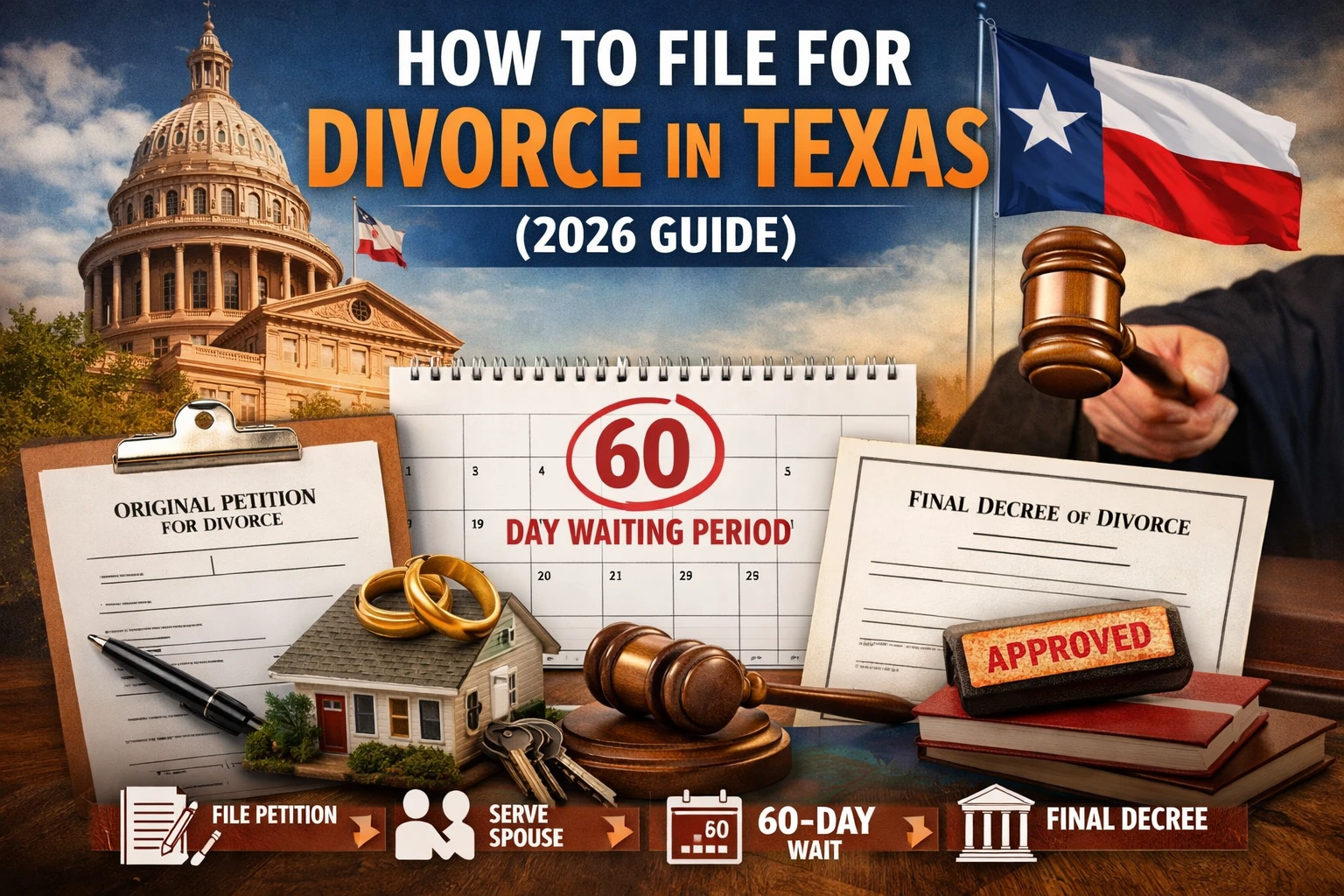
Texas law imposes a 60-day waiting period from the date the respondent is served with the divorce petition (statutes.capitol.texas.gov). This waiting period cannot be waived except in cases of family violence. After the 60-day period expires, you can request a final hearing or ask the judge to sign the decree based on the agreed settlement. In uncontested cases, many judges will sign the final decree without requiring an appearance. Understanding Starting the Divorce Process helps ensure you meet all procedural requirements and timelines.
Enforceability and Legal Binding Requirements
A divorce settlement agreement is legally binding once it’s signed, notarized, and incorporated into the final decree of divorce. Enforceability depends on several factors.
The agreement must be clear and unambiguous. Vague language creates disputes because each party may interpret terms differently. Courts will enforce specific, detailed provisions but struggle with ambiguous ones.
Both parties must have signed voluntarily without duress or fraud. The agreement should include language stating that each party had the opportunity to consult with an attorney and signed freely.
The agreement cannot violate public policy or law. Provisions that attempt to waive child support are unenforceable because Texas law prioritizes the child’s best interests.
Once the final decree of divorce is entered by the judge, the agreement becomes a court order. Violation can result in contempt of court charges, which may include fines or jail time.
An agreement that’s signed but never incorporated into a final court order may be treated as a contract rather than a court order. Always ensure your agreement is formally adopted by the court in the final decree.
Common Mistakes to Avoid When Drafting Your Agreement
One frequent error is failing to address all assets and debts. Couples sometimes overlook smaller items, retirement accounts, or debts they forgot about. A thorough inventory prevents this problem.
Another mistake is using ambiguous language. Phrases like "fair division," "reasonable support," or "as needed" create confusion. Specific language, exact dates, amounts, percentages, and descriptions, prevents misinterpretation.
Many self-represented litigants fail to address tax implications. Transferring retirement accounts requires a Qualified Domestic Relations Order (QDRO) to avoid immediate tax penalties. The agreement should reference this requirement.
Overlooking digital assets is increasingly common. Cryptocurrency, online business accounts, and digital photos have real value but are often forgotten. Your agreement should inventory digital property and specify how it’s divided.
Failing to address modification and enforcement provisions is another gap. While courts can modify support orders based on changed circumstances, the agreement should clarify the process.
Before finalizing your agreement, ask yourself: “If my spouse violates this provision three years from now, could a court enforce it?” If the answer is unclear, the provision needs revision. Specificity and clarity are what make agreements enforceable.
Drafting a divorce settlement agreement requires attention to detail and understanding of Texas family law. The agreement you create today will govern your financial and parental responsibilities for years to come, so precision matters. Ready Divorce Service provides step-by-step guidance to ensure your agreement is complete, enforceable, and compliant with all Texas requirements. To explore which approach works best for your situation, review Which Plan is Right for You? [For detailed information on Texas divorce(/uncontested-texas-divorce-simple-steps/) procedures and requirements | courts.texas.gov] provides official resources, and the Texas Family Code contains the specific laws governing divorce agreements. If your situation involves complex assets or custody disputes, consulting with a family law attorney ensures your agreement protects your interests fully.
| Provision | Purpose | Key Details |
|---|---|---|
| Basic Identifiers | Establish parties and case information | Names, addresses, marriage date, case number |
| Property Division | Allocate community assets | Descriptions, valuations, recipient for each asset |
| Debt Allocation | Assign responsibility for liabilities | Creditor name, balance, responsible party |
| Custody Arrangement | Establish conservatorship and possession | Schedule of days/times, decision-making authority |
| Child Support | Provide financial support for children | Amount, due date, payment method |
| Spousal Maintenance | Address alimony if applicable | Amount, duration, termination conditions |
| Enforceability Clause | Confirm binding nature | Acknowledgment of voluntary signing, legal advice opportunity |
Frequently Asked Questions
Can I draft my own divorce settlement agreement in Texas?
Yes, you can draft your own divorce settlement agreement in Texas as a self-represented litigant (pro se). Texas law permits uncontested divorces where both spouses agree on all terms. Your agreement must be notarized, include all required provisions (property division, custody, support), and comply with Texas Family Code requirements. Many couples successfully file without an attorney when they reach full agreement on terms. However, accuracy is critical, errors can delay court approval or create enforceability issues.
What must be included in a Texas marital settlement agreement?
A valid Texas marital settlement agreement must include: identification of both spouses, a statement that the marriage is irretrievably broken, division of all community property and debt, any separate property claims, child custody arrangements (conservatorship), possession and access schedules, child support amounts, medical support provisions, spousal maintenance (if applicable), and any waivers of service. The agreement must be signed, notarized, and filed with the court as part of your final decree of divorce. Missing sections can result in court rejection.
Is a divorce settlement agreement legally binding in Texas?
Yes, a properly executed divorce settlement agreement is legally binding in Texas once the court approves it and issues a final decree of divorce. The agreement becomes a court order that both parties must follow. To be enforceable, it must meet Texas contract law standards: mutual agreement, consideration, legal purpose, and proper execution (signatures and notarization). If either party violates the terms after the decree is final, the other party can file for enforcement through the court.
How does community property law affect my settlement agreement?
Texas is a community property state, meaning most assets and debts acquired during marriage belong equally to both spouses unless classified as separate property (owned before marriage, inherited, or received as a gift). Your settlement agreement must properly identify and divide all community property and debt. You can agree to an unequal division if both spouses consent. Separate property should be clearly documented. Misclassifying assets or failing to address all community property can lead to disputes and court intervention.
This article was written using GrandRanker