Table of Contents
- Can You File for Divorce in Texas Without a Court Appearance?
- Understanding Uncontested Divorce Texas Requirements
- The Texas Divorce Waiting Period and Timeline
- How to File for Divorce Pro Se in Texas
- Using Waiver of Service to Avoid Court Appearance
- The Prove-Up Hearing and Virtual Appearance Options
- Fees, Costs, and Tracking Your Divorce Filing
- Common Mistakes to Avoid When Filing Pro Se
Last Updated: August 28, 2026
Can You File for Divorce in Texas Without a Court Appearance?
Yes, you can file for an uncontested divorce in Texas without appearing in court, provided both parties agree on the terms and meet specific requirements. This option allows you to complete your divorce through document submission and, in many cases, a brief virtual appearance or written testimony. At Ready Divorce Service, we guide clients through this simplified process to help them avoid the time and expense of contested litigation.
The key is understanding which scenarios qualify for a no-court-appearance divorce and what paperwork must be filed correctly. Texas law allows divorcing couples to resolve their case without a trial when they’ve reached an agreement. However, the process still requires proper documentation, filing with the district clerk, and compliance with state waiting periods. With accurate guidance, you can file pro se, representing yourself, and complete your divorce affordably.

Understanding Uncontested Divorce Texas Requirements
An uncontested divorce in Texas means both spouses agree on all material issues: property division, custody arrangements, support obligations, and debt allocation. This agreement is the foundation that allows you to bypass a trial and complete your case through document filing and a brief final hearing.
Residency Requirements
To file for divorce in Texas, at least one spouse must have been a resident for the six months immediately preceding the filing, and the filing must occur in the county where the respondent resides or where the petitioner has resided for the 90 days before filing (statutes.capitol.texas.gov). These requirements ensure the court has jurisdiction over your case. File only after you’ve met the six-month residency threshold to avoid dismissal.
When Both Parties Agree
When both spouses consent to the divorce and its terms, you’re working with an agreed divorce. This means you’ve already negotiated property division, custody, visitation, child support, spousal support, and debt responsibility outside the courtroom. Your job is to document that agreement in the proper legal format and submit it to the court. The district clerk will process your paperwork, and a judge will review it for compliance with Texas law. If everything is in order, the judge signs off on your final decree of divorce without requiring you to appear in person.
Ready Divorce Service specializes in helping couples document their agreements accurately, ensuring the court accepts your papers on the first submission.
The Texas Divorce Waiting Period and Timeline
Texas imposes a mandatory 60-day waiting period from the date your petition for divorce is filed until the court can grant a final decree of divorce (statutes.capitol.texas.gov). This waiting period applies regardless of whether your divorce is contested or uncontested.
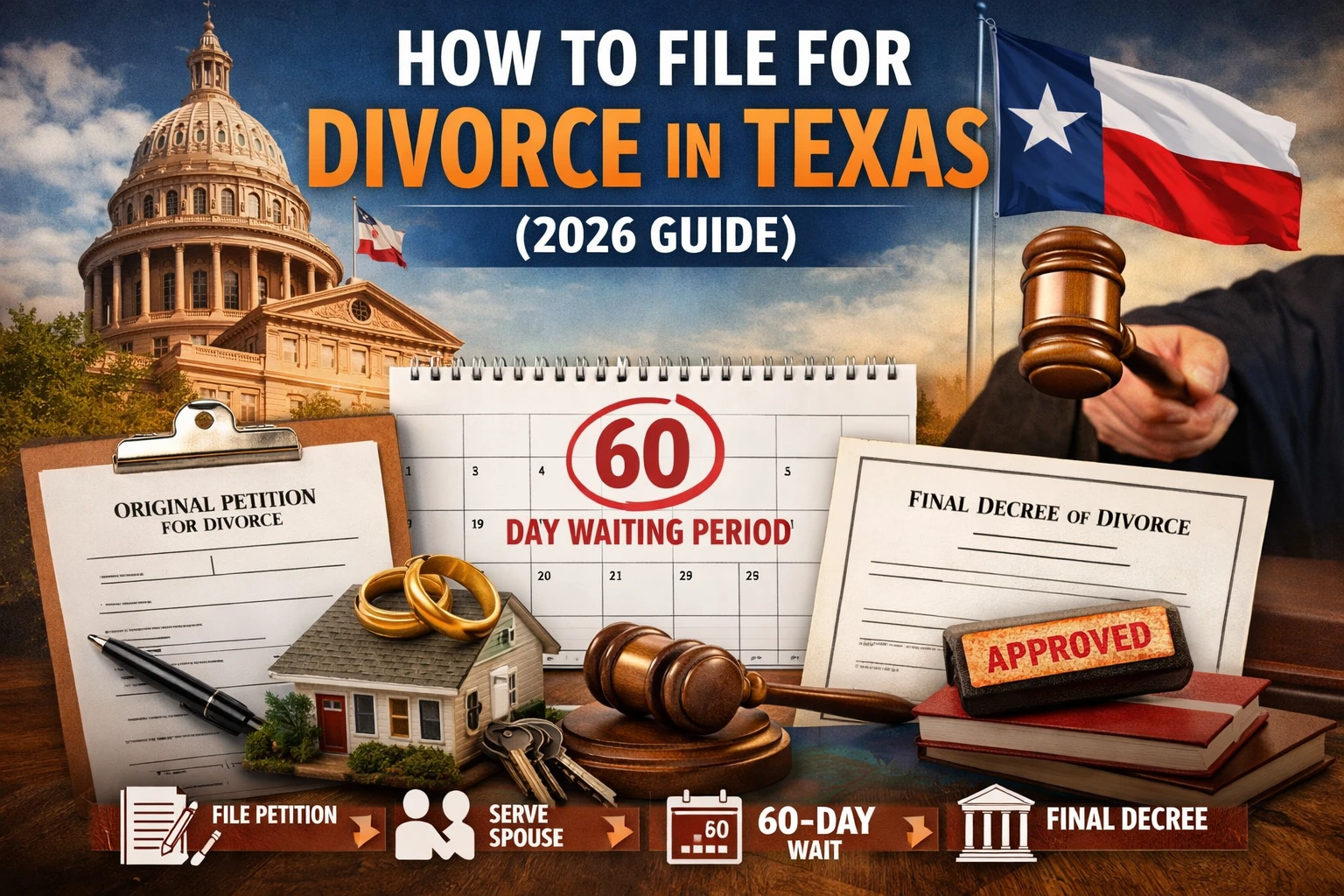
The timeline typically unfolds as follows: file your petition with the district clerk, serve your spouse or obtain their waiver of service, wait 60 days, submit your final paperwork and any required affidavits, and then attend a prove-up hearing or submit written testimony. If you’re organized and file correctly, you can complete an uncontested divorce in 90 to 120 days. Delays often occur when documents are incomplete, service isn’t properly documented, or the court has a backlog. Monitor your docket and confirm the district clerk received all documents to prevent unnecessary delays.
How to File for Divorce Pro Se in Texas
Filing pro se means representing yourself without a lawyer. Many people do this successfully for uncontested divorces, especially when both parties are cooperative and assets are straightforward. The process requires attention to detail and strict adherence to Texas procedural rules.
Gather Required Documents and Forms
Before you file anything, collect the documents you’ll need:
- A verified petition for divorce (signed and notarized)
- A family law information form (required in most Texas counties)
- A proposed final decree of divorce
- Proof of service or a waiver of service from your spouse
- Any agreements regarding property division, custody, or support
- Financial affidavits if child support or spousal support is involved
- Proof of completion of a parenting class (required if minor children are involved)
Gathering these documents upfront prevents discovering halfway through filing that you’re missing something critical. Ready Divorce Service helps you identify exactly which forms your specific county requires.
Complete the Petition and Required Paperwork
The petition for divorce is your opening document. It states your name, your spouse’s name, the county where you’re filing, your residency facts, and the grounds for divorce (Texas allows no-fault divorce). The petition must be notarized, signed in front of a notary public, and stamped with their seal.
Your proposed final decree of divorce is equally important. This is the document the judge will sign to end your marriage. It includes all the terms you and your spouse agreed to: property awards, custody arrangements, support amounts, and effective dates. The final decree must be specific and enforceable; vague language won’t work. List each asset and which spouse receives it.
File With the District Clerk’s Office
Once your documents are complete and notarized, file them with the district clerk of the district court in your county. You can file in person, by mail, or through online filing systems that many Texas counties now offer. Filing fees typically range from $300 to $400 for a divorce without minor children; add more if children are involved.
When you file, the district clerk will stamp your documents with a case number and filing date. Ask the clerk for a file-stamped copy of everything you submitted. Keep careful records of what you filed, when, and what the clerk received to prevent confusion later.

Using Waiver of Service to Avoid Court Appearance
If your spouse doesn’t cooperate with service of process, you’ll face delays and additional costs. A waiver of service of process is a document your spouse signs agreeing that they received notice of the divorce and don’t need formal service by a process server.
What Is a Waiver of Service?
A waiver of service is your spouse’s written acknowledgment that they know about the divorce lawsuit and agree not to require formal service. Instead of having a process server deliver the citation and petition, your spouse simply signs the waiver and returns it to you. This saves the cost of service and moves your case forward faster.
The waiver must be notarized and filed with the district clerk along with your petition. Once filed, service of citation is complete, and your 60-day waiting period begins.
Checklist for Service of Waiver
Use this checklist to ensure your waiver of service is complete:
- Waiver form uses your county’s approved format (check with district clerk)
- Both spouses’ names are spelled correctly and match the petition
- Case number is included if you’ve already filed the petition
- Your spouse signs the waiver in front of a notary public
- Notary stamps and signs the waiver, including their expiration date
- You have a copy for your records and one to file with the court
- Waiver is filed with the district clerk within 30 days of your spouse signing
- You receive a file-stamped copy confirming the clerk received it
- The waiver is included in your docket
A missing notary seal or an unsigned waiver will be rejected. If your spouse refuses to sign a waiver, you’ll need formal service of citation, which takes longer but is still possible.
The Prove-Up Hearing and Virtual Appearance Options
After the 60-day waiting period expires and all paperwork is filed, you’ll need to finalize your divorce through a prove-up hearing, final hearing, or uncontested hearing. It’s the court’s chance to confirm that your agreement is valid and that the terms comply with Texas law.
What Happens at a Prove-Up Hearing
A prove-up hearing is typically brief, often just 5 to 15 minutes. You appear before a judge, who asks standard questions: Are you entering this agreement voluntarily? Do you understand the terms? Are there any debts or assets you’ve forgotten to disclose? You answer yes, the judge reviews your final decree, and if everything is in order, the judge signs it. Your divorce is now final.
The hearing protects both parties by ensuring neither spouse was coerced and that all material facts are on the record.
Virtual Hearing Protocols
Many Texas courts now allow virtual appearances via video conference for prove-up hearings in uncontested divorces. You can appear from home or an office, connected by Zoom or the court’s designated platform. Virtual hearings save time and travel, especially if you live far from the courthouse.
To request a virtual appearance, contact the district clerk or the judge’s office and ask about their virtual hearing procedures. You’ll typically need a stable internet connection, a quiet location, and a professional appearance. If the judge denies your virtual request or your court doesn’t offer it, you can attend in person or submit written testimony and affidavits instead, though this requires prior approval.
Fees, Costs, and Tracking Your Divorce Filing
Filing for divorce involves court costs and filing fees. Understanding these expenses helps you budget.
Court Costs and Filing Fees
Filing fees in Texas vary by county and depend on whether minor children are involved. A divorce without minor children typically costs $300 to $400 in filing fees (texas.gov). If you have minor children, expect to pay an additional $50 to $100 for court-ordered services like parenting classes and mediation.
If you cannot afford the filing fee, you can request indigent status by submitting a statement of inability to afford court costs. If approved, the court waives or reduces your fees.
Additional costs include notary fees (typically $5 to $15 per document), process server fees if you need formal service (around $100 to $300), and certified copies of your final decree (usually $5 to $10 per copy). These costs are still far less than hiring a lawyer, which typically costs $1,500 to $5,000 or more for an uncontested case.
Post-Filing Tracking
After you file, monitor your case regularly. Check the docket online through your county’s court website or by calling the district clerk. Confirm that your filing was received, that the case number is assigned correctly, and that all documents appear in the system. If something is missing, contact the clerk immediately.
About 60 days after filing, when the waiting period expires, submit your final paperwork: the final decree, any affidavits, and a cover letter requesting a prove-up hearing or written approval. Include a self-addressed, stamped envelope if filing by mail. Keep copies of everything you file and maintain a simple log with dates and what you submitted.
Common Mistakes to Avoid When Filing Pro Se
People filing pro se often make preventable errors that delay their divorce or cause rejection of documents.
The most common mistake is incomplete or incorrect paperwork. A misspelled name, missing notary seal, or wrong case number causes the court to reject your filing. Always double-check every document before submitting it.
Another frequent error is failing to serve your spouse properly. If you don’t document service of citation or obtain a waiver of service, your 60-day waiting period doesn’t start, and your case stalls.
People also underestimate the 60-day waiting period. You cannot finalize your divorce before 60 days have passed, no matter how ready you feel.
Failing to include all required disclosures is another pitfall. If you have minor children, you must complete a parenting class and file proof of completion. Missing these requirements causes delays.
Finally, many people don’t keep copies of everything they file or don’t track what the court received. Without documentation, you can’t prove you filed something if the court claims it didn’t receive it. Keep meticulous records and obtain file-stamped copies from the district clerk.
Filing for divorce in Texas without a court appearance is achievable when both spouses agree on the terms and follow proper procedures. The process requires accurate paperwork, attention to deadlines, and careful post-filing tracking, but it’s far less expensive and stressful than contested litigation. Ready Divorce Service specializes in helping couples navigate uncontested divorce with step-by-step guidance and document preparation that ensures full compliance with Texas law. Our goal is to make your transition simple, affordable, and stress-free by handling the details so you can move forward with confidence. Starting the Divorce Process to learn more about how we support clients through every stage of the filing process.
Frequently Asked Questions
Q: Can you get divorced in Texas without going to court?
A: Yes, you can file for an uncontested divorce in Texas without a court appearance if both parties agree on all terms and use a waiver of service. The judge may grant a final divorce decree based on submitted documents alone. However, some cases require a prove-up hearing, which may be conducted virtually. The key is having full spousal agreement and filing complete, accurate paperwork with the district clerk.
Q: What is the Texas divorce waiting period, and how long does the process take?
A: Texas imposes a mandatory statutory waiting period of 60 days from the date the citation is served on your spouse. This waiting period cannot be waived, even in uncontested divorces. The total timeline typically ranges from 60 to 90 days for straightforward uncontested cases, depending on court scheduling and document processing. More complex situations with minor children or disputed assets may take longer.
Q: What documents do I need to file for divorce pro se in Texas?
A: Essential documents include the Original Petition for Divorce, Waiver of Service (if your spouse agrees), Agreed Divorce Decree, and a Final Decree of Divorce. If minor children are involved, you'll need a custody and support agreement. The district clerk's office provides a divorce packet with required forms. Ensure all documents are properly notarized where required and filed with the correct county of residence.
Q: What happens if I mess up the paperwork when filing for divorce?
A: If your documents contain errors or omissions, the district clerk or judge may reject them, requiring corrections and resubmission. This delays your case. Incomplete or improperly formatted paperwork can prevent the court from processing your divorce, potentially adding weeks or months to the process. Accurate preparation from the start, whether through careful self-filing or professional document preparation, helps avoid costly delays and ensures compliance with Texas law.
This article was written using GrandRanker