Table of Contents
- What Makes an Uncontested Divorce With Children Possible
- Understanding Child Custody and Conservatorship in Texas
- Texas Divorce Parenting Plan Requirements
- Texas Child Support Guidelines 2024
- Uncontested Divorce Timeline With Children
- Required Legal Forms and Documents for Filing
- Residency Requirements and Jurisdiction
- Common Mistakes to Avoid When Filing
Last Updated: August 24, 2026
What Makes an Uncontested Divorce With Children Possible
An uncontested divorce child custody arrangement in Texas becomes possible when both spouses agree on all major issues before filing: child custody, support obligations, property division, and debt allocation. Unlike contested divorces, uncontested cases move through the court system faster because there’s no dispute to resolve.
The key to success is reaching genuine agreement on every significant matter and documenting those agreements in writing. The court then reviews the paperwork for compliance with Texas law and approves it. This approach dramatically reduces stress for everyone involved, especially the children.
At Ready Divorce Service, we guide Texas residents through this process by helping you prepare accurate legal documents that meet state requirements. The difference between a smooth filing and one that gets rejected often comes down to whether your paperwork follows Texas Family Code specifications exactly. The most common reason filings get rejected is incomplete or incorrectly formatted documents, missing signatures, wrong legal terminology, or failure to address all required custody elements.
Understanding Child Custody and Conservatorship in Texas
Texas law uses the term "conservatorship" instead of "custody." A conservator is a parent granted legal rights and responsibilities for a child. Understanding the distinction between managing conservator and possessory conservator roles is essential when filing an uncontested divorce child custody agreement.

Managing Conservator vs. Possessory Conservator
The managing conservator holds primary decision-making authority and typically has the child living with them most of the time. This parent makes major decisions about education, healthcare, religious upbringing, and other significant life choices.
A possessory conservator has the right to possess the child during specified times outlined in the possession and access schedule. This parent can make routine decisions during their possession time but does not have authority over major life decisions.
In many uncontested cases, one parent becomes the managing conservator while the other is the possessory conservator. Some parents choose joint managing conservatorship, where both share decision-making authority equally. This requires both parents to communicate effectively and is becoming more common as courts recognize the value of both parents remaining actively involved.
Decision-Making Authority and Parental Rights
Decision-making authority determines who can make choices about the child’s education, medical care, religious training, and other significant matters. Medical decisions include choosing doctors and approving surgeries. Educational decisions cover school selection and extracurricular activities. Religious upbringing decisions address whether the child will follow a particular faith tradition.
The parent without primary decision-making authority still has the right to information about the child’s welfare. They can receive school records, medical reports, and other documentation, ensuring both parents stay informed about their child’s life.
Texas Divorce Parenting Plan Requirements
A parenting plan outlines how both parents will share time with the child and make decisions. Texas law requires that every uncontested divorce child custody case include a parenting plan addressing possession and access, decision-making authority, and support obligations. The court reviews this plan to ensure it serves the child’s best interests.
Possession and Access Schedules
The possession and access schedule specifies exactly when each parent has the child. Texas provides a Standard Possession Order (SPO) that many parents adopt, but you can create a custom schedule if both parents agree. The SPO typically gives the managing conservator primary possession with the possessory conservator having the child on alternating weekends, one weeknight per week, and extended summer vacation.
Your schedule must be detailed enough that both parents know exactly when transitions occur. Specify exact pickup and drop-off times, locations, and who handles transportation rather than using vague language like "reasonable access."
Holiday schedules deserve special attention. Thanksgiving, Christmas, spring break, and summer vacation all require clear designation of which parent has the child. Some families alternate holidays yearly; others split them. The key is making it specific enough that neither parent has to guess.
Co-Parenting Communication and Medical Decisions
Effective co-parenting communication prevents disputes that could later require court intervention. Many parents use co-parenting apps designed for this purpose, shared calendars, and message logs that document all communication about the child.
Medical decisions require both parents to have access to health information. Your parenting plan should specify that both parents receive copies of medical records and school reports. One parent might make routine medical decisions during their possession time, but major procedures typically require consultation with the other parent.
Health insurance coverage is critical. Texas requires at least one parent to maintain health insurance for the child. Your uncontested divorce child custody agreement must specify which parent provides this coverage and how uncovered medical expenses are split. If the child takes medication for ADHD, anxiety, or other conditions, both parents should understand the treatment plan.
Texas Child Support Guidelines 2024
Texas child support is calculated using the state’s guidelines, which consider both parents’ income and the number of children. The guideline amount is presumed correct unless one parent can show it would be unjust or inappropriate.

Income Withholding Orders and Payment Enforcement
An income withholding order requires the child support payer’s employer to deduct child support directly from their paycheck. This automatic deduction ensures consistent, on-time payments and creates a clear payment record.
Income withholding orders are standard in Texas child support cases, even in uncontested divorces. If the payer becomes self-employed or changes jobs, the withholding order must be updated. Failure to notify the court of employment changes makes the withholding order ineffective.
Enforcement mechanisms exist if child support falls behind. The state can suspend driver’s licenses, intercept tax refunds, and report delinquency to credit bureaus. These consequences make it critical that support obligations are clearly documented.
Health Insurance and Medical Support Requirements
Texas law requires that at least one parent maintain health insurance coverage for the child (statutes.capitol.texas.gov). Your divorce decree must specify which parent provides this coverage and whether the other parent reimburses a portion of the premium.
Medical support includes health insurance, dental coverage, vision coverage, and payment of uncovered medical expenses. The parent providing insurance typically covers the premium, while uncovered costs, deductibles, copays, and orthodontia are often split between parents according to their income percentages. substance abuse assessment.
The child support guidelines account for health insurance costs. If one parent pays significantly more for coverage, this can be factored into the support calculation.
Uncontested Divorce Timeline With Children
Understanding the timeline helps you plan for the transition ahead. An uncontested divorce child custody case typically moves faster than contested divorces, but Texas law imposes a minimum waiting period.
The 60-Day Statutory Waiting Period
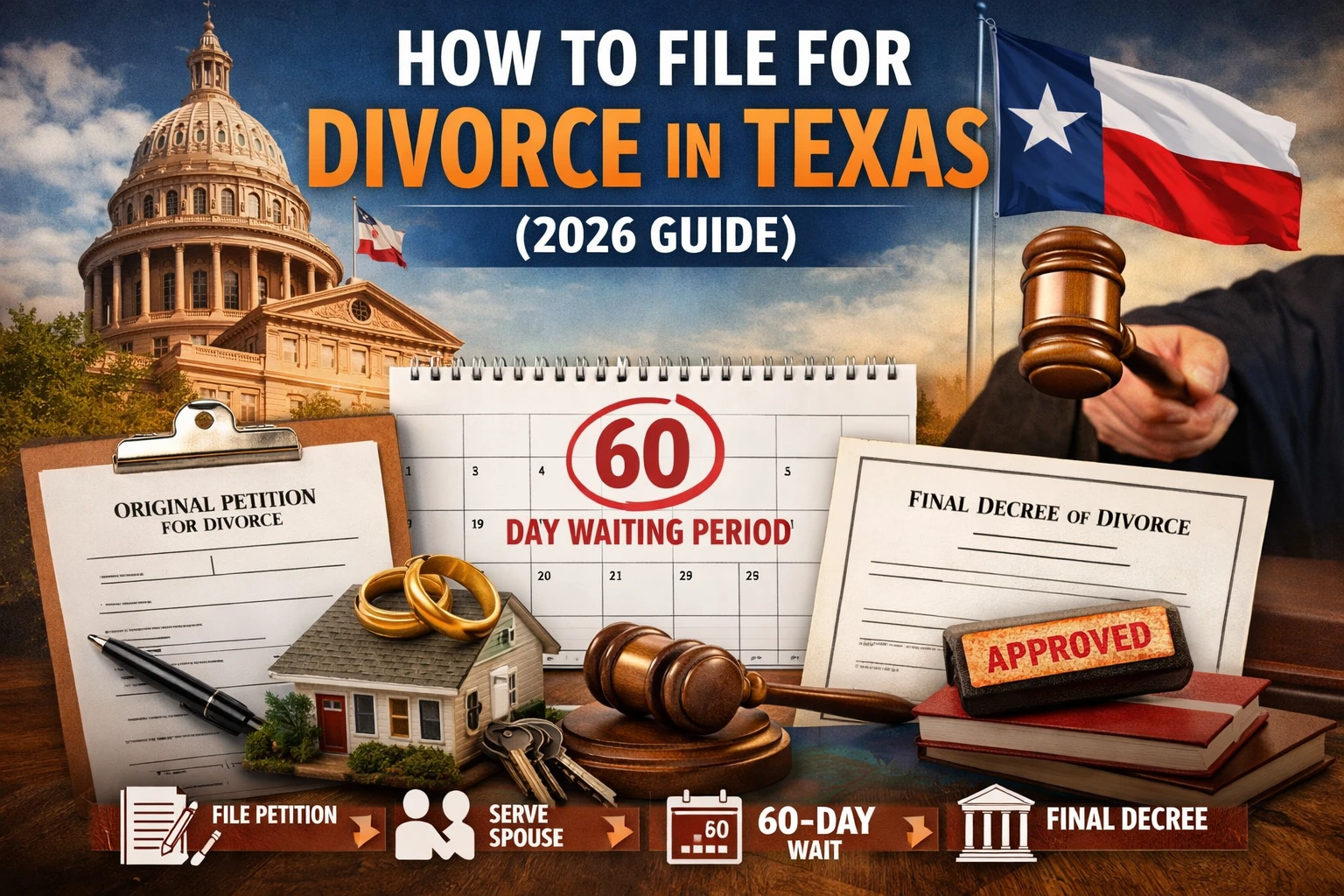
Texas imposes a mandatory 60-day waiting period from the date you file your Original Petition for Divorce until the court can grant your final divorce decree (statutes.capitol.texas.gov). This cooling-off period applies to all divorces. You cannot bypass this waiting period even if both spouses agree to everything.
The 60-day clock starts on the date the Original Petition is filed with the court. If you file on January 1st, the earliest your divorce can be finalized is March 2nd. During this waiting period, you’ll complete all paperwork, serve your spouse, and prepare your final decree.
Filing and Court Processing Steps
The filing process begins when you submit your Original Petition for Divorce to the district court in the county where you or your spouse resides. The court clerk assigns a case number and sets the filing date, starting the 60-day waiting period.
Your spouse must be served with the petition. In an uncontested case, your spouse typically signs a Waiver of Service, acknowledging they received notice and waiving formal service requirements. This speeds up the process.
After service is complete and your spouse has signed necessary documents, you prepare your Final Decree of Divorce and supporting paperwork, including the parenting plan and child support calculations. Understanding Starting the Divorce Process can help clarify what to expect at each stage.
Once the 60-day waiting period has passed, you file your Final Decree with the court. In an uncontested case, the judge typically signs this without a hearing. The entire process, from filing to final decree, typically takes 75-90 days in an uncontested case, assuming all paperwork is accurate and properly filed.
Required Legal Forms and Documents for Filing
Texas requires specific forms and documents for every divorce filing. An uncontested divorce child custody case requires more documents than a childless divorce because you must address custody, support, and parenting arrangements.
Original Petition for Divorce and Agreed Divorce Decree
The Original Petition for Divorce initiates your case. It includes basic information about both spouses, the marriage date, any children, and a statement that the marriage is insupportable. Texas allows no-fault divorce, meaning you don’t need to prove wrongdoing.
The petition must include the names and birthdates of all minor children. The Agreed Divorce Decree is the final document that ends your marriage, including all terms you and your spouse have agreed to: custody arrangements, child support, property division, and debt allocation. Both spouses must sign this document, and the judge signs it to make it final.
Your agreed decree must be extremely specific about custody arrangements. Instead of "reasonable visitation," specify exact dates, times, and locations. Instead of "child support as agreed," state the exact monthly amount.
Affidavit for Prove-Up and Service Documents
An Affidavit for Prove-Up is a sworn statement where at least one spouse confirms that the information in the divorce petition and final decree is accurate. This affidavit allows the judge to approve your divorce without a hearing. The affidavit must be notarized.
Service documents prove that your spouse received notice of the divorce filing. In an uncontested case, this is typically a Waiver of Service signed by your spouse. If your spouse doesn’t sign a waiver, you must have them formally served by a process server or sheriff’s deputy.
Residency Requirements and Jurisdiction
Texas has specific residency requirements that determine whether a court has jurisdiction to grant your divorce. One spouse must have been a Texas resident for at least six months before filing and must have lived in the county where you’re filing for at least 90 days (statutes.capitol.texas.gov).
If you’ve recently moved to Texas, you might not yet meet the six-month requirement. The county of jurisdiction is typically where either spouse resides. Filing in the county where you live is usually more convenient.
Common Mistakes to Avoid When Filing
Understanding common filing mistakes helps you avoid delays and rejections. Incomplete child information is frequent, you must include the full legal name and birthdate for every minor child, matching exactly as it appears on their birth certificate.
Incorrect child support calculations lead to rejected filings. Using the wrong income figure or applying the guidelines incorrectly results in a decree the court won’t approve. Missing notarizations cause rejection, your Affidavit for Prove-Up must be notarized.
Vague custody language causes future disputes. Saying "the parties will share custody" isn’t specific enough. You must state which parent is the managing conservator, which is the possessory conservator, and provide exact possession and access schedules.
Failure to address health insurance creates compliance issues. Texas requires that your decree specify which parent provides health insurance and how uncovered medical expenses are paid. Missing signatures are surprisingly common, both spouses must sign the agreed decree, the judge must sign it, and both must sign the Affidavit for Prove-Up.
Ready Divorce Service helps you avoid these mistakes by providing expert guidance and document preparation to ensure every form is complete, properly signed, and formatted according to Texas requirements, preventing rejections and delays.
Filing an uncontested divorce child custody case in Texas is manageable when you understand the requirements and follow the process carefully. The combination of clear custody agreements, accurate child support calculations, and properly completed legal documents creates a smooth path through the court system. Ready Divorce Service specializes in helping Texas residents navigate this process with confidence, ensuring your paperwork meets state requirements and your case proceeds without unnecessary delays. To explore how we can assist with your specific situation, visit Which Plan is Right for You? to discuss your needs and learn which package is right for your circumstances.
Frequently Asked Questions
Q: Can you do an uncontested divorce with children in Texas?
A: Yes. An uncontested divorce with children is possible when both spouses agree on custody arrangements, child support, and other major terms. Texas Family Code allows this path, which typically requires filing an Original Petition for Divorce, a Parenting Plan, and a Final Decree of Divorce that addresses conservatorship and possession schedules. The process still includes a mandatory 60-day waiting period and court approval, but avoids litigation.
Q: What are the mandatory child custody requirements in a Texas uncontested divorce?
A: Texas requires you to designate a Managing Conservator (primary decision-maker) and a Possessory Conservator (parent with scheduled possession and access rights). You must also establish a Parenting Plan that covers possession schedules, decision-making authority, and how major decisions about the child's health, education, and welfare will be made. This plan becomes part of the court-ordered Final Decree of Divorce and is binding on both parents.
Q: How long does an uncontested divorce with children take in Texas?
A: An uncontested divorce timeline with children typically takes 2-4 months from filing to Final Decree. This includes the mandatory 60-day cooling-off period after filing the Original Petition for Divorce, plus time for court processing and scheduling a prove-up hearing. The exact timeline depends on county court schedules and how quickly you complete required documents like the Parenting Plan and Affidavit for Prove-Up.
Q: What happens if I make a mistake on the divorce forms?
A: Court errors can delay or reject your filing. Common mistakes include missing notarized signatures, incomplete child support calculations, or inconsistencies between the Parenting Plan and the Final Decree. If the court rejects documents, you may need to refile, extending your timeline. Accurate document preparation from the start protects you from costly delays and ensures compliance with Texas Family Code requirements.
This article was written using GrandRanker