Table of Contents
- 1. Hiding Assets or Financial Information in Your Texas Uncontested Divorce
- 2. Letting Emotions Drive Legal Decisions in an Uncontested Divorce
- 3. Failing to Disclose Debts and Liabilities in Your Marital Estate
- 4. Ignoring the Best Interests of the Child in Custody Arrangements
- 5. Using Generic or Out-of-State Uncontested Divorce Forms Texas Courts Reject
- How to File for Uncontested Divorce in Texas: A Step-by-Step Overview
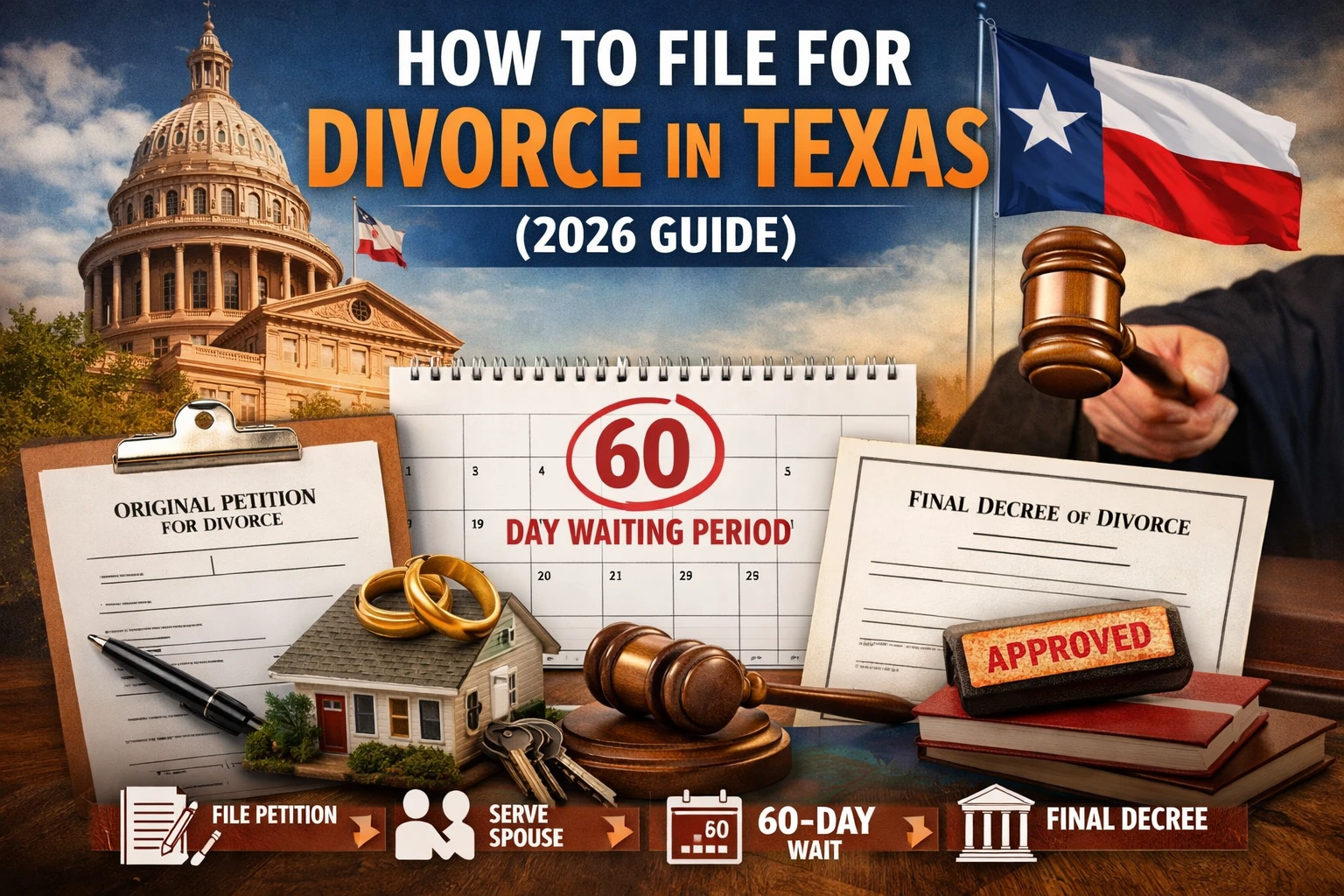
- Understanding the Texas Divorce 60-Day Waiting Period
- Frequently Asked Questions
Last Updated: September 12, 2026
1. Hiding Assets or Financial Information in Your Texas Uncontested Divorce
Hiding assets in an uncontested divorce turns a simple filing into a contested case. Texas courts require both spouses to sign a sworn inventory and appraisement listing every asset and debt, and a judge’s approval depends on full transparency.
Texas is a community property state: most property acquired during the marriage belongs to both spouses, and the court assumes you’ve disclosed all of it. Omit an account, vehicle, or retirement account and your spouse can petition to reopen the divorce; many courts treat a false inventory as fraud on the court, which can void your settlement.
The fix is unglamorous but effective:
- List every account, even ones with small balances
- Include retirement accounts and pension plans by name and approximate value
- Note any separate property you’re claiming and why it qualifies
- Sign and date the inventory before filing
2. Letting Emotions Drive Legal Decisions in an Uncontested Divorce
In an uncontested case, emotion converts a paperwork matter into a docket matter. The moment one spouse refuses to sign the settlement agreement or the waiver of service, the case becomes litigation, attorney fees, court dates, and delays measured in months rather than weeks.
Emotional decisions rarely look dramatic, refusing to budge on a piece of furniture, or insisting on a possession schedule out of spite. Each refusal carries a procedural cost:
- A refused waiver of service. Without a signed waiver, you must serve the other spouse formally, through a process server or constable, which adds cost, adds weeks, and requires a return of service to be filed before the case can proceed.
- A refused settlement agreement. No agreed decree means no uncontested prove-up. The case gets set for a contested hearing, and a judge decides the terms neither of you could.
- A refused inventory signature. The sworn inventory and appraisement is supposed to be signed by both spouses. If one refuses, the court can require a formal discovery process, which is the opposite of what an uncontested filing is for.
If a negotiation stalls, ask whether the term matters in five years. If not, concede it, protecting your case’s uncontested status is worth more than most terms.
Write your settlement terms down before you talk. Couples who negotiate from a written list reach agreement faster than couples who negotiate from memory, because the list removes the emotional back-and-forth of “you said” versus “I said.” Keep a signed copy of the waiver of service and the settlement agreement in the same folder as your petition, clerks frequently ask for them together at the prove-up.
A spouse who refuses to sign the waiver of service is not just being difficult, they are forcing you into formal service, which means a constable or private process server, a return of service affidavit, and a longer timeline. Budget for that possibility before you assume your case will stay uncontested.
The single most valuable thing you can protect in an uncontested divorce is the uncontested status itself. Every emotional refusal to sign a waiver, inventory, or settlement agreement converts a paperwork matter into a docket matter, and docket matters are decided by a judge, not by you.
3. Failing to Disclose Debts and Liabilities in Your Marital Estate
Debt liability is where most do-it-yourself filings fall apart. A decree divides debts as well as assets, and the division binds the spouses. Fail to list a credit card, medical bill, or personal loan and the decree can’t allocate it, and since creditors aren’t bound by your decree, an undisclosed debt can come back to whichever spouse the creditor pursues.
The marital estate includes both what you own and what you owe. A complete financial disclosure covers:
- Mortgage balances and home equity loans on the marital home
- Auto loans, including vehicles one spouse is keeping
- Credit card balances on joint and individual accounts
- Student loans and their classification as separate or community debt
- Outstanding medical bills and personal loans
The most common omission is a spouse’s individual credit card the other never knew about. List it anyway, an uncomfortable line item is cheaper than a post-divorce collections fight.
A decree that “holds each spouse responsible for their own debts” does not stop a creditor from pursuing the other spouse on a joint account. Creditors are not parties to your divorce, so the decree only governs what happens between the two of you.
4. Ignoring the Best Interests of the Child in Custody Arrangements
Custody terms are the one part of an uncontested divorce a judge scrutinizes regardless of the parents’ agreement. The legal standard is the best interests of the child, applied to every possession and access order whether or not both parents signed off.
An agreement that looks fine to two adults can still be rejected. Common problems: schedules that ignore school calendars, undefined medical and educational decision-making, and arrangements that make one parent’s time impractical. Judges also check whether the order keeps both parents involved.
Draft custody terms around the child’s actual routine, not the parents’ preferences. Work backward from school pickup times, extracurricular schedules, and holiday rotations; if your order answers those logistics clearly, it’s more likely to be approved without a hearing.
Child custody terms must satisfy the best interests of the child standard even in an uncontested case. A judge can reject a signed agreement that doesn’t serve that standard.
5. Using Generic or Out-of-State Uncontested Divorce Forms Texas Courts Reject
Out-of-state or generic forms are the most common reason uncontested filings get rejected at the clerk’s window. Texas has its own petition format, required affidavits, and county-level filing requirements, so a form from a national website may look official and still miss the exact language a Texas court requires.
Courts reject filings for reasons that feel trivial to the filer but are procedural dealbreakers:
- The petition doesn’t include the required residency allegations. Texas requires the petition to state that at least one spouse has been a domiciliary of Texas for the required period and a resident of the filing county for the required period. Generic forms often omit this language entirely, or state it in a way that doesn’t track the statutory phrasing.
- The waiver of service isn’t properly executed or notarized. A waiver of service is not just a signature, it must be in the form the court accepts, signed by the responding spouse, and notarized where required. An unnotarized waiver is treated as no waiver at all, and the case stalls until service is completed.
- The final decree doesn’t match the relief requested in the petition. If the petition asks for a name change, a specific property division, or a particular custody arrangement, the decree must grant exactly that. A decree that awards something the petition never requested can be rejected as outside the pleadings.
- Required exhibits or attachments are missing. Depending on the county, this can include a cover sheet, a standing order acknowledgment, a child support worksheet, or a proposed parenting plan.
- The county’s local rules require a form the state doesn’t. Some counties require their own cover sheet, their own scheduling order, or their own prove-up affidavit. A form that is correct in one county can be rejected in the next one over.
Each rejection costs you a filing fee and resets your timeline. The Texas Judicial Branch resources on self-represented litigants outline the procedural expectations courts apply to filings, and the gap between “close enough” and “correct” is where most pro se cases fail.
Call your county district clerk before you file and ask three questions: which forms does this county require, does the clerk’s office offer a pre-filing review, and what does the local prove-up hearing look like. Many counties do offer a pre-filing review, and it catches errors before they cost you a fee. Ask specifically whether the county requires a cover sheet, a standing order acknowledgment, or a child support worksheet if you have minor children.
A rejected filing is not just a delay, it can reset your 60-day waiting period clock if the petition itself is rejected rather than a later document. Confirm the petition is complete before you file, not after.
The difference between a form that works and a form that gets rejected is usually one of three things: the residency allegation, the waiver of service, or the match between the petition and the decree. Check those three first.
How to File for Uncontested Divorce in Texas: A Step-by-Step Overview
The uncontested divorce process in Texas follows a fixed sequence, and skipping or reordering steps produces most rejected filings.

Here’s the sequence:
- Confirm residency requirements. At least one spouse must have lived in Texas for the required period, and you file in the county where either spouse has resided.
- Draft and file the divorce petition. The petition states the grounds, the requested relief, and the jurisdiction.
- Serve the other spouse or obtain a waiver of service. A signed waiver avoids the cost and delay of formal service.
- Complete the financial disclosure and inventory. Both spouses sign the inventory and appraisement.
- Draft and sign the settlement agreement. This becomes the basis for the final divorce decree.
- File the final decree and supporting documents. The court clerk reviews for completeness.
- Attend the prove-up hearing. For an uncontested case, this is typically brief, and the judge signs the divorce decree.
If you’re uncertain where to start, TexasLawHelp’s guide to filing for divorce without a lawyer walks through the petition stage in plain language. Ready Divorce Service offers a starting the divorce process guide that maps these steps to the documents each one requires, and a plan comparison if you’re deciding how much help you need.
Understanding the Texas Divorce 60-Day Waiting Period
Texas law imposes a 60-day waiting period before a court can grant a divorce. The clock starts when the petition is filed, not when the spouses agree, so even a fully signed settlement cannot produce a final decree before that period runs.
The waiting period is not idle time. Use it to finish the work that determines whether your filing is accepted:
| Task | When to Do It | Why It Matters |
|---|---|---|
| Complete financial disclosure | During the 60 days | Prevents post-decree disputes over hidden assets |
| Finalize custody schedule | During the 60 days | Must satisfy the best interests standard |
| Review the final decree for accuracy | Before the prove-up | Errors delay the judge’s signature |
| Confirm county filing requirements | Before filing | Missing forms cause rejection |
| Prepare for the prove-up hearing | Final weeks | Keeps the hearing brief and routine |
The waiting period is also when many filers discover a missing document. Checking your file against county requirements during this window separates a one-visit filing from a rejected one.
Texas Attorney General information on [child support(/texas-divorce-forms-with-children/) and family law matters | texasattorneygeneral.gov] can help you confirm the support terms that must be addressed in your decree if you have minor children.
Frequently Asked Questions
What happens if my uncontested divorce forms are rejected by the court clerk?
If the court clerk rejects your forms, you will receive a notice explaining the reason, such as missing signatures, incorrect filing fees, or incomplete information. You can correct the errors and refile, but this delays your case. To avoid rejection, double-check that all forms are the current versions required by your county and that all required exhibits and attachments are included. Using a document preparation service can help ensure your paperwork meets local requirements.
How does the 60-day waiting period affect my uncontested divorce?
In Texas, the 60-day waiting period begins the day your divorce petition is filed. The court cannot grant a final divorce decree until at least 60 days have passed. You can use this time to finalize your settlement agreement, gather financial documents, and prepare for the prove-up hearing. If you have children, you may also need to attend a parenting course. Missing this deadline or filing incomplete paperwork can extend the process beyond 60 days.
Can mistakes in a Final Decree of Divorce lead to future legal issues?
Yes. Errors in the Final Decree of Divorce, such as incorrect property descriptions, omitted retirement accounts, or vague language about debt liability, can cause problems later. For example, if the decree does not clearly assign a mortgage or credit card debt, both ex-spouses may remain liable. Ambiguity can lead to post-divorce litigation. Review the decree carefully before signing, and ensure it accurately reflects your settlement agreement.
Do I need an attorney to file an uncontested divorce in Texas?
You are not required to hire an attorney for an uncontested divorce in Texas. Many people file pro se, meaning they represent themselves. However, you must follow all court procedures, use the correct forms, and meet deadlines. If your case involves complex assets, debts, or child custody, consulting an attorney or using a document preparation service can help you avoid costly mistakes. Ready Divorce Service offers step-by-step guidance and accurate document preparation for Texas uncontested divorces.