Table of Contents
- What Community Property Laws in Texas Mean for Your Divorce
- Your Texas Divorce Property Division Checklist
- How to Divide Property in a Texas Uncontested Divorce: Step by Step
- Using a Texas Divorce Decree Property Division Template
- Uncontested Divorce Timeline: What Happens After You File
- How to Divide Property in Texas Uncontested Divorce Without Costly Mistakes
- Frequently Asked Questions
Last Updated: September 13, 2026
What Community Property Laws in Texas Mean for Your Divorce
Texas is one of nine community property states, which shapes every decision about dividing assets in an uncontested divorce. Under Texas community property law, most property acquired during marriage belongs to both spouses equally, regardless of whose name is on the title, a car titled only in one spouse’s name is still community property.
The Texas Family Code, Title 1, Chapter 3 establishes a legal presumption that property possessed during marriage is community property. That presumption matters because it puts the burden on the spouse claiming an asset is separate to prove it. If you can’t document it, the court treats it as community property.
Separate Property vs. Community Property
Community property is property either spouse acquires during the marriage, including income, retirement benefits earned during those years, and most real estate purchased while married.
Separate property is property owned before marriage, acquired by gift or inheritance during marriage, or received as a personal injury recovery. It stays with its original owner, but only if you can prove it, which is where tracing comes in.
Tracing Separate Property and Reimbursement Claims
Tracing documents an asset’s origin and history to prove it’s separate. If you sold a premarital house and used the proceeds as a down payment on a new home, a court will likely treat the new home as community property without bank statements and closing documents connecting that money to the original asset.
Reimbursement claims work the other way: if community funds paid down a mortgage on one spouse’s separate property, the community estate may be owed reimbursement. These claims rarely resolve cleanly, so most couples negotiating an uncontested divorce trade them rather than litigate.
The most expensive mistake in property characterization is poor record-keeping. If you commingled separate funds in a joint account, restoring that asset’s separate status becomes far harder, and you may lose a claim you legitimately had.
Your Texas Divorce Property Division Checklist
A written inventory is the foundation of any Texas divorce property division checklist. Courts expect a full accounting of the marital estate, and a complete list prevents the back-and-forth that turns an uncontested case into a contested one:
- List every bank and brokerage account with balances as of the filing date
- Document all real property with addresses, mortgage balances, and fair market value
- Gather retirement statements for every pension plan and retirement account
- Record vehicles, their values, and any outstanding loans
- Inventory household furniture, electronics, and personal property
- List all credit cards, medical bills, student loans, and personal loans
- Identify digital assets: cryptocurrency wallets, payment app balances, domain names, and online accounts
- Note any separate property and the documentation that proves it
- Flag any reimbursement claims either spouse may have
Work through this list together if you can, agreement here keeps your divorce uncontested.
Real Property, Retirement Accounts, and Digital Assets
Real property is usually the largest asset, and dividing it means choosing between selling and splitting proceeds, one spouse buying out the other, or a deferred sale, each with different tax and timing consequences.
Retirement benefits need their own treatment. Pension plans and employer retirement accounts typically require a Qualified Domestic Relations Order to divide, and that order is separate from your divorce decree. A decree awarding retirement benefits without a QDRO may transfer nothing.
Courts treat cryptocurrency as property, but valuation is the hard part: a wallet’s value on the filing date may differ sharply from its value at trial, and if you don’t document the holdings, you can’t divide them.
For retirement accounts, confirm whether the plan is a defined benefit pension or a defined contribution account before you negotiate. Defined benefit plans require an actuarial valuation to divide properly, and skipping that step means you’re splitting a number nobody has verified.
How to Divide Property in a Texas Uncontested Divorce: Step by Step
An uncontested divorce moves faster and costs less because you and your spouse agree on terms before filing. Property division happens through documents you prepare, sign, and submit, not courtroom argument. Here’s the sequence:
Step 1: Complete your inventory and appraisement. List every asset and liability with values as of a consistent date, then exchange it with your spouse. Use the filing date for account balances and the most recent appraisal or statement for real property and retirement accounts. This document becomes the backbone of your settlement and the source of every asset description in the decree.
Step 2: Negotiate the terms. Decide who keeps what, who pays which debts, and how you’ll handle anything you can’t split evenly. Write down every agreement, even small ones, the dog, the last credit card bill, the tax refund. Undocumented verbal agreements are the most common source of post-divorce disputes.
Step 3: Draft the mediated settlement agreement. Your MSA records the terms you both accepted. Once signed, Texas courts treat it as binding and it’s very difficult to back out of later. It need not be filed to be enforceable, but it must be in writing, signed by both parties, and include a statement that it is not subject to revocation.
Step 4: Prepare the final decree of divorce. The decree is the court order that actually divides your marital estate. It must match the MSA and describe each asset specifically enough that a title company, bank, or plan administrator can act on it. This is where most DIY filings fail: “the parties will divide the retirement account equally” gives the plan administrator nothing to work with, while a decree naming the plan, account number, exact dollar amount or percentage, and method of transfer is enforceable.
Step 5: File with the court and complete the waiting period. Submit your petition and supporting documents, then serve your spouse or file a waiver of service. The court cannot grant the divorce until the statutory waiting period passes, use that window to finalize the decree, obtain any needed QDRO, and confirm your property descriptions.
Step 6: Obtain the judge’s signature. Once the court approves the property division, your divorce is final and the decree governs. Record the decree with the county clerk if real property is involved, and send the QDRO to the plan administrator promptly, a QDRO that sits in a drawer transfers nothing.

Drafting the Mediated Settlement Agreement and Final Decree
The MSA is your agreement; the final decree is the court’s order. They must say the same thing. When they don’t, the decree controls, and any term you negotiated but failed to include disappears.
Specificity separates a decree that works from one that creates problems later. “Wife receives the 2019 Honda Accord” is enforceable; “Husband and wife will divide vehicles fairly” is not. The same applies to debt allocation (name the creditor, account, and who pays), real property (include the full legal description, not just the street address), and retirement accounts (name the plan administrator and plan, and specify whether transfer is by QDRO or direct rollover).
A TexasLawHelp guide to final divorce decrees explains that the decree must divide all community property and confirm all separate property, or the court may lack authority over an omitted item later. That’s why a thorough inventory from the start pays off at drafting time. If you omit an asset, it remains community property after the divorce, and you may need a separate suit to divide it, which defeats the purpose of an uncontested filing.
Before you file, read your draft decree out loud and ask: could a stranger who has never met you use this document to transfer the asset? If the answer is no, the description is too vague.
Handling Retirement Accounts: The QDRO Step Most Couples Miss
Retirement benefits are often the second-largest asset in a divorce and the most likely to be mishandled in a DIY uncontested case. A decree awarding one spouse a share of a 401(k) or pension does not by itself transfer anything, the plan administrator needs a separate Qualified Domestic Relations Order (QDRO) before it will move the money.
A QDRO is separate from your divorce decree and must be submitted to the plan administrator, who reviews it for compliance with the plan’s terms and federal law. If it doesn’t match the plan’s requirements, the administrator can reject it and you may need to amend and resubmit, the single biggest cause of delay in otherwise uncontested divorces.
For defined contribution accounts like 401(k)s and IRAs, the QDRO typically specifies a dollar amount or percentage as of a specific date. For defined benefit pensions, an actuarial valuation is usually needed to determine the marital portion, and the QDRO must specify the form of benefit and survivor beneficiary treatment.
A QDRO that transfers retirement funds is generally not a taxable event, but a QDRO that requires a lump-sum distribution to the alternate payee can trigger immediate taxes and penalties. Confirm the tax treatment with a tax professional before you sign the decree.
Dividing Real Property: Deed, Mortgage, and Tax Mechanics
If one spouse keeps the house, the decree must award the property to that spouse and require them to refinance or assume the mortgage. A decree does not remove a spouse from a mortgage, only the lender can. If the keeping spouse cannot refinance, the other remains liable on the loan after the divorce, a common and expensive oversight.
If you sell the house, the decree should specify how proceeds are split, who pays closing costs, and what happens if the sale doesn’t close by a certain date. A primary residence sale may qualify for the capital gains exclusion, but the rules for divorced couples are specific, confirm with a tax professional.
Digital Assets and Cryptocurrency
Courts treat cryptocurrency as property, but valuation is the hard part: a wallet’s value on the filing date may differ sharply from its value at trial, and if you don’t document the holdings, you can’t divide them. The decree should identify the wallet, exchange account, or specific holdings and specify the valuation date. For online business accounts, domain names, and payment app balances, the same rule applies: if it isn’t described, it isn’t divided.
Retirement accounts, real property, and digital assets are the three categories where a generic decree fails. Each requires its own order, its own description, and its own tax analysis. Treat them as separate projects, not line items.
Using a Texas Divorce Decree Property Division Template
A template gives you structure, but the substance must come from your own inventory. Most include the standard decree sections, appearances, jurisdiction, property division, debt allocation, and the judge’s signature block, but they can’t describe your specific assets.
When you use a Texas divorce decree property division template, replace every placeholder with exact descriptions: account numbers, full legal descriptions of real property, vehicle identification numbers, and plan names. Courts reject decrees with vague or missing asset descriptions because they can’t be enforced.
What a Compliant Property Division Clause Looks Like
Most guides tell you to “be specific” without showing you what specific looks like. Here is the pattern that works, using a hypothetical asset:
Weak clause: “The parties shall divide the retirement account equally.”
Compliant clause: “The Court finds that the parties’ community estate includes the Fidelity 401(k) Plan, account number ending in 1234, held in the name of John Doe. The Court ORDERS that the plan administrator shall transfer to Jane Doe, as alternate payee, fifty percent (50%) of the account balance as of the date of the divorce decree, by Qualified Domestic Relations Order. The parties shall cooperate in submitting a QDRO to the plan administrator within thirty (30) days of the date of this decree.”
The compliant clause names the plan, account, percentage, valuation date, method of transfer, and deadline, a plan administrator can act on it. A title company can act on a real property clause with the full legal description and recording information, and a bank can act on an account clause naming the institution and account number.
The Sections Every Decree Needs
A property division template should include, at minimum:
- An appearances section identifying both parties and the court
- A jurisdiction and venue section establishing the court’s authority
- A section confirming separate property and awarding it to its owner
- A section dividing community property, asset by asset
- A section allocating community debt, creditor by creditor
- A section addressing retirement accounts and QDROs
- A section addressing real property, including recording instructions
- A section addressing vehicles and titles
- A section addressing digital assets and cryptocurrency
- A signature block for the judge
If your template is missing the retirement, real property, or digital asset sections, it is not complete for a modern divorce.
Common Template Errors That Get Decrees Rejected
Three errors account for most rejected decrees:
- Placeholder text left in. A decree that still says “[INSERT ACCOUNT NUMBER]” will not be signed.
- Inconsistent party names. If the petition says “John A. Doe” and the decree says “John Doe,” the court may require a correction.
- Missing asset descriptions. A decree that awards “the furniture” without a list is unenforceable if the parties later disagree about what that meant.
If you’ve already started filling out forms on your own, that work isn’t wasted, a document preparation service can review it, correct errors, and align it with the decree format the court expects.
A template is a starting point, not a finished document. The value is in the structure; the enforceability comes from the specific asset and debt descriptions you add. If you cannot describe an asset well enough for a stranger to transfer it, the clause is not finished.
Uncontested Divorce Timeline: What Happens After You File
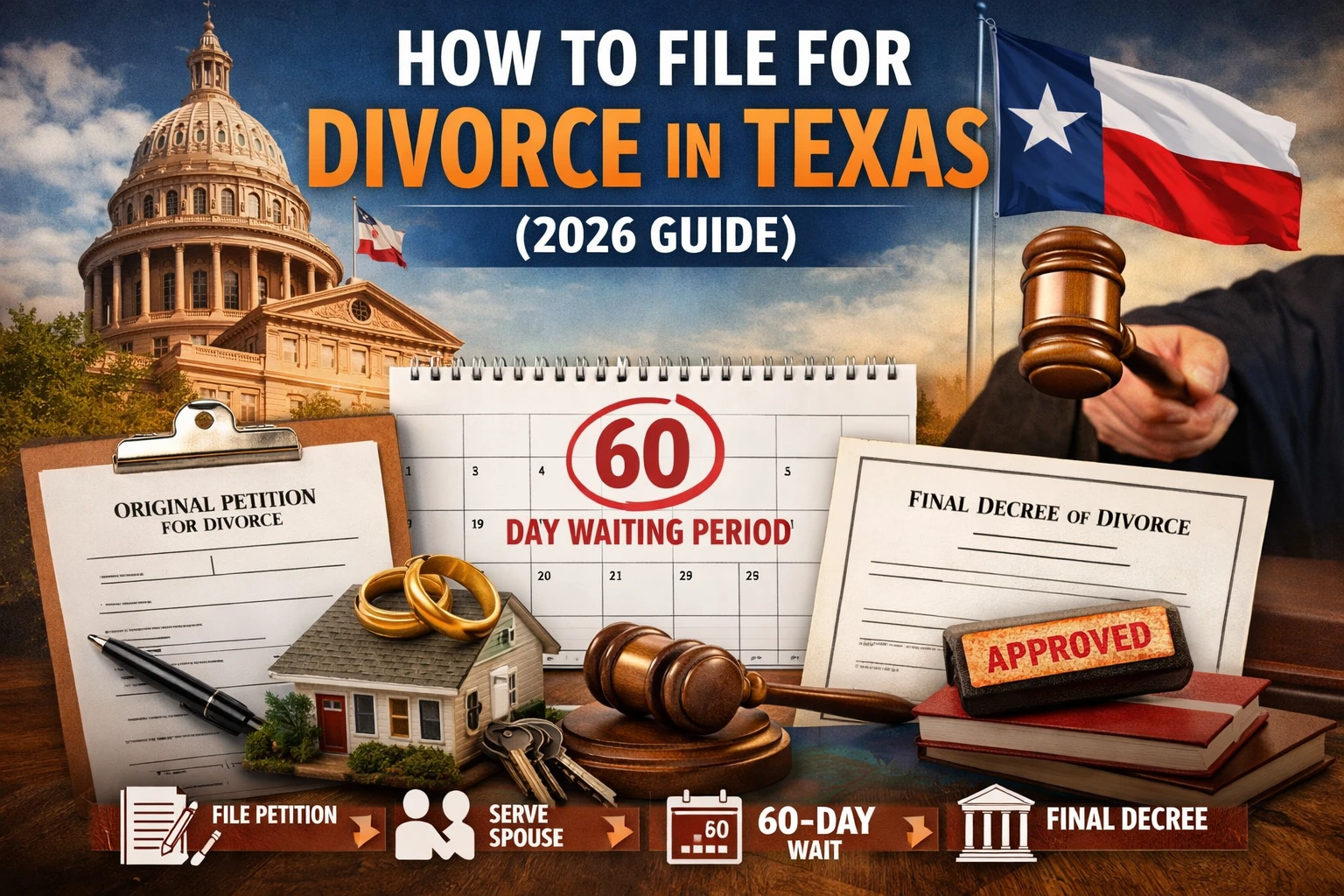
The uncontested divorce timeline in Texas is governed by a statutory waiting period. After you file, the court cannot grant your divorce until a set number of days have passed, and the exact requirement is set by Texas Family Code Section 6.702. Check the current statute for the precise number of days, since the rule is set by law and can be amended.
That waiting period isn’t dead time, it’s when you finalize the decree, obtain any needed QDRO, and confirm your property descriptions. Couples who use the window well file a complete package the day the period ends.
After the judge signs, the decree becomes your permanent record of the property division. Record it with the county clerk if real property is involved, and send the QDRO to the plan administrator promptly.
| Phase | What Happens | Who Acts |
|---|---|---|
| Filing | Petition and supporting documents submitted | Petitioner |
| Waiting period | Decree finalized, QDRO prepared | Both spouses |
| Court review | Judge reviews the agreed decree | Court |
| Finalization | Decree signed and recorded | Petitioner |
How to Divide Property in Texas Uncontested Divorce Without Costly Mistakes
Most failed uncontested divorces fail on documentation, not disagreement. Couples agree on terms, then submit a decree a judge can’t approve because an asset is described vaguely or a debt isn’t assigned to anyone.
Three mistakes account for most of these problems:
- Leaving assets off the decree. An omitted asset stays community property after divorce, which means you may need a separate suit to divide it.
- Awarding retirement benefits without a QDRO. The decree says one spouse gets half the account, but the plan administrator has no order to act on.
- Ignoring tax consequences. How you divide property affects what you owe. Transferring a retirement account through a QDRO generally avoids immediate tax, while withdrawing funds to split them does not. Confirm the treatment with a tax professional before you sign.
Document preparation is where an experienced service earns its keep. At Ready Divorce Service, we help Texas couples assemble a complete, compliant filing so the court approves the division the first time. If you’re unsure which level of support fits your situation, our guide to choosing the right uncontested divorce package walks through the options, and our starting the divorce process page covers what to gather before you begin.
Dividing property in an uncontested divorce comes down to documentation: a complete inventory, a specific decree, and the right orders for retirement accounts. Get those right and the court approves your division without a hearing. Ready Divorce Service specializes in Texas uncontested divorce document preparation, offering step-by-step guidance, accurate filings that comply with state law, and an affordable alternative to traditional litigation. Start with our questionnaire and get a clear path from filing to final decree.
Frequently Asked Questions
What is the difference between separate and community property in Texas?
Community property laws in Texas treat most assets and debts acquired during the marriage as belonging to both spouses. Separate property is what you owned before the marriage, plus gifts and inheritances received during it. If you want to keep something as separate property, you generally need clear records showing where it came from. Without that proof, a court may treat it as part of the marital estate subject to division.
Do I need a lawyer for an uncontested divorce in Texas?
You are not required to hire a lawyer for an uncontested divorce. Many couples handle the paperwork themselves or use a document preparation service to draft the Final Decree of Divorce and related forms. That said, if your situation involves retirement accounts, real property, or disputed separate property claims, having a qualified attorney review your agreement before filing can prevent problems later.
What assets cannot be touched in a divorce?
Separate property, meaning assets you owned before the marriage or received as a gift or inheritance during it, is generally not divided as part of the community estate. Retirement benefits earned before the marriage, personal injury settlements for pain and suffering, and certain government benefits may also fall outside community division. Proving these claims usually requires tracing separate property with documentation.
How long does an uncontested divorce take in Texas?
An uncontested divorce timeline in Texas starts with a mandatory waiting period after the respondent is served or files an answer. Once that period passes, the court can approve your Final Decree of Divorce. The total time depends on your county’s court schedule and whether both spouses have signed a Mediated Settlement Agreement. Filing complete, accurate documents the first time helps avoid delays.