Table of Contents
- What Happens at a Texas Uncontested Divorce Final Hearing
- The Texas Divorce 60-Day Waiting Period Explained
- How to Schedule Your Final Hearing
- Documents You Need for the Final Hearing
- Proving Up a Divorce in Texas: What to Expect in Court
- Virtual vs. In-Person Hearing Logistics
- Final Decree of Divorce Form Texas: Signing and Post-Hearing Steps
- Frequently Asked Questions
Last Updated: September 16, 2026
What Happens at a Texas Uncontested Divorce Final Hearing
The Texas uncontested divorce final hearing process is the short court appearance where a judge reviews your settlement agreement, confirms it is fair and voluntary, and signs the order that legally ends your marriage. In most uncontested cases the hearing itself takes only a few minutes, but everything leading up to it has to be correct. This guide from Ready Divorce Service walks through each stage, from the 60-day waiting period to the moment you receive a signed divorce decree.
The stakes are simple: show up prepared, or the judge sends you home to fix paperwork. Most people who prepare properly finish in a single appearance. The steps below cover scheduling, documents, courtroom expectations, and what to do after the judge signs.
Prove-Up Hearing Basics
A prove-up hearing is the formal proceeding where one spouse presents sworn testimony to confirm the divorce agreement is valid. The judge does not renegotiate your settlement; the goal is to verify that both parties agreed freely and that nothing in the decree conflicts with state law.
The person who filed the petition typically attends and answers a short set of questions under oath. If your spouse signed a waiver of service, they usually do not need to appear. Because the case is uncontested, no one argues against you. The judge reviews the final decree, asks you to confirm key facts, and signs if everything is in order.
Bring two copies of your final decree to the hearing: one for the judge and one for the court clerk to stamp. Courts keep the original, and you want a file-stamped copy for your records the same day.
The Texas Divorce 60-Day Waiting Period Explained
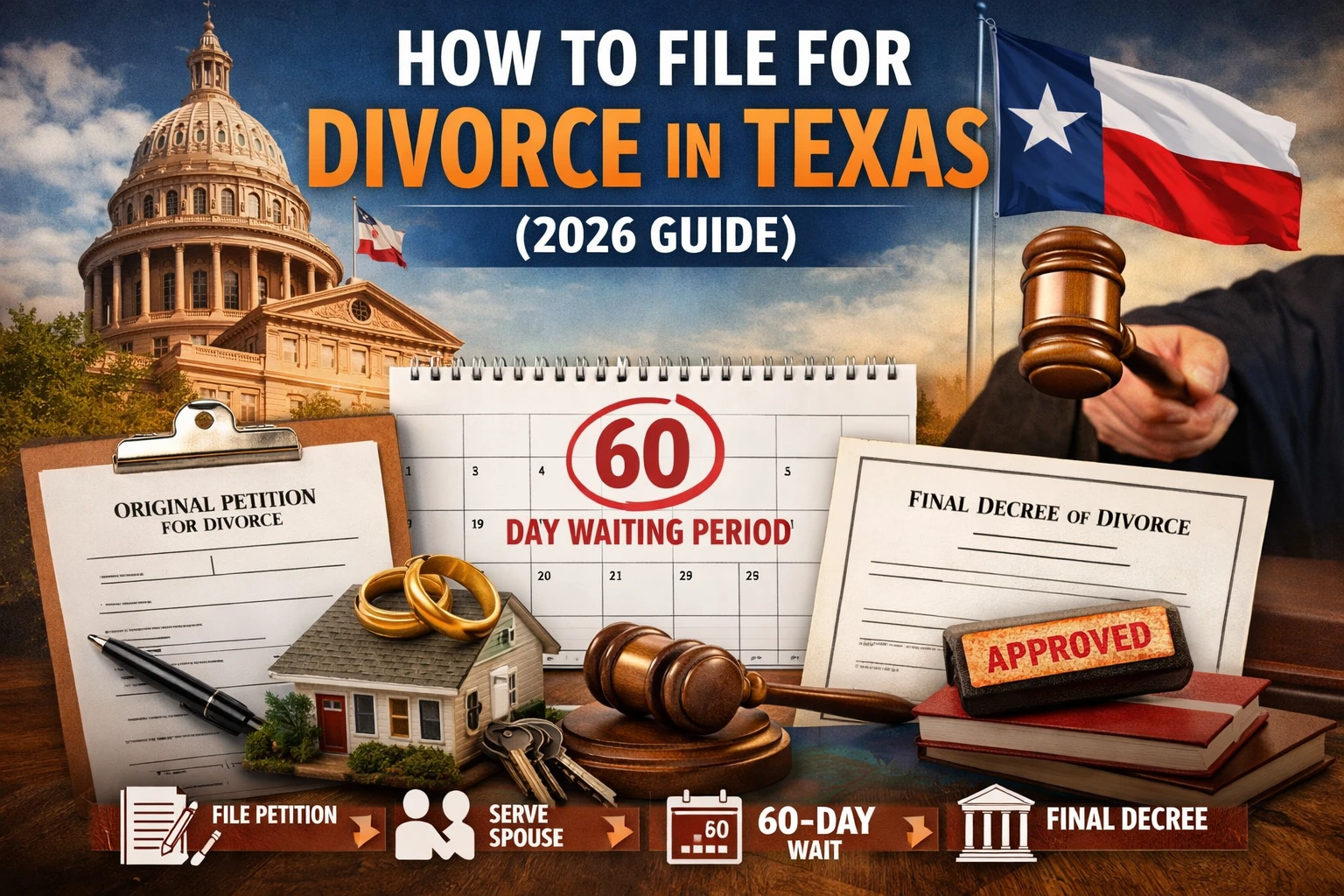
The Texas divorce 60-day waiting period is a statutory pause that begins the day the petition for divorce is filed. No judge can grant a final divorce before that window closes, even when both spouses agree on every term.
Use the waiting period productively rather than treating it as dead time. It is the window to finalize your divorce settlement agreement, confirm how community property will be divided, and prepare the documents the court will expect at the final hearing. If you have minor children, this is also when you finalize custody and support terms so nothing is left open on hearing day.
Many people assume the 60 days is the whole timeline. It is not. The waiting period is a minimum, and the actual schedule depends on your county’s court docket and how quickly your paperwork is accepted. For a full breakdown of what happens during this stage, see the official Texas judicial guidance on family law cases.
How to Schedule Your Final Hearing
Scheduling is where most uncontested cases stall, because there is no automatic hearing date. The 60-day waiting period only makes you eligible; someone still has to ask the court to put the case on the docket. In most counties the person who filed the petition (the petitioner) makes that request through the district clerk’s office.
Start by confirming three things with the clerk in the county where the petition was filed:
- Your case number and the court the case was assigned to.
- Whether the county uses an online docket or e-filing portal (many now do) or requires an in-person or phone request.
- Whether the county requires a separate Notice of Hearing to be filed and served.
From there, the sequence usually looks like this:
- File the request to set. Some counties call this a “request for hearing,” a “motion to set,” or a “docket request.” Ask the clerk for the exact form name your county uses.
- File a Notice of Hearing if required. This tells the other side the date, time, and place. If your spouse signed a waiver of service, they may not need notice, but confirm that with the clerk rather than assuming.
- Serve the notice. If your spouse has not waived service, the notice has to be served the same way the original petition was, and you file proof of service with the court.
- Pay any setting fee. Fees vary by county and by whether the case is filed as an agreed or default matter. Ask the clerk for the current amount before you submit.
- Confirm the format. Ask whether the appearance is in person, by video, or by phone, and get the platform and link in writing if it is remote.
A common pattern is that people assume the court will call them once the 60 days pass. It will not. If you do nothing, the case sits. Some counties also limit how far out you can request a setting, so ask whether there is a window (for example, settings only available within a certain number of weeks) before you pick a date.
If your spouse is not cooperating and has not waived service, the scheduling path changes and you may need a default prove-up instead of an agreed one. That is a different procedural track, and it is worth confirming with the clerk which track your case is on before you request a date.
Ask the clerk two questions before you hang up: “What is the exact name of the form I file to request a hearing?” and “Does my county require a separate Notice of Hearing?” Those two answers prevent most scheduling delays.
For county-specific filing rules and forms, the official state judicial branch family law resources is the starting point, but the district clerk in your county is the final word on local procedure.
Documents You Need for the Final Hearing
The final hearing packet usually includes the final decree of divorce, proof that the other spouse was served or signed a waiver, and any supporting orders for children or property. Missing documents are the most frequent reason a hearing gets postponed.
- Final Decree of Divorce, complete and unsigned
- Signed waiver of service or proof of service
- Divorce settlement agreement, if separate from the decree
- Any agreed orders on children, support, or property
- Your case number and the judge’s name
- Photo identification
Review every name, date, and address before you file. A typo in a legal name can send the whole packet back.
Filing an incomplete packet does not just delay you. It can reset your scheduling, push your hearing weeks out, and add another filing fee. Check the county’s document checklist before you submit anything.
Proving Up a Divorce in Texas: What to Expect in Court
Proving up a divorce means answering the judge’s questions under oath so the court can confirm the agreement is valid and voluntary. It is a short, structured exchange, not a trial. Most uncontested prove-ups take only a few minutes once the judge calls the case.

The questions the judge typically asks
- State your name and confirm you are the petitioner.
- Confirm the marriage is insupportable because of discord or conflict of personalities.
- Confirm the 60-day waiting period has passed.
- Confirm the settlement agreement was voluntary and that you are asking the court to approve it.
- Confirm whether there are children and whether the decree addresses conservatorship, possession, and support.
- Confirm the property division is what you agreed to.
Courtroom etiquette and dress
- Dress: business casual is the safe standard. Avoid shorts, tank tops, hats, and anything with slogans.
- Address the judge as “Your Honor.” Stand when you speak if the court expects it, and wait for the judge to finish before you answer.
- Silence your phone before you enter the courtroom. Do not record unless the judge gives permission.
- Bring printed copies of your decree and any supporting orders, even if you filed electronically.
- Arrive early enough to pass through security and find the right courtroom. Security lines can be long in larger courthouses.
Virtual vs. in-person logistics
If you are appearing remotely and your connection drops mid-hearing, do not panic. Rejoin the same link and wait to be readmitted. Tell the court you lost connection before you continue answering questions.
What the judge does next
If everything is in order, the judge signs the Final Decree of Divorce on the spot or shortly after.
Virtual vs. In-Person Hearing Logistics
Many courts now offer remote appearances, and the logistics differ enough that you should confirm the format before the day arrives.
Final Decree of Divorce Form Texas: Signing and Post-Hearing Steps
The hearing is the easy part. The real work is the paperwork before and after it: a complete packet gets you in and out in one visit, and a certified copy of the signed decree is what you use for every account update afterward.
Frequently Asked Questions
Do I have to appear in court for an uncontested divorce in Texas?
In most Texas counties, at least one spouse must appear for the final hearing, even if the divorce is uncontested. This is called a prove-up hearing. Some counties allow affidavits or virtual appearances instead of in-person testimony. Check with your local court clerk for specific rules. If you cannot appear, you may be able to submit a sworn statement, but this varies by county.
How long does it take to get a divorce decree after the final hearing?
After the final hearing, the judge signs the Final Decree of Divorce. The signed decree is typically filed with the court clerk within a few days. You can usually obtain a certified copy within one to two weeks. Processing times vary by county. Once signed, the divorce is final. You may need to wait for the clerk to notify you or check the court docket online.
What documents do I need to bring to my final divorce hearing?
Bring a copy of the Final Decree of Divorce form, any signed agreements (such as a divorce settlement agreement), and proof of the 60-day waiting period. If you have children, bring the parenting plan. Also bring your case number and any notice of hearing. Some courts require a sworn statement or affidavit. Check with your court clerk for a complete list.
Can I finalize my divorce without a hearing in some counties?
Yes, some Texas counties allow a divorce to be finalized without an in-person hearing if both parties agree and submit a waiver of service or affidavit. This is often called a prove-up on the papers. However, many counties still require a brief court appearance. Contact your local district clerk to confirm whether your county permits a waiver. Procedures vary widely.