Table of Contents
- Is a Lawyer Required by Law?
- Understanding Uncontested Divorce Requirements
- How Long Does a Divorce Take in Texas?
- Filing for Divorce Pro Se: What You Need to Know
- Divorce Forms for Self-Represented Litigants
- When an Attorney Is Necessary
- Financial Impact: DIY vs. Attorney-Represented Divorce
- Finding Legal Aid and Low-Cost Assistance
- Frequently Asked Questions
Last Updated: September 20, 2026
Is a Lawyer Required by Law?
No law in Texas requires you to hire an attorney to file for divorce. You have the right to represent yourself, known as filing pro se. This applies whether your divorce is uncontested or contested. However, having legal representation can significantly impact the outcome of your case, especially when complications arise.
Whether you need a texas divorce lawyer depends on your situation’s complexity, asset disputes, child custody, or significant debt all warrant professional counsel.
Understanding Uncontested Divorce Requirements
An uncontested divorce occurs when both spouses agree on property division, child custody, child support, and spousal support, making the process simpler and faster.
In an uncontested divorce, you typically do not need a texas divorce lawyer, just file the correct forms and wait out Texas’s mandatory 60-day waiting period.
Requirements include both spouses signing all documents, agreeing on property/debt division and custody/support arrangements, completing court forms correctly, and paying filing fees. Paperwork mistakes can delay or derail your filing, making document preparation services valuable.
Many people assume they need an attorney just to file paperwork. In reality, for uncontested divorces, accurate document completion matters far more than legal representation. Getting the forms right the first time saves months of delays.
How Long Does a Divorce Take in Texas?
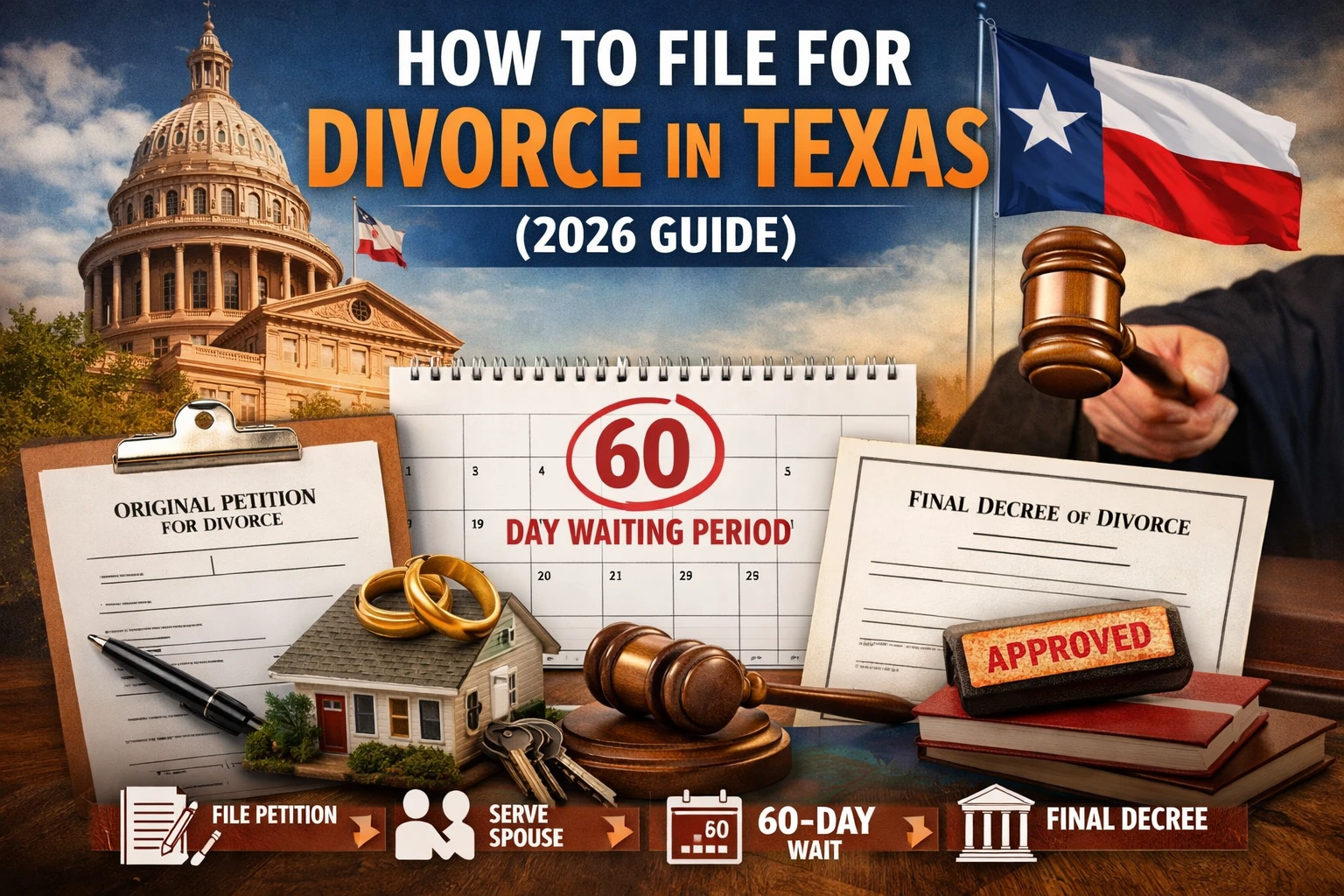
Texas imposes a mandatory 60-day waiting period from filing that cannot be waived. After 60 days, you can request a final hearing and divorce decree.
Uncontested divorces take 60 days minimum (often 2-3 months with processing); contested divorces take 6 months to 2+ years.
Filing for Divorce Pro Se: What You Need to Know
A common mistake is assuming the court clerk will help you complete forms correctly. Court staff cannot provide legal advice. They can only tell you which forms to file, not whether you filled them out right. Incorrect forms get rejected, costing you time and money.
Pro se divorce works best when your divorce is truly uncontested, you have few assets and no children, both spouses cooperate fully, and you understand legal terminology.
Divorce Forms for Self-Represented Litigants
Texas courts provide specific forms for uncontested divorces through the court clerk’s office and online. Using current, correct forms is essential; outdated or incorrect forms get rejected.
Using the wrong county’s forms or outdated versions is a frequent cause of filing delays. Always verify with your court clerk that you have the current, correct forms before completing them.
When an Attorney Is Necessary
Some situations require professional legal representation. A texas divorce lawyer becomes necessary when complications arise that you cannot resolve on your own or when one spouse refuses to cooperate.

Red-Flag Checklist: When You Absolutely Need an Attorney
Use this checklist to assess whether your divorce is truly safe to handle pro se. If you check any of the following boxes, consult an attorney before filing:
Spousal Cooperation & Communication
- Your spouse has refused to sign agreements or discuss settlement
- Your spouse has hired an attorney
- You cannot locate your spouse for service of process
- There is a history of domestic violence, abuse, or threats
- Your spouse has threatened to contest the divorce
Assets & Financial Complexity
- Either spouse owns a business, partnership, or professional practice
- You have retirement accounts (401k, IRA, pension) acquired during marriage
- Combined marital assets exceed $100,000
- One spouse has significantly higher income than the other
- You suspect hidden income, unreported assets, or offshore accounts
- Either spouse is self-employed or has variable income
- You own real estate beyond your primary residence
- Either spouse has substantial debt (credit cards, business loans, student loans)
Children & Custody
- You have minor children and cannot agree on custody or visitation
- One parent has concerns about the other’s fitness or safety
- One parent plans to relocate with the children
- Child support calculations are complex (multiple children, income variations)
- Either parent receives disability benefits or has special needs
Other Risk Factors
- This is a second or subsequent divorce with existing child support or alimony obligations
- Either spouse has a criminal history or restraining order
- You do not fully understand what you are agreeing to
- Your spouse is pressuring you to sign quickly or without review
Child Custody and Support Considerations
Child custody disputes require understanding Texas Family Code standards, documentation needs, court procedures, and how relocation or employment changes affect orders. Child support calculations are complex with variable income or multiple children. An attorney ensures you understand your rights and obligations.
Property and Debt Division Disputes
Texas is a community property state, splitting most marital assets equally. Disputes arise over what qualifies as community versus separate property, asset valuation, and debt division. Without legal guidance, you may agree to unfair splits or overlook assets.
Financial Impact: DIY vs. Attorney-Represented Divorce
Filing pro se costs less upfront, but lowest cost doesn’t guarantee best financial outcome. Account for both immediate costs and long-term risks of errors.
Upfront Costs: Pro Se vs. Attorney
Pro se filing typically costs:
- Court filing fees (varies by county, generally $200-$500)
- Document preparation services, if used
- Service of process fees, if applicable ($50-$200)
- Total: pricing depends on quantity, dates, and delivery
Attorney representation typically costs:
- Hourly rates ($150-$400+ per hour, depending on attorney experience and location)
- Flat fees for uncontested divorces
- Court costs and filing fees ($200-$500)
- Total: pricing depends on quantity, dates, and delivery
The Hidden Cost: Post-Divorce Modification Errors
A poorly drafted decree creates costly problems years later. Vague language on child support, custody, or alimony invites expensive modification suits. Retirement account division errors may be irreversible. Tax implications of property division often go unaddressed, creating unexpected liabilities. Clear, detailed decrees prevent years of conflict.
Real-World Cost Comparison
Scenario 1: Uncontested Divorce, No Children, Few Assets
- Pro se cost: pricing depends on quantity, dates, and delivery
- Attorney cost: pricing depends on quantity, dates, and delivery
- Risk of DIY error: Low (fewer moving parts)
- Verdict: DIY is reasonable if both parties genuinely cooperate
Scenario 2: Uncontested Divorce, Two Children, Moderate Assets ($150,000)
- Pro se cost: pricing depends on quantity, dates, and delivery
- Attorney cost: pricing depends on quantity, dates, and delivery
- Risk of DIY error: Moderate to High (child support calculations, custody language, asset division)
- Hidden cost if errors occur: pricing depends on quantity, dates, and delivery
- Verdict: Attorney representation likely pays for itself through error prevention
Scenario 3: Contested Divorce or Complex Assets
- Pro se cost: pricing depends on quantity, dates, and delivery
- Attorney cost: pricing depends on quantity, dates, and delivery
- Risk of DIY error: Very High (contested cases require legal strategy and court procedure knowledge)
- Verdict: Attorney is essential; DIY is not a viable option
Why DIY Mistakes Are Expensive to Fix
Once a divorce decree is final, correcting errors is difficult and costly. The court will not reopen a final decree without substantial cause. This means:
- Modification suits are required to change terms, costing $1,500-$5,000 each
- Enforcement actions are needed if one party violates the decree, adding legal fees
- Tax corrections may require amended returns and IRS negotiations
- Asset division errors may be irreversible if the other party refuses to cooperate
The Middle Ground: Document Preparation Services
A middle ground exists between full pro se representation and hiring an attorney. For uncontested divorces where both spouses genuinely agree on all terms, Which Plan is Right for You? can help you determine whether document preparation services are sufficient for your situation. Expert document preparation ensures your paperwork is accurate and legally sound, helping you avoid costly mistakes without the full expense of attorney representation.
When document preparation is sufficient:
- Both spouses genuinely agree on all terms
- Assets and income are straightforward
- No child custody disputes exist
- You want professional review without full attorney costs
When you still need an attorney:
- Any disagreement exists between spouses
- Assets or income are complex
- Children are involved and custody is unclear
- You need courtroom representation
Finding Legal Aid and Low-Cost Assistance
If you cannot afford an attorney, legal aid organizations provide free or low-cost services. Texas has several resources available.
Resources include:
- Texas RioGrande Legal Aid
- State Bar of Texas Lawyer Referral Service
- Local community legal clinics
- Law school clinics in your area
Frequently Asked Questions
What are the requirements for an uncontested divorce in Texas?
An uncontested divorce requires both spouses to agree on all terms, including property division, child custody, and support. Both parties must sign the divorce petition and any required agreements. You’ll file the necessary divorce forms with the court clerk, pay the filing fee, and wait the mandatory waiting period. The Texas Family Code governs these requirements. If you and your spouse have reached a complete settlement, you may be able to file without an attorney through pro se filing.
Can I file for divorce on my own if we have minor children?
Yes, you can file pro se with minor children if your divorce is uncontested and both parents agree on custody, support, and possession and access arrangements. However, the court requires a detailed parenting plan and child support calculation. Mistakes in these documents can delay your case or result in rejection by the court clerk. Many self-represented litigants benefit from document preparation assistance to ensure compliance with Texas Family Code requirements for minor children.
How long does a divorce take in Texas after filing?
Texas has a mandatory 60-day waiting period from the date you file the divorce petition. During this time, your spouse must be served with the divorce documents. In an uncontested divorce where both parties agree, your final hearing typically occurs after the 60 days. The total timeline can range from 2 to 3 months for straightforward uncontested cases, but contested divorces involving litigation may take significantly longer.
What happens if I make mistakes on my divorce forms?
If the court clerk identifies errors in your divorce forms, they may reject the documents and return them for correction. This delays your case and can cost you additional filing fees. Common mistakes include incomplete asset disclosure, incorrect calculations for child support, or improper service of process. Some mistakes discovered later during the final hearing may require a settlement agreement modification, creating additional court costs and stress.