Table of Contents
- Can You File for Divorce Online in Texas?
- Texas Divorce Residency Requirements
- Uncontested Divorce Texas Forms You Need
- eFileTexas Divorce Filing Process: Step by Step
- Texas Divorce 60-Day Waiting Period and Key Deadlines
- Filing Fees, Court Costs, and Financial Hardship Waivers
- Common E-Filing Rejections and How to Fix Them
- Frequently Asked Questions
Last Updated: September 30, 2026
Can You File for Divorce Online in Texas?
Yes. You can complete most of the filing for divorce online texas process through the state’s e-filing system, though a judge still has to sign off on the final decree. This guide from Ready Divorce Service walks you through each step, from residency rules to the 60-day waiting period.
Online filing speeds up delivery, not the legal process itself. The 60-day waiting period and residency rules apply no matter how you file.
Texas Divorce Residency Requirements
You or your spouse must have lived in Texas for at least 6 months before filing, and in the county where you file for at least 90 days. These are the two residency tests that decide which court has jurisdiction over your case.
A few things to know:
- Six-month state rule: One spouse must be a Texas resident for 6 months.
- Ninety-day county rule: One spouse must live in the filing county for 90 days.
- Military exception: Active-duty service members may use their home state of record.
- No minimum marriage length: You can file the day after your wedding.
Uncontested Divorce Texas Forms You Need
An uncontested divorce needs a core set of forms, and missing even one can stall your case. The exact list varies by county, so check your local district clerk’s requirements before you start.
The standard package usually includes:
- Original Petition for Divorce – starts the case and states your grounds
- Waiver of Citation – your spouse signs this to skip formal service
- Final Decree of Divorce – the judge’s order that ends the marriage
- Affidavit of Indigency – only if you cannot afford filing fees
eFileTexas Divorce Filing Process: Step by Step
The eFileTexas process has five main stages: register as a self-represented filer, prepare and upload your documents, submit the filing envelope, serve your spouse, and wait out the 60-day period for the judge’s signature. Most people finish the upload in a single sitting, but the acceptance step is where filings stall.

- Create your eFileTexas account. Register as a self-represented filer, also called pro se. You will confirm your email, set a password, and add your contact information. Use an email you check daily, every clerk notice, acceptance, and rejection goes there.
- Pick the right court. Choose the district clerk in your county’s family law division. If you are unsure which court hears family cases in your county, call the district clerk’s office before you start. Filing in the wrong court is one of the most common reasons a filing is returned.
- Prepare your documents as text-searchable PDFs. The Original Petition for Divorce is the lead document. If you have a Waiver of Citation signed by your spouse, attach it as a separate document in the same envelope. Do not combine multiple forms into one PDF unless your county’s local rules tell you to.
- Build the filing envelope. In eFileTexas, you select a filing type (for example, “Original Petition”), a filing code, and the party you represent. Then you attach each PDF and match it to the correct document type. Mismatched document types are a frequent rejection reason.
- Pay the filing fee or request a waiver. You can pay by credit card or e-check through the portal. If you are requesting a fee waiver, you upload the Affidavit of Indigency in the same envelope, see the fees section below for how that works.
- Submit and watch for the clerk’s response. After you submit, the filing goes into a queue. The clerk either accepts it (you get a case number and docket entry) or returns it with a note explaining what to fix. A return is not a denial, you correct the specific issue and resubmit.
- Serve your spouse. Filing the petition does not notify your spouse by itself. If they signed a Waiver of Citation, file that waiver with the court. If they did not, you must arrange formal service of process through a constable, sheriff, or private process server, and then file the return of service with the clerk.
Filing the petition does not notify your spouse by itself. If they do not sign a Waiver of Citation, you must arrange formal service of process, or the case cannot move forward. A missing return of service is one of the most common reasons a final decree hearing gets pushed past day 60.
Before you hit submit, open each PDF and confirm three things: the document is text-searchable (not a photo), every required signature line is filled, and the case style at the top matches the court you selected. Fixing these before submission saves a full rejection cycle.
Texas Divorce 60-Day Waiting Period and Key Deadlines
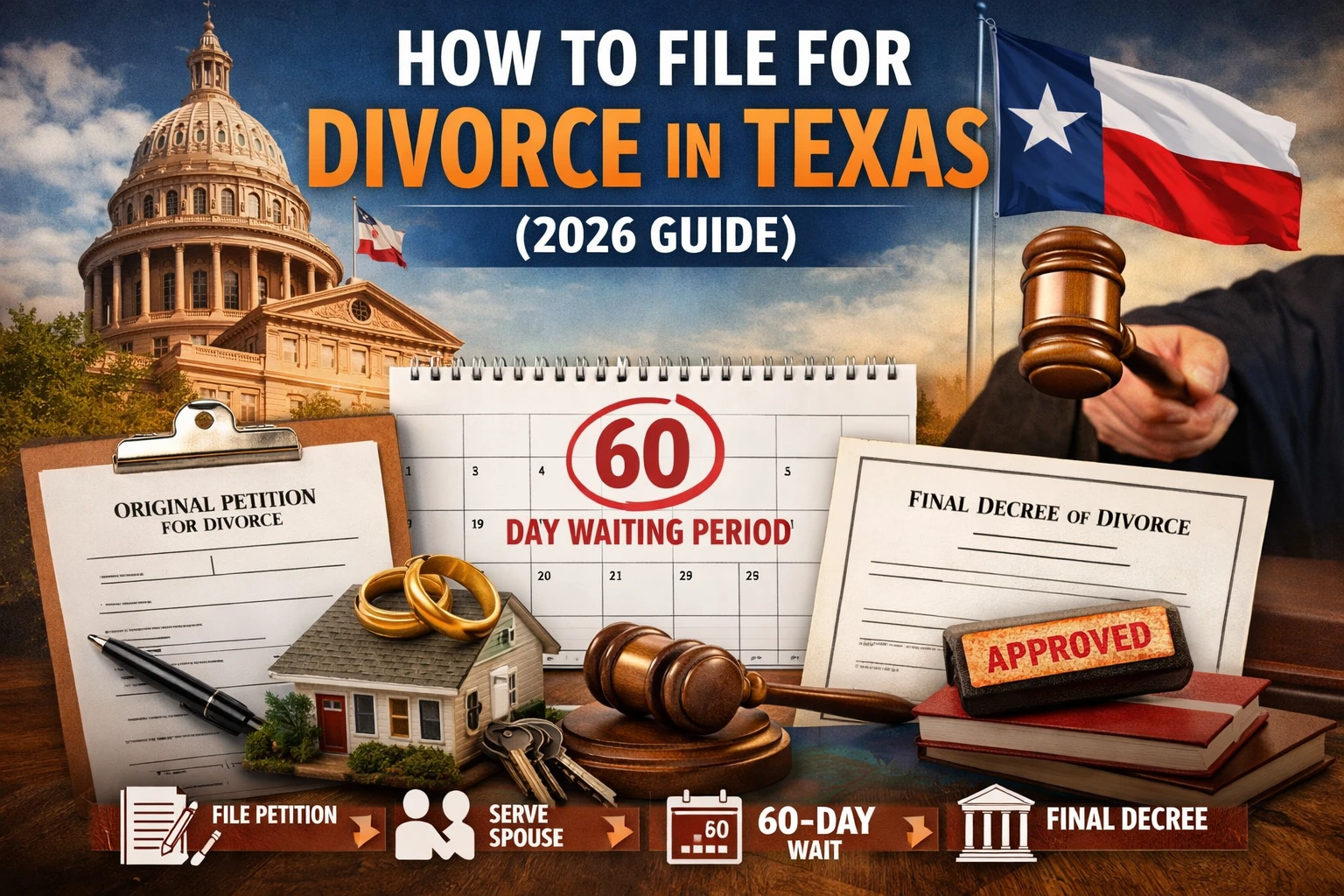
Texas law requires a 60-day waiting period before a judge can grant a divorce. The clock starts the day you file your petition, not the day your spouse is served.
| Stage | Timing | What Happens |
|---|---|---|
| File petition | Day 0 | Case opens, clock starts |
| Serve spouse | Days 1-30 | Waiver signed or formal service |
| Wait period | Days 1-60 | Finalize decree and agreements |
| Final hearing | Day 60+ | Judge reviews and signs |
Filing Fees, Court Costs, and Financial Hardship Waivers
Filing fees vary by county, so there is no single statewide number. Expect to pay a district clerk filing fee plus any service costs if you use a constable, sheriff, or private process server. Some counties also charge a separate fee for the final decree or for records copies.
How to file the Affidavit of Indigency online
- Get the right form for your county. Many district clerks post their own version. Use the county’s form if one exists; otherwise the statewide form is usually accepted.
- Complete it truthfully and specifically. The affidavit asks about income, expenses, dependents, and public benefits. You are signing under oath, so list what you actually receive, including any benefits such as SNAP, Medicaid, or TANF, and attach proof if you have it.
- Upload it in the same filing envelope as your petition. Do not file the petition first and the affidavit later. Filing them together lets the clerk process the waiver before assessing fees.
- Select the correct filing code. In eFileTexas, choose the filing type that corresponds to an affidavit of indigency or fee waiver, not the general “Original Petition” code. A wrong code can send the affidavit to the wrong queue.
- Wait for the clerk’s decision. The clerk reviews the affidavit and either grants the waiver, denies it, or asks for more information. If it is granted, the filing fee is removed from your case. If it is denied, you will be asked to pay the fee before the case moves forward.
- Keep a copy of the approved affidavit. You may need to reference it if the court later assesses other costs, such as a jury fee or a records fee.
What the waiver does and does not cover
- It typically covers the district clerk’s filing fee.
- It may cover service of process costs, but this varies by county, ask the clerk.
- It does not cover fees charged by a private process server, a mediator, or an attorney.
- It does not cover costs you incur later, such as a fee to obtain a certified copy of the final decree.
Practical notes
- Ask your district clerk for the current fee schedule before you file, so you know what you are asking to waive.
- Request the waiver at the same time you file your petition.
- Keep copies of any proof of income or benefits.
- Some counties charge extra for service of process, and that charge may or may not be waivable.
- If your affidavit is denied, you can usually ask the clerk what additional documentation would support it, or pay the fee and proceed.
A fee waiver is not automatic. You have to file the affidavit in the same envelope as your petition, select the right filing code, and wait for the clerk’s decision before the fee is removed.
Common E-Filing Rejections and How to Fix Them
Most e-filing rejections come from small technical issues, not legal problems. The clerk sends the document back with a note, and you fix it and resubmit.
The usual culprits:
- Wrong court selected – confirm the family law division in your county.
- Missing signature – use an electronic signature where the portal allows it.
- Unreadable PDF – scan at a clean resolution and avoid photos of pages.
- Missing case number – add it on every follow-up filing.
- Incomplete forms – fill every required field, even the ones that seem minor.
Save a master copy of every document you file. When the clerk flags one page, you can correct just that page instead of rebuilding the whole packet.
Frequently Asked Questions
Can I file for divorce by myself in Texas?
Yes. Texas allows you to file as a pro se petitioner, meaning you represent yourself without a lawyer. You will need to prepare the petition for divorce, file it with the district clerk, arrange service of process on your spouse, and complete the final decree. Many people use a document preparation service to help with the paperwork while still filing on their own. The court clerk can explain local rules, but cannot give legal advice.
Is filing for divorce online in Texas legit?
Yes. The eFileTexas system is the state’s official electronic filing portal, managed by the Office of Court Administration. Filing through eFileTexas is legally the same as filing paper documents at the courthouse. Online divorce services simply help you prepare the correct forms and submit them through the same system. What matters is that your forms are accurate and complete for your county.
What is the 60-day waiting period in Texas divorce?
Texas law requires a 60-day waiting period from the date the petition for divorce is filed before a court can grant a final decree. This is a minimum, not a guarantee. The actual timeline depends on court schedules, whether your spouse responds, and whether you have minor children or property to divide. Use the waiting period to finalize your settlement agreement, gather documents, and prepare the final decree.
What are the residency requirements to file for divorce in Texas?
At least one spouse must have lived in Texas for the six months immediately before the divorce is filed, and in the county where the case is filed for the 90 days immediately before filing. If you recently moved, you may need to wait until you meet both timeframes. These are the only residency rules; you do not need to be a U.S. citizen to file.
Filing for divorce online in Texas is manageable when your paperwork is complete and your county’s rules are followed. The process still has real deadlines, and a rejected filing costs you time you cannot get back. Ready Divorce Service helps you prepare accurate documents, guides you through each step, and supports Spanish-speaking clients with real people, not just translated forms. Get started with Ready Divorce Service and move through your uncontested divorce with confidence.