Table of Contents
- Understand Eligibility and Residency Requirements for Uncontested Divorce
- Gather Your Financial Records and Assets
- Understanding the Texas Divorce Waiting Period
- Prepare Uncontested Divorce Forms Texas Requires
- How to Handle Divorce Without Children in Texas
- Filing Fees for Divorce in Texas and Payment Options
- Your Post-Divorce Checklist and Next Steps
- Frequently Asked Questions
Last Updated: September 3, 2026
Understand Eligibility and Residency Requirements for Uncontested Divorce
An uncontested divorce in Texas is one where both spouses agree on all major issues, property division, spousal support, and child custody, before filing. The key advantage is simplicity: the process moves faster and costs significantly less than a contested divorce.
To file, at least one spouse must have been a Texas resident for six months immediately before filing, and you must have lived in the county for at least 90 days. Your marriage must be valid in Texas; if you were married outside Texas but now live here, that’s acceptable. However, if you’re separated but not yet divorced from a previous marriage, you cannot file for a new divorce until that prior divorce is finalized.
Ready Divorce Service helps clients verify these eligibility requirements upfront, ensuring your filing meets all jurisdictional thresholds and preventing costly delays. Understanding Starting the Divorce Process can clarify exactly what documentation and timelines apply to your situation.
Gather Your Financial Records and Assets
Before preparing divorce documents, collect comprehensive financial records. Both spouses must disclose all assets, debts, and income sources to the court; incomplete disclosure can invalidate your agreement later.

List all bank accounts, investment accounts, and retirement savings with account numbers, balances, and institution names. For retirement accounts like 401(k)s and IRAs, note whether they’re individual or joint. If either spouse has a pension, gather the most recent statement showing vested and unvested balances.
Document real property ownership: titles to your home, rental properties, or land, including current market value and outstanding mortgage balance. Do the same for vehicles: make, model, year, VIN, and current value.
Gather debt statements for credit cards, personal loans, car loans, and business debts, noting creditor name, account number, and current balance. Both spouses remain liable for joint debts unless the divorce agreement explicitly assigns responsibility.
Collect income documentation for the last two years: tax returns, recent pay stubs, and 1099 forms if self-employed. Include disability benefits, retirement income, or investment returns statements.
List digital assets: cryptocurrency holdings, online business accounts, domain names, and valuable digital collections with usernames, balances, and approximate values.
Ready Divorce Service guides you through organizing these records into the format required by Texas courts.
Understanding the Texas Divorce Waiting Period
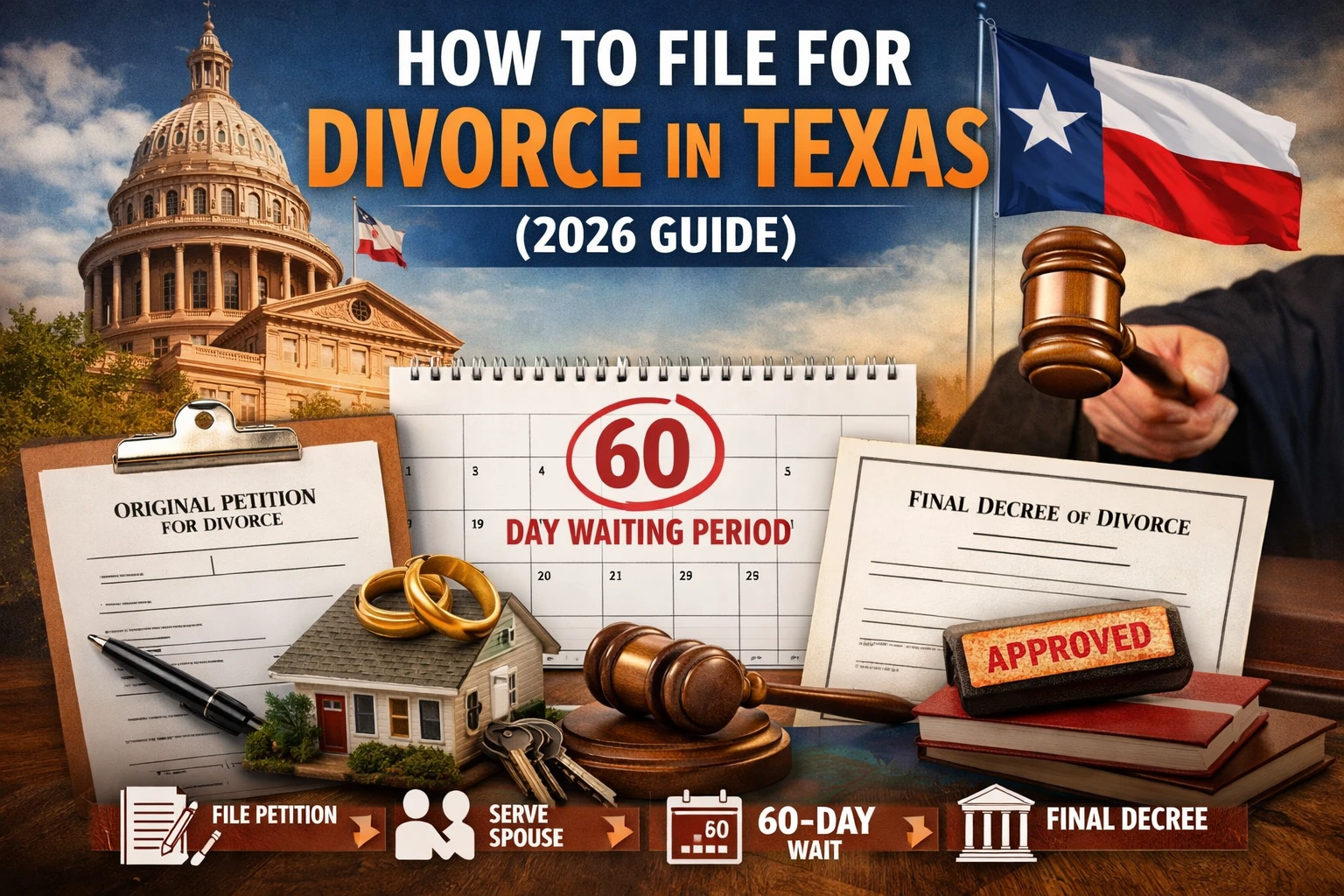
Texas imposes a mandatory 60-day waiting period from the filing date before the court can grant a final decree of divorce. This applies to all divorces, contested or uncontested, and cannot be bypassed except by formal written waiver from both spouses, rarely used in practice.
During this time, finalize your divorce settlement agreement outlining property division, debt handling, and any custody or support arrangements. By the time 60 days expire, your agreement should be complete and ready for the court.
Understanding this timeline helps you plan your filing date. Count backward 60 days from your desired finalization date to determine when to file.
Prepare Uncontested Divorce Forms Texas Requires
Texas courts require specific forms for an uncontested divorce filing. The Petition for Divorce formally requests the court to dissolve your marriage and includes basic information about both spouses, the marriage date, and whether minor children are involved.
File on “no-fault” grounds, stating the marriage has become “insupportable” due to discord or conflict making reconciliation impossible. This is the most straightforward approach for uncontested divorces.
You’ll also need your signed, notarized divorce settlement agreement documenting property division, spousal maintenance, and custody/support if applicable. A Sworn Inventory and Appraisement lists all community property and separate property with descriptions and estimated values.
Both spouses must complete a Statement of Financial Information providing the court with income, expenses, assets, and liabilities. If minor children are involved, file a Suit Affecting the Parent-Child Relationship form and a child support calculation worksheet.
These forms have specific formatting requirements and must be filed in a particular order. Mistakes can result in rejection and resubmission. Ready Divorce Service ensures every form is completed accurately and filed in compliance with Texas Family Code requirements.
How to Handle Divorce Without Children in Texas
If you have no minor children together, your uncontested divorce is significantly simpler. You don’t need to address custody, visitation, or child support, narrowing your focus to property division and spousal maintenance.
Texas is a community property state: assets and debts acquired during the marriage are presumed equally owned by both spouses, regardless of who earned the income. Separate property includes assets owned before marriage, received as gifts or inheritance, or acquired with separate property funds.
Dividing community property doesn’t require a 50/50 split of each asset. You can agree to divide the total community estate any way you both find acceptable, one spouse keeps the house while the other keeps retirement accounts of equivalent value, or you sell assets and divide proceeds.
Spousal maintenance is optional unless one spouse cannot support themselves due to age, health, or other factors. If you agree to maintenance, specify the amount and duration in your settlement agreement. If neither wants it, omit it.
The filing process is identical to divorces with children: file a Petition for Divorce, complete financial disclosure forms, and wait 60 days. The main difference is the absence of child-related documents and reduced complexity.
Without custody issues, the final hearing is typically brief or may not be required at all. The judge reviews your settlement agreement, confirms fair property division, and grants the final decree.
Filing Fees for Divorce in Texas and Payment Options
Filing fees vary by county, typically between $300 and $500 for the initial Petition for Divorce filing. Additional fees for serving your spouse range from $50 to $150 depending on the service method.
Contact your county clerk’s office for exact fees. Most accept cash, check, or credit card, though some may have restrictions.
If you cannot afford filing fees, request a fee waiver by filing an Affidavit of Inability to Pay. The judge reviews your request and decides whether to grant it.
Beyond court fees, consider document preparation costs. Online form services or self-preparation cost little beyond the filing fee. Professional document preparation services like Ready Divorce Service cost a fraction of full attorney fees, making them affordable for uncontested divorces.
Your Post-Divorce Checklist and Next Steps
Once your final decree is granted, obtain at least three certified copies from the county clerk for updating your name, changing beneficiaries, and modifying accounts and property titles.
Update your identification documents. If changing your name, file paperwork with the Texas Department of Public Safety to update your driver’s license and notify the Social Security Administration.
Notify your employer of name changes and update your tax withholding if your filing status changes. Review and update beneficiary designations on all insurance policies, retirement accounts, and investment accounts.
If you have a mortgage with your ex-spouse’s name on the loan, refinance in your name alone to remove their liability. Close joint credit card accounts and establish individual credit in your own name.
Update your estate plan: review your will, trust, and power of attorney. While Texas law automatically revokes certain provisions related to your ex-spouse in your will, updating your entire estate plan ensures your wishes are current.
If circumstances change significantly, consider reviewing custody or support arrangements. Either party can request modification if there’s a substantial change in circumstances.
Ready Divorce Service provides guidance through this post-divorce transition, ensuring you understand what comes next and helping you organize the practical steps that follow the final court order.
Preparing for an uncontested divorce in Texas requires careful organization, accurate documentation, and understanding of state-specific requirements. The process is straightforward when both spouses agree, but missing steps or incomplete forms can derail your filing. Ready Divorce Service specializes in guiding you through each phase, from verifying eligibility to preparing court-compliant documents to managing the post-divorce transition. Our step-by-step approach ensures your uncontested divorce stays on track and complies fully with Texas Family Code requirements. Which Plan is Right for You? can help you understand which package fits your specific situation and move forward with confidence.
Frequently Asked Questions
What is the typical timeline for an uncontested divorce in Texas?
An uncontested divorce in Texas typically takes 60 days or longer from the date you file. Texas law imposes a mandatory waiting period between filing and final divorce decree. The exact timeline depends on how quickly you gather documents, file all required forms, and complete the service of process. Court scheduling can add additional time, but uncontested cases generally move faster than contested divorces.
Do I need a lawyer for an uncontested divorce in Texas?
No, you do not need a lawyer for an uncontested divorce in Texas. You can file pro se, meaning you represent yourself. However, you must ensure all documents comply with Texas Family Code requirements and court procedures. Many people use document preparation services to help ensure accuracy and avoid costly filing errors that could delay or complicate the process.
What documents are required to file for an uncontested divorce in Texas?
Required documents typically include the Petition for Divorce, Waiver of Service (if your spouse agrees not to be formally served), financial disclosure forms, and a Divorce Settlement Agreement outlining the division of assets, debts, and any custody arrangements. If you have minor children, you’ll also need a parenting plan. The county district clerk can provide a complete list of required forms for your specific situation.
What happens if I make mistakes on my divorce forms?
Court errors can result in your filing being rejected, requiring you to resubmit corrected documents and potentially delaying your final decree. This can also mean additional filing fees and extended court timelines. Using a document preparation service helps ensure your petition for divorce, financial disclosures, and settlement agreement meet all Texas requirements and reduce the risk of costly mistakes.
This article was written using GrandRanker