Table of Contents
- Eligibility Requirements for Divorce in Texas
- Filing the Original Petition for Divorce
- Serving the Other Spouse and Proof of Service
- Understanding the Texas Divorce Waiting Period (60 Days)
- Preparing Uncontested Divorce Forms in Texas
- How to Prove Up a Divorce in Texas and Schedule Your Final Hearing
- Filing Your Final Decree of Divorce and Obtaining Certified Copies
- Common Errors to Avoid When Filing the Final Decree
- Frequently Asked Questions
Last Updated: September 1, 2026
How to File Final Decree of Divorce in Texas
Filing a final decree of divorce in Texas requires careful attention to legal procedures and strict adherence to state requirements. This guide walks you through every stage of how to file final decree of divorce in Texas, explaining what happens at each step and highlighting common pitfalls to avoid. Ready Divorce Service specializes in guiding individuals through each phase with accuracy and efficiency, ensuring your filing complies fully with Texas law while keeping costs manageable and stress minimal.
Eligibility Requirements for Divorce in Texas
Before filing for divorce, you must meet certain eligibility criteria established by Texas law.

Residency requirements form the foundation of eligibility. At least one spouse must have been a resident of Texas for at least six months immediately before filing, and the spouse filing must have lived in the county for at least 90 days before the petition is filed. These timelines are strict; if you haven’t met them, the court will dismiss your case.
Grounds for divorce in Texas fall into two categories: fault-based and no-fault. A no-fault divorce requires only that the marriage has become insupportable due to discord or conflict of personalities that prevents any reasonable expectation of reconciliation. This is the most common approach and typically simpler to pursue. Fault-based grounds include cruelty, adultery, abandonment, felony conviction, and living apart for at least three years.
Age and capacity matter as well. Both spouses must be at least 18 years old. If either spouse lacks mental capacity to understand the nature of the divorce proceedings, the court may require a guardian ad litem to represent their interests.
Filing the Original Petition for Divorce
The original petition for divorce is the formal document that initiates your case and sets the tone for everything that follows.

The petition must include specific information: the names and addresses of both spouses, the date and place of marriage, any minor children and their ages, a description of community property and separate property, and your request for relief (custody, support, property division). You’ll file your original petition with the district court clerk in the county where you meet the residency requirement. The filing fee varies by county but typically ranges based on the county’s fee schedule. When you file, you receive a docket number that tracks your case through the entire process.
Common filing mistakes include incomplete property descriptions, incorrect legal descriptions of real estate, missing information about children, or failure to properly identify the respondent. Ready Divorce Service helps ensure your petition contains all required elements and meets your county’s specific formatting requirements, reducing the risk of rejection or revision requests.
The petition also establishes whether you’re seeking an uncontested or contested divorce. In an uncontested divorce, both spouses agree on all major issues: property division, custody, support, and debt allocation. This path is significantly simpler and faster than a contested divorce. If you’re unsure which approach fits your situation, Which Plan is Right for You? can help you understand your options and choose the path that best matches your needs and circumstances.
Serving the Other Spouse and Proof of Service
Once you file your petition, the other spouse must be formally notified through a legal process called service.
Service methods include personal service (a constable or process server physically delivers the documents to the respondent), certified mail with return receipt, or waiver of service (the respondent voluntarily agrees to accept service). Personal service is the most common and safest method because it creates an undeniable record.
Proof of service must be filed with the court within a specific timeframe. This proof, typically called a return of service or affidavit of service, documents that the respondent received the petition and other required documents. Without proper proof of service, the court cannot proceed. In uncontested divorces, the respondent often signs a waiver of service, acknowledging receipt and agreeing not to contest the divorce. This waiver must be notarized and filed with the court, accelerating the process by eliminating the need for formal personal service.
Understanding the Texas Divorce Waiting Period (60 Days)
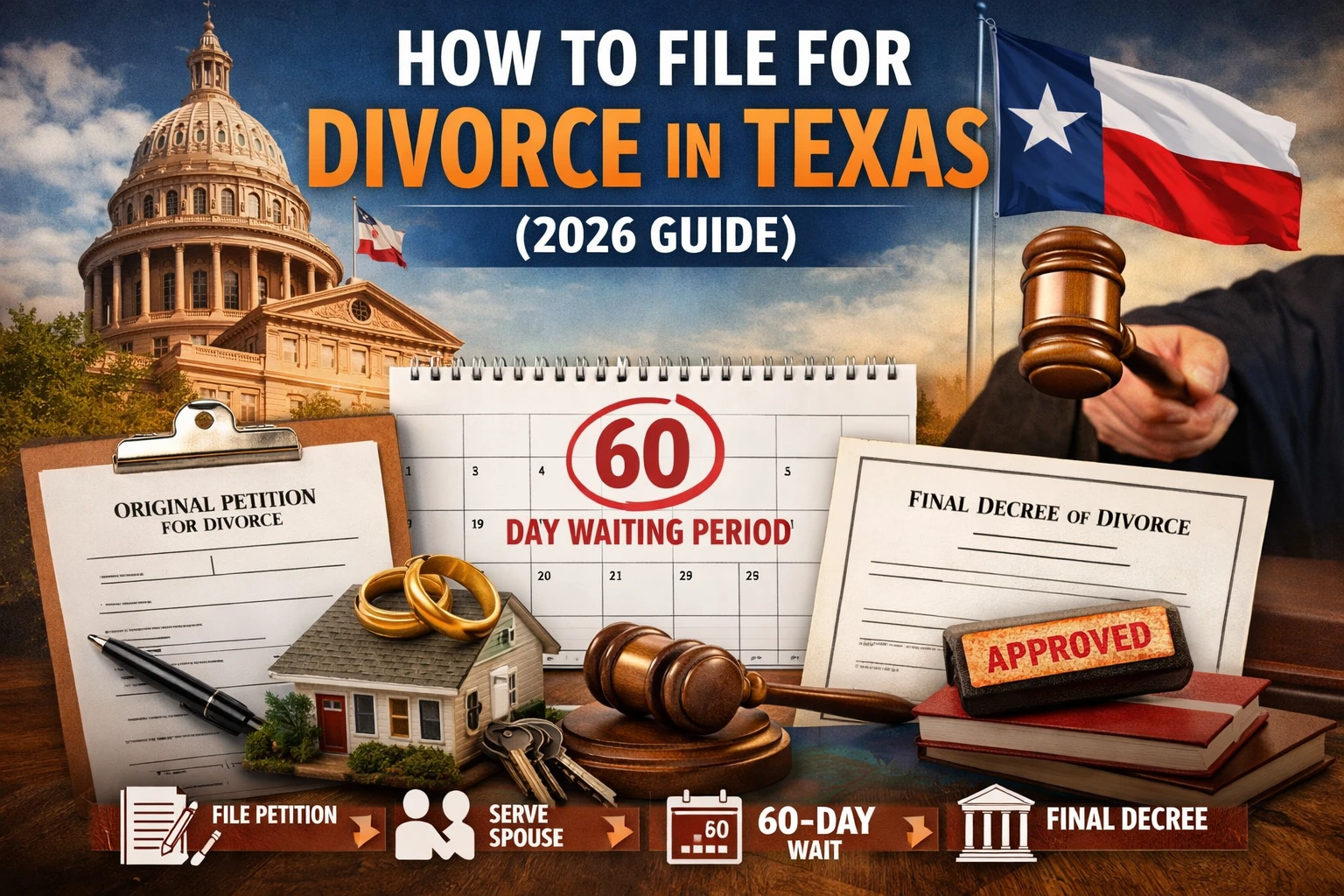
Texas law imposes a mandatory waiting period of 60 days between filing your petition and the earliest date your divorce can be finalized. This period exists to ensure both parties have time to consider their decision and explore reconciliation if desired.
The 60-day clock starts the day your petition is filed, not the day the respondent is served. The earliest your final decree can be entered is on the 61st day after filing. Exceptions to the waiting period exist in limited circumstances. If both spouses agree in writing that the waiting period should be waived and the judge approves the waiver, the divorce can be finalized sooner. However, courts rarely grant waivers unless there are compelling reasons.
During this waiting period, you and your spouse can continue negotiating settlement terms and preparing required documents. Understanding Starting the Divorce Process helps you know exactly what to expect during this period and what documents you’ll need to prepare.
Preparing Uncontested Divorce Forms in Texas
Uncontested divorce forms in Texas include several essential documents beyond the initial petition.
The final decree of divorce is the court’s formal order dissolving your marriage. It includes all terms agreed upon: property division, debt allocation, custody arrangements, child support, and spousal maintenance if applicable. The decree must be signed by the judge and entered into the court record.
Property division documentation requires detailed schedules listing all community property and how it’s divided. Texas is a community property state, meaning property acquired during marriage (except gifts and inheritances) is presumed to be community property owned equally by both spouses. Your forms must clearly identify which assets go to which spouse and the value assigned to each.
Custody and support documents must specify custody arrangements, visitation schedules, and child support amounts if minor children are involved. Texas child support guidelines provide a formula based on the obligor’s net monthly income, but parents can agree to different amounts if they document that the agreed amount is in the child’s best interest. The forms must be specific about pickup and drop-off times, holiday schedules, and decision-making authority.
Debt allocation is often overlooked but critically important. If you don’t clearly assign debts in your decree, you may both remain liable to creditors even after divorce. Your forms should list all debts and specify which spouse is responsible for each one. Ready Divorce Service provides templates and guidance for preparing these uncontested divorce forms in Texas, ensuring they contain all required information and comply with your county’s specific requirements.
How to Prove Up a Divorce in Texas and Schedule Your Final Hearing
“Proving up” a divorce is the legal process of presenting evidence to the court that the requirements for divorce have been met and that the agreed terms are fair and in compliance with law.
To prove up your divorce, you must demonstrate that proper service occurred, that the mandatory waiting period has elapsed, that the petitioner meets residency requirements, that the marriage is insupportable, and that the proposed final decree is fair and not unconscionable. In uncontested cases with a waiver of service, much of this is documented through affidavits rather than live testimony.
Scheduling your final hearing requires contacting the district court clerk after the 60-day waiting period has passed. Many counties allow you to request a prove-up hearing without a full trial. You’ll need to coordinate with the judge’s office to find an available date. Bring your original petition, proof of service or waiver of service, your final decree, and any other documents the court requires. Testimony at a prove-up hearing is typically brief in uncontested cases. The petitioner may be asked to confirm that the marriage is insupportable, that property division is fair, that child support calculations are correct, and that the other spouse has agreed to all terms. If both spouses appear and confirm their agreement, the judge can sign the final decree immediately.
Filing Your Final Decree of Divorce and Obtaining Certified Copies
Once the judge signs your final decree, your divorce is legally complete. However, additional steps ensure you have the official documentation you’ll need for name changes, updating records, and resolving any post-divorce issues.
Filing the signed decree occurs when you submit it to the district court clerk after the judge has signed it. The clerk enters it into the court record and creates the official court record of your divorce.
Obtaining certified copies of your final decree is essential. A certified copy bears the court’s seal and clerk’s signature, certifying it as an official court document. You’ll need certified copies to change your name with the Social Security Administration, update your driver’s license, modify insurance beneficiaries, and update property titles if applicable. Most people obtain multiple certified copies (typically 3-5) to avoid returning to the courthouse repeatedly. The district court clerk charges a fee for each certified copy, usually a few dollars per copy.
Name change procedures following divorce require your certified decree plus an application with your county clerk. If you’re changing your name back to a former name or to a new name, you’ll file the appropriate paperwork and may need to appear for a brief hearing, depending on your county’s requirements. Ready Divorce Service helps you understand what certified copies you need and guides you through obtaining them efficiently.
Common Errors to Avoid When Filing the Final Decree
Even small mistakes in your final decree can create serious problems.
Incomplete property descriptions rank among the most frequent errors. Always use complete legal descriptions for real estate, including the county, lot number, and any relevant survey information. Vague custody language causes ongoing conflict in families with minor children. Your decree should specify exact custody arrangements, holiday schedules, and which parent makes decisions about education, medical care, and religious upbringing.
Failing to address all debt is a critical mistake. If you don’t assign every debt in your decree, both spouses may remain liable to creditors even after divorce. Your decree must list every debt and clearly assign responsibility. Incorrect child support calculations create problems immediately. If your decree specifies child support that doesn’t match the guideline amount, you must document why the deviation is in the child’s best interest.
Missing required signatures or notarization can invalidate documents. Your decree must be signed by the judge. Any agreements must be notarized if required by your county. Failing to file proof of service prevents your case from proceeding. Even if the other spouse agrees to everything, you must file proof that they were properly served or that they signed a waiver of service.
Incorrectly calculating the 60-day waiting period leads to premature filing of your final decree. Remember that the clock starts the day your petition is filed, not when the other spouse is served. Filing your final decree before the 61st day means the court will reject it. Ready Divorce Service reviews your documents before filing to catch these errors, saving time, money, and stress by ensuring your paperwork meets all requirements the first time.
Navigating the final decree of divorce in Texas involves multiple legal requirements and strict procedural rules. Missing even one step or making a single documentation error can delay your divorce by weeks or months. Ready Divorce Service specializes in guiding you through this process with step-by-step accuracy, ensuring your final decree of divorce in Texas is prepared correctly and filed on time. Our team helps you understand each requirement, prepare compliant documents, and avoid the common mistakes that derail uncontested divorces. Get started with Ready Divorce Service and move toward your fresh start with confidence and clarity.
| Common Error | How to Prevent | Impact of Missing This |
|---|---|---|
| Incomplete property descriptions | Use full legal descriptions and addresses for all assets | Disputes over asset division after divorce is final |
| Vague custody language | Specify exact schedules, pickup times, and decision authority | Ongoing conflict and potential need for modification |
| Failing to assign all debt | List every debt and clearly assign responsibility | Both spouses remain liable to creditors |
| Incorrect child support calculation | Use Texas guideline formula or document deviation | Decree may be challenged or modified |
| Missing required signatures or notarization | Verify all documents are properly signed and notarized | Court rejects documents; case delayed |
| No proof of service filed | File proof of service or waiver of service with court | Court lacks jurisdiction to proceed |
| Filing final decree too early | Calculate 60-day waiting period from filing date | Court rejects final decree as premature |
Start gathering documents for your final decree immediately after the 60-day waiting period begins, not after it ends. Having everything prepared and ready means you can file the moment the 61st day arrives, avoiding unnecessary delays and getting your divorce finalized on schedule.
Never file your final decree before the 61st day after your petition was filed. Texas courts will reject it automatically. A premature filing wastes time and creates frustration when you have to resubmit. Mark the exact date on your calendar and verify it before submitting anything to the court.
The final decree of divorce is the court’s binding order that dissolves your marriage. It must contain all agreed terms regarding property, debt, custody, and support. Errors in this document can create problems for years after your divorce is complete, making accuracy essential.
Frequently Asked Questions
How do I know if I’m eligible to file for divorce in Texas?
You must meet residency requirements: either you or your spouse must have lived in Texas for at least six months, and in the county where you’re filing for at least 90 days. You must also have grounds for divorce. Texas is a no-fault divorce state, meaning you can file based on insupportability (irreconcilable differences) without proving wrongdoing. If you meet these requirements, you can proceed with filing the original petition for divorce in the district court clerk’s office.
What is the Texas divorce waiting period, and how does it affect my timeline?
Texas law requires a mandatory 60-day waiting period from the date you file the original petition for divorce. This waiting period cannot be waived. During this time, you and your spouse can reach an agreement on property division, child custody, child support, and spousal maintenance. Once the 60 days have passed, you can schedule your final hearing and file the final decree of divorce with the court.
What uncontested divorce forms do I need to file in Texas?
For an uncontested divorce in Texas, you typically need the original petition for divorce, a waiver of service (if your spouse agrees not to be formally served), the final decree of divorce, and any agreed orders regarding property division, custody, and support. If you have minor children, you’ll also need a divorce set A or set B, which includes the parenting plan and child support information. The district court clerk can provide the required forms, or you can access them through the court’s website.
How do I prove up a divorce in Texas, and what happens at the final hearing?
To prove up a divorce in Texas means to present evidence to the judge that the grounds for divorce exist and that any agreed terms are fair. At your final hearing, you’ll testify briefly about meeting residency requirements and that the marriage has become insupportable. If you have an uncontested agreement, the judge will review your final decree of divorce and any supporting documents. If everything is in order, the judge will sign the decree, making your divorce final. You won’t need extensive testimony if both parties agree on all terms.
This article was written using GrandRanker