Table of Contents
- Best Online Resources for Divorce Paperwork
- Understanding the Uncontested Divorce Process in Texas
- How to File for Divorce Without an Attorney in Texas
- Texas Divorce Filing Fees and Cost Comparison
- Court-Approved Forms and Document Preparation Tools
- E-Filing Procedures and What to Expect
- Handling Divorce with Minor Children
- Conclusion
- Frequently Asked Questions
Last Updated: September 2, 2026
Best Online Resources for Divorce Paperwork
Finding reliable online resources for divorce paperwork can mean the difference between a smooth filing process and costly delays. Texas residents navigating an uncontested divorce now have access to court-approved tools, step-by-step guides, and document preparation platforms that make the process manageable without requiring expensive attorney fees. Ready Divorce Service has helped hundreds of Texas residents complete their divorce filings accurately and efficiently, and in this guide, we’ll walk you through the best online resources available for divorce paperwork in Texas.
The best online resources for divorce paperwork combine [court-approved forms](/guide-to-texas-divorce-forms/) with clear filing instructions and Texas-specific guidance. Combining these resources with proper document organization dramatically increases your chances of first-time approval.
Understanding the Uncontested Divorce Process in Texas
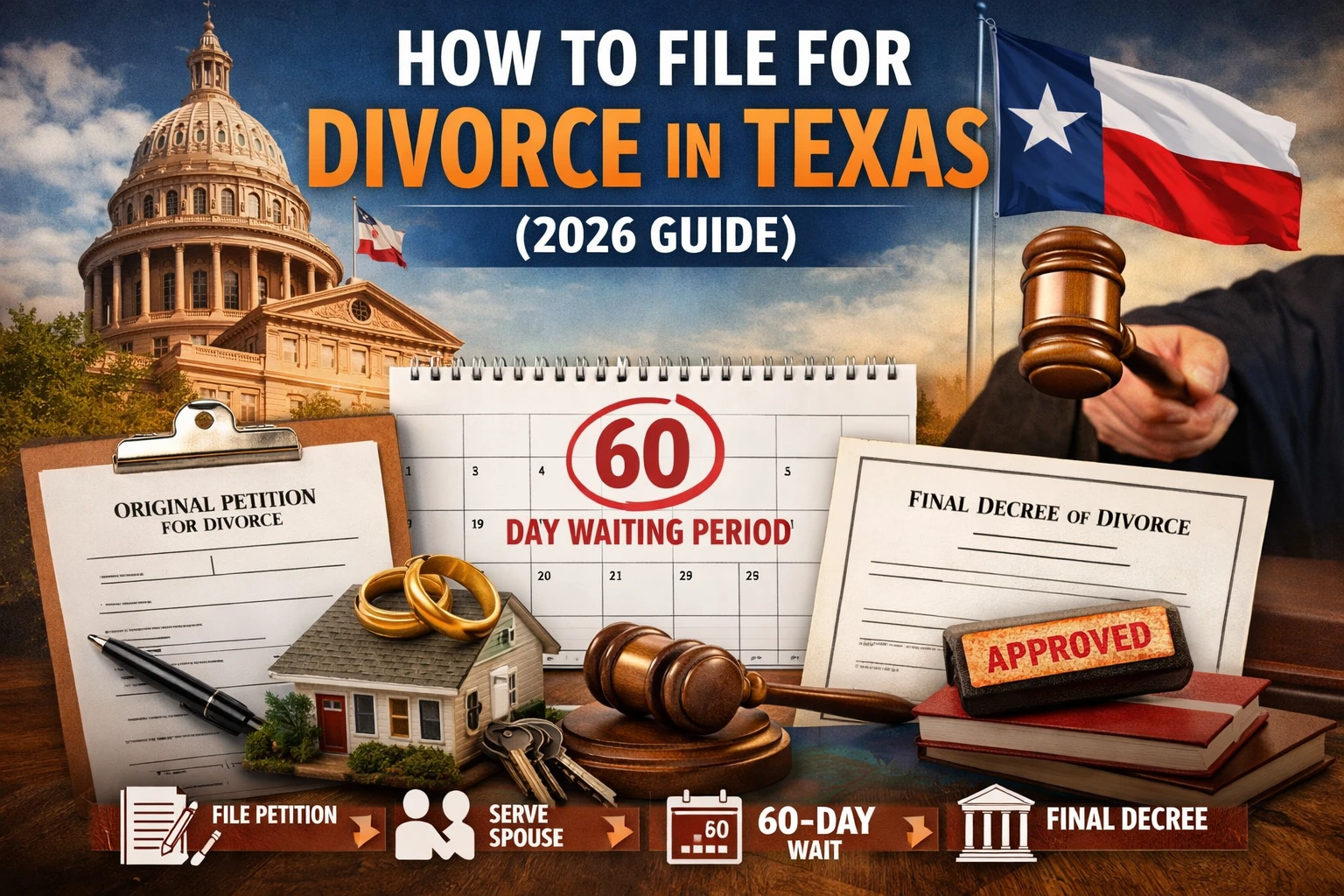
An uncontested divorce in Texas is one where both spouses agree on all major terms: property division, custody arrangements, and support obligations. The process begins with filing a petition for divorce with your county clerk. Texas requires a 60-day waiting period from filing before a final decree can be entered, though this can be waived with both parties’ consent.
Key requirements include:
- One spouse must have lived in Texas for at least 6 months before filing
- At least one spouse must reside in the county for at least 90 days
- A completed Original Petition for Divorce
- A Final Decree of Divorce (signed by both parties or the judge)
- Proper service of citation on your spouse
- Disclosure of financial information (SAPCR cases with minor children require additional documentation)
Understanding these requirements upfront helps you use online resources effectively. Many mistakes stem from incomplete knowledge of procedural steps, which is why court-approved forms paired with clear instructions are essential. If you’re unsure about the specific steps required in your situation, resources like Starting the Divorce Process can walk you through Texas-specific procedural requirements.

How to File for Divorce Without an Attorney in Texas
Filing for divorce without an attorney is entirely legal in Texas when your paperwork is accurate and complies with state requirements.
Step 1: Gather Required Information
Collect your spouse’s full legal name and current address, marriage date, children’s names and birthdates, and a summary of community property and debts.
Step 2: Access Court-Approved Forms
Texas courts provide free, fillable forms through the Texas Courts Online Self-Help Center and your county clerk’s office. Using court-approved forms rather than generic templates significantly reduces rejection risk.
Step 3: Complete Your Petition for Divorce
The Original Petition for Divorce identifies both parties, states grounds for divorce, and outlines agreements regarding property, custody, or support. If you have minor children, you’ll also complete a SAPCR (Suit Affecting the Parent-Child Relationship) case concurrently.
Step 4: Prepare Your Final Decree
The Final Decree of Divorce is the court order that officially ends your marriage. This document must match your petition and include all agreed-upon terms. Both spouses typically sign this before filing.
Step 5: Serve Your Spouse
Texas law requires proper service of your petition and citation on your spouse. You can use a process server, sheriff’s office, or request a waiver of service if your spouse agrees. Improper service can invalidate your entire filing.
Step 6: File with Your County Clerk
File your original petition with your county district clerk’s office. Most counties now accept e-filing, which speeds the process and provides immediate confirmation.
Step 7: Wait the 60-Day Period
Texas mandates a 60-day waiting period from filing date. During this time, finalize any remaining agreements and ensure all financial disclosures are exchanged.
Step 8: Obtain Your Final Decree
After 60 days, submit your signed Final Decree to the court. If everything is in order, the judge signs it and your divorce is finalized.
The most common filing mistake is incomplete financial disclosures. Texas requires both spouses to exchange a detailed list of assets and debts. Skipping this step often triggers court requests for amended documents, delaying your case by weeks.
Texas Divorce Filing Fees and Cost Comparison
Filing fees in Texas vary by county but typically range from $250 to $350 for the initial petition filing. However, the true cost of a DIY divorce extends beyond the clerk’s filing fee.
Direct Filing Costs:
- County clerk filing fee: $250-$350
- Certified copies of final decree: $5-$10 per copy (typically need 2-3)
- Service of citation (if using a process server): $50-$150
- Notarization (if required): $5-$15
- E-filing transaction fees: $10-$25
Total estimated cost for straightforward DIY filing: $300-$500
This compares dramatically to attorney-assisted divorce, which typically ranges from $1,500 to $5,000+. Even when using online document preparation services, the total cost remains a fraction of traditional legal representation.
The Hidden Cost of Errors
When a court rejects your filing due to incomplete disclosures, unsigned documents, or conflicting information, you must correct and resubmit. While most counties don’t charge a second filing fee, the resubmission restarts your 60-day waiting period, adding 2-4 weeks of delay. A single rejection can cost you in lost opportunities or attorney consultation fees.
Cost-Benefit Analysis: DIY vs. Document Preparation Assistance
Scenario 1: Pure DIY Filing
- Upfront cost: $300-$500
- Success rate for uncontested cases with no minor children: ~85-90%
- Expected total cost if one rejection occurs: $600-$1,000 + time cost
Scenario 2: Online Document Preparation Service
- Upfront cost: Pricing for document preparation services varies. Please check the provider’s website for current pricing.
- Success rate for uncontested cases: Document preparation services aim to reduce errors and improve the likelihood of successful filing.
- Expected total cost if one rejection occurs: Correcting and resubmitting documents may still incur time costs.
Scenario 3: Attorney-Assisted Filing
- Upfront cost: $1,500-$5,000+
- Success rate: ~99%
- Expected total cost: $1,500-$5,000 (flat)
The Decision Framework:
- Pure DIY: Uncontested, no minor children, minimal assets, straightforward property division
- Document Preparation Service: Uncontested with minor children, moderate assets, or low confidence in completing forms
- Attorney Assistance: Contested elements, complex property, business interests, or significant spousal support
Many DIY filers focus only on the upfront filing fee and ignore the true cost of errors. A single rejection can cost you in delay costs or lost opportunities. Budget for the full cost of your chosen approach, including the cost of potential errors.
Court-Approved Forms and Document Preparation Tools
Texas provides several official sources for court-approved divorce forms.
Texas Courts Online Self-Help Center
The official Texas Courts Self-Help Center offers free, fillable PDF forms designed specifically for Texas divorce proceedings. These forms are updated regularly and recognized by all Texas courts. Forms include the Original Petition for Divorce, Final Decree of Divorce, Disclosure of Assets and Liabilities, SAPCR forms, and Waiver of Service.
County Clerk’s Office
Your county district clerk’s office maintains local copies of required forms and can answer procedural questions specific to your county. Many county websites now host downloadable forms and filing instructions.
Document Preparation Services
Online document preparation tools guide you through form completion with interview-style questionnaires. These services ask targeted questions and automatically populate the correct forms with your answers, reducing errors and ensuring all required fields are completed. When evaluating which service is right for your situation, Which Plan is Right for You? can help you compare different levels of support based on your specific needs and complexity.

When selecting a document preparation tool, verify it uses Texas-specific forms and provides clear instructions for each section. Generic divorce form services may not account for Texas-specific requirements, increasing rejection risk.
E-Filing Procedures and What to Expect
E-filing (electronic filing) is now available in most Texas counties and significantly speeds the divorce process. However, e-filing introduces technical and procedural hurdles that trip up many DIY filers.
How E-Filing Works:
- Create an account with your county’s e-filing system
- Upload your completed, signed documents in PDF format
- Pay the filing fee online
- Receive immediate confirmation of filing with your case number
- Access your case online to monitor status and deadlines
E-Filing Requirements:
- Documents must be in PDF format, properly formatted and readable
- File sizes typically limited to 25MB per document
- Signatures can be digital or scanned images
- All required pages must be included in a single filing
- Document margins and font sizes must meet court standards (typically 1-inch margins, 12-point font minimum)
Common E-Filing Rejections and How to Fix Them:
Rejection: “Incomplete financial disclosures”
This is the most common rejection reason. Texas requires both spouses to exchange a Disclosure of Assets and Liabilities listing all community property, separate property, and debts. Fix: Review the Texas Courts Self-Help Center template. Ensure every asset and debt is listed, even if its value is approximate. Resubmit with a cover letter explaining the correction.
Rejection: “Unsigned or improperly signed documents”
Scanned signatures may render as illegible in the court’s system. Fix: Re-scan at higher resolution (300 DPI minimum), use a digital signature tool like DocuSign, or print the document, sign it in blue ink, and re-scan.
Rejection: “Incorrect case caption or party names”
The case caption must match exactly across all documents. Fix: Pull your original petition from the court system and copy the exact case caption into every other document.
Rejection: “Missing required pages or exhibits”
Court systems track page counts. Fix: Before uploading, print your complete PDF and count every page. Verify that the page count stated in your document header matches the actual number of pages.
Rejection: “File format error, document not readable”
Some PDF creation methods produce files the court’s system cannot parse. Fix: Use a standard PDF converter like Adobe Acrobat or Smallpdf.com. Print to PDF using your operating system’s native function rather than converting directly from Word.
Rejection: “Conflicting information between petition and decree”
If your petition states one property division but your decree states something different, the court rejects the filing. Fix: Ensure your Final Decree mirrors the agreed-upon terms in your petition. If you’ve negotiated changes, file an amended petition before submitting the decree.
The Rejection Resubmission Process:
When the court rejects your filing, you receive a rejection notice specifying the problem. You do not pay a second filing fee to resubmit corrected documents in most Texas counties, you simply correct the issue and re-upload. However, your new filing date becomes the date of resubmission, which restarts the 60-day waiting period.
Before you upload anything, create a checklist of every required document and verify that each one is complete, properly formatted, and consistent with the others. Spending 15 minutes on a pre-upload review can save you weeks of delays.
Handling Divorce with Minor Children
When minor children are involved, your divorce case automatically includes a SAPCR (Suit Affecting the Parent-Child Relationship) component. This requires additional documentation and specific court-approved forms.
Required SAPCR Documents:
- Parenting Plan (detailing custody, visitation, and decision-making authority)
- Child Support Worksheet (if applicable)
- Possession and Access Schedule (specific visitation arrangement)
- Affidavit Regarding Parental Responsibility and Conservatorship
Parenting Plan Requirements:
Texas courts require a detailed parenting plan addressing primary residence, custody arrangement, visitation schedule (including holidays and summers), decision-making authority, child support amount, and transportation procedures. The parenting plan must be in the child’s best interest according to Texas Family Code standards.
Child Support Calculations:
Texas uses a statutory formula based on the paying parent’s net monthly income:
- 20% for one child
- 25% for two children
- 30% for three children
- 35% for four children
- 40% for five or more children
These percentages can be modified if circumstances warrant. Online resources specifically designed for SAPCR cases help ensure your parenting plan and support calculations meet Texas requirements.
Conclusion
Navigating divorce paperwork without an attorney is achievable when you use the right combination of court-approved forms, clear filing instructions, and reliable guidance. Texas provides free access to official forms through the Texas Courts Self-Help Center and county clerk offices, while online document preparation tools simplify the process and reduce errors.
The challenge isn’t finding resources, it’s knowing which ones truly ensure compliance with Texas law and won’t result in costly rejections or delays. Ready Divorce Service specializes in helping Texas residents complete accurate divorce paperwork that meets all state requirements. Our step-by-step guidance, document preparation assistance, and support with SAPCR cases ensure your filing is done right the first time. Start your divorce journey with confidence by exploring Which Plan is Right for You? to find the guidance level that matches your situation.
Frequently Asked Questions
Can I file divorce papers myself in Texas?
Yes, you can file for an uncontested divorce without an attorney in Texas. You’ll need to complete court-approved forms, including a petition for divorce and a final decree. The process requires filing with your county clerk and following e-filing procedures. Many individuals use online resources and document preparation tools to ensure their paperwork meets state requirements. However, accuracy is critical, any errors may result in rejection by the court.
What are the mandatory requirements for filing divorce in Texas?
To file for divorce in Texas, you must meet residency requirements, file the correct court-approved forms, pay the required filing fees, and serve the other party with a citation or obtain a waiver of service. If minor children are involved, you’ll need to include a parenting plan and SAPCR (Suit Affecting the Parent-Child Relationship) documentation. You must also comply with the 60-day waiting period before the final decree can be granted.
Are online divorce documents legally binding in Texas?
Online divorce documents are legally binding in Texas only if they are court-approved forms completed accurately and filed properly with the county clerk. Documents must include all required information, be notarized where required, and follow procedural compliance rules. The final decree becomes binding once signed by the judge. Using reputable online resources that provide official court forms ensures your documents meet legal standards.
How long does the divorce process take in Texas?
The minimum timeline in Texas is 60 days from the date the respondent is served with the citation. However, the total process typically takes longer due to document preparation, court processing, and scheduling. Once you file, the county clerk processes your case, and the judge reviews your final decree. The actual time depends on court caseload, whether your documents are accepted on first submission, and how quickly you complete each step.
What happens if my divorce paperwork is rejected by the court?
If your paperwork is rejected, the court will notify you of the specific errors or missing information. Common rejection reasons include incomplete forms, incorrect case numbers, procedural non-compliance, or missing affidavits. You’ll need to correct the documents and resubmit them. This delays your case and may extend the overall timeline. Using interactive form preparation tools or document review services helps catch errors before filing, reducing the risk of rejection.
This article was written using GrandRanker