Table of Contents
- Simple Steps for Uncontested Texas Divorce: An Overview
- Texas Residency and Eligibility Requirements
- Texas Uncontested Divorce Forms You’ll Need
- Filing Your Original Petition for Divorce
- Service of Process and Waiver of Service
- How Long Does Uncontested Divorce Take in Texas
- Do I Need a Lawyer for Uncontested Divorce in Texas
- Uncontested Divorce Checklist: Asset Division and Agreements
Last Updated: July 25, 2026
Simple Steps for Uncontested Texas Divorce: An Overview
At Ready Divorce Service, we help individuals navigate the uncontested divorce process in Texas with clarity and confidence. When both spouses agree on major terms, property division, spousal support, and child custody, an uncontested divorce is significantly simpler than contested litigation. This guide walks you through simple steps for uncontested texas divorce, from filing through finalization.
An uncontested divorce means you and your spouse have already resolved your differences outside of court. You’re not fighting over assets, custody, or support, simply formalizing an agreement you’ve reached. This approach saves time, reduces legal costs, and eliminates courtroom stress. According to the Texas State Law Library self-help resources, uncontested divorces are processed far more efficiently when proper documentation is submitted upfront.
The fastest path through an uncontested divorce is having a written agreement signed before you file. Most couples who skip this step delay their divorce by 30-60 days while the court requests clarification or additional documentation.
Texas Residency and Eligibility Requirements
To file for divorce in Texas, at least one spouse must be a resident of the state for a minimum of six months immediately before filing, and a resident of the specific county for at least 90 days before filing the petition. If both spouses live in Texas, you can file in the county where either spouse resides. If one spouse lives outside Texas, you must file where the Texas resident lives.
Your eligibility also depends on grounds for divorce under Texas Family Code. Texas recognizes both fault-based and no-fault grounds. The most common is “insupportability,” a no-fault option meaning the marriage has become insupportable due to discord or conflict that prevents any reasonable expectation of reconciliation. You don’t need to prove wrongdoing, simply that the marriage cannot continue.
You must have been a Texas resident for six months and a resident of your specific county for 90 days before filing. If you don’t meet these requirements, your petition will be dismissed.
Texas Uncontested Divorce Forms You’ll Need
Filing an uncontested divorce requires specific legal forms that comply with Texas Family Code and local court rules. The primary form is the Original Petition for Divorce, which initiates your case and outlines basic information about you, your spouse, any minor children, and the grounds for divorce.
If you have minor children, you’ll also need Suit Affecting the Parent-Child Relationship (SAPCR) forms, which address custody, visitation, and child support. These include the Parenting Plan, detailing how you and your spouse will share parenting responsibilities and make decisions about the child’s upbringing.
For asset and debt division, you’ll need a Divorce Decree specifying how community property is divided. Community property in Texas includes all assets and debts acquired during the marriage, regardless of whose name is on the account.
Additional forms you may need include:
- Waiver of Service: Allows your spouse to waive formal service of process, speeding up the timeline
- Agreed Divorce Decree: The final court order resolving all issues
- Affidavit Regarding Suit Affecting Parent-Child Relationship: Required if you have minor children
- Inventory and Appraisement: Lists all community property and debts (required in some counties)
- Affidavit of Inability to Pay Court Costs: If you qualify for indigency status
The Texas Courts Online self-help center provides templates for many forms, though specific forms required vary by county. Contact your county clerk’s office to confirm which forms are required in your jurisdiction.
Using the wrong form version or failing to include required information causes courts to reject your filing and delay your divorce by weeks. Always verify with your county clerk that you’re using the current, correct form before submitting.
Filing Your Original Petition for Divorce
The Original Petition for Divorce officially starts your case. This form must include your name, your spouse’s name, your residence address, the county where you’re filing, the grounds for divorce, and information about any minor children or property you own.

When completing the petition, be accurate and thorough. Include your full legal name, your spouse’s full legal name, and both current addresses. If you have minor children, list their names, dates of birth, and whether you’re seeking custody. Describe the community property, real estate, vehicles, bank accounts, retirement accounts, and any significant debts.
State which grounds for divorce you’re using. “Insupportability” is the standard no-fault ground. You don’t need extensive detail about why the marriage failed, just state that it has become insupportable due to discord or conflict that prevents reasonable expectation of reconciliation.
File the petition with the district court clerk in your county. The filing fee typically ranges from $200 to $400, depending on local court costs. Many courts accept e-filing, allowing you to submit documents electronically. After filing, the court clerk will assign a case number and set a case management conference date.
Service of Process and Waiver of Service
Service of process is the legal requirement to notify your spouse that you’ve filed for divorce. Texas law requires that your spouse be formally served with a copy of your petition before the court can proceed. However, in an uncontested divorce, you can simplify this by obtaining a Waiver of Service.
A Waiver of Service is a document your spouse signs agreeing that they’ve received notice of the divorce and don’t require formal service by a process server or sheriff’s deputy. This saves time and money, formal service costs $50 to $150, while a waiver costs nothing. Service must occur at least 20 days before your trial or hearing date. Obtaining a waiver early prevents delays and keeps your divorce on schedule.
If your spouse lives out of state or is difficult to locate, consider hiring a private process server rather than relying on the sheriff’s office. Private servers are often faster and more thorough.
How Long Does Uncontested Divorce Take in Texas
The timeline for an uncontested divorce in Texas is primarily governed by the mandatory waiting period, not by court backlogs or complexity.
Understanding the 60-Day Waiting Period
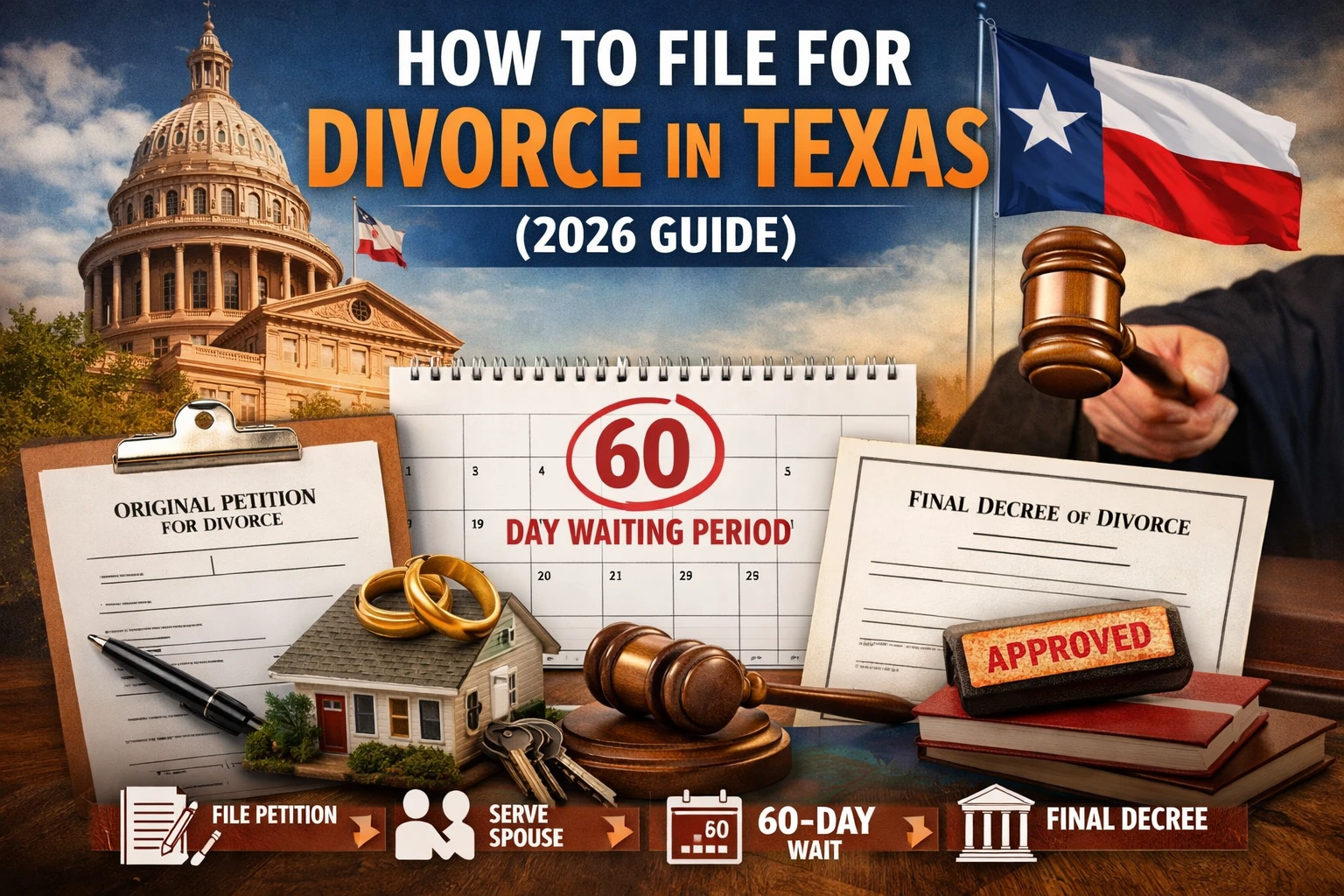
Texas law imposes a mandatory 60-day waiting period from the date you file your petition until the judge can grant your divorce. This waiting period cannot be waived, even if both spouses agree and have no disputes. The 60 days begins on the date your petition is filed with the court clerk, not the date your spouse is served. If you file on January 1, the earliest your divorce can be finalized is April 1.
After the 60-day period expires, you must schedule a hearing with the judge. In an uncontested divorce where both parties agree, the hearing is typically brief, often just 15-20 minutes. Most uncontested divorces in Texas are finalized within 120-150 days from filing, assuming no complications arise and both spouses cooperate.
Do I Need a Lawyer for Uncontested Divorce in Texas
Texas law allows you to represent yourself, known as “pro se” representation, in divorce cases. Many individuals successfully file uncontested divorces without an attorney, especially when there are no minor children and minimal property to divide.
However, divorce law is complex, and mistakes in paperwork can delay your case or result in an unfavorable outcome that’s difficult to reverse. Ready Divorce Service specializes in helping individuals navigate this complexity by providing accurate document preparation and step-by-step guidance. Our team ensures your documents comply with Texas law and local court requirements, reducing the risk of rejection or delay.
If your situation involves minor children, significant property, or any disputed issues, consulting with an attorney is strongly recommended. A brief consultation with a family law attorney (typically $150-$300) can clarify your rights and obligations. Legal aid may be available if you cannot afford an attorney. Contact the State Bar of Texas Lawyer Referral Service to find low-cost or pro bono legal assistance.
Uncontested Divorce Checklist: Asset Division and Agreements
Before you file, you and your spouse should complete a comprehensive agreement covering all assets, debts, and obligations. This agreement becomes the foundation of your divorce decree and prevents disputes that could delay finalization.
Community Property Division
Texas is a community property state, meaning all property acquired during the marriage, regardless of whose name is on the title, is presumed to be community property owned equally by both spouses. This includes income, real estate, vehicles, retirement accounts, and business interests. Debts incurred during the marriage are also community property.
Your divorce decree must specify how community property is divided. In most uncontested divorces, spouses divide property 50-50, though Texas law allows for an “unequal but just” division if both parties agree.
Create a detailed inventory of all community property:
- Real estate (primary residence, rental properties, land)
- Vehicles and recreational equipment
- Bank accounts and savings
- Investment accounts and stocks
- Retirement accounts (401k, IRA, pension)
- Business interests
- Personal property of significant value
- Debts (mortgage, car loans, credit cards, student loans)
For each asset, determine its current fair market value. For real estate, use a recent appraisal or comparable sales. For vehicles, use Kelley Blue Book or NADA Guides. For retirement accounts, request a statement showing the current balance.
Once you’ve inventoried everything, divide the property in a way both spouses find fair. The key is that the total value each spouse receives is approximately equal, unless you both agree otherwise.
| Asset Type | Spouse A | Spouse B | Value |
|---|---|---|---|
| Primary residence | Receives | Assumes mortgage | $250,000 |
| 401(k) account | Receives | $120,000 | |
| Vehicle 1 | Receives | Assumes loan | $18,000 |
| Vehicle 2 | Receives | $12,000 | |
| Savings account | Receives | $25,000 | |
| Credit card debt | Assumes | $8,000 |
Minor Children and Spousal Support
If you have minor children, your divorce decree must address custody, visitation, and child support. Texas law presumes that joint managing conservatorship (shared custody) is in the child’s best interest unless evidence shows otherwise.
Your parenting plan should specify which parent has primary custody, the visitation schedule for the non-custodial parent, how major decisions are made, and holiday and summer break schedules.
Child support is calculated using the Texas child support guidelines, which consider both parents’ income, the number of children, and the percentage of time each parent spends with the child. The guideline amount is typically 20% of the obligor’s net income for one child, increasing slightly for each additional child. However, parents can agree to a different amount if both believe it serves the child’s best interest.
Spousal support (alimony) is less common in Texas and is only awarded in specific circumstances. If you qualify and both spouses agree, you can include spousal support in your divorce decree. The amount and duration are negotiable but typically range from $1,000 to $5,000 monthly, lasting 3-10 years depending on the marriage length.
Child support calculations are based on specific income thresholds and formulas in Texas Family Code. Even if you and your spouse agree on an amount, it must fall within reasonable guidelines or the court may reject it. Use the Texas child support calculator to ensure your agreed amount is defensible.
Post-Divorce Checklist: What Comes After Finalization
Once your divorce decree is signed by the judge, your divorce is officially finalized. However, several administrative tasks remain to ensure the decree is properly executed.
Within 30 days of the final decree, update your name if you’re resuming a maiden name or former name. Notify financial institutions of the divorce and update beneficiary designations on life insurance, retirement accounts, and any accounts where a beneficiary is named.
If you received the family home, refinance the mortgage in your name alone to remove your ex-spouse’s liability. Update your will, power of attorney, and healthcare directives, as your divorce decree does not automatically remove your ex-spouse from these documents.
File a Qualified Domestic Relations Order (QDRO) if retirement accounts were divided. A QDRO is a court order that allows you to transfer a portion of your ex-spouse’s 401(k) or pension to your own account without tax penalties. Update your health insurance through your employer, the marketplace, or a private plan.
Frequently Asked Questions
What are the residency requirements for an uncontested divorce in Texas?
Texas requires at least one spouse to be a resident of the state for a minimum of six months before filing for divorce, and a resident of the county where you file for at least 90 days. The Texas Family Code Section 6.301 establishes these residency requirements. Meeting these thresholds qualifies you to file in a Texas district court and proceed with your uncontested divorce.
How long does an uncontested Texas divorce actually take from start to finish?
Texas law mandates a 60-day waiting period from the date you file your Original Petition for Divorce before the Final Decree can be signed. However, the total timeline also depends on how quickly you and your spouse agree on terms, complete required forms, serve your spouse, and submit documents to the county clerk. Many uncontested divorces are finalized within 90 to 120 days if all paperwork is prepared accurately.
Do I need a lawyer for an uncontested Texas divorce?
No. Texas law allows you to file pro se (on your own) without an attorney. Many people successfully complete uncontested divorces without legal representation, especially when both spouses agree on all terms. However, you must comply with all Texas Family Code requirements and accurately complete all required legal forms. If your situation involves minor children, significant assets, or debt, consulting a legal professional or using document preparation services can help ensure accuracy and protect your interests.
What forms do I need to file for an uncontested Texas divorce?
The core documents include the Original Petition for Divorce, a Waiver of Service or proof of service, and the Final Decree of Divorce. Depending on your circumstances, whether you have minor children, community property to divide, or spousal support agreements, you may also need a Marital Settlement Agreement, Agreed Judgment, and child custody or support orders. The Texas court clerk and self-help resources can provide the specific legal forms required for your county.
Can I get an uncontested divorce in Texas if we have minor children?
Yes. Uncontested divorces with minor children are possible when both parents agree on custody, visitation, child support, and related arrangements. You’ll need to include a detailed child custody order and child support agreement in your Final Decree of Divorce. The court must approve arrangements that serve the best interests of the children. Many families successfully complete uncontested divorces with minor children by using mediation and clear written agreements on parenting plans.
What is the 60-day waiting period in Texas divorce law?
Texas imposes a mandatory 60-day waiting period from the date you file your Original Petition for Divorce before the Final Decree can be signed and finalized. This cooling-off period applies to all divorces, including uncontested ones. During this time, you and your spouse must reach agreement on all terms, complete required paperwork, and handle service of process. The waiting period cannot be waived except in rare cases involving family violence.
📞 Get Started Today – Your Peaceful Divorce Is Just a Click Away
When you’re ready to move on, we’re ready to help.
📲 Call us now at (800) 432-0018
🖥️ Start your divorce online today