Quick Summary
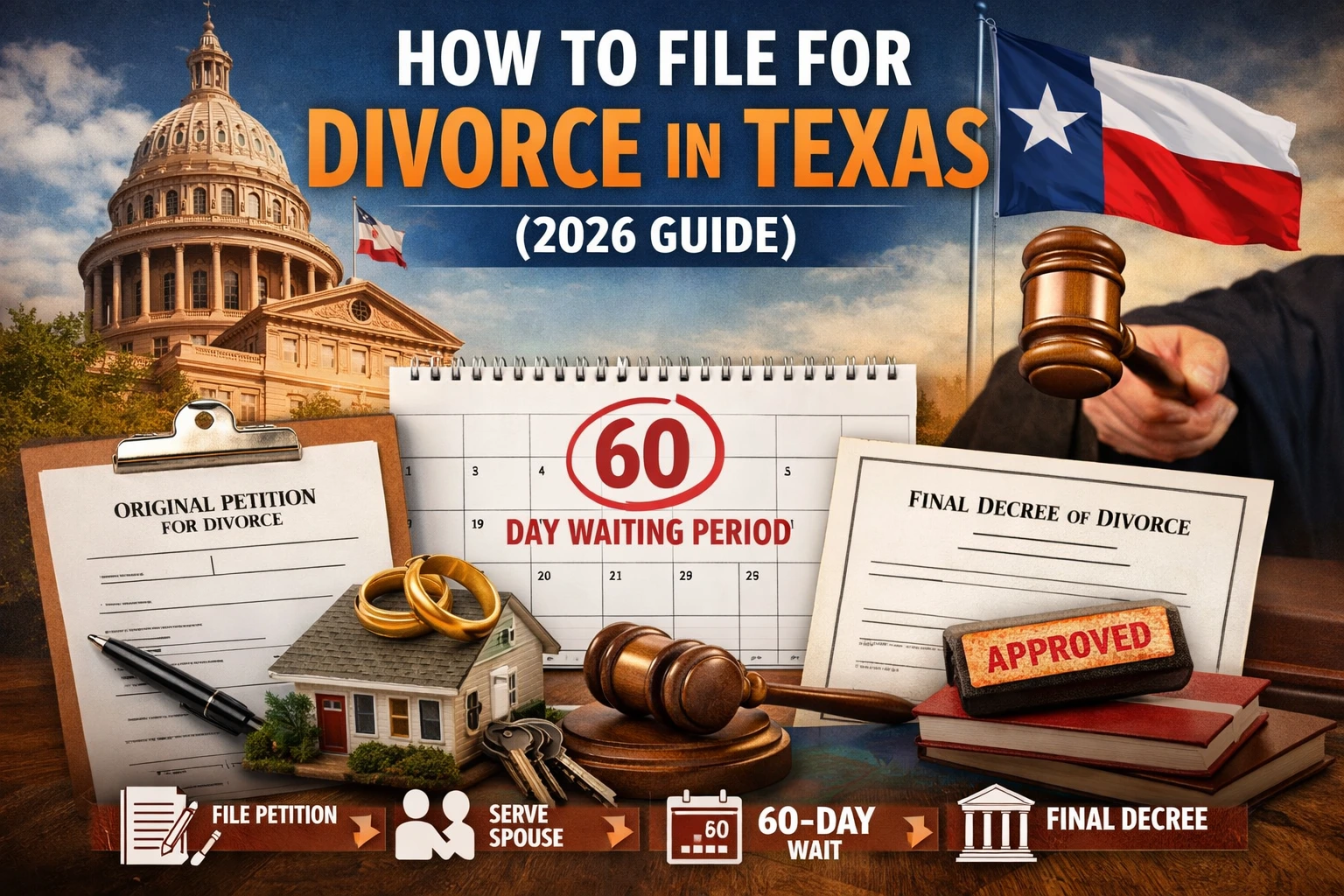
Divorce in Texas, called dissolution of marriage, ends the marriage and resolves property, debts, custody, child support, and spousal support. The process moves through filing a petition, serving your spouse, a mandatory 60-day waiting period, and a signed final decree. An uncontested divorce still requires a judge to sign the final decree.
- Confirm you meet Texas residency requirements before filing your divorce petition.
- Texas has a mandatory waiting period of 60 days from the date the petition is filed.
- Your spouse can sign a waiver of service instead of being formally served.
- Build a complete inventory of assets, debts, and retirement accounts before agreeing to terms.
- Retirement accounts like 401(k)s typically need a separate Qualified Domestic Relations Order to divide them.
Table of Contents
- How Divorce Works in Texas: The Basics
- Uncontested, Contested, and Default Divorces: Which Applies to You
- Step-by-Step: The Texas Divorce Process from Filing to Final Decree
- Dividing Property, Debts, and Finances Fairly
- Child Custody, Support, and Parenting Plans in Texas
- Protecting Yourself and Your Records During a Divorce
- Taxes, Insurance, and Retirement After the Divorce Is Final
- Preparing Your Divorce Paperwork With Ready Divorce Service
- Frequently Asked Questions
How Divorce Works in Texas: The Basics
If you are considering divorce in Texas, the most useful first step is understanding how the process is structured. Texas divorce is governed by the Texas Family Code, and it moves through a defined sequence of filing, notice to your spouse, a waiting period, and a final decree.
Divorce in Texas is called dissolution of marriage. It ends the marriage and resolves property division, debts, child custody, child support, and any spousal support.
Residency Requirements You Must Meet
Before you can file in a Texas family court, you must meet residency rules. Texas has residency requirements that must be met before a divorce can be filed. These requirements apply statewide, but counties may handle filings differently, so confirm local practice with the clerk of the court where you plan to file.
Fault and No-Fault Grounds Explained
Texas recognizes both no-fault and fault-based grounds for divorce. The most common ground is “insupportability,” a no-fault reason that requires no proof of wrongdoing. Fault grounds, such as adultery or cruelty, are available but are less frequently used because they require proof and can complicate the case. Most uncontested divorces rely on the no-fault ground, which keeps the filing simpler and less adversarial.
Uncontested, Contested, and Default Divorces: Which Applies to You
Texas divorces generally fall into three categories. An uncontested divorce is one where both spouses agree on all issues, including property, debts, custody, and support, and the paperwork reflects that agreement. A contested divorce is one where the spouses disagree on one or more issues, which may require negotiation, mediation, or a trial. A default divorce occurs when one spouse is served with divorce papers and does not respond within the required time.
An uncontested divorce is not the same as a divorce that requires no court involvement. Even when you agree on everything, a judge must still review and sign the final decree. If your situation involves significant disagreement, complex assets, or safety concerns, you may need a licensed Texas attorney. If you are unsure which path fits your situation, you can review Which Plan is Right for You? to see how the options compare.
Step-by-Step: The Texas Divorce Process from Filing to Final Decree
The Texas divorce process follows a predictable sequence, although timing and details can vary by county. Understanding each stage, and what can go wrong at each one, helps you avoid delays and document errors.

- Confirm that you meet the residency requirements.
- Prepare and file the Petition for Divorce with the district clerk.
- Serve your spouse, or have your spouse sign a waiver of service.
- Observe the 60-day waiting period.
- Finalize agreements and submit the proposed final decree.
- Attend any required hearing, and obtain the signed final decree.
Filing the Petition and Required Forms
The process begins when one spouse, the petitioner, files an Original Petition for Divorce in the appropriate district court. The petition is not a long document, but it must be accurate.
A common pattern is for the petition to be filed alongside a temporary restraining order or a standing order.
Depending on your situation, additional forms may include the required initial disclosures, a sworn inventory and appraisement, child-related forms such as the parenting plan and the child support worksheet, and proposed orders.
Service, Waivers, and the 60-Day Waiting Period
After filing, your spouse must be formally notified. There are three common routes:
- Service of citation. A constable, sheriff, or private process server delivers the citation and petition. This is the default method and creates a dated record of notice.
- Waiver of service. Your spouse signs a waiver of service, which acknowledges receipt and waives formal service. In an agreed or uncontested case, this is usually the simplest and least expensive route.
- Alternative service. If your spouse cannot be located, the court may allow service by posting or publication after you file a motion and affidavit describing your efforts.
Texas has a mandatory waiting period from the date the petition is filed before a divorce can be finalized. The waiting period is a floor, not a deadline.
The waiting period has limited exceptions, which a licensed Texas attorney can explain. If you believe an exception applies, that is a question for a licensed Texas attorney, not a document preparer.
Finalizing Agreements and the Prove-Up
Once the waiting period has run and the spouses have reached agreement, the terms are written into an agreed final decree of divorce.
In an uncontested case, the court may finalize the divorce on the pleadings, or it may require a brief prove-up hearing where the petitioner testifies to the residency facts, the grounds, and the agreement. For a clear overview of what to expect at this stage, see Starting the Divorce Process.
If the spouses disagree on any issue, the case moves from an agreed track into negotiation, mediation, or a trial setting. That is a materially different process, and it is the point at which a licensed Texas attorney is usually necessary.
The Texas divorce process follows a sequence of stages, and each one has its own timing and common pitfalls.
| Step | What to do | Time or frequency |
|---|---|---|
| Confirm residency | Meet Texas residency requirements before filing | Before filing |
| File petition | File Original Petition for Divorce with the district clerk | Start of process |
| Serve spouse | Serve citation or obtain a waiver of service | After filing |
| Waiting period | Observe the mandatory waiting period | 60 days from filing |
| Finalize agreements | Write agreed terms into a proposed final decree | After waiting period |
| Final hearing | Attend any required hearing and obtain signed decree | Varies by county |
Dividing Property, Debts, and Finances Fairly
Texas is a community property state. Generally, property acquired during the marriage is presumed to be community property, subject to division by the court.
A fair division does not always mean an equal split. Courts consider the circumstances of each case when dividing the community estate, so an agreement between spouses is often the most predictable outcome. What follows is the practical, asset-by-asset work that most guides skip.
Building a Complete Inventory Before You Agree to Anything
Before you sign anything, make a complete list of assets, debts, retirement accounts, and bank accounts. Many people overlook digital accounts, vehicles, business interests, and tax refunds, which can create problems later if left out of the final decree. A useful inventory covers:
- Real property. The deed, the mortgage balance, the current payoff figure, and the homestead status. Texas homestead protections affect how a house can be divided or sold.
- Bank and brokerage accounts. Account numbers, balances as of a stated date, and whose name is on the account.
- Retirement accounts. 401(k)s, IRAs, pensions, and deferred compensation. These are often the largest single asset in a divorce and the most frequently mishandled.
- Vehicles and titled property. VINs, loan balances, and lienholder information.
- Business interests. Ownership percentage, valuation method, and whether the business is separate or community property.
- Debts. Credit cards, student loans, medical debt, and any debt in one spouse’s name only.
- Personal property. Furniture, jewelry, tools, and items with sentimental or resale value.
Watch out: A decree that awards an asset but does not identify it precisely, by account number or legal description, can leave you unable to enforce the award later.
Retirement Accounts and the QDRO
Retirement accounts such as 401(k)s and pensions typically require a Qualified Domestic Relations Order (QDRO) to divide them without triggering tax penalties. The decree alone does not transfer the money.
A common pattern is for the decree to be signed and the divorce finalized while the QDRO is still being prepared. That is normal, but the QDRO must be completed and submitted to the plan administrator, or the former spouse may have no way to access the awarded funds.
Post-Decree Financial Cleanup
The final decree does not automatically update the rest of your financial life. After the divorce is final, plan to work through the following:
- Titles and deeds. Transfer vehicle titles and record a new deed for any real property awarded to one spouse. A decree is not a deed; the county records office needs the actual transfer document.
- Beneficiaries. Update beneficiary designations on life insurance, retirement accounts, and payable-on-death accounts. A decree that requires a spouse to change a beneficiary does not change it, the plan’s own form does.
- Insurance. Health insurance coverage often ends for a former spouse, and you may need to explore continuation options or new coverage. Update auto, homeowners, and life insurance policies to reflect the new household.
- Estate documents. Update your will, powers of attorney, and any trust documents. A will that leaves everything to a former spouse is a problem you can fix in an afternoon.
- Taxes. Filing status for federal income taxes changes once the divorce is final, and the treatment of alimony and child-related tax benefits depends on the terms of your decree and current federal rules. Consult a qualified tax professional about how your settlement affects your return.
- Credit and debt. Confirm that debts assigned to your former spouse are actually being paid, and consider whether any joint accounts should be closed or refinanced.
Address these items in your decree so that you are not left with unexpected gaps after the case closes. A decree that is silent on a joint account or a beneficiary designation leaves the problem for later, and later is usually more expensive than now.
Child Custody, Support, and Parenting Plans in Texas
When children are involved, Texas courts focus on the best interest of the child. Custody in Texas is described in terms of conservatorship, which covers both decision-making authority and the parenting time arrangement. Parents may agree to a parenting plan, and the court will review it to confirm it serves the child’s interests.
Child support is calculated according to state guidelines, which consider the income of the parents and the number of children. Parents can agree on support within those guidelines, and the court will review the agreement.
Protecting Yourself and Your Records During a Divorce
Divorce is a stressful process, and protecting yourself financially and personally is part of preparing well. Start by gathering copies of tax returns, bank and retirement statements, property deeds, insurance policies, and loan documents. Keep them in a secure location and make digital backups.
If you feel unsafe at home or have experienced family violence, your safety comes first. Texas law provides protective order options, and local domestic violence organizations and law enforcement may be able to help you plan for your safety.
Taxes, Insurance, and Retirement After the Divorce Is Final
A divorce decree affects more than your household. Filing status for federal income taxes changes once the divorce is final, and the treatment of alimony and child-related tax benefits depends on the terms of your decree and current federal rules.
Health insurance coverage often ends for a former spouse, and you may need to explore continuation options or new coverage. Retirement accounts such as 401(k)s and pensions typically require a Qualified Domestic Relations Order to divide them without penalty.
Preparing Your Divorce Paperwork With Ready Divorce Service
Accurate paperwork is one of the best ways to avoid delays in a Texas divorce. Ready Divorce Service helps clients prepare documents, organize the required filings, and assist with the process from petition through final decree.
If you have reached an agreement with your spouse and want a clear, organized path to finalizing your divorce, we invite you to explore our service options and see which level of support fits your situation.
Frequently Asked Questions
Can I file for divorce in Texas without a lawyer?
Yes. Texas residents can file for divorce without an attorney, representing themselves in what is called pro se. The paperwork must still meet Texas Family Code requirements and local court procedures, which can vary by county. Many people choose document preparation and procedural assistance rather than full representation to keep costs lower while avoiding common filing errors. Ready Divorce Service provides document preparation and procedural assistance; it is not a law firm and does not give individualized legal advice. If your case involves complex property, custody disputes, or contested issues, consulting a licensed Texas attorney is a good idea.
How long does a divorce take in Texas?
Texas law requires a waiting period from the date the petition is filed before a divorce can be finalized, with some exceptions. The waiting period is a minimum, not a guarantee of finalization on any particular day. Uncontested divorces where both spouses agree often move faster than contested cases, which can take many months or longer. Timing also depends on court schedules and the county where you file, so check with your local district clerk for specifics.
What happens if my spouse does not respond to divorce papers?
If your spouse is properly served and does not file an answer, the case may proceed as a default divorce, provided the legal requirements are met. Service must be completed correctly, typically by a constable, sheriff, or process server, or through a waiver of service if your spouse signs one. Improper service can delay or derail your case, so it is important to follow the correct procedure. Each county may have slightly different requirements for default judgments.
What documents do I need to prepare for a Texas divorce?
Most Texas divorce cases start with an Original Petition for Divorce, along with a civil case information sheet and any required family-law forms for your county. If you have children, you will likely need information about custody, support, and a parenting plan. Many filings also require a financial information statement covering assets, debts, income, and expenses. Gathering tax returns, bank statements, retirement account records, and property information early helps keep the process organized. Requirements vary by county, so confirm the current forms with your local district clerk.
What is the difference between an uncontested and a contested divorce in Texas?
An uncontested divorce is one where both spouses agree on property division, child custody, support, and other terms. These cases generally involve less time, cost, and conflict. A contested divorce arises when spouses disagree on one or more issues, which can lead to mediation, negotiation, or a trial before a judge. Even an agreed divorce still requires court involvement and a final decree signed by the judge. Your situation determines which path fits best.
What residency requirements must I meet to file for divorce in Texas?
To file for divorce in Texas, at least one spouse must meet statewide and county residency requirements before filing. Confirm the current requirements with the Texas Family Code and your local court. If you have recently moved, verify your eligibility before filing, because filing in the wrong county can cause delays. A licensed Texas attorney can advise you if your residency history is unclear.
How is property divided in a Texas divorce?
Texas is a community property state, which means property acquired during marriage is generally presumed to belong to both spouses and is divided in a manner the court deems just and right. Property owned before marriage, or received as a gift or inheritance, is generally considered separate property. Spouses who agree on a division can include their terms in a written settlement agreement, which the court reviews. Accurate records of assets and debts help prevent disputes and delays during the process.
Can Ready Divorce Service help if my divorce involves children or shared debt?
Ready Divorce Service offers flexible, limited-scope and comprehensive assistance, so clients can choose support for a specific stage of the process or more complete help from petition through finalization. Cases involving children or shared debts often require additional documents and careful attention to custody, support, and property terms. Because these issues can be complex, a consultation can help determine which package fits your situation. Ready Divorce Service is not a law firm and does not provide legal representation. You can review options through the service options page at https://www.readydivorceservice.com/which-uncontested-divorce-package-is-right-for-you/.