Table of Contents
- Is an Uncontested Divorce With Children Right for Your Family?
- Understanding Eligibility and Jurisdiction Requirements
- Creating a Texas Parenting Plan That Serves Your Children
- Child Support in an Uncontested Divorce: Calculation and Documentation
- Divorce Paperwork With Minor Children: Required Forms and Documents
- Co-Parenting After Divorce: Building a Sustainable Framework
- Frequently Asked Questions
Last Updated: October 13, 2026
Is an Uncontested Divorce With Children Right for Your Family?
An uncontested divorce with children is a legal process where both spouses agree on all major terms, including custody, parenting time, child support, and property division, without going to court.
At Ready Divorce Service, we help Texas families navigate this process. The key question isn’t whether an uncontested divorce is possible, it’s whether it’s right for you.
When an uncontested divorce works
An uncontested divorce works when both parents commit to a civil, child-focused process with honest communication and compromise.
This approach typically works well when:
- Both parents want to minimize disruption to the children’s lives
- You can discuss custody and support without heated arguments
- You’re willing to work with a neutral third party or mediator if needed
The benefits: lower costs, faster completion, less emotional strain, and greater privacy.
When you should not pursue an uncontested divorce
Some situations make an uncontested divorce inappropriate or unsafe, domestic violence, substance abuse, or hidden assets won’t protect your children or your rights.
You should not pursue an uncontested divorce if:
- There’s a history of abuse or coercion in your relationship
- One parent is being pressured into agreement
- One spouse is hiding income, assets, or debts
Understanding Eligibility and Jurisdiction Requirements
To file an uncontested divorce with children in Texas, you must meet specific jurisdiction and residency requirements.
Texas requires at least one spouse to have lived in the state six months before filing, and 90 days in the county where you file, so the court can enforce orders affecting your children. If you’re unsure whether you meet these requirements or need clarity on the filing process, Starting the Divorce Process can walk you through the specific steps.
Both spouses must also sign a Marital Settlement Agreement covering child custody, parenting time, child support, health insurance, and property division.
With minor children, Texas courts require all custody and support arrangements to be documented and approved, and the judge must find the agreement serves the children’s best interests.
Creating a Texas Parenting Plan That Serves Your Children
A Texas parenting plan outlines how you and your co-parent share responsibility for your children, custody, visitation, decision-making, and handling changes and emergencies.

Custody terms you need to understand
Texas law separates custody into two concepts, and your plan should address both:
- Conservatorship is the legal term for custody. Joint managing conservatorship is the default, with both parents sharing rights and duties; sole managing conservatorship gives one parent exclusive authority and is reserved for safety concerns or an absent or unfit parent.
- Possession and access is the Texas term for parenting time. The court’s Standard Possession Order is the statutory default schedule; parents may agree to a modified schedule if the judge finds it in the children’s best interest.
- Domicile restrictions limit where a child may live. Many agreed plans include a geographic restriction (a named county and contiguous counties) so a parent cannot move the child far away without modifying the order.
A practical parenting-plan checklist
Use this checklist as a working document. Fill in specific times, not general descriptions like “weekends.”
Regular schedule
- Which parent has the child on which weekdays, with drop-off and pick-up times
- Whether the schedule alternates weekly, follows a 2-2-3 or 5-2-2 pattern, or another rotation
- Where exchanges happen and who transports
Holidays and school breaks
- How each major holiday is divided, and whether it alternates by odd/even year
- Spring break, winter break, Thanksgiving, and summer vacation blocks
- Each parent’s birthday, the child’s birthday, and Mother’s Day/Father’s Day
Transportation and logistics
- Who drives to and from exchanges, and what happens if a parent is late
- How transportation costs, including long-distance travel, are shared
- What notice is required before traveling out of the area with the child
Communication
- The primary channel for scheduling (often a co-parenting app or shared calendar)
- How quickly each parent responds to routine messages
- How the child communicates with the other parent by phone or video, and when
Decision-making
- Which decisions require both parents’ consent (school choice, non-emergency medical care, mental health treatment, extracurriculars, religious upbringing)
- Who holds tie-breaking authority if the parents cannot agree
- How each parent is notified of school, medical, and activity information
Changes and emergencies
- The notice required before either parent relocates
- How the plan is amended (in writing, signed by both parents, filed with the court)
- What happens if a parent is hospitalized, deployed, or unavailable
Talking with your children at each age
How you tell your children matters. They need honesty, reassurance, and clarity, not details about adult conflicts or finances.
Ages 9-12. Children this age can handle more direct information: “We’ve decided we’re not happy as a couple, so we’re getting divorced.
Teenagers. Acknowledge their feelings and involve them appropriately in decisions that affect them, such as activity schedules or weekend stays.
Write the plan as if a stranger will have to read it and know exactly what to do next Tuesday at 6 p.m. Specificity is what keeps a plan out of court.
When agreement is not appropriate
Some situations make a negotiated parenting plan unsafe or unfair. With domestic violence, coercive control, stalking, or substance abuse, an uncontested process can give one parent leverage over the other; a court-supervised process, protective order, or separate attorneys is safer. A plan built on unequal bargaining power is not a real agreement and can be set aside if it is not in the children’s best interest.
Child Support in an Uncontested Divorce: Calculation and Documentation
Child support in an uncontested divorce is calculated using Texas’s child support guidelines, based on the paying parent’s net monthly resources. Understanding how the guideline works, and how to document it, helps you reach an agreement a judge will approve and that holds up if circumstances change.
How the guideline actually works
Texas applies a percentage of the paying parent’s net monthly resources: 20% for one child, 25% for two, 30% for three, 35% for four, 40% for five, and not less than 50% for six or more.
“Net resources” is not take-home pay.
A child support worksheet, the standard Texas courts form, walks through each step. Both parents sign it, and it is filed with the divorce paperwork.
What counts as income
The guideline is broad. Income can include:
- Wages, salary, commissions, and overtime
- Self-employment and business income
- Bonuses, tips, and severance
If a parent is voluntarily unemployed or underemployed, a court can assign earning capacity based on work history, education, and local job opportunities rather than accept zero income.
Records to gather before you negotiate
Both parents should prepare a financial packet. Missing records are the most common reason an agreed support figure gets rejected or modified later.
- Federal and state tax returns for the last two years, with all schedules
- Recent pay stubs covering at least the last few months
- Profit-and-loss statements and business bank statements for self-employed parents
When a court will deviate from the guideline
A judge may deviate from the guideline if the evidence shows it is unjust or inappropriate. Common reasons:
- The child has special needs requiring ongoing medical, therapeutic, or educational services
- The paying parent has other children to support under a different order
- The parents split physical custody roughly equally, making the guideline unfair
Any deviation must be explained in writing in the order. If you agree to a number outside the guideline, say why, a bare number invites a challenge later.
What the support order should cover
Beyond the monthly payment, your agreement should address:
- The monthly amount, due date, and payment method (wage withholding is common and often required)
- Who provides health insurance and how the premium is shared
- How uncovered medical, dental, and vision expenses are divided, often proportionally to income
Enforcement if payments stop
An agreed order is enforceable. If a parent falls behind, the other can file an enforcement action; remedies include wage withholding, property liens, license suspension, tax refund interception, and contempt. Because enforcement is easier with a clear written order, the documentation you prepare now matters for years.
Do not agree to a support number you cannot document. A figure that is not supported by the worksheet and financial records can be challenged later, and the resulting modification may be worse than the number you could have agreed to up front.
Ready Divorce Service helps you document these calculations correctly so your agreement is enforceable and protects both parents and your children.
Divorce Paperwork With Minor Children: Required Forms and Documents
Filing an uncontested divorce with children requires specific forms and documentation. Texas courts provide standardized forms to ensure all required information is included and properly formatted.
Document checklist for filing
Gather and prepare these documents before filing:
- Original Birth Certificates: Copies for all minor children
- Social Security Numbers: For both spouses and all children
- Tax Returns: Last two years for both spouses
Missing documents delay your case. Courts won’t approve an uncontested divorce until all required paperwork is complete and accurate.
Filing and service of process
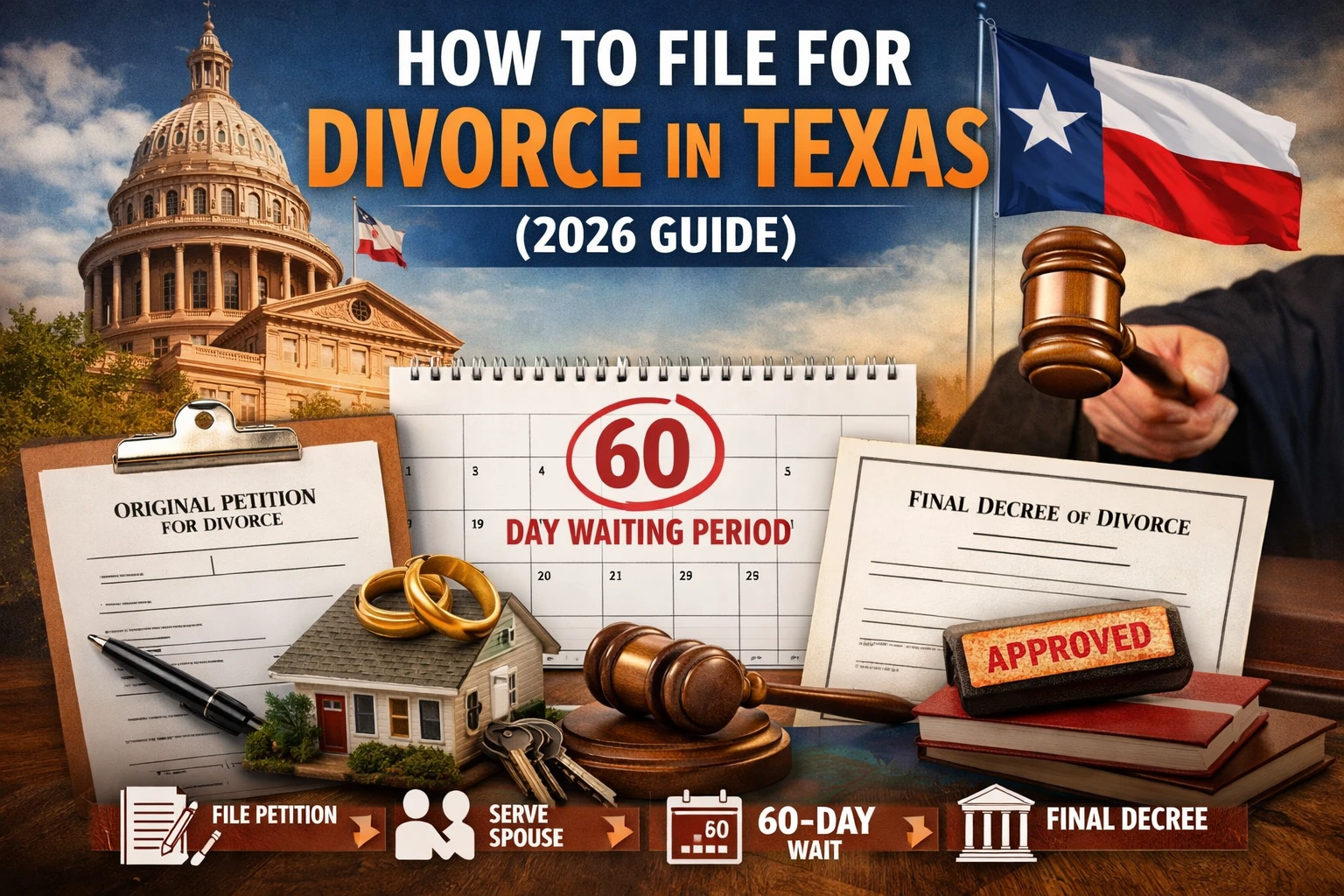
Once documents are ready, file the Original Petition for Divorce in the county where you meet residency requirements.
Service of process means officially notifying your spouse of the filing.
After service, Texas law requires a 60-day waiting period before the judge can grant your divorce.
Once the waiting period ends, you submit final paperwork to the judge.
Keep copies of everything you file. You’ll need these for school enrollment, health insurance changes, and any future modifications to custody or support.
Co-Parenting After Divorce: Building a Sustainable Framework
The divorce is final, but your co-parenting relationship continues for years. Building a sustainable framework now prevents conflicts and protects your children’s wellbeing.
Successful co-parents keep communication focused on the children, using a co-parenting app or email for scheduling rather than personal disputes, and stick to the parenting plan, consistency matters to children.
Respect each other’s parenting style. Unless there’s a safety concern, let your ex parent their own way during their time, children benefit from two involved parents with different approaches.
Managing changes and modifications
Life changes, a parent may relocate, a child’s needs may shift, or income may change.
You can modify custody or support by agreement (a new Agreed Modification) or by requesting a court modification if you can’t agree.
Common reasons for modification include:
- A parent’s job loss or significant income change
- A child’s special needs or health changes
- One parent wanting to relocate
The best co-parenting relationships are built on the principle that your children benefit from having two involved, cooperative parents. Protecting that relationship protects your children.
An uncontested divorce with children reduces conflict and keeps your family’s focus on what matters most: your children’s wellbeing.
Ready Divorce Service helps Texas families complete uncontested divorces efficiently and affordably, with expert guidance on parenting plans, child support calculations, and document preparation that complies with Texas law. Which Plan is Right for You? can help you find the package that fits your situation.
Frequently Asked Questions
Can parents agree on custody and child support in an uncontested divorce?
Yes. When both parents reach mutual agreement on child custody, parenting time, and child support before filing, you can pursue an uncontested divorce with children. Both parents must sign the divorce decree acknowledging their agreement. The court reviews the agreement to ensure it serves the children’s best interests before granting the final decree. This approach avoids lengthy court hearings and reduces family stress.
What should a parenting plan include when parents divorce?
A comprehensive parenting plan should specify physical custody and visitation schedules, decision-making authority for education and medical care, holiday and vacation arrangements, and how major expenses will be handled. Include provisions for communication between parents, how changes will be requested, and dispute resolution methods. The plan should address each child’s age and needs, transportation arrangements, and any special circumstances affecting parenting time. Courts expect detailed, child-centered plans that prioritize stability.
When might an uncontested divorce not be appropriate for a family?
An uncontested divorce is not appropriate if one parent is coerced, if there is domestic violence or abuse, if one parent cannot fully understand the agreement, or if either parent believes the agreement does not serve the children’s best interests. If one parent fears the other or feels pressured to accept unfavorable terms, pursuing an uncontested divorce may harm the family. Courts will not approve agreements that appear to result from coercion or that fail to protect children’s welfare. Seek independent legal counsel if you have safety concerns.
How is child support addressed in an uncontested divorce?
Child support is calculated based on both parents’ income, the number of children, and custody arrangement. Both parents must provide financial disclosure documents showing income, assets, and expenses. The amount is typically determined using state guidelines, though parents can agree to a different amount if both consent. The agreement must be documented in the divorce decree and includes provisions for health insurance, medical expenses, and how support may be modified if circumstances change significantly.