Table of Contents
- What Happens Immediately After Filing Your Divorce Petition
- Serving Your Spouse With Legal Notice
- Understanding the Texas Divorce Waiting Period
- Responding to a Divorce Petition in Texas
- Temporary Orders for Child Custody and Support
- The Uncontested Divorce Process in Texas
- What to Do After Your Divorce Is Finalized
- Conclusion
Last Updated: August 29, 2026
What Happens Immediately After Filing Your Divorce Petition
Once you submit your petition to the district court, the court clerk assigns a case number to your file. This number becomes your identifier throughout the entire divorce proceeding. The clerk’s office will generate official court documents, and you’ll receive copies for your records.

You must ensure that your spouse receives proper legal notice of the divorce filing. This service of process is a legal requirement that protects both parties and ensures the court has jurisdiction to proceed. Without proper service, the divorce cannot move forward.
Ready Divorce Service helps clients understand each step after filing divorce texas so you’re never caught off guard by court requirements or procedural deadlines.
Serving Your Spouse With Legal Notice
Service of citation is the formal process of delivering divorce papers to your spouse, and it must be completed correctly to satisfy Texas law. The respondent must receive official notice that a divorce petition has been filed.

Texas law allows several methods of service. Personal service, where a process server or constable physically hands the divorce papers to your spouse, is most common and provides clear proof that service occurred. Alternatively, if your spouse agrees, they may sign a waiver of service, which acknowledges receipt without requiring a formal process server.
For cases where locating your spouse proves difficult, the court may authorize service by certified mail or publication in a newspaper. These alternative methods require court approval but ensure proper legal notice even if your spouse is hard to find.
The process server files an affidavit with the court documenting when and how service was completed. This affidavit becomes part of your official court record and proves the respondent received legal notice. Common mistakes include attempting to serve your spouse yourself, which Texas law typically does not allow, or failing to follow specific procedures for alternative service methods.
Understanding the Texas Divorce Waiting Period
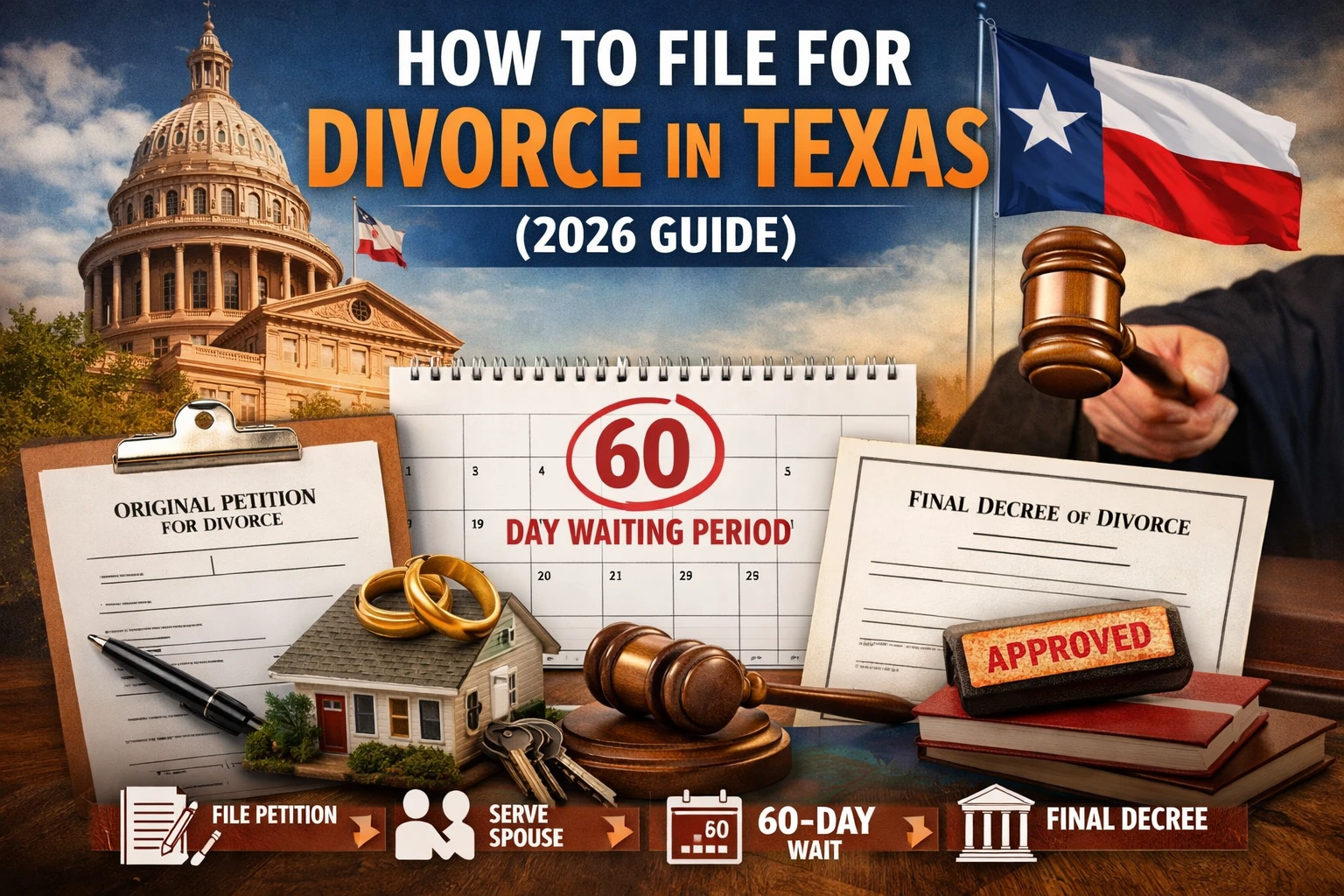
Texas imposes a mandatory waiting period of 60 days from the date your Original Petition for Divorce is filed. This waiting period cannot be waived except in cases involving family violence. It exists to give both spouses time to consider the decision and explore settlement options.
During this period, you and your spouse can negotiate the terms of your divorce, including child custody, support, and property division. You can also request temporary orders from the court if immediate decisions are needed regarding child custody, child support, or spousal support.
The 60-day clock starts from the date the Original Petition for Divorce is filed with the district court, not from the date your spouse receives service. After the mandatory waiting period ends, you can proceed to finalize your divorce if all terms have been agreed upon. Uncontested divorces move relatively quickly once the 60 days have passed, while contested divorces may take considerably longer.
Responding to a Divorce Petition in Texas
If you are the respondent receiving divorce papers, you typically have 20 days to file a response with the court. This response tells the court whether you agree or disagree with the petition’s contents.
Your response is critical. Even if you agree with everything in the petition, filing a formal response protects your legal interests and ensures the court has a complete record of both parties’ positions. If you fail to respond within the 20-day window, the court may enter a default judgment against you, granting the petitioner’s requests without your input.
The response allows you to contest any claims in the petition or propose alternative terms for child custody, support, and property division. If you and the petitioner have already reached agreement on all issues, your response can indicate this, moving the case toward an uncontested divorce process.
Ready Divorce Service helps both petitioners and respondents ensure their documents are accurate and comply with Texas requirements, protecting your interests regardless of which role you play.
Temporary Orders for Child Custody and Support
If you have minor children, temporary orders become especially important. These orders address immediate needs for child custody, conservatorship, possession and access, and child support while the divorce is pending. Temporary orders remain in effect until the final decree of divorce is issued.
You can request temporary orders at any point after filing the Original Petition for Divorce. Many attorneys recommend requesting them early if your situation involves concerns about child safety, substance abuse, or significant income disparity. The court schedules a hearing where both parents present their circumstances, and the judge issues temporary orders based on the best interests of the child standard.
What Judges Consider in Temporary Order Hearings
Judges examine the stability of each parent’s living situation, work schedule, and ability to provide childcare. If one parent has been the primary caregiver, courts often favor continuity by maintaining that arrangement temporarily. The child’s age, health needs, and any special requirements also influence the decision. Judges consider each parent’s relationship with the child and the child’s own preferences if the child is old enough to express them meaningfully.
Income documentation is critical. Bring recent pay stubs, tax returns, and any evidence of self-employment income to your hearing. Texas child support guidelines calculate support based on the obligor’s net monthly income, with the standard rate being 20% of net income for one child, increasing incrementally for additional children.
Preparing for Your Temporary Orders Hearing
Create a clear narrative about your parenting involvement with specific examples of school pickups, medical appointments, homework help, and extracurricular activities you’ve managed. Bring documentation such as school records showing you as the emergency contact or medical records where you’re listed as the decision-maker.
If you’re requesting a specific possession schedule, propose one that is realistic and sustainable. Judges are skeptical of arrangements that sound good on paper but won’t work in practice. Temporary orders typically address conservatorship (which parent makes major decisions), possession and access (the schedule for when each parent spends time with the child), and child support (the monthly amount one parent pays to the other).
Modification During the Divorce Process
If your circumstances change significantly during the divorce process, such as job loss, relocation, or changes in the other parent’s availability, you can request modification of temporary orders. Courts are more likely to modify temporary orders if you can demonstrate a material and substantial change in circumstances.
Temporary arrangements often become the basis for final custody and support orders, making this phase strategically important to your long-term family structure.
The Uncontested Divorce Process in Texas
An uncontested divorce occurs when both spouses agree on all major issues: property division, child custody, child support, and spousal support if applicable. This path typically resolves faster and costs less than contested divorces because no litigation is necessary.
You and your spouse must reach agreement on how to divide community property, assets and debts acquired during the marriage. Texas law presumes community property should be divided fairly, though "fairly" does not always mean equally. You have flexibility in negotiating a division that works for both of you.
Once you’ve agreed on all terms, these agreements are documented in a settlement agreement or decree. The court reviews the agreement to ensure it complies with Texas law and that any child support amounts meet statutory guidelines, but the court generally approves agreements both parties have negotiated.
The timeline for an uncontested divorce is significantly shorter than contested cases. After the mandatory 60-day waiting period expires, you can submit your agreed-upon documents to the court. Many uncontested cases are finalized within 90 to 120 days from filing. If you’re unsure whether your situation qualifies as uncontested or need help determining the right approach for your circumstances, Which Plan is Right for You? can help you understand your options and find the solution that fits your needs.
What to Do After Your Divorce Is Finalized
Once the judge signs your final decree of divorce, your marriage is legally dissolved. However, several important tasks remain to fully complete your divorce transition and protect your interests going forward.
Immediate Legal and Financial Tasks
Obtain certified copies of your final decree from the district court clerk’s office, order at least five to ten copies, as you’ll need them for multiple purposes. Update your driver’s license, passport, and Social Security records. Contact the vital records office to ensure your name change is recorded if you’re resuming a former name.
Review your financial accounts and update beneficiary designations within the first two weeks after finalization. Change the beneficiaries on life insurance policies, retirement accounts, and any investment accounts. Update your will or create a new one if you don’t have one.
Address your property division obligations without delay. If the decree requires you to transfer property titles, refinance mortgages, or divide retirement accounts, complete these tasks promptly. For retirement accounts like 401(k)s and IRAs, work with a qualified domestic relations order (QDRO) professional to ensure proper division.
Update your insurance coverage within one week. Notify your health insurance provider of your status change and obtain your own health insurance immediately if you were covered under your ex-spouse’s policy. Update your auto and homeowners insurance as well, especially if property division changed who owns certain assets.
The Emotional and Mental Health Transition
Many people experience a complex mix of relief, grief, uncertainty, and identity confusion after finalization, even when divorce was clearly the right choice. Consider whether counseling or therapy would help you process the transition. Individual therapy can address grief, anger, identity reconstruction, and adjustment to your new life structure.
Support groups specifically for divorced individuals provide community and normalize the experience. If you’re struggling with depression, anxiety, or other mental health concerns, reach out to your primary care physician or a mental health professional. Post-divorce depression is common and treatable.
For parents, be intentional about supporting your children’s emotional adjustment. Age-appropriate conversations about the divorce, reassurance about both parents’ continued love, and consistency in routines help children process the change.
Rebuilding Your Identity and Life Structure
Divorce often disrupts your sense of identity and daily routines. Many people find that rebuilding these elements intentionally accelerates their recovery. This might include reconnecting with friendships, pursuing hobbies or interests you set aside, or developing new skills and activities that reflect who you are now.
Establish new routines that feel authentic to your current life. Create a home environment that reflects your preferences and brings you comfort. Small changes can help your space feel like yours rather than a remnant of your marriage.
Creating a Post-Divorce Checklist
Create a comprehensive post-divorce checklist to track both administrative and personal recovery tasks:
Administrative Checklist (Complete within 30 days):
- Obtain certified copies of final decree
- Update driver’s license and passport
- Update Social Security records
- Change beneficiaries on life insurance, retirement accounts, investment accounts
- Update or create new will
- Notify health insurance provider; obtain new coverage if needed
- Update auto and homeowners insurance
- Initiate property title transfers
- Arrange QDRO processing for retirement account division
- Update employer records and tax withholding
Personal Recovery Checklist (Ongoing):
- Schedule therapy or counseling if desired
- Research support groups in your area
- Reconnect with friends and family
- Establish new routines and rituals
- Pursue a hobby or interest you’ve neglected
- Set personal goals for the next 6-12 months
- Check in regularly on your emotional well-being
The weeks and months after divorce finalization are a transition period, not an endpoint. By addressing both the practical requirements and your emotional needs, you create a foundation for moving forward with clarity and resilience.
Conclusion
The period after filing divorce texas involves multiple steps, strict deadlines, and important decisions that affect your future. From starting the divorce process through serving your spouse with legal notice, navigating the mandatory waiting period, responding to petitions, and finalizing your divorce, each phase requires attention to detail and understanding of Texas requirements.
Ready Divorce Service specializes in guiding clients through this entire process with accurate document preparation and step-by-step support. Our expertise in Texas divorce law ensures your filing complies with all court requirements, protecting your interests and moving your case forward efficiently. Whether you’re navigating an uncontested divorce or need clarification on what happens after filing divorce texas, we’re here to make your transition simple and stress-free.
Frequently Asked Questions
What is the mandatory waiting period for divorce in Texas?
Texas law requires a 60-day mandatory waiting period from the date you file your Original Petition for Divorce. This cooling-off period begins when the Original Petition for Divorce is filed with the district court. Even in uncontested divorces where both parties agree, you cannot finalize the divorce before this 60 days passes. The court clerk will track this timeline and won't grant your final decree until the period expires.
What happens if my spouse does not respond to the divorce petition?
If your spouse fails to respond to the divorce petition within the required timeframe, the court may issue a default judgment in your favor. This means the court can proceed without your spouse's participation and grant the divorce based on your Original Petition. However, you must still complete the mandatory 60-day waiting period. A default judgment doesn't bypass this requirement, it only allows the divorce to move forward without the respondent's agreement or appearance.
Do I have to attend a court hearing for an uncontested divorce in Texas?
In an uncontested divorce where both spouses agree on all terms (child custody, support, property division), you may not need to attend a court hearing. Many uncontested divorces are finalized by the judge reviewing the agreed-upon documents without requiring either party to appear. However, some courts require at least the petitioner to appear briefly. Check with your district court clerk about local procedures. Ready Divorce Service can guide you on what your specific court requires.
What happens during the discovery process in a contested divorce?
The discovery process allows both spouses to exchange financial information, documents, and evidence relevant to the divorce. This includes bank statements, tax returns, property valuations, and other records needed to divide community property fairly. Discovery can happen through written questions (interrogatories), document requests, and depositions. In contested divorces, discovery helps both sides understand the full financial picture before trial. In uncontested divorces, discovery is typically unnecessary because both parties have already agreed on the terms.
This article was written using GrandRanker