Table of Contents
- How to File Uncontested Divorce in Texas: What You Need to Know
- Uncontested Divorce Texas Forms and Required Documents
- Step-by-Step Process: How to File Your Uncontested Divorce
- Cost of Uncontested Divorce in Texas: What to Expect
- Timeline for Uncontested Divorce in Texas: How Long It Takes
- Do I Need a Lawyer for Uncontested Divorce in Texas?
- Common Mistakes to Avoid When Filing Uncontested Divorce
- Conclusion
How to File Uncontested Divorce Texas: Step-by-Step Guide
Last Updated: July 23, 2026
When you and your spouse agree on property division, custody, and support, you can avoid costly litigation. Learning how to file uncontested divorce Texas is the path to a faster, more affordable dissolution of your marriage. At Ready Divorce Service, we’ve guided hundreds of Texans through this process with accuracy and confidence, ensuring their paperwork meets every state requirement the first time. An uncontested divorce in Texas can be completed in as little as 60 days, compared to contested divorces that often drag on for years.
Understanding Uncontested vs. Contested Divorce
In an uncontested divorce, both spouses consent to the terms of dissolution: property division, custody arrangements, and support obligations. In a contested divorce, one or both parties dispute these terms, forcing the court to intervene and decide for you. An uncontested divorce is faster, cheaper, and less emotionally draining because neither party fights the other in court. However, it only works if you truly agree on everything, if disagreement exists on even one major issue, such as custody or division of a retirement account, your case becomes contested.
An uncontested divorce requires both spouses to agree on property division, custody, and support before filing. If either party contests any major issue, the case cannot proceed as uncontested.
Texas Residency Requirements and the 6-Month State Rule
Before filing for divorce in Texas, you must meet the state’s residency requirement. Texas requires that at least one spouse be a domiciliary resident of the state for at least six months immediately preceding the filing of the petition. Additionally, the petitioner must have been a resident of the county where the divorce is filed for at least 90 days.
These timelines are strict. If you don’t meet the six-month state rule or the 90-day county rule, the court lacks jurisdiction to grant your divorce, and your filing will be dismissed. Track your residency dates carefully, as filing prematurely wastes your filing fee and delays your divorce unnecessarily.
Filing before meeting the six-month state rule or 90-day county rule will result in dismissal of your petition. The court has no authority to grant a divorce if residency requirements are not satisfied. Plan your filing date accordingly.
Uncontested Divorce Texas Forms and Required Documents
The Texas court system requires specific forms and documents to process your uncontested divorce. Missing or incomplete paperwork is a common reason for rejection.
Original Petition for Divorce and Core Filing Documents
The Original Petition for Divorce officially starts your case. This form tells the court who you are, who your spouse is, whether you have minor children, and what you’re asking the court to do. It must include your name and your spouse’s name, the county where you’re filing, the date of your marriage, and the date of separation. If you have minor children, list their names and birthdates. Describe all community property, real estate, vehicles, bank accounts, retirement accounts, and debts, and state how you and your spouse have agreed to divide everything.
The Final Decree of Divorce is the order the judge signs at the end of your case. This document formally dissolves your marriage and includes all the terms you and your spouse agreed to, addressing property division, custody arrangements (if applicable), and any support obligations. You’ll also need an Affidavit, which is a sworn statement under oath confirming the facts stated in your petition.
Waiver of Service and Affidavit of Indigency
The Waiver of Service is a critical document in uncontested divorce. It’s a statement signed by your spouse agreeing that they’ve been informed of the divorce filing and waiving their right to formal service of process. When your spouse signs a Waiver of Service, you don’t have to pay a sheriff or process server to deliver the petition, saving money and time.
An Affidavit of Indigency is filed only if you cannot afford the court filing fee. Texas allows indigent filers to request a waiver or deferral of court costs if your income is at or below 200% of the federal poverty line. Filing fees in Texas typically range from $300 to $400 depending on the county.
Step-by-Step Process: How to File Your Uncontested Divorce
Step 1: Prepare and Complete All Required Forms
Contact your district court clerk’s office or visit the county’s website to download the official forms. Complete the Original Petition for Divorce first, filling in your name, your spouse’s name, the county and state where you’re filing, your marriage date, and your separation date. List any minor children by name and birthdate, and describe all community property with how you and your spouse have agreed to divide everything.
Prepare the Final Decree of Divorce, which should mirror the terms in your petition exactly. If you have minor children, you’ll also need a Suit Affecting the Parent-Child Relationship (SAPCR) section addressing custody, visitation, and child support. Prepare an Affidavit confirming the facts in your petition, which you’ll sign in front of a notary public. If you cannot afford the filing fee, complete the Affidavit of Indigency and include it with your filing.

Step 2: File with the District Court Clerk
Take your forms to the district court clerk’s office in the county where you’re filing. Bring the original and at least two copies of each document. The clerk will review your paperwork for completeness and correctness. Pay the filing fee at this time, unless you’ve been granted a fee waiver based on indigency. Ask the clerk for a case number and file stamp, and keep this receipt in a safe place.
Step 3: Serve the Respondent and Obtain Waiver of Service
After filing with the clerk, you must notify your spouse (the respondent) of the divorce filing. Deliver a copy of the filed petition, the affidavit, and the proposed final decree to your spouse, and ask your spouse to sign the Waiver of Service and return it to you. Once your spouse has signed the Waiver of Service, file it with the court clerk. If your spouse will not sign a Waiver of Service, you’ll need to hire a process server or have the sheriff serve the documents formally, which adds cost and delay.
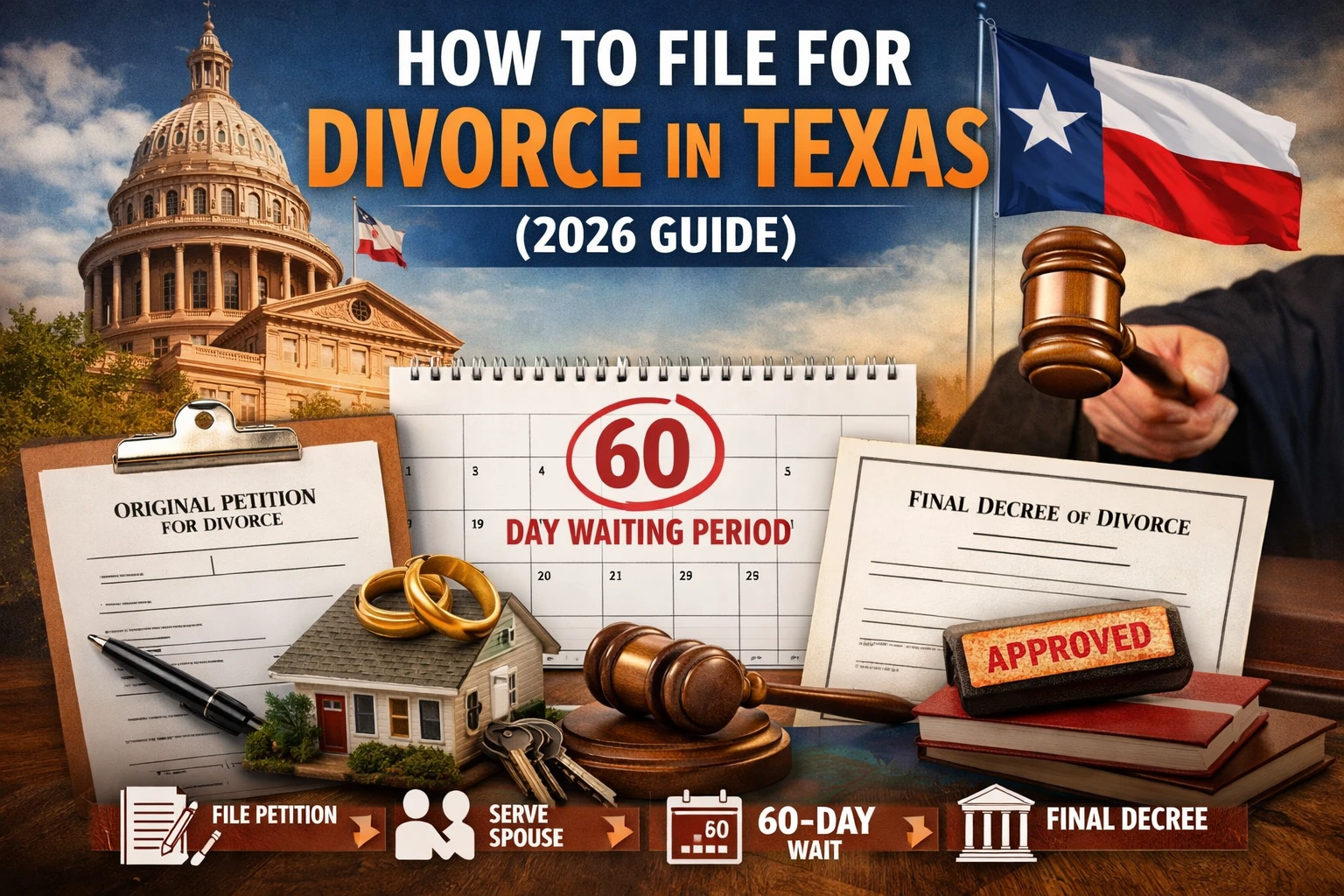
Step 4: Navigate the 60-Day Waiting Period
Texas law imposes a mandatory 60-day waiting period from the date you file your petition until the court can grant your divorce. This waiting period cannot be waived, even if both parties agree. Use this time to finalize any remaining details with your spouse and review the final decree to ensure all property division terms are correct, custody arrangements are clear, and support obligations are accurate.
Step 5: Attend the Prove-Up Hearing and Obtain Final Decree
After the 60-day waiting period has passed, you’re eligible for your prove-up hearing. Contact the judge’s office to schedule the hearing. Many judges handle uncontested divorces on a docket day when they hear multiple uncontested cases in one morning. The hearing typically lasts only 5-10 minutes per case. At the hearing, the judge will ask you basic questions about your marriage and agreement, and if satisfied, will sign the Final Decree of Divorce.
In some cases, the judge may allow you to submit your case on the papers without appearing in person. Ask the judge’s office whether this is an option in your county.
Many uncontested divorces can be submitted on the papers without a live hearing. Contact the judge’s office to ask whether this option is available in your county. It saves time and eliminates the need to appear in court.
Cost of Uncontested Divorce in Texas: What to Expect
Court Fees and Filing Costs
The district court filing fee in Texas typically ranges from $300 to $400, depending on the county. If you cannot afford the filing fee, you can file an Affidavit of Indigency and request a waiver or deferral. Additional costs may include certified copies of your divorce decree, which the clerk charges a small fee for (usually $5-$15 per copy). Some counties offer e-filing options, which may include an additional e-filing fee of $25-$50.
Document Preparation and Legal Aid Resources
If you prepare your own documents, your costs are limited to court fees and certified copies, typically $350-$450 total. If you use a service like Ready Divorce Service to prepare your documents, you’ll pay for document preparation assistance in addition to court fees. Ready Divorce Service specializes in ensuring your forms are accurate and complete, which reduces the risk of rejection and delays.
If you cannot afford either court fees or document preparation, legal aid organizations in Texas may be able to help. Organizations like Texas RioGrande Legal Aid and State Bar of Texas Lawyer Referral Service can connect you with low-cost or free legal assistance based on your income.
Timeline for Uncontested Divorce in Texas: How Long It Takes
The 60-Day Waiting Period and 90-Day County Rule
The 60-day waiting period is the biggest factor in your timeline. You cannot obtain a final decree before 60 days have passed from the date you file your petition. In practice, the timeline looks like this:
- Day 1: You file your petition with the clerk
- Days 1-60: The mandatory waiting period; you serve your spouse and obtain the Waiver of Service
- Day 61 or later: You can request a prove-up hearing
- Day 61-90: The judge schedules and conducts your prove-up hearing
- Final decree issued: Your divorce is complete
For most uncontested cases, the entire process takes 60-90 days.
Post-Filing Logistics and E-Filing Considerations
After you file, track deadlines and follow up with the court clerk to ensure your case is moving forward. E-filing is available in many Texas counties and can speed up the process. After the 60-day waiting period has passed, contact the judge’s office to request a prove-up hearing date. Don’t assume the judge will automatically schedule you.
Do I Need a Lawyer for Uncontested Divorce in Texas?
Pro Se Filing and Self-Represented Litigant Resources
Pro se means representing yourself without a lawyer. In Texas, you have the right to file for divorce pro se. If your divorce is truly uncontested and your situation is straightforward, no minor children, minimal property, no significant debts, you can likely file pro se successfully. Texas courts provide forms and instructions for self-represented litigants. If you file pro se, you’re responsible for ensuring your paperwork is complete and correct.
When Professional Assistance Makes Sense
Professional assistance makes sense if your situation is complex. If you have minor children, significant property to divide, retirement accounts, or if your spouse is uncooperative, working with a professional is wise. Ready Divorce Service can help you prepare accurate, court-compliant documents without the full cost of hiring a traditional lawyer. We specialize in uncontested divorces and understand Texas requirements thoroughly. A traditional family law lawyer can provide comprehensive legal advice and represent you in court, but lawyer fees are typically higher than document preparation services for uncontested cases.
Pro se filing is possible for straightforward, uncontested divorces but requires careful attention to forms and deadlines. For complex situations or if you want professional guidance, document preparation services or legal representation can be valuable investments.
Common Mistakes to Avoid When Filing Uncontested Divorce
Document Rejection Reasons and How to Prevent Them
The most common reason for document rejection is incomplete or inaccurate information. Missing signatures, incorrect case numbers, or inconsistent information between documents will cause the clerk to reject your filing. Use the official court forms for your county. Ensure all names are spelled consistently throughout all documents. Sign all documents in the correct places. Have your affidavit notarized, it must be signed in front of a notary public. Include all required pages of each document.
Asset Division Checklists and Community Property Considerations
Texas is a community property state, which means that property acquired during the marriage (with some exceptions) is owned equally by both spouses. Community property includes real estate, vehicles, bank accounts, retirement accounts, and debts incurred during the marriage. Separate property includes property owned before the marriage, inherited property, gifts to one spouse, and property designated as separate in a prenuptial agreement.
When dividing community property, list every asset and debt. Don’t forget retirement accounts, which are often overlooked. A 401k or pension earned during the marriage is community property and must be divided. Create a complete inventory of all community property before drafting your agreement.
Minor Children Issues and Custody Documentation
If you have minor children, your divorce must address custody, visitation, and child support. The court requires a Suit Affecting the Parent-Child Relationship (SAPCR) section in your petition when children are involved. This section specifies who has primary custody, the visitation schedule, child support obligations, health insurance coverage, and who makes educational and medical decisions.
Create a detailed visitation schedule with exact days and times. Calculate child support using the Texas child support guidelines, which are based on the net monthly income of the obligor and the number of children. Include health insurance provisions specifying which parent will provide health insurance and who pays for uninsured medical expenses.
| Common Mistake | Consequence | Prevention |
|---|---|---|
| Incomplete asset list | Property left out of division; disputes after divorce | Create detailed inventory of all assets and debts |
| Vague custody language | Confusion about visitation schedule; future disputes | Write specific dates, times, and pickup/dropoff locations |
| Missing notarization | Affidavit invalid; documents rejected | Have affidavit signed in front of notary public |
| Inconsistent names | Documents rejected as inconsistent | Use exact same spelling throughout all documents |
| Forgetting retirement accounts | Community property not divided; one spouse loses benefits | Include 401k, IRA, pension in asset division |
Conclusion
Filing an uncontested divorce in Texas is achievable when you understand the requirements, follow the correct procedures, and complete your paperwork accurately. The 60-day waiting period and court filing fees are unavoidable, but the process is straightforward when both spouses cooperate.
Ready Divorce Service has helped hundreds of Texans navigate this process with confidence. Our document preparation service ensures your forms are complete, accurate, and court-compliant, eliminating the stress of getting the details right. We guide you through each step, from initial paperwork through your final decree, so you can move forward with clarity and peace of mind.
Frequently Asked Questions
What are the main requirements for filing an uncontested divorce in Texas?
To file an uncontested divorce in Texas, you must meet the 6-month state residency requirement and the 90-day county rule. You need to prepare the Original Petition for Divorce, obtain a Waiver of Service from your spouse, and complete the Final Decree of Divorce. If you have minor children, you must include a custody and support agreement. All documents must comply with Texas Rules of Civil Procedure and be filed with the District Court clerk in your county.
What uncontested divorce Texas forms do I absolutely need to file?
The essential forms include: Original Petition for Divorce, Final Decree of Divorce, Waiver of Service (if your spouse agrees not to be formally served), and an Affidavit of Indigency if you qualify for filing fee waiver. If you have minor children, you’ll need a Suit Affecting the Parent-Child Relationship (SAPCR) form and child support documentation. The District Court clerk can provide a complete divorce kit or your county’s specific form requirements.
How long does an uncontested divorce take in Texas, including the waiting period?
An uncontested divorce in Texas typically takes 60-90 days minimum due to the mandatory 60-day waiting period that begins after filing with the District Court. The 90-day county rule means some counties require an additional 30-day wait. After the waiting period expires, you attend a prove-up hearing where the judge reviews your Final Decree of Divorce. Total time from filing to completion is usually 2-3 months for straightforward cases with no complications.
Do I need a lawyer to file for uncontested divorce in Texas, or can I file pro se?
You can file for uncontested divorce in Texas as a self-represented litigant (pro se) without hiring a lawyer, especially if you and your spouse agree on all terms. However, pro se filers must still comply with Texas Rules of Civil Procedure and complete all required documents accurately. Many people use divorce kits or document preparation services to ensure compliance. Consider professional help if you have minor children, significant assets, or community property disputes to avoid costly mistakes.
What happens if the court rejects my divorce documents, and how can I avoid common rejection reasons?
Common rejection reasons include incomplete forms, missing signatures, incorrect legal descriptions of property, and failure to include required child support information. To avoid rejection, verify all forms match your county’s current templates, ensure both spouses sign where required, include specific details about community property division, and attach all supporting documentation. If rejected, the court clerk will notify you of deficiencies, you’ll have time to correct and refile, but this delays your timeline.
📞 Get Started Today – Your Peaceful Divorce Is Just a Click Away
When you’re ready to move on, we’re ready to help.
📲 Call us now at (800) 432-0018
🖥️ Start your divorce online today