Table of Contents
- What Is an Uncontested Divorce?
- Texas Legal Requirements for Filing
- Pro Se Divorce Requirements in Texas
- How Long Does an Uncontested Divorce Take?
- Texas Divorce Forms Without a Lawyer
- When You Should Hire an Attorney
- Risks of DIY Divorce and Hidden Complexity
- Frequently Asked Questions
Last Updated: September 24, 2026
What Is an Uncontested Divorce?
An uncontested divorce is a legal process where both spouses agree on all major terms before filing with the court, and an uncontested divorce attorney can help ensure the agreement is legally sound. You agree on property division, spousal support, child custody, and child support without dispute. The court reviews your agreement and issues a final decree of divorce if everything complies with state law.
Uncontested divorces move faster and can be more affordable than contested divorces because there’s no litigation or extended court battles.
Texas Legal Requirements for Filing
Residency requirements: Either you or your spouse must have lived in Texas for at least 90 days before filing, and you must file in the county where you’ve lived for at least 30 days. The court won’t hear your case without meeting these requirements.
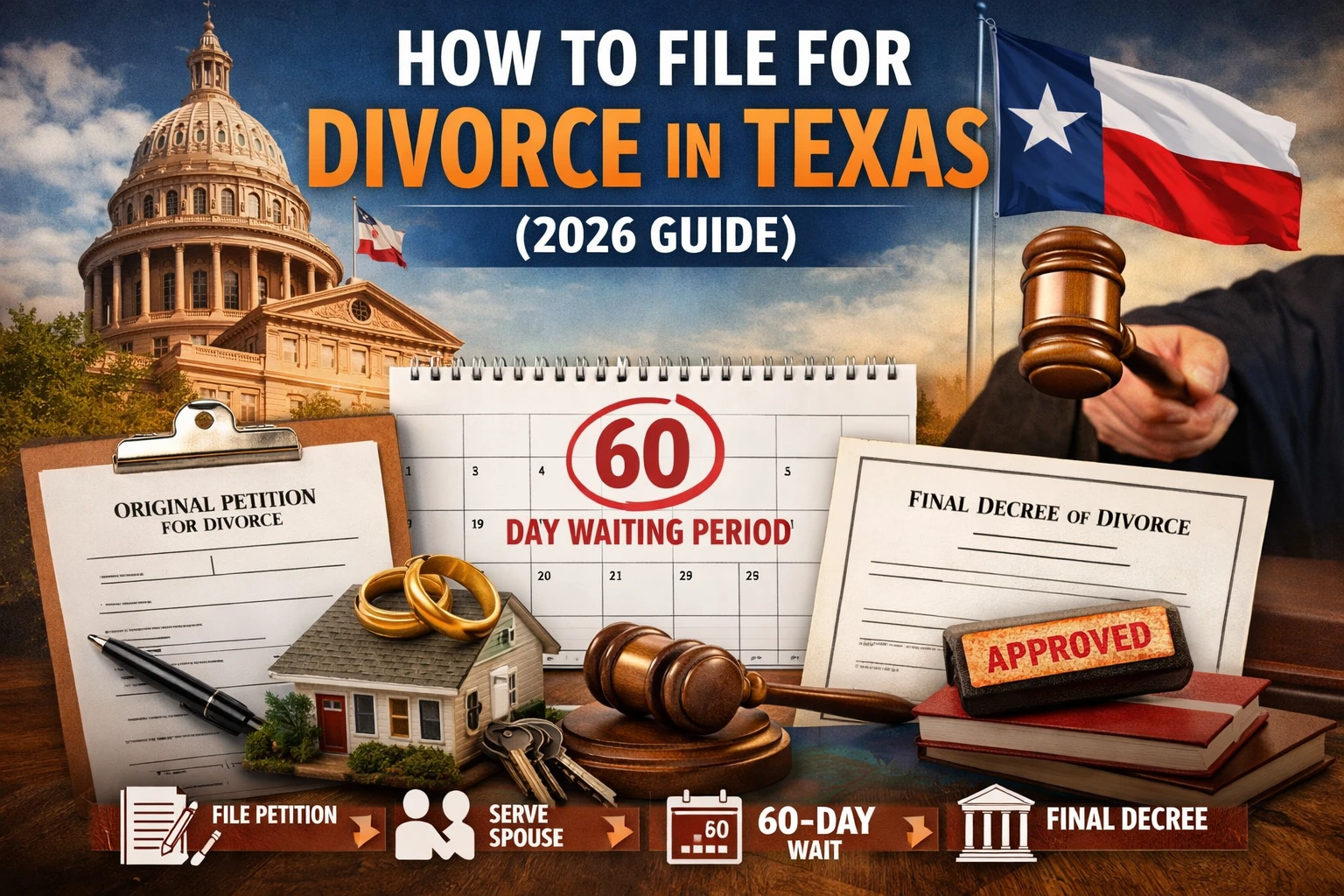
Waiting periods: Texas law requires a 60-day waiting period from filing before the court can finalize your divorce, regardless of whether it’s contested or uncontested.
Court costs and filing fees: Each district court charges a filing fee to process your petition. Contact your local court clerk for the exact amount in your county.
Jurisdiction and venue: File in the district court of the county where you live.
Pro Se Divorce Requirements in Texas
Pro se means representing yourself without a lawyer. Texas allows this in uncontested divorces, but you must meet specific procedural requirements or the court will reject your paperwork. Understanding Starting the Divorce Process and the exact requirements in your county is the first step to avoiding costly rejections.
The Four Core Procedural Requirements
First, you need the correct forms: the petition for divorce, a waiver of service (if your spouse agrees not to be formally served), and a final decree of divorce. Check your county court’s website for local variations and required supplemental forms.
Second, you must follow proper service rules. A waiver of service (your spouse agrees they received notice) can speed things up. Formal service by a process server or constable takes longer. If your spouse won’t sign a waiver, this may signal your divorce is not truly uncontested.
Third, all documents must be typed and formatted correctly. One formatting error can delay your case by weeks.
Fourth, you need to understand community property rules. Texas is a community property state, meaning most assets acquired during marriage belong to both spouses equally. Your agreement must divide property fairly or the judge may reject it.
The Hidden Complexity Check
Before you file pro se, assess these complexity factors:
- Do you own a home together? Calculating equity buyouts incorrectly leads to disputes years later.
- Do either of you have retirement accounts (401k, IRA, pension)? These require a Qualified Domestic Relations Order (QDRO) to divide properly. Missing or incorrectly drafted QDROs are one of the most common post-divorce problems.
- Does either spouse have business ownership or self-employment income? Valuing and dividing a business fairly can be complex.
- Are there significant debts (credit cards, student loans, car loans)? If you don’t explicitly assign each debt to one spouse in your decree, both of you may remain liable to creditors after divorce.
- Do you have minor children? Child support calculations are complex if either parent is self-employed or has irregular income. Custody arrangements need specificity about holidays, school breaks, and decision-making authority.
- Is there a significant income disparity between you and your spouse? Calculating spousal support duration and amount requires legal knowledge.
- Does either spouse suspect the other is hiding assets or income? Pro se filing is risky without access to discovery tools to uncover hidden accounts or unreported income.
How Long Does an Uncontested Divorce Take?
The timeline has two phases: the mandatory 60-day waiting period from filing, then court processing (typically 2-4 weeks). Total time from filing to final decree usually ranges from 75 to 90 days for uncontested cases, assuming no errors or delays.
Texas Divorce Forms Without a Lawyer
Texas provides official divorce forms through the State Bar of Texas and county courts. Basic forms include: Petition for Divorce, Waiver of Service, Final Decree of Divorce, Marital Property Agreement, and Child Support Agreement. Each form has specific sections you must complete correctly. Generic online templates often don’t match Texas requirements, and court clerks cannot advise whether your forms are legally sound.
When You Should Hire an Attorney
Some uncontested divorces are simple enough to handle yourself. Others have hidden complexity that may benefit from professional guidance. If you’re unsure whether your situation qualifies as straightforward, Which Plan is Right for You? can help you assess your specific circumstances.
Hire an attorney if you have minor children. Child custody and child support calculations involve legal standards and statutory guidelines. If you make mistakes here, the court may reject your agreement or approve something that harms your interests. An attorney ensures your custody arrangement protects your rights and follows the law.
Hire an attorney if significant assets are involved. Community property division seems straightforward until you encounter retirement accounts, business interests, or real estate. Dividing these incorrectly can cost you thousands. An attorney identifies all marital property and ensures fair division.
Hire an attorney if spousal support is on the table. Spousal support calculations depend on income, earning capacity, and length of marriage. Agreeing to the wrong amount without understanding the law leaves you vulnerable.
Hire an attorney if your spouse hired one. If your spouse has legal representation and you don’t, you’re at a disadvantage. Attorneys negotiate better settlements for their clients. Representing yourself against an attorney is risky.
Hire an attorney if you’re unsure about your legal rights. Many people don’t know what they’re entitled to under Texas law. An attorney explains your rights and ensures your agreement protects them.

Risks of DIY Divorce and Hidden Complexity
Filing for an uncontested divorce without professional help carries real risks. Understanding these dangers helps you decide whether to proceed alone or get support. More importantly, understanding how to detect and prevent them before you file can help you avoid costly post-divorce litigation.
Immediate Filing Risks
Paperwork rejection is the most common risk. Courts reject incomplete or incorrectly formatted documents regularly. A single missing signature, wrong font size, or incomplete section sends your filing back. Each rejection delays your divorce by weeks and requires you to resubmit corrected papers. To detect this risk before filing: have someone unfamiliar with your case review your documents against the court’s checklist. If you cannot explain why each section is filled out the way it is, the court likely won’t accept it either.
Jurisdictional errors invalidate your divorce. Filing in the wrong county or before meeting the 90-day residency requirement means the court has no jurisdiction. Your entire divorce could be invalid, requiring you to file again.
The Post-Divorce Modification Crisis (The Gap Competitors Miss)
The most expensive risk of DIY divorce emerges not at filing, but months or years after your decree is signed. A vague or poorly drafted final decree creates disputes that require modification litigation, which costs far more than getting the decree right the first time.
Detection Checklist: Before You File
Before submitting your final decree, ask yourself:
- Can I explain in plain language what each section of my decree means, and would my spouse agree with my interpretation?
- Have I assigned every asset and every debt to a specific spouse, with that spouse’s agreement?
- If we have children, have I specified exact custody schedules, decision-making authority, and how modifications will be triggered?
- If child support is involved, have I used the statutory formula and documented the income figure I used?
- If spousal support is involved, have I specified the exact duration and termination conditions?
- Have I obtained a QDRO (or confirmed one is not needed) for any retirement accounts?
- Have I verified that my spouse’s financial disclosure is complete and consistent with tax returns and bank statements?
If you cannot confidently answer “yes” to all of these, your decree is at risk of post-divorce modification disputes. Many people think they saved money by avoiding a lawyer, only to spend more fixing errors later. Ready Divorce Service helps you navigate these pitfalls with accurate document preparation, a detailed complexity assessment, and step-by-step guidance to ensure your filing meets all state requirements and your decree is specific enough to help prevent future disputes.
Frequently Asked Questions
Can I represent myself in a Texas uncontested divorce?
Yes, you can represent yourself (called pro se representation) in an uncontested divorce if both spouses agree on all terms, including property division, spousal support, and child custody. Texas allows self-representation, but you must follow all statutory requirements, file correct documents with the district court, and meet residency and waiting period rules. Many people file without an attorney when their situation is straightforward, though errors in documentation can delay or complicate the process.
How long does an uncontested divorce take in Texas?
An uncontested divorce in Texas typically takes 60 to 90 days from filing, though it can extend longer if documents are incomplete or the court has a backlog. Texas law imposes a mandatory 60-day waiting period from the date the petition for divorce is filed before the final decree of divorce can be entered. After the waiting period ends and all paperwork is properly filed, the court usually approves the divorce within 30 days if everything is in order.
What happens if I make a mistake on my divorce documents?
Errors on divorce forms can result in the court rejecting your filing, requiring you to resubmit corrected documents and extending your timeline. Common mistakes include incorrect residency information, missing signatures, improper asset division language, or failure to comply with statutory requirements. The court clerk may catch some errors before filing; others may not surface until a judge reviews your petition for divorce. Post-divorce modification can address some issues, but correcting errors before filing is far simpler and less costly.
Do I need an attorney if we have children or shared debt?
You do not automatically need an attorney for uncontested divorce with children or debt, but complexity increases. You must include a custody agreement (conservatorship order), child support calculations, and a detailed property division plan that addresses all community property and liabilities. Texas courts require that child support follow statutory guidelines unless both parties agree otherwise. If you handle this yourself, errors in custody language or asset disclosure can create enforcement problems later. Many people in this situation work with document preparation services to ensure compliance without the full cost of legal representation.