Table of Contents
- What Is Divorce Mediation and How Does It Work?
- Key Benefits of Mediation Over Litigation
- How Divorce Mediation Cost Compares to Traditional Litigation
- Preparing for Divorce Mediation: A Practical Checklist
- The Uncontested Divorce Process in Texas: Where Mediation Fits
- Virtual Mediation and Handling High-Conflict Situations
- Tax Implications and What Happens If Mediation Fails
- Frequently Asked Questions
Last Updated: September 25, 2026
What Is Divorce Mediation and How Does It Work?
Divorce mediation is a structured negotiation process in which a neutral third party helps separating spouses reach their own settlement on asset division, custody arrangements, and support, rather than letting a judge decide. In a Texas divorce mediation, both spouses and their legal counsel, if they choose to retain it, meet with a trained mediator who guides the conversation toward a binding agreement.
The process follows a predictable arc: an opening joint session where ground rules are set, private caucuses where each side speaks candidly with the mediator, and settlement negotiations that continue until both parties sign a mediated settlement agreement. That signed document is enforceable, and a judge typically approves it without relitigating the terms.
What most people get wrong is assuming mediation only makes sense for uncontested divorce cases.
Key Benefits of Mediation Over Litigation
The core benefit is control. Litigation hands your outcome to a judge who has never met your family. Mediation keeps the final decree of divorce in your hands, which matters enormously when children and long-term finances are involved.
Cost Savings and Faster Timelines
Litigation bills by the hour, and contested cases can run for months of discovery, hearings, and continuances. Mediation compresses that timeline into a handful of sessions. Attorney fees and court costs drop sharply because you are paying for structured negotiation, not courtroom procedure. For couples who already agree on the big issues, a simplified divorce path becomes realistic once mediation confirms the terms.
Privacy and Control Over the Outcome
Court proceedings are public records. Mediation is confidential, which means your financial disclosure, your parenting disagreements, and your settlement numbers stay between you, your spouse, and the mediator. For anyone with a business interest, a public-facing job, or just a strong preference for privacy, that confidentiality is often the deciding factor.
How Divorce Mediation Cost Compares to Traditional Litigation
Divorce mediation cost is almost always lower than litigating the same dispute, because you pay for one neutral’s time instead of two attorneys preparing for trial. The gap widens with every contested issue: a case that settles in mediation typically burns a fraction of the billable hours a courtroom fight consumes.
What Actually Drives the Mediator’s Fee
Mediators generally bill in one of three ways, and the model you pick shapes your total more than the headline rate:
- Hourly. The mediator bills for time in session plus preparation and drafting. Common in complex financial cases.
- Flat session rate. A fixed fee per half-day or full-day session, regardless of how the hours break down. Predictable, and it rewards arriving prepared.
- Retainer against hourly. You deposit a set amount up front and the mediator draws it down. Common for court-appointed mediators, who often require the retainer before scheduling.
The Hidden Cost Drivers
Two variables move the final number more than the hourly rate:
- Number of sessions. Every additional session multiplies the mediator’s fee and, if you retain counsel, your attorney’s review time on top of it.
- Whether you bring attorneys. Attorney-assisted mediation costs more per session but can shorten the total by resolving legal questions in the room rather than in follow-up correspondence.
| Factor | Mediation | Traditional Litigation |
|---|---|---|
| Billing basis | One mediator, hourly, flat session, or retainer | Two attorneys billing hourly, plus experts and filing fees |
| Typical duration | Weeks to a few months | Often many months to over a year |
| Discovery process | Voluntary, simplified exchange | Formal, court-supervised, billable at every step |
| Privacy | Confidential process | Public court record |
| Decision-maker | The spouses | A judge |
| Cost predictability | High once session count is scoped | Low; driven by motions and continuances |
| Best for | Couples willing to negotiate | High-conflict or bad-faith cases |
Skipping financial disclosure to “save time” backfires. If your spouse later proves you hid an account or understated income, the mediated settlement agreement can be challenged, and you will pay far more to defend it than the disclosure would have cost.
Preparing for Divorce Mediation: A Practical Checklist
Preparation is where mediations are won or lost. Bring complete, organized documents and a written list of your priorities, ranked. Couples who arrive with a clear picture of their finances resolve asset division and support questions in a fraction of the sessions.

Documents and Financial Disclosure to Gather
Use this checklist before your first session:
- Recent pay stubs and the last two years of tax returns for both spouses
- Bank, brokerage, and retirement account statements
- Mortgage statement, property tax records, and vehicle loan balances
- Credit card and loan statements showing shared debt
- Documentation of separate property claims, such as an inheritance or premarital asset
- Health insurance and childcare cost records if children are involved
- A written list of your top three priorities and your bottom-line positions
Number every document and bring three copies: one for you, one for your spouse, and one for the mediator. Handing over a clean, indexed folder signals good faith and shortens the opening session by a meaningful margin.
The Uncontested Divorce Process in Texas: Where Mediation Fits
Mediation sits between agreement and filing. Once you and your spouse settle the terms, those terms get written into a final decree of divorce and submitted for a judge’s approval. A court-ordered mediation can also occur earlier if a judge requires it before allowing the case to proceed.
The Stage-by-Stage Sequence
For an uncontested divorce, the path generally runs in this order:
- Reach agreement on the substantive issues, property division, debt allocation, conservatorship and possession if children are involved, and support.
- Document the agreement through mediation. The mediator drafts a mediated settlement agreement (MSA) that both spouses sign. Under the Texas Family Code, a properly executed MSA is binding on the parties and the court must generally render judgment in its terms unless a narrow statutory exception applies.
- Prepare the final decree. The MSA gets translated into a formal decree of divorce with the statutory language the court requires.
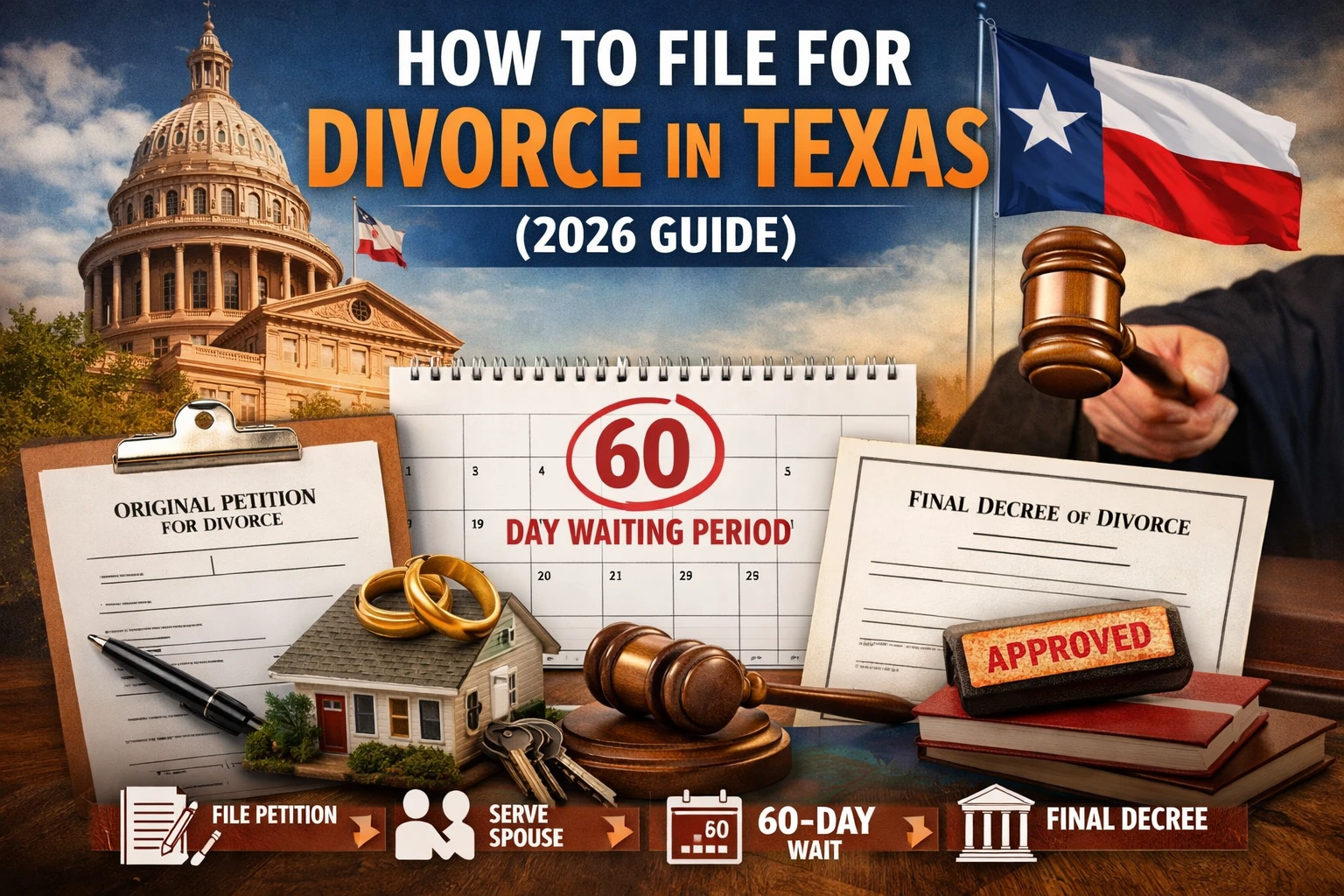
- File the petition with the district clerk in the county where the case belongs, and pay the filing fee.
- Serve the respondent, or obtain a waiver of service if your spouse will sign one, which is common in agreed cases and saves both time and a process-server fee.
- Wait out the statutory waiting period. Texas imposes a waiting period after the petition is filed before a divorce can be granted, with limited exceptions. The Texas Statutes, Family Code is the official source for the current rule and its exceptions.
- Attend the final hearing and have the judge sign the decree.
Where Mediation Changes the Math
Mediation does not replace any of those steps, it front-loads the agreement so the later steps become clerical rather than adversarial. Couples who mediate a full settlement often move through filing, service waiver, and the final hearing without a single contested motion.
If your spouse is willing to sign a waiver of service, get it notarized and filed early. It removes a step from the timeline and eliminates the cost of formal service.
Virtual Mediation and Handling High-Conflict Situations
Virtual mediation works, and it solves a real logistics problem. Sessions run over video conferencing with documents shared electronically, which removes travel time and lets each spouse participate from a private, comfortable space. The tradeoff is that the mediator has less control over side conversations, so virtual sessions demand stricter ground rules and a firm agenda.
- Separate caucuses instead of joint sessions, so the parties rarely speak directly
- A written agenda circulated in advance, with no deviations
- Time limits on each topic, enforced by the mediator
- Escalation to a judge only after documented impasse
Virtual mediation is best for couples who can follow an agenda and stay civil on camera. High-conflict cases need caucus-heavy formats, not open joint sessions.
Tax Implications and What Happens If Mediation Fails
Most mediated settlements carry tax consequences that litigation does not make any clearer. How you structure spousal support, child support, and asset transfers determines who owes what to the IRS, and a mediator can help you see those consequences before you sign. Tax treatment of support payments and property transfers depends on how the final decree characterizes each item, so confirm the specifics with a tax professional before you agree.
Couples who have reached a basic agreement but need help formalizing asset division, custody arrangements, and support terms without going to trial.
Frequently Asked Questions
What is the downside to divorce mediation?
Mediation requires both spouses to negotiate in good faith. If one party refuses to compromise or hides assets, the process can stall. Mediation also does not work well when there is a history of domestic violence or a severe power imbalance. In those cases, a judge may need to decide. Additionally, any agreement reached in mediation is not final until a judge approves it, so there is no guarantee the terms will be accepted exactly as written.
How much does divorce mediation typically cost in Texas?
Divorce mediation cost in Texas varies based on the mediator’s hourly rate, the complexity of assets and debts, and whether you use a private or court-appointed mediator. Compared to litigation, mediation usually costs less because it avoids multiple court appearances and lengthy discovery. For a specific estimate, contact a mediation provider directly.
Is mediation mandatory in all divorce cases?
No. Mediation is not automatically required in every Texas divorce. However, many courts order mediation for contested issues like custody arrangements, asset division, or spousal support. Even when not ordered, couples can choose mediation voluntarily. If you are pursuing an uncontested divorce process, you may not need mediation at all if you and your spouse already agree on all terms. Check with your local court for its specific rules.
How does mediation help in maintaining privacy during a divorce?
Mediation keeps your personal and financial details out of public court records. In litigation, filings and testimony become part of the court docket, which anyone can access. Mediation sessions are confidential, and the mediator cannot be called to testify about what was said. This confidentiality encourages honest settlement negotiations without fear of public exposure. If privacy is a priority, mediation offers a clear advantage over a traditional courtroom divorce.