Table of Contents
- What Makes a Divorce Uncontested in Texas
- Residency and Filing Requirements for an Uncontested Divorce
- Texas Divorce Forms for Uncontested Divorce: A Complete List
- Dividing Property and Debt in a Texas Uncontested Divorce
- Handling Children: Custody, Support, and Conservatorship
- How Long Does an Uncontested Divorce Take in Texas?
- Filing for Divorce Without a Lawyer in Texas: What to Expect
- After the Final Decree: A Post-Filing Checklist
- Frequently Asked Questions
Last Updated: September 10, 2026
What Makes a Divorce Uncontested in Texas
An uncontested divorce is a divorce in which both spouses agree on every major issue, including property division, debt allocation, and, when children are involved, custody and support terms. In Texas, that agreement is what allows a case to move through the courts without a trial.
“Uncontested” is not a status you declare but a condition you maintain: one spouse changing their mind about the house, or refusing to sign a document, can push a case toward the contested track. This guide from Ready Divorce Service walks through the full lifecycle, from residency rules to the weeks after the final decree.
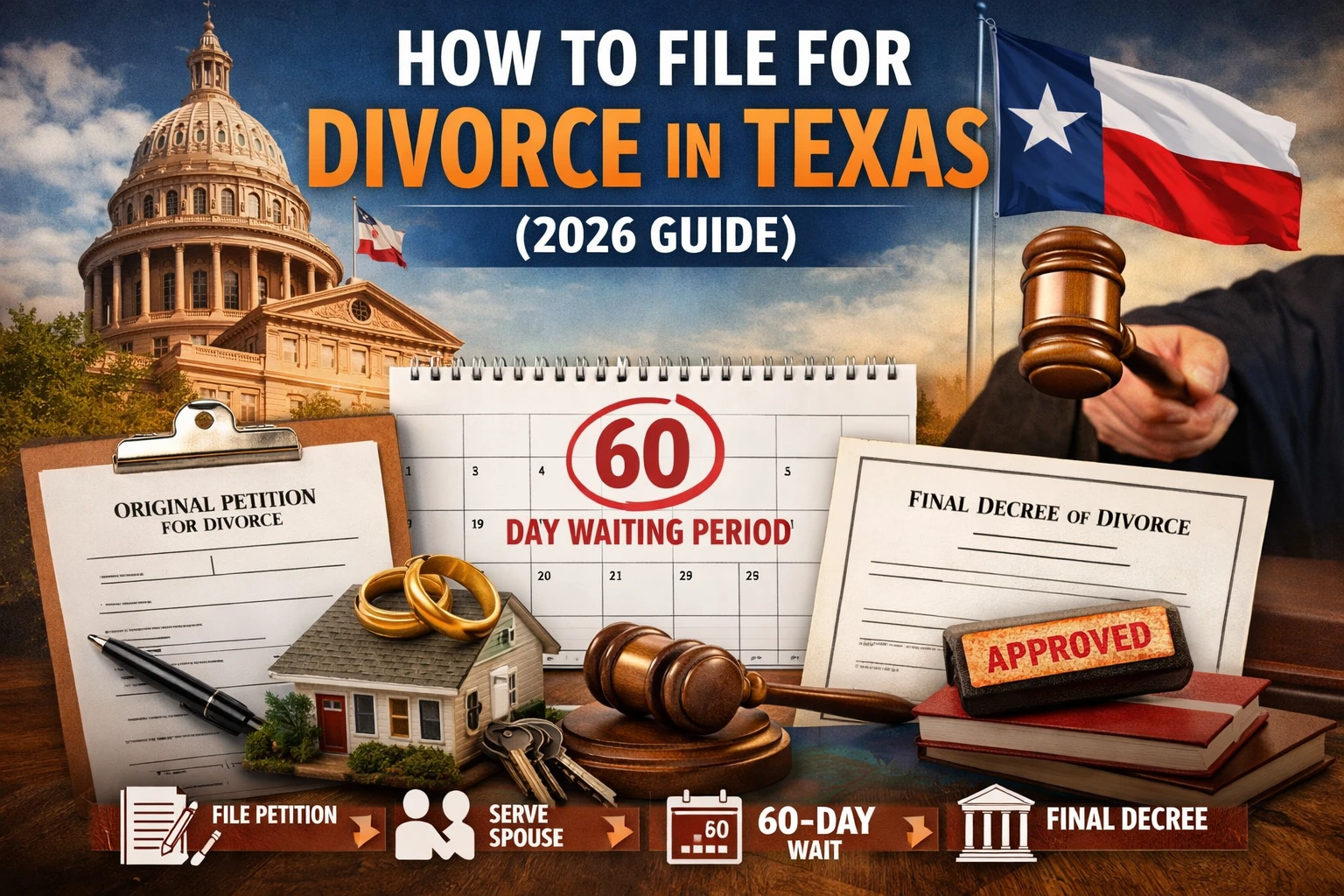
The 5 phases we cover below, filing, service, waiting period, decree, and post-filing cleanup, are the same ones the Texas judicial branch’s self-help divorce resources organize their guidance around. Below, we’ll show you exactly what each phase requires.
An uncontested case is defined by agreement, not by paperwork. If you and your spouse agree on all terms before filing, the process stays simple. If even one issue is disputed, the case can shift to the contested track.
Residency and Filing Requirements for an Uncontested Divorce
Texas requires at least one spouse to have lived in the state for the 6-month state rule before filing, and in the county where the case is filed for the 90-day county rule. Both clocks must be satisfied before the court has jurisdiction.
County and State Residency Rules
These are statutory prerequisites, not formalities: file too early and the court can dismiss the case, forcing you to start over. Confirm dates via lease, utility bills, or driver’s license records first.
Where to File: District Court and County Clerk
Uncontested divorce petitions go to the district court through the county clerk’s office, your contact for filing fees, case numbers, and hearing scheduling. If the fee is a barrier, an affidavit of indigency may allow you to proceed without prepayment, though approval depends on the court.
Texas Divorce Forms for Uncontested Divorce: A Complete List
The core set includes the original petition for divorce, a waiver of service, the final decree of divorce, and supporting documents such as a marital settlement agreement. Courts often publish local forms, so confirm which version your county accepts before downloading anything.
Core Forms: Original Petition and Waiver of Service
The original petition starts the case, identifying the petitioner, respondent, grounds, and relief requested. In an uncontested case, the grounds are almost always insupportability, the no-fault ground under the Texas Family Code. It need not itemize every asset, but must describe relief broadly enough that the decree doesn’t award something the petition never requested.
The waiver of service keeps the case amicable: your spouse tells the court they received the petition and need not be formally served, eliminating sheriff’s fees and process-server delays. Two details matter: it must be signed after the petition is filed and typically notarized. A waiver signed before filing, or missing a notary block, is a common reason a clerk rejects a packet.
Final Decree and Supporting Documents
The final decree of divorce ends the marriage, restating every agreed term: property, debt, and, if applicable, conservatorship and support. The petition is the opening request and the decree the closing order; both must describe the same assets and children, or the judge may send the packet back.
Supporting documents can include a marital settlement agreement, property inventories, and, where relevant, pay stubs or a credit report. Some counties also require a statement of names, addresses, and the last three digits of each Social Security number, so check local rules before assembling the packet.
How the Forms Fit Together
Order of execution matters as much as content. A sequence that works in most counties:
- Draft the property and debt inventory first, so both the petition and the decree pull from the same list.
- File the original petition with the county clerk and pay the filing fee (or submit an affidavit of indigency).
- Have your spouse sign the waiver of service in front of a notary, then file it with the clerk.
- Draft the final decree from the inventory, not from memory.
- Sign the decree in front of a notary, and have your spouse do the same.
- Submit the signed decree and any supporting documents for the judge’s review.
The single most common cause of rejected filings is a mismatch between the petition and the final decree. If the decree awards your spouse a vehicle that the petition never listed, the judge may send it back. Build the inventory first, then draft both documents from it.
A Readiness Check Before You Download Anything
Before spending time on forms, run a self-check. An uncontested divorce fits only if all of the following are true:
- You and your spouse agree on how to divide every asset and every debt.
- You and your spouse agree on conservatorship, possession, and child support (if you have minor children).
- Your spouse is willing to sign a waiver of service and a final decree.
- Neither spouse is hiding assets or income.
- Neither spouse is asking the court to set aside a premarital agreement or a prior order.
If any box is unchecked, the case is not truly uncontested, and a form packet won’t fix that. Resolving the disagreement first, or getting a lawyer for that one issue, is usually faster than filing and hoping the judge approves a decree the other side won’t sign.
Forms are the easy part. The hard part is confirming that both spouses actually agree, and that the petition and the decree describe the same deal. Do the readiness check before you download a single form.
Dividing Property and Debt in a Texas Uncontested Divorce
Texas is a community property state: most property acquired during the marriage belongs to both spouses equally, while separate property generally stays with the spouse who owned it before the marriage or received it by gift or inheritance.

Community Property vs. Separate Property
The distinction decides what has to be divided. Community property includes income earned during the marriage, most purchases made with it, and retirement contributions made while married; separate property includes premarital assets and gifts. If you can’t agree on a category, pause and get clarity before filing.
Retirement Accounts and Digital Assets
Retirement accounts are often the largest shared asset in a marriage of 8 to 10 years, and dividing them usually requires a separate order beyond the decree, so flag them early. Digital assets deserve the same treatment: cryptocurrency, online business accounts, domain names, and shared subscriptions have value and belong in the property inventory.
A simple division worksheet helps:
| Asset Type | Typical Category | Action Needed |
|---|---|---|
| Home equity | Community | Agree on buyout or sale |
| 401(k) contributions | Community | Separate order may be required |
| Inheritance received during marriage | Separate | Document the source |
| Cryptocurrency holdings | Community | List wallet and value |
| Shared cloud storage | Community | Transfer or close account |
Handling Children: Custody, Support, and Conservatorship
With minor children, Texas uses conservatorship rather than custody, and the court must approve any arrangement you propose. Most uncontested cases use a standard possession order as the baseline, adjusted for each family’s schedule.
Child support follows state guidelines based on income and number of children; courts can deviate only with written findings. If you agree on a number, document how you arrived at it to speed the judge’s review and reduce rejections.
Never leave child support blank or write “to be determined” in an uncontested decree. The court cannot approve a final order that omits a required child support term, and you’ll be sent back to refile.
How Long Does an Uncontested Divorce Take in Texas?
The statutory waiting period is 60 days from the petition’s filing date, not from when you agree on terms or sign the waiver. A case filed March 1 cannot be finalized before roughly April 30, no matter how quickly the paperwork is done.
What Actually Controls the Calendar
Three events, not one, determine how long an uncontested case takes:
- Filing date. This starts the 60-day clock. Nothing else can shorten it.
- Waiver of service on file. The court will not set a hearing until the respondent has either been served or signed a waiver. A missing waiver is the most common reason a case sits idle.
- Hearing or prove-up date. Some counties finalize uncontested cases by affidavit, without a hearing. Others require one or both spouses to appear briefly before the judge. Court scheduling, not the 60-day rule, is usually the longest variable.
A genuinely uncontested case realistically takes roughly 60 to 90 days from filing to signed decree: the low end for counties allowing an affidavit prove-up, the high end for crowded dockets. Incomplete cases get reset, sometimes weeks later, pushing the total past 120 days.
Using the 60-Day Window Productively
Use the waiting period to finalize the property inventory, draft the decree, gather supporting documents, and confirm the waiver of service is notarized and on file. Prepared cases move through the calendar quickly.
A week-by-week view of how the window is typically used:
| Window | Task |
|---|---|
| Days 1-7 | File the petition, pay the fee, confirm the case number |
| Days 8-21 | Have your spouse sign and notarize the waiver of service; file it |
| Days 22-45 | Build the property and debt inventory; draft the final decree |
| Days 46-60 | Sign the decree, assemble supporting documents, request a hearing date |
| Day 60+ | Prove-up or affidavit submission; judge signs the decree |
After the Decree: The Post-Filing Checklist Most Guides Skip
The decree is not the finish line. Several administrative steps still need to happen, and missing them creates problems months or years later. A vehicle still titled in both names can block a future sale; a retirement account without a separate division order can sit untouched for years.
- Request certified copies of the final decree from the county clerk (order at least two or three; banks, title companies, and the Social Security Administration may each want one)
- Update your name with the Social Security Administration if you changed it, then wait for the new card before updating other agencies
- Update your driver’s license and vehicle registration
- Retitle the home, vehicles, and any accounts awarded to you
- Update beneficiary designations on retirement accounts and life insurance
- Close or separate joint bank and credit accounts
- Transfer or close shared digital accounts, including cloud storage and subscriptions
- File the separate order for any retirement account division (a qualified domestic relations order, or QDRO, is often required for employer plans)
- Update your will, power of attorney, and healthcare directives
The final decree ends the marriage. The post-filing checklist is what actually separates your finances. Treat both as required steps, and budget time for the administrative cleanup after the judge signs.
Filing for Divorce Without a Lawyer in Texas: What to Expect
Filing pro se means representing yourself. It’s allowed in Texas, and for a genuinely uncontested case with a clear agreement, many people succeed. The work is administrative, not argumentative: correct forms, county, signatures, and order.
Where pro se filers struggle is with the details. A missing waiver, a mismatch between petition and decree, or a hearing scheduled before the 60-day mark will each send the case back. That’s where document preparation services come in. Ready Divorce Service specializes in helping Texas residents prepare uncontested divorce documents that comply with state requirements, and we provide expert guidance and document preparation to ensure your filing is completed in full compliance with state law. If you’re weighing how much support you need, Which Plan is Right for You? breaks down the options, and our Starting the Divorce Process guide covers the full sequence from filing onward.
After the Final Decree: A Post-Filing Checklist
The final decree ends the marriage. The post-filing checklist is what actually separates your finances. Treat both as required steps.
Frequently Asked Questions
What paperwork is needed for an uncontested divorce in Texas?
You will need an original petition for divorce, a waiver of service or acceptance of service, a final decree of divorce, and any supporting documents such as a property settlement agreement or child support worksheets. If you cannot afford the filing fee, an affidavit of indigency may be filed. A complete Texas uncontested divorce checklist should include all forms required by your county’s district court, plus copies for both spouses and the court clerk.
How long does an uncontested divorce take in Texas?
Texas has a mandatory 60-day waiting period from the date the original petition is filed before a court can grant a divorce. After that, the timeline depends on court scheduling and whether all documents are in order. Many uncontested cases finish within 60 to 90 days, but some take longer if the court is busy or paperwork needs corrections. Filing for divorce without a lawyer in Texas can still move quickly if you follow the steps correctly.
Do I need a lawyer for an uncontested divorce in Texas?
Texas law does not require you to hire a lawyer for an uncontested divorce. You can file pro se, meaning you represent yourself. However, you must complete all forms accurately and follow court procedures. A document preparation service can help you avoid common mistakes, especially with property division, child support, and conservatorship. If your case involves complex assets or disputes, consult a licensed Texas attorney.
What not to do during divorce in Texas?
Avoid hiding assets, ignoring court deadlines, or making major financial changes without disclosure. Do not sign a final decree before you fully understand its terms, and do not assume a waiver of service means your spouse agrees to everything. In Texas, community property and debt allocation must be handled properly. Also, do not miss the 60-day waiting period requirements or fail to file the final decree correctly, as this can delay your case.
An uncontested divorce in Texas rewards preparation and punishes guesswork. The forms are public, but the sequencing, the residency clocks, and the post-decree cleanup are where cases stall. Ready Divorce Service provides step-by-step guidance, accurate document preparation, and a clear path from filing through the final decree, with support available in Spanish for clients who need it. Get started with Ready Divorce Service and move through your uncontested divorce with confidence.