Table of Contents
- Why Choosing the Right Filing Path Matters
- Texas No Fault Divorce Requirements: The Starting Point
- Way 1: File an Uncontested Divorce Together
- Way 2: File a Contested Divorce and Go to Court
- Way 3: File for Divorce With Minor Children
- Way 4: File for Divorce Without Minor Children
- Understanding Divorce Filing Fees and Court Costs
- The Waiting Period for Divorce in Texas: What Happens After You File
- Frequently Asked Questions
Last Updated: September 6, 2026
Filing for divorce in Texas follows a specific legal process, but the path you take depends entirely on your situation. Understanding the 4 ways to file before you start can save months of delays and hundreds of dollars in avoidable fees. At Ready Divorce Service, the most common mistake we see is people choosing the wrong filing path from the outset. If you are unsure which route fits your circumstances, our Which Plan is Right for You? page can help you evaluate your options before you commit.
The single most important thing to know: Texas is a no-fault divorce state, meaning neither spouse must prove the other did something wrong. You can state that the marriage has become insupportable due to discord, and that is sufficient grounds.
Why Choosing the Right Filing Path Matters
Choosing the wrong path is the fastest way to turn a simple divorce into a contested, expensive court battle. The distinction between uncontested and contested determines whether you appear before a judge multiple times or just once, and whether you control the timeline or the court does.
Your filing path is not permanent. Many couples who start contested can reach an agreement through negotiation or mediation and convert to an uncontested filing, which saves time and money.
Texas No Fault Divorce Requirements: The Starting Point
Before you can file any divorce petition in Texas, you must satisfy the state’s residency and jurisdiction rules. You must have lived in Texas for the six months preceding your filing, and you must have resided in the county where you file for at least 90 days.
You also need a legal ground for divorce. Texas recognizes both fault grounds, such as cruelty or adultery, and no-fault grounds. The most common no-fault ground is insupportability, meaning the marriage has become insupportable because of discord or conflict of personalities that destroys the legitimate ends of the marital relationship.
The court must also have jurisdiction over your marriage. If you were married in another state but meet the Texas residency requirements, Texas courts can still grant your divorce. The Texas Judicial Branch self-help resources provide a helpful overview of these preliminary requirements before you invest in the paperwork. For a detailed walkthrough of what filing entails once you meet these criteria, Ready Divorce Service’s Starting the Divorce Process guide explains the procedural steps in plain language.
Way 1: File an Uncontested Divorce Together
An uncontested divorce means you and your spouse agree on every issue: property division, debt allocation, and, if applicable, child custody and support. This is the fastest and most affordable path. Both spouses typically sign a Waiver of Service, which means the Respondent acknowledges the suit and waives their right to be formally served.
The process begins with one spouse, the Petitioner, filing an Original Petition for Divorce with the district court. The other spouse, the Respondent, then files an Answer or signs the waiver. After the mandatory waiting period, you attend a final hearing where a judge reviews your agreement and signs the Final Decree of Divorce.

If you and your spouse agree on the major terms but disagree on minor details, resolve those before filing. Amending a petition after filing adds time and can require additional court appearances.
Way 2: File a Contested Divorce and Go to Court
When you and your spouse cannot agree on property division, debt, or children, you file a contested divorce. This path triggers the full machinery of the Texas civil court system, and understanding the sequence of events is critical to managing your expectations and your budget.
The process begins when one spouse, the Petitioner, files the Original Petition for Divorce. The Respondent must then be formally served with the petition and a citation by a sheriff or constable, a private process server, or by certified mail with a return receipt requested, never by you or your spouse.
Once served, the Respondent has a strict deadline to file a written Answer, generally 20 days if served in person, or longer by other means. Failing to file on time can result in a default judgment granting the Petitioner everything requested.
After the Answer is filed, the case enters the discovery phase. Discovery tools include:
- Interrogatories: Written questions that must be answered under oath.
- Requests for Production: Demands for documents like bank statements, tax returns, and retirement account statements.
- Requests for Admission: Statements the other party must admit or deny, narrowing the issues for trial.
- Depositions: In-person, recorded questioning of a party or witness under oath, conducted by attorneys.
Each of these tools has specific deadlines and objection rules under the Texas Rules of Civil Procedure. A party who fails to respond adequately can face motions to compel, which require a court hearing and can result in sanctions.
Early in a contested case, either spouse can request temporary orders covering who stays in the marital home, who pays which bills, temporary child support, and temporary spousal maintenance. Temporary restraining orders (TROs) are commonly filed alongside the petition to freeze assets and prohibit canceling insurance, selling property, or harassment.
Texas courts strongly encourage settlement, and most counties require mediation before trial. Mediation is a structured negotiation led by a neutral third-party mediator. If you reach an agreement, the mediator drafts a Memorandum of Understanding, which your attorney converts into a final decree. If mediation fails, the case proceeds to trial.
The financial reality is stark: while an uncontested filing might cost a few hundred dollars in court fees, a contested case through discovery and trial can easily cost $15,000 to $30,000 or more in attorney fees alone, with many attorneys requiring a $5,000 to $10,000 retainer upfront.
Many couples start contested, engage in discovery, and then realize the cost and emotional toll. Most contested cases still settle before trial, often during or just before mediation, and you can convert to an uncontested filing at any point before trial if you reach an agreement.
If you are the Respondent in a contested divorce, do not ignore the petition. Missing the 20-day deadline to file an Answer can result in a default judgment that strips you of your rights to property, custody, and support. If you cannot afford an attorney, contact the State Bar of Texas Legal Help Line or your local legal aid organization immediately.
A contested divorce is a process of escalation: petition, service, answer, discovery, temporary orders, mediation, and trial. Each stage has its own deadlines and costs. Understanding this sequence helps you make informed decisions about when to negotiate and when to fight.
Way 3: File for Divorce With Minor Children
Divorces involving minor children trigger the Suit Affecting the Parent-Child Relationship, adding mandatory requirements. Texas courts prioritize the child’s best interests, and you must establish a parenting plan covering conservatorship, visitation, and child support.
Even in an uncontested divorce with children, both parents typically must complete a court-approved parenting class. Texas courts encourage joint managing conservatorship, but the arrangement depends on your circumstances. Child support follows state guidelines based on the non-custodial parent’s income.
Children do not automatically make your divorce contested, if you agree on the parenting plan and support, you can still file uncontested. The paperwork is more complex, and accuracy matters because courts scrutinize parenting plans closely; a single error can trigger a rejection and delay your final decree.
Way 4: File for Divorce Without Minor Children
Without minor children, your divorce is simpler and focuses exclusively on property and debt division. Texas is a community property state, meaning assets and debts acquired during the marriage generally belong to both spouses equally, and you must divide the marital estate in a way the court considers just and right.
Without children, there is no mandatory parenting class or child support calculation. Primary disputes center on property characterization, whether an asset is separate property acquired before marriage or community property acquired during it. Spousal maintenance is available only in limited circumstances, typically long marriages or specific hardships.
This is the most straightforward path and best suited to a simplified, document-preparation approach. If you have already divided assets and debts, you can file an uncontested divorce without children and move through the process efficiently.
Understanding Divorce Filing Fees and Court Costs
Every Texas divorce requires a filing fee paid to the district clerk when you submit your Original Petition. The base fee varies by county and changes annually, so verify the current schedule with your county district clerk’s office before filing.
The filing fee covers the court’s administrative costs, but it is rarely the only expense. Below is a breakdown of the costs you should budget for:
- Filing fee: $250-$400 (county-dependent)
- Service of process: $50-$100 if served by a constable or sheriff; $75-$150 for a private process server. If you use certified mail, the cost is roughly $10-$15.
- Citation by publication: $100-$200 for the required newspaper publication, plus the cost of an attorney ad litem (a court-appointed attorney to represent the absent spouse), which can be $500-$1,500.
- Certified copies of the Final Decree: $1-$5 per page. A final decree is typically 10-20 pages, so budget $20-$50 for the copies you will need for name changes, property transfers, and insurance updates.
- E-filing fees: Many counties charge a convenience fee of $5-$15 per document for electronic filing.
- Parenting class: $25-$50 per parent, required in cases involving minor children.
- Mediation (if contested): $300-$500 per hour, split between the parties. A full-day mediation can cost $1,500-$3,000 per party.
If you cannot afford the filing fee, you can file a Statement of Inability to Afford Payment of Court Costs (formerly a pauper’s or indigency affidavit), disclosing your income, assets, and expenses. If approved, the filing fee is waived, but the waiver does not cover service of process, publication costs, or other third-party expenses.
Do not assume your filing fee is your only cost. The single most common budget mistake we see is people planning for the filing fee but not for service of process or certified copies. If your spouse must be served by a constable or process server, or if the court requires publication because you cannot locate your spouse, those costs add up quickly and are your responsibility.
Beyond court costs, plan for the broader financial impact. During the pendency of your divorce, you are still financially tied to your spouse: open a new bank account in your name only and redirect your income there, pull a full credit report from all three major bureaus (Equifax, Experian, and TransUnion) to document joint accounts, and consider placing a fraud alert on your credit file.
Gather and copy all financial documents before the case progresses: tax returns for the last three years, pay stubs, bank statements, retirement account statements, mortgage documents, and vehicle titles. Having them organized saves attorney time and money.
Budget for the full cost of your divorce, not just the filing fee. Budget for the full cost of your divorce, not just the filing fee. For an uncontested divorce, this typically includes filing, service, and certified copies. For an uncontested divorce with children, a parenting class fee is also usually required. Contested cases require a completely different budget.
Before you file, call your county district clerk’s office and ask for the current fee schedule. Many counties post it online. Knowing the exact costs upfront prevents surprises and helps you decide whether to pursue a fee waiver.
The Waiting Period for Divorce in Texas: What Happens After You File
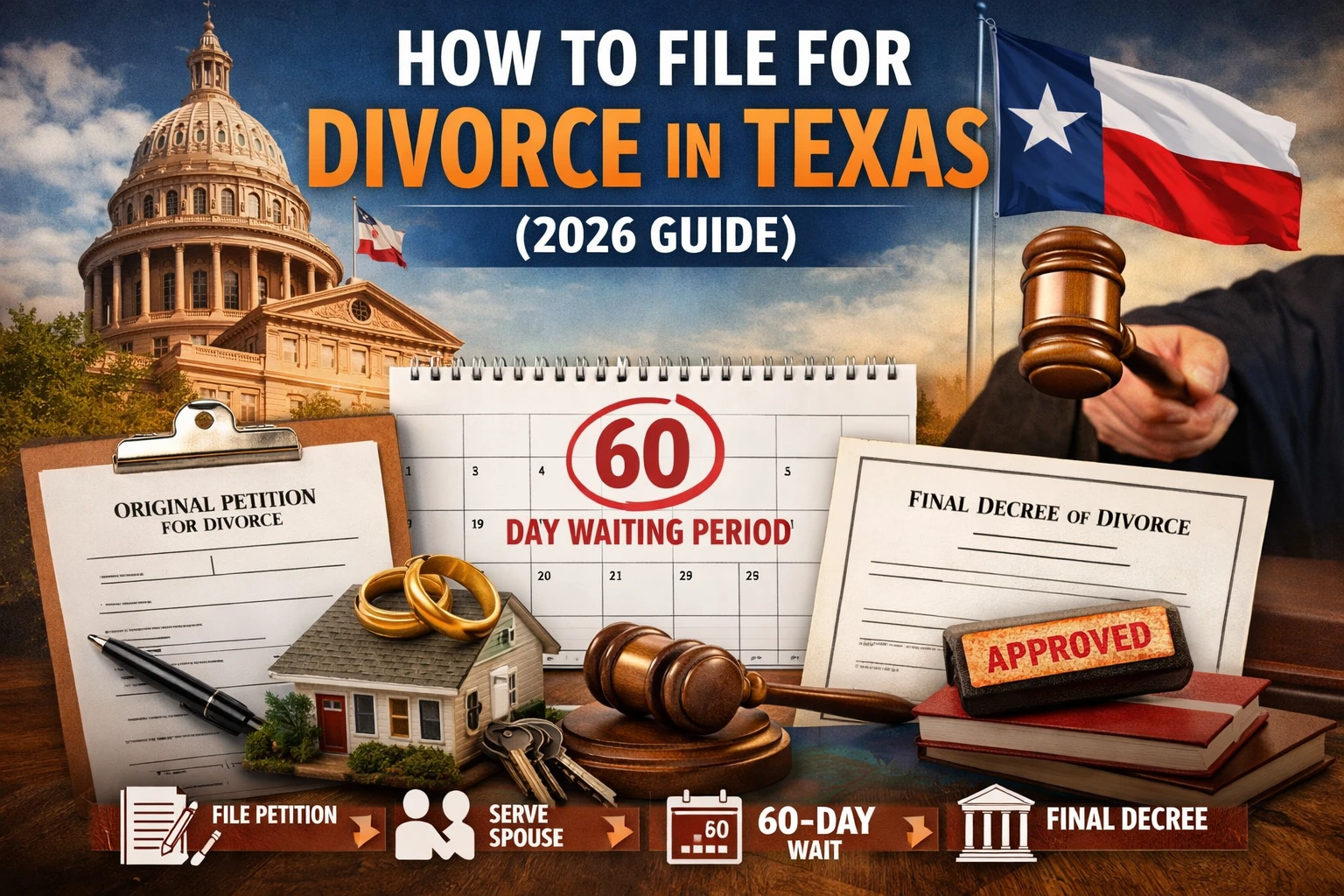
Texas law imposes a mandatory 60-day waiting period from the date the Original Petition is filed before a judge can grant your divorce. This period is designed to give couples time to reconcile, though the court cannot force it.
The 60-day clock starts the day you file, not the day your spouse is served. If your spouse delays signing the Waiver of Service or filing an Answer, that time still counts. In contested cases, discovery and negotiation typically extend the timeline far beyond 60 days.
Use this waiting period productively. Finalize your property division details, update beneficiary designations on life insurance and retirement accounts, and gather the financial documents you will need for the final hearing. The Texas Family Code provisions on divorce waiting periods confirm that no divorce can be finalized before this period elapses.
The 60-day waiting period is a floor, not a ceiling. In an uncontested divorce where both spouses cooperate, you can realistically finalize shortly after day 60. In a contested case, expect the process to take several months or longer.
Choosing the right path among the 4 ways to file for divorce in Texas depends on whether your divorce is contested or uncontested and whether you have minor children. The fastest, most affordable route is an uncontested filing where both spouses agree, and that is where Ready Divorce Service provides expert guidance and accurate document preparation to keep your filing fully compliant with Texas law. Get started with Ready Divorce Service by completing our questionnaire and take the first step toward your final decree.
Frequently Asked Questions
What is the easiest way to get divorced in Texas?
The easiest way to file for divorce in Texas is an uncontested divorce. This requires you and your spouse to agree on all issues, including property division and debts, before filing. You can then submit the Original Petition for Divorce together, often using a document preparation service. This path avoids court hearings and lengthy negotiations, making the process faster and less stressful than a contested divorce.
How much does it cost to get a simple divorce in Texas?
The primary cost to file for divorce in Texas is the filing fee paid to the county clerk, which varies by county. There are also fees for serving your spouse with papers. If you cannot afford the fee, you can file an indigency affidavit to have it waived. Beyond court costs, expenses depend on whether you hire a lawyer or use a document preparation service. Check with your specific district court for the exact fee schedule.
Do you need a lawyer to file for divorce in Texas?
No, you can file for divorce in Texas without a lawyer by representing yourself, which is known as filing pro se. Many couples with straightforward situations choose this route to save money. However, you must ensure your paperwork is accurate and compliant with state law. A document preparation service can help you complete the forms correctly, while a lawyer is recommended for complex cases involving significant assets or disputes.
What is the 10 year rule in divorce in Texas?
The ’10-year rule’ in Texas refers to spousal maintenance, not the divorce process itself. If your marriage lasted 10 years or longer, a court may award you spousal maintenance if you lack sufficient property to meet your needs and cannot support yourself. This is a key factor in contested divorces. It does not change the 60-day waiting period or the grounds for divorce you must cite.