Table of Contents
- What Is a No-Fault Divorce in Texas?
- Texas Divorce Residency Requirements
- The 60-Day Waiting Period and Timeline
- How Long Does a Divorce Take in Texas?
- Uncontested Divorce Texas Process: Filing and Documentation
- No-Fault vs. Fault-Based Divorce: Key Differences
- Common Mistakes to Avoid in Your Filing
- Conclusion
Last Updated: August 22, 2026
What Is a No-Fault Divorce in Texas?
A no-fault divorce in Texas is a legal dissolution of marriage where neither spouse must prove wrongdoing by the other. Instead, the petitioner simply states that the marriage has become insupportable due to conflict or personality differences, with no reasonable expectation of reconciliation. This is the most common pathway for ending a marriage in Texas and forms the foundation of the state’s modern divorce law.
The key distinction is straightforward: you don’t need evidence of adultery, cruelty, abandonment, or conviction of a felony. Texas recognizes insupportability as grounds for divorce, meaning the relationship is fundamentally broken and cannot be repaired. This approach removes the adversarial burden of proving fault and allows couples to move forward more efficiently.
Ready Divorce Service helps Texas residents navigate this process by providing step-by-step guidance on filing requirements and document preparation. Since no-fault divorce is the default option in Texas, understanding how it works is essential before you file anything.
Texas Divorce Residency Requirements
Before you file for divorce in Texas, you must meet specific residency criteria. Texas requires that at least one spouse be a domiciliary resident of the state for at least six months immediately preceding the filing of the petition (statutes.capitol.texas.gov). Additionally, the petitioner must have been a resident of the county where the divorce is filed for at least 90 days (statutes.capitol.texas.gov).
These residency requirements establish jurisdiction and ensure Texas courts have the authority to grant the divorce. If you’ve recently moved to Texas or are considering filing in a specific county, timing matters. The 90-day county requirement begins when you establish residency there, not when you became a Texas resident overall.
Here’s what this means in practice: if you moved to Texas six months ago but only arrived in your current county three months ago, you can file for divorce now. The six-month state requirement is satisfied, and you’ve met the 90-day county threshold. However, if you arrived in the county only 60 days ago, you’ll need to wait another 30 days before filing.
If you’re unsure whether you meet the residency requirements, document the exact dates you arrived in Texas and your current county. Ready Divorce Service can review your timeline to confirm eligibility before you invest time in preparing documents.
The 60-Day Waiting Period and Timeline
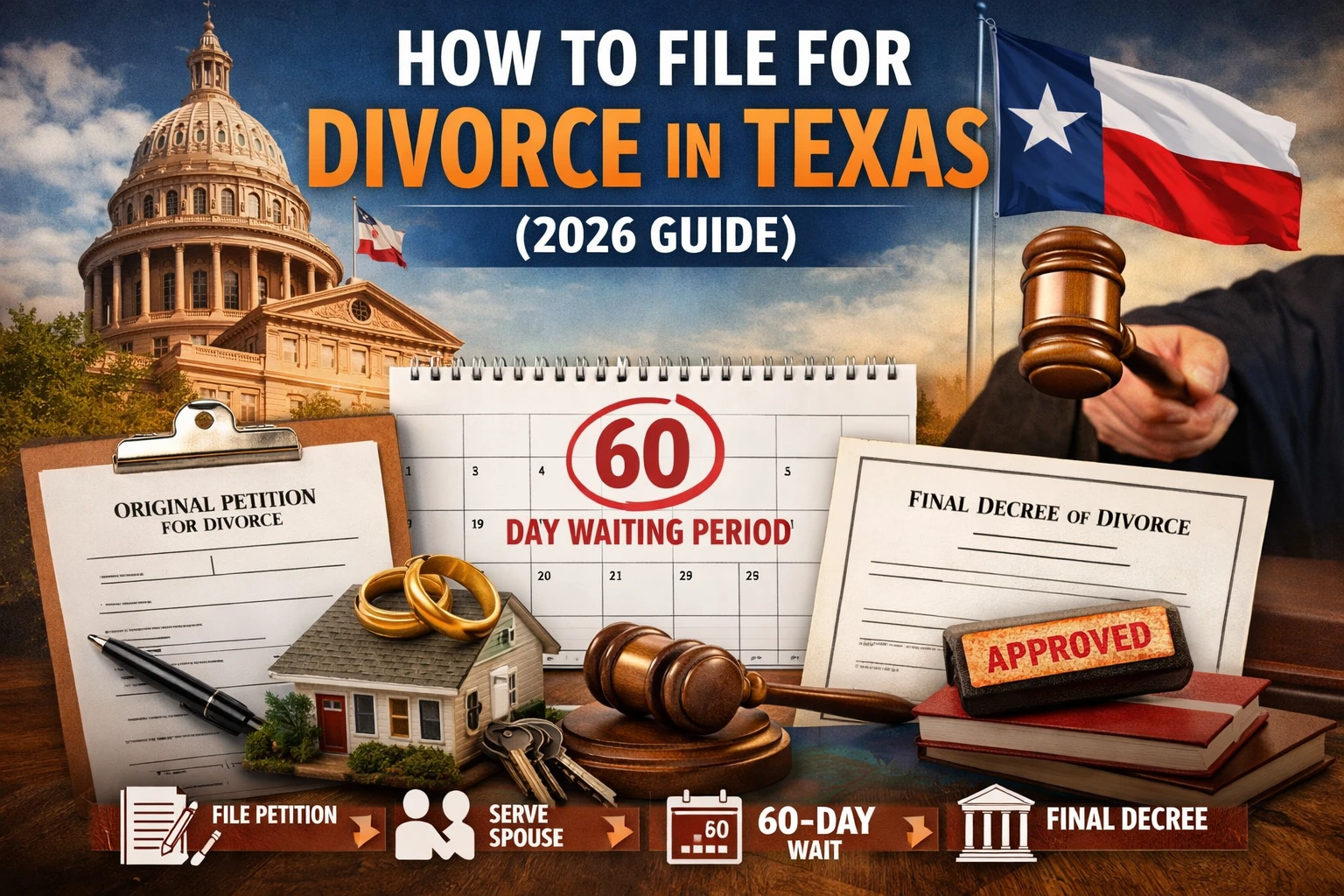
Texas imposes a mandatory 60-day waiting period from the date the divorce petition is filed until the divorce can be finalized (statutes.capitol.texas.gov). This cooling-off period is built into state law and cannot be waived, even if both spouses agree. The waiting period begins the day the respondent is served with the petition or the day they sign a waiver of service.
The 60-day clock is non-negotiable. You cannot obtain a final divorce decree before this period expires, regardless of how quickly you complete paperwork or reach agreements. However, the waiting period does not prevent you from negotiating terms, signing settlement agreements, or preparing all final documents during this time. Many couples use these 60 days productively to finalize their divorce decree with all terms already settled.
After the 60 days have passed, you can request a final hearing before the district court judge. If your divorce is uncontested and all paperwork is in order, the judge may grant the divorce without requiring you to appear in person.
The 60-day waiting period is mandatory and cannot be shortened. Use this time to finalize agreements and ensure all documents are accurate and complete.
How Long Does a Divorce Take in Texas?
The actual duration of your divorce depends heavily on whether it is contested or uncontested. An uncontested divorce with no disputes over property, custody, or support can be finalized in approximately 60 days, the mandatory waiting period plus a few days for final processing.
A contested divorce, where spouses disagree on major issues, typically takes much longer. These cases may require multiple court appearances, discovery processes, mediation sessions, and temporary orders hearings. Contested divorces in Texas commonly take between four and twelve months, though complex cases involving significant assets, business interests, or custody disputes can extend beyond a year.
Several factors influence how quickly your divorce progresses. The complexity of your financial situation matters, couples with significant assets, multiple properties, or business ownership need more time to divide community property fairly. The presence of minor children also extends the timeline, as the court must establish custody and support arrangements that serve the children’s best interests. Court docket availability affects timing as well, as some districts move cases through the system faster than others.
For uncontested divorces where both spouses cooperate, the process is straightforward: file the petition, serve the respondent, wait 60 days, submit the final decree, and obtain the judge’s signature. Ready Divorce Service specializes in simplifying this timeline for couples who have already reached agreement on all terms.
If your divorce becomes contested during the process, expect the timeline to extend significantly. Disputes over custody or property division require court intervention and cannot be rushed.
Uncontested Divorce Texas Process: Filing and Documentation
An uncontested divorce in Texas follows a clear procedural path once you’ve prepared the necessary documents. The petitioner files the petition with the district court clerk, pays the filing fee, and arranges service of process on the respondent. If the respondent agrees to the divorce terms and signs a waiver of service, the process moves forward without court hearings.
The uncontested pathway assumes both spouses have agreed on all material issues: property division, custody arrangements, child support, spousal support, and any other relevant terms. This agreement should be documented in a settlement agreement or divorce decree that both parties sign before or shortly after filing.

Required Documents and Forms
Your petition for divorce must include specific information required by Texas law. The civil case information sheet identifies the case type, the parties involved, and basic facts about the marriage. The petition itself states the grounds for divorce (insupportability in a no-fault case), lists any children of the marriage, and describes the relief sought. mortgage calculations after divorce.
If you and your spouse have agreed on all terms, you’ll also prepare a final decree of divorce. This document outlines the complete settlement: how community property is divided, custody and visitation arrangements, child support amounts, spousal support if applicable, and any other agreed-upon terms. Both spouses must sign the decree before the judge can approve it.
Required documents typically include:
- Original petition for divorce
- Civil case information sheet
- Final decree of divorce (with agreed terms)
- Waiver of service (if applicable)
- Any required disclosures of assets and debts
- Child support guidelines worksheet (if minor children are involved)
- Parenting plan or custody agreement (if minor children are involved)
Ready Divorce Service ensures all documents comply with Texas court requirements and are properly formatted for filing. Small errors in paperwork can delay your case, so accuracy is essential.
Service of Process and Waiver Options
Service of process means officially notifying the respondent that a divorce petition has been filed. Texas law requires that the respondent receive proper notice before the court can proceed. The most formal method is hiring a process server or sheriff’s deputy to deliver the petition and citation to the respondent in person, creating a documented record that service occurred.
Alternatively, if the respondent agrees to the divorce, they can sign a waiver of service. This document acknowledges receipt of the petition and waives the requirement for formal service by a process server. A waiver of service is common in uncontested divorces and saves time and expense.
If your spouse is cooperative, request a waiver of service in writing before filing. This speeds up the process and demonstrates to the court that both parties are working together toward resolution.
No-Fault vs. Fault-Based Divorce: Key Differences
Texas allows both no-fault and fault-based grounds for divorce, but they operate very differently in practice. A no-fault divorce requires only that one spouse declare the marriage is insupportable with no reasonable expectation of reconciliation. No proof of misconduct is necessary.
Fault-based grounds, by contrast, require proving specific wrongdoing by the other spouse. Texas recognizes several fault grounds: adultery, cruelty, abandonment, conviction of a felony, living apart for at least three years, and confinement in a mental hospital. Each requires evidence to support the claim.

The practical difference is significant. A no-fault divorce is faster and less adversarial because neither spouse needs to gather evidence or prove misconduct. Fault-based divorces often become contentious because proving fault requires testimony, documents, and sometimes expert witnesses.
However, fault grounds can influence property division and custody arrangements in some cases. If one spouse committed adultery or cruelty, the court may award a larger share of community property to the innocent spouse or consider the fault when determining custody if it affects the children’s best interests. For most couples, especially those seeking to minimize conflict and expense, no-fault divorce is the better option.
Common Mistakes to Avoid in Your Filing
The most frequent error couples make is incomplete or inaccurate paperwork. Missing information, incorrect names, or wrong case numbers can cause the court to reject documents and delay your divorce. Double-checking every form against Texas court requirements before filing is essential.
Another common mistake is failing to properly serve the respondent. If service is improper or the respondent claims they never received notice, the court may dismiss the case. Using a process server or obtaining a signed waiver of service protects you from this problem.
Many people underestimate the importance of the settlement agreement or final decree. Vague language about property division or custody can lead to disputes later or prevent the judge from approving the decree. Every asset should be clearly identified and assigned to one spouse or divided with specific percentages.
Failing to disclose all assets and debts is a serious mistake that can invalidate your divorce decree. Texas law requires full disclosure of community property and separate property. Hiding assets or downplaying debt creates legal liability and may result in the court setting aside the final decree.
Not addressing minor children adequately is another critical error. If you have children, you must establish custody, visitation, and child support. Vague parenting arrangements or failure to follow child support guidelines can lead to court intervention and modification requests later.
Incomplete or inaccurate paperwork is the leading cause of divorce filing rejections. Take time to verify every detail before submitting documents to the court clerk.
Ready Divorce Service helps you avoid these pitfalls by reviewing your documents for accuracy and compliance with Texas law before you file. This preventive approach saves time, money, and stress.
Navigating a no-fault divorce in Texas requires understanding residency requirements, the mandatory 60-day waiting period, and proper filing procedures. The process is straightforward for couples who have reached agreement on all terms, but mistakes in documentation or procedure can derail your case. Ready Divorce Service specializes in guiding Texas residents through uncontested divorce with accurate document preparation and step-by-step support. Get started with Ready Divorce Service and complete your divorce process with confidence and clarity.
Frequently Asked Questions
What does 'insupportability' mean in a Texas no-fault divorce?
Insupportability is the legal term for irreconcilable differences, essentially, the marriage has broken down and there is no reasonable expectation of reconciliation. In Texas, you don't need to prove wrongdoing or assign blame. Either spouse can file based on insupportability alone, making it the simplest ground for a no-fault divorce. The court accepts this as sufficient reason to grant a divorce without requiring evidence of fault.
Do you need a lawyer for a no-fault divorce in Texas?
No, you do not legally require a lawyer for a no-fault, uncontested divorce in Texas. Many individuals file pro se (without an attorney), especially when both spouses agree on terms. However, proper document preparation and compliance with Texas court rules are critical. Mistakes in paperwork can delay your case or result in rejection. Working with a document preparation service ensures accuracy and reduces the risk of costly errors.
How long does a no-fault divorce take in Texas?
The minimum timeline is 60 days from the date the petition is filed, plus service of process time. In uncontested cases where both spouses agree on all terms, the process typically takes 60 to 90 days. However, if there are delays in serving the respondent, scheduling the final hearing, or court backlogs, it can extend longer. The 60-day waiting period is mandatory and cannot be waived except in limited domestic violence situations.
What are the residency requirements for filing a no-fault divorce in Texas?
At least one spouse must be a resident of Texas for a minimum of 6 months before filing, and the petitioner must have resided in the county where the case is filed for at least 90 days. These residency requirements establish the court's jurisdiction. If you don't meet these requirements, you cannot file in Texas. The petition must be filed in the district court of the county where you or your spouse lives.
This article was written using GrandRanker