Table of Contents
- What You’ll Need Before You Start
- Understanding Uncontested Divorce Requirements
- How to Prepare Divorce Papers Step by Step
- Texas Divorce Forms Online for Couples
- Common Mistakes in Divorce Paperwork to Avoid
- Filing Your Papers and What Comes Next
- Conclusion
Last Updated: August 19, 2026
What You’ll Need Before You Start
Gather your marriage certificate, identification, Social Security number, and driver’s license. Collect financial records: bank statements, mortgage documents, retirement account statements, property deeds, car titles, and credit card statements. If you have minor children, gather birth certificates and any existing custody or support agreements. Creating a checklist can help prevent discovering halfway through that you’re missing a critical document.
Determine whether your divorce is uncontested, meaning you and your spouse agree on property division, custody, support, and all major terms. Most couples filing pro se (representing themselves) do so because they’ve already reached an agreement and want to avoid attorney fees.
Verify your county’s specific requirements by contacting your district court clerk’s office or visiting the court’s website to confirm which forms are required.
Before you start filling out any forms, create a folder (digital or physical) with all your documents organized by category: financial, property, children, and personal identification. This single step cuts preparation time by hours and dramatically reduces errors.
Understanding Uncontested Divorce Requirements
An uncontested divorce means both spouses agree on all material terms and are willing to sign the necessary documents. This is the fastest, least expensive path to ending a marriage in Texas.
Texas law requires that you have been married in Texas or lived in Texas for at least six months before filing. You must also satisfy the 60-day waiting period mandated by state law, the earliest your divorce can be finalized is 60 days after filing your petition.
Both spouses must sign all required documents, including the petition, marital settlement agreement, and financial affidavit. You must disclose all community property and debts. Texas is a community property state, meaning most assets and debts acquired during the marriage belong equally to both spouses, regardless of whose name appears on the account or title. Incomplete financial disclosure is one of the leading reasons courts reject divorce filings.
If you have minor children, you’ll need a parenting plan that addresses custody, visitation, and child support. Texas courts prioritize the best interest of the child, so your agreement must demonstrate that both parents have meaningful involvement in the child’s life unless circumstances warrant otherwise.
Uncontested divorce works only when both spouses genuinely agree on all terms and are willing to sign the documents. If your spouse is unwilling to cooperate or disputes any major issue, you need a contested divorce process or legal representation.
How to Prepare Divorce Papers Step by Step
Preparing divorce papers correctly requires following a specific sequence. Start with the petition, move to financial documentation, then draft your settlement agreement.
Step 1: Obtain and Review the Correct Texas Divorce Forms
Texas provides standardized forms for uncontested divorces on the Texas Supreme Court’s official website. Download the most current versions, using outdated forms is a frequent error that leads to court rejection.
The core forms you’ll need are:
- Petition for Dissolution of Marriage, the document that initiates your divorce case
- Marital Settlement Agreement, the agreement detailing how you’ll divide property, assets, and debts
- Financial Affidavit, a sworn statement of your income, expenses, assets, and liabilities
- Proof of Service, documentation that you’ve served your spouse with the petition
- Order Granting Divorce, the final document the judge signs to finalize your divorce
Review each form carefully and read the instructions provided. Printing all forms and reviewing them with your spouse before completing anything can help prevent disagreements later.

Step 2: Complete the Petition for Dissolution of Marriage
The petition is the formal request to the court to end your marriage. Fill in your full legal name, your spouse’s full legal name, and your county of residence. The petition must be filed in the county where you or your spouse has lived for at least 90 days preceding the filing. Include the date you were married and the date of separation. If you have minor children, list their names and dates of birth.
State that your marriage has become insupportable due to discord or conflict of personalities that prevents any reasonable expectation of reconciliation. This is Texas’s no-fault ground for divorce. Describe your desired custody arrangement, if applicable, using clear language. Include a statement about property division: "The petitioner and respondent have agreed to a division of community property as detailed in the attached Marital Settlement Agreement."
Sign and date the petition. You’ll need to have your signature notarized, many banks, UPS stores, and legal document services offer notarization for a small fee.
Step 3: Prepare Your Financial Affidavit
The financial affidavit is a sworn statement of your financial situation. Courts require this document to verify that you’ve fully disclosed your income, expenses, assets, and debts.
List all sources of income: employment wages, self-employment income, rental income, retirement distributions, and any other money you receive regularly. Include your spouse’s income as well. Document all monthly expenses: rent or mortgage, utilities, insurance, groceries, childcare, transportation, and any debt payments.
List all assets with their approximate values: bank accounts, retirement accounts, vehicles, real estate, jewelry, and any other property of significant value. List all debts: mortgages, car loans, credit cards, medical debt, and student loans. Include the creditor name, account number, and current balance. Failing to disclose debts is a serious error that can result in court rejection. sell a house.
Sign the affidavit before a notary public.
Step 4: Draft the Marital Settlement Agreement
The marital settlement agreement is the contract between you and your spouse that details how you’ll divide property, allocate debt, and arrange custody.
Start with identification. Name both spouses and include the case number once it’s assigned. State that you’re entering into this agreement voluntarily and with full understanding of your rights.
Address property division by listing each significant asset and specifying who receives it. Example: "Wife shall receive the home located at [address], including all equity therein, and shall be responsible for the mortgage." Be specific about vehicles, bank accounts, retirement accounts, and personal property.
Address debt division by specifying who is responsible for each debt. Example: "Husband shall be responsible for the credit card account ending in 4567, currently owed to [creditor] in the amount of $[amount]."
If you have minor children, include a detailed parenting plan specifying custody (sole or joint), primary residence, visitation schedule, and decision-making authority for education, medical care, and religious upbringing. Include a child support amount if applicable.
Both spouses must sign the agreement before a notary public.
A common mistake is leaving financial or custody terms vague in the settlement agreement. Every term must be specific and measurable.
Step 5: Organize and Verify All Documentation
Before filing, organize all your documents in the order the court expects and verify that everything is complete and accurate.
Create a checklist:
- Petition for Dissolution of Marriage, signed and notarized
- Marital Settlement Agreement, signed and notarized by both spouses
- Financial Affidavit, signed and notarized
- Proof of Service (completed after you serve your spouse)
- Cover sheet (required by some courts)
- Filing fee receipt or fee waiver documentation
- Copies of all documents for service on your spouse
Review each document one final time for spelling errors, incorrect dates, or missing information. Verify that all signatures match the names listed in the petition.
Texas Divorce Forms Online for Couples
The Texas Supreme Court provides free, official divorce forms on its website. These are the most current and legally compliant forms available. Using outdated forms from other websites is a common mistake that leads to rejection.
The official forms include detailed instructions that explain what information belongs in each blank. Many counties now offer e-filing options, allowing you to submit documents electronically rather than in person. Check your court’s website to see if e-filing is available.
Common Mistakes in Divorce Paperwork to Avoid
Most errors in divorce paperwork fall into predictable categories. Avoiding these mistakes dramatically increases the likelihood that your filing will be accepted on the first submission.
Incomplete Financial Disclosure is the most common reason courts reject divorce filings. Review your credit report to ensure you haven’t missed any debts. Vague Property and Debt Division doesn’t satisfy court requirements, every asset and debt must be explicitly assigned to one spouse or the other. Inconsistent Information Across Documents creates confusion. If your petition lists one asset value and your financial affidavit lists a different value, the court will question which is accurate.
Missing Signatures or Notarization is a legal requirement. A notary public’s signature is required on the petition, financial affidavit, and settlement agreement. Incorrect or Outdated Forms are risky, always download forms directly from the court’s official source. Failure to Serve Your Spouse Properly can delay your case or result in rejection. Unclear Custody or Parenting Plans are unacceptable, specify exact days, times, and holidays.
Before submitting your paperwork to the court, have someone you trust review it for errors. A fresh set of eyes often catches mistakes that the person who prepared the documents misses.
Filing Your Papers and What Comes Next
Once your paperwork is complete and your spouse has signed all required documents, you’re ready to file with the court.
Visit your county district court clerk’s office in person or check whether your court accepts e-filing. Bring the original petition, settlement agreement, financial affidavit, and any other required documents. Pay the filing fee, which varies by county but typically ranges from a few hundred dollars. If you cannot afford the fee, ask about fee waivers.

The court clerk will assign a case number and provide you with a file-stamped copy of your petition. You must serve your spouse with a copy of the petition and other documents. If your spouse is cooperating, you can often use certified mail or hand delivery. File a "Proof of Service" with the court documenting how and when you served your spouse.
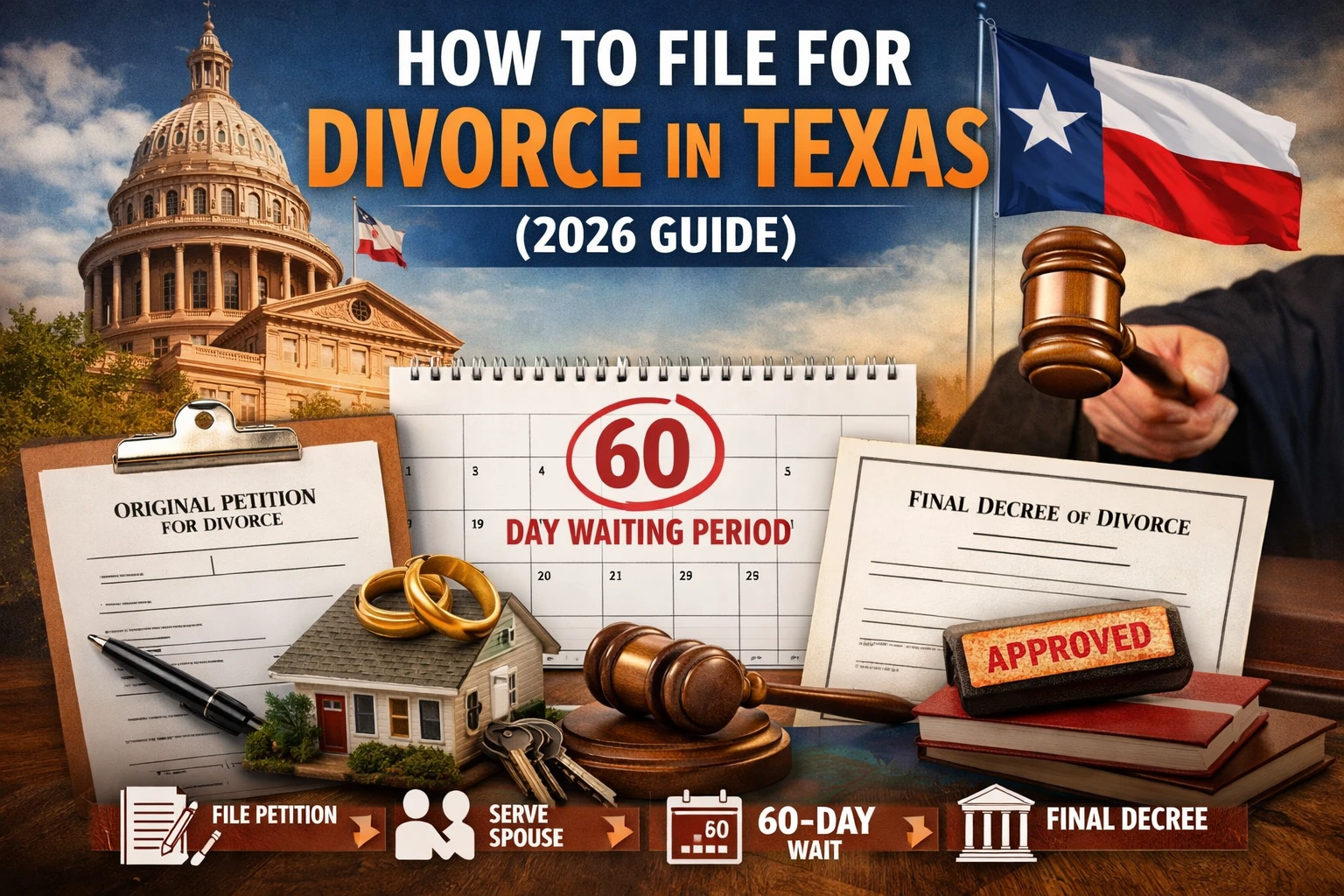
The 60-day waiting period begins on the date you file your petition. If both spouses remain in agreement and no issues arise, the divorce can be finalized at the end of 60 days. Approximately 60 days after filing, the court will issue a final decree of divorce. This document officially ends your marriage. After the divorce is finalized, you’ll need to update your identification documents, change your name if desired, update insurance beneficiaries, and modify your will or other legal documents.
Preparing divorce papers correctly requires attention to detail, complete financial disclosure, and clear communication with your spouse about all terms. The most common mistakes, incomplete forms, vague property division, and missing signatures, are entirely preventable if you follow a systematic approach and verify your work before filing.
Ready Divorce Service specializes in guiding Texas residents through this process with accuracy and efficiency. Our step-by-step guidance ensures your documents comply with state law and are complete before submission, dramatically reducing the risk of court rejection. Whether you’re navigating an uncontested divorce with minor children or dividing significant assets, our team helps you prepare documents that stand up to court scrutiny. Start with a questionnaire to understand your specific situation and receive personalized guidance tailored to your needs.
Frequently Asked Questions
What is the biggest mistake people make when preparing divorce papers?
The most common error is incomplete or inaccurate financial disclosure. Many pro se filers underreport assets, forget to include all debts, or fail to properly value marital property. This can lead to the court rejecting your filing or, worse, invalidating your entire settlement. Always review your financial affidavit multiple times and ensure every account, property, and debt is listed with current values. Courts take this documentation seriously, and errors here delay your case significantly.
Can I prepare my own divorce papers without a lawyer?
Yes, you can prepare your own divorce papers if your divorce is uncontested, meaning you and your spouse agree on all major issues including property division, debt allocation, and child custody if applicable. Many people successfully file pro se by carefully following court-approved forms and instructions. However, accuracy is critical. Even small mistakes in form completion, notarization, or service of process can result in rejection or delays. Consider professional document review if you're uncertain about any section.
What documents are required to file for an uncontested divorce?
The core documents include the Petition for Dissolution of Marriage, a Financial Affidavit (detailing all income, assets, and debts), and a Marital Settlement Agreement outlining how you've divided property, debt, and custody arrangements. You'll also need proof of service showing your spouse was properly notified, a case number from the court clerk, and any sworn statements required by your county. Some courts may require additional forms depending on whether minor children are involved. Always check your specific court's website for the complete list.
What happens if I make an error in my divorce filing?
Minor errors may be corrected through an amended filing, but significant mistakes, such as incorrect case numbers, improper notarization, or incomplete financial disclosure, can result in your petition being rejected or dismissed. The court clerk will typically notify you of defects, and you'll have a deadline to correct them. This process extends your timeline and adds stress. That's why careful review before filing, using court-approved forms, and ensuring all signatures and notarizations are proper is essential to avoid costly delays.
This article was written using GrandRanker