Table of Contents
- What You Need Before Filing for an Uncontested Divorce
- Texas Divorce Forms Requirements
- Texas Divorce Filing Fees and Court Costs
- The Uncontested Divorce Waiting Period in Texas
- Step-by-Step Filing Checklist
- Common Filing Mistakes to Avoid
- Post-Filing Checklist and Next Steps
- Frequently Asked Questions
Last Updated: October 3, 2026
What You Need Before Filing for an Uncontested Divorce
An uncontested divorce checklist helps you organize the paperwork and stay on track. Filing for an uncontested divorce in Texas requires preparation, agreement between spouses, and the right documents.
An uncontested divorce requires both spouses to agree on all major issues: property division, child custody, and support. If you agree on everything, an uncontested divorce is faster and cheaper than a contested one.
Eligibility Requirements
To file for an uncontested divorce in Texas, at least one spouse must have lived in Texas for six months and in the filing county for at least 90 days. You need a valid marriage certificate or proof of common-law marriage. Both spouses must be 18 or older, mentally competent, and in agreement on all terms.
Agreements You Must Reach
Before filing, you and your spouse must agree on every major issue in an uncontested divorce checklist: property and debt division, child custody and support (if applicable), spousal support, health insurance coverage, and tax filing status. If you cannot agree on any issue, your divorce becomes contested and takes longer and costs more.
Texas Divorce Forms Requirements
Filing for an uncontested divorce in Texas requires specific court-approved forms. Each of the 254 counties maintains its own approved forms, and using the wrong county’s version causes rejection.
Required Legal Documents
Core documents required in virtually all Texas counties include: Original Petition for Divorce, Waiver of Service, Agreed Decree of Divorce, Marital Property Division Agreement, Parenting Plan (if children involved), Child Support Agreement (if applicable), Financial Affidavit, and Domestic Relations Information Sheet. Some counties require additional documents. Each form must be completed accurately; missing information or blank fields cause rejection.
A common and costly mistake is using outdated forms from old websites or forms from a different county. Texas courts strictly enforce form compliance. Using a form from Harris County (Houston) in Tarrant County (Fort Worth) will result in rejection, and you will have to refile and restart the 60-day waiting period. Always verify the current date on the form and confirm it is approved by your specific county.
How to Locate Your County’s Approved Forms
Get forms from your county district court clerk’s office website by searching “[Your County Name] Texas District Court” and navigating to the Family Law or Divorce Forms section.
Obtain forms via: (1) County Clerk’s Website, fastest and most reliable; (2) In-Person Visit, staff can verify completeness (8 a.m.-5 p.m. weekdays); (3) Phone or Email Request, many offices mail or email forms upon request.
When you visit or call the clerk’s office, ask if they have an instruction sheet or checklist specific to uncontested divorces. Many counties provide a one-page guide showing which forms are required, in what order they should be filed, and common completion errors to avoid. This document is invaluable and often free.
County-Specific Variations to Expect
Expect county variations in form names, formatting, additional requirements (such as Certification of Informal Discovery or SAPCR cover sheets), signature and notarization rules, and filing instructions (number of copies, paper stock, submission procedures).
Common Form Completion Errors That Cause Rejection
Common errors causing rejection: incomplete Financial Affidavit (use exact figures from tax returns, pay stubs, bank statements); inconsistent information across forms (matching asset values and support amounts); missing or illegible notarized signatures; incorrect case caption (typos cause rejection); vague parenting plans (specify custody type, exact visitation schedules, and decision-making authority); missing signature lines on required forms.
If your filing is rejected, the clerk will typically provide a written explanation of what is missing or incorrect. However, you must then correct the documents, refile, and restart the 60-day waiting period. This can add 2-3 months to your timeline. Review every form multiple times before submitting to avoid this costly mistake.
Texas Divorce Filing Fees and Court Costs
Filing fees typically range from $200-$500 by county; check your county clerk’s website for exact amounts. Additional costs include service of process ($50-$150 if needed), certified copy fees ($5-$15 each), and publication costs (rare in uncontested cases).
Ask your county clerk if fee waivers are available based on income. Some Texas counties offer reduced or waived filing fees for low-income filers. This can save you hundreds of dollars.
The Uncontested Divorce Waiting Period in Texas
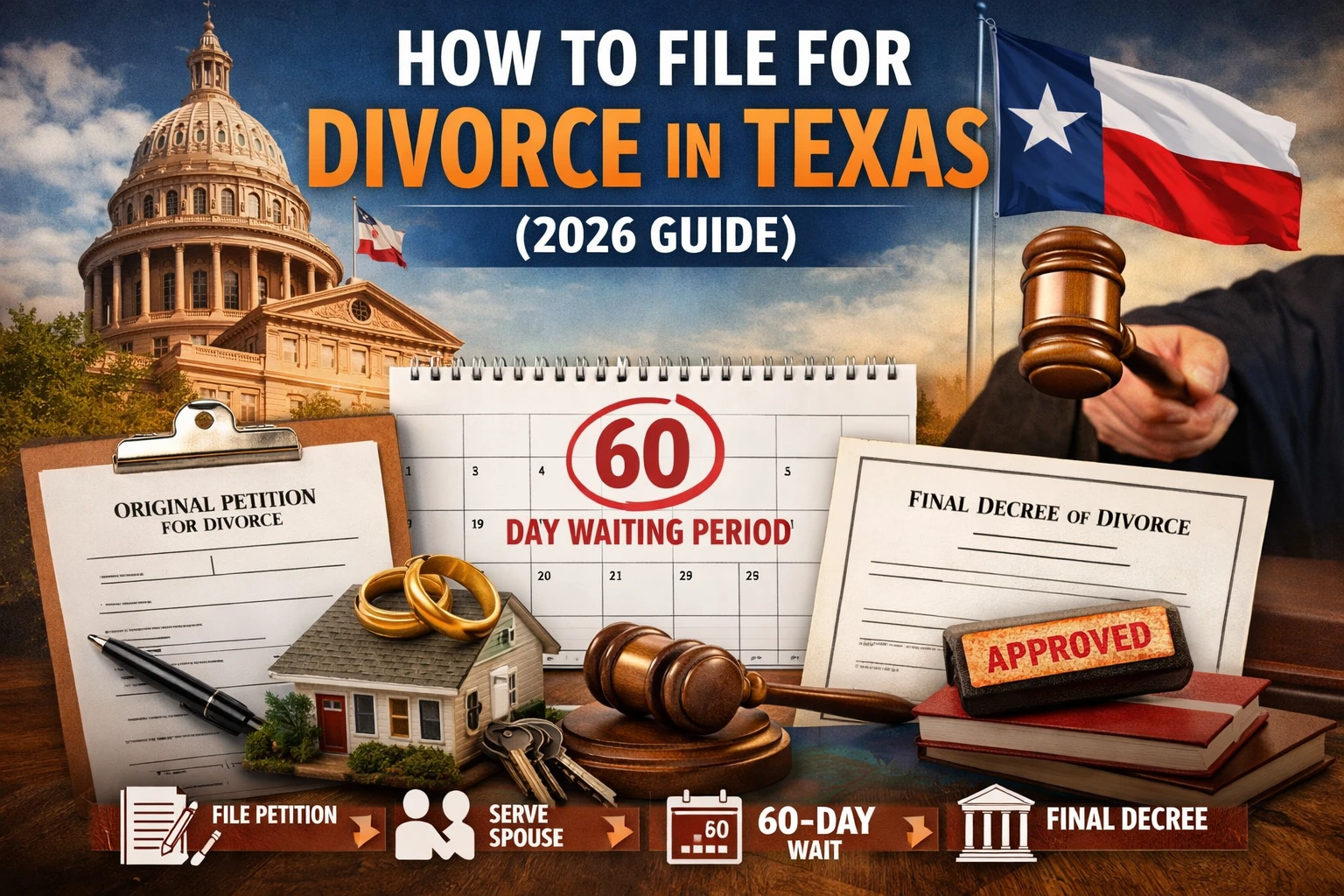
Texas law requires a minimum 60-day waiting period from the filing date before you can finalize your divorce. This period gives spouses time to reconsider and ensures thoughtful decision-making. You cannot skip it, even in uncontested cases. Use this time to confirm all terms are correct; once you sign the final decree, changes become difficult.
Step-by-Step Filing Checklist
Before You File
Preparation prevents mistakes and delays. Complete these steps before submitting anything to the court:
- Gather all financial documents (bank statements, tax returns, retirement account statements)
- List all assets and debts with your spouse
- Create a detailed parenting plan if children are involved

The most important step before filing is ensuring both spouses genuinely agree on everything. Disagreements discovered after filing waste time and money. Spend extra time on this step.
Filing with the Court
Once you have completed all documents, file them with the district court clerk:
- Visit or contact your county district court clerk’s office
- Submit original documents and required copies
- Pay the filing fee (bring exact amount or check)
The clerk will assign your case a docket number. This number appears on all future court documents. Write it down and keep it safe.
After Filing
After filing, specific steps must be completed within the 60-day waiting period:
- Ensure your spouse receives proper service (waiver signed or process server used)
- File proof of service with the court
- Wait the full 60-day period
If you need guidance on Starting the Divorce Process, Ready Divorce Service can help you understand each requirement and ensure nothing falls through the cracks.
Common Filing Mistakes to Avoid
Avoid these common mistakes: incomplete Financial Affidavits (court needs specific numbers); missing notarized signatures (invalidates documents); wrong county forms (always use your county’s approved forms); forgetting to serve your spouse (court cannot proceed without proof of service); incorrect case information (typos cause rejections); missing copies (court needs multiple copies); incomplete parenting plans (must be detailed and specific).
Filing with mistakes is expensive. You may have to refile, paying filing fees again and restarting the waiting period. Take time to review everything before submitting.
Post-Filing Checklist and Next Steps
After you file your uncontested divorce petition, your case enters a structured process governed by the 60-day waiting period and court review procedures. Understanding what happens at each stage prevents anxiety and helps you stay organized.
Immediately After Filing (Days 1-5)
After filing, within 3-5 business days: confirm receipt with the clerk’s office, obtain a stamped petition copy, serve your spouse (or file their signed Waiver of Service), file proof of service, and organize your case file with all documents and the case number.
If your spouse signed a Waiver of Service, file it immediately. This waives the formal service requirement and allows the waiting period to begin. If service is delayed, the waiting period does not start until proof of service is filed.
During the 60-Day Waiting Period (Days 6-60)
During the 60-day waiting period: monitor for court requests and respond within 10-14 days; verify proof of service was filed; review all agreements to confirm accuracy; gather additional documentation if requested; prepare the final decree for submission around day 50 (must be signed and notarized); avoid major financial changes; do not update beneficiaries until after the divorce is final.
If the court requests additional information and you do not respond within the deadline, the judge may delay finalizing your divorce or, in rare cases, reject the agreement. Always respond to court requests promptly, even if the request seems minor.
Preparing for Final Decree Submission (Days 50-60)
As the waiting period nears its end: ensure both spouses have signed and notarized the Agreed Decree (verify notarization requirements with your county clerk); prepare the submission package with the decree, supporting agreements, and a brief cover letter; include a proposed order if required by your county; make three copies; submit before day 60 to avoid restarting the waiting period.
The final decree is the most important document in your divorce. Once the judge signs it, your marriage is legally dissolved. Take time to ensure it is accurate and complete before submitting it.
Judge Review and Signature (Days 60-90)
After submitting the final decree: the judge will review the Agreed Decree, Financial Affidavits, and any parenting plans or support agreements for compliance with Texas law and fairness. In most uncontested cases, the judge signs without a hearing, but some judges request a brief hearing to confirm both spouses understand and agree.
Receiving and Finalizing Your Divorce (Days 90+)
Once the judge signs the final decree: receive notice of the signed decree; obtain 5-10 certified copies ($5-$15 each) for name changes, beneficiary updates, and property refinancing; update your driver’s license, Social Security records, passport, and voter registration; notify your employer, insurance companies, banks, and creditors; update beneficiary designations on life insurance and retirement accounts; refinance or retitle property if needed; file your final tax return; archive documents in a safe place for at least 7 years.
Certified copies of your final decree are essential. Do not rely on a single copy. Order extras and store them safely. You will likely need them for name changes, property transfers, and updating insurance or financial accounts.
Timeline Summary
Here is a typical timeline for an uncontested divorce in Texas:
- Day 1, File petition and documents with the court clerk
- Days 1-5, Court dockets case and assigns case number; you arrange service of spouse
- Days 6-60, 60-day waiting period; court may request additional information
- Days 50-60, You submit signed and notarized final decree to the judge
Total time from filing to final decree: typically 90-120 days if everything is completed correctly and no complications arise. If you’re unsure which uncontested divorce package is right for you, consider exploring your options to find the support level that fits your situation.
Frequently Asked Questions
What is the first step to filing for an uncontested divorce in Texas?
The first step is ensuring you meet eligibility requirements: you or your spouse must have lived in Texas for at least six months, and you must have lived in the county where you’re filing for at least 90 days. Next, you and your spouse must reach written agreements on all key issues, including property division, spousal support, and child custody if applicable. Once you have these agreements in place, you’ll prepare your petition and required forms. Ready Divorce Service can guide you through this entire initial process to ensure accuracy and compliance with Texas law.
Do I need a lawyer for an uncontested divorce in Texas?
No, you do not need a lawyer for an uncontested divorce in Texas. Since both spouses agree on all terms, you can file pro se (representing yourself) by completing the required forms and following the filing procedures. However, having professional guidance to ensure your documents are accurate and complete can prevent costly court rejections. Many individuals use document preparation services to review their forms and ensure full compliance with Texas requirements, which is more affordable than traditional legal representation.
How long is the mandatory waiting period for an uncontested divorce in Texas?
Texas law requires a mandatory 60-day waiting period from the date you file your petition until the court can grant your final divorce decree. This waiting period applies to all divorces, whether contested or uncontested. During this time, you must serve your spouse with the divorce documents and allow them to respond. After the 60 days have passed and all agreements are finalized, the court can issue your Final Decree of Divorce. Understanding this timeline helps you plan for when your divorce will be officially complete.
What documents are required to file for divorce in Texas?
Required documents include the Original Petition for Divorce, a Domestic Relations Information Sheet, a Financial Affidavit (if there are assets or debts), a Parenting Plan and Child Support Agreement (if you have minor children), and a Marital Settlement Agreement detailing division of property and liabilities. You’ll also need a Waiver of Service or proof of service showing your spouse received the documents. The exact forms depend on whether you have children and the complexity of your assets. Texas courts provide standardized forms, and Ready Divorce Service can help ensure you complete each one correctly and completely.