Table of Contents
- Understanding Uncontested Divorce in Texas
- Eligibility Requirements and the 60-Day Waiting Period
- Required Suit Affecting the Parent-Child Relationship Forms
- Step-by-Step Filing Process and E-Filing Options
- Court Costs, Filing Fees, and Fee Waivers
- Organizing Your Documents and Creating a Filing Checklist
- What to Expect After Filing: Timeline and Next Steps
- Mediation vs. Litigation: Choosing the Right Path for Your Family
Last Updated: August 25, 2026
Understanding Uncontested Divorce in Texas
An uncontested divorce is a legal dissolution of marriage where both spouses agree on all major terms, including property division, child custody, child support, and spousal support, before filing with the court. This path eliminates lengthy litigation and allows couples to reach a final divorce decree more efficiently.
In Texas, an uncontested divorce still requires formal legal documents filed with the district court in your county. The process involves submitting a suit affecting the parent-child relationship (SAPCR) petition if you have minor children, along with a parenting plan, child support calculations, and other required forms. Even though you and your spouse agree, the court must verify that your settlement is fair and that custody arrangements serve the best interests of your children.
The biggest mistake couples make is treating an uncontested divorce as “no divorce at all.” You still need formal court approval. The upside: with agreement in place, you control the timeline and avoid surprise legal fees.
Eligibility Requirements and the 60-Day Waiting Period
Before filing for divorce in Texas, at least one spouse must have been a resident of Texas for the six months immediately preceding the filing date, and you must have lived in your current county for at least 90 days before filing (statutes.capitol.texas.gov).
Texas imposes a mandatory 60-day waiting period from the date you file your original petition until the court can grant your final divorce decree (statutes.capitol.texas.gov). This cooling-off period applies to all divorces, contested or uncontested, and cannot be bypassed under any circumstances.
During this 60-day window, finalize your settlement agreement and ensure all documents are accurate and complete. The 60-day period starts from the date your original petition is filed with the district clerk, not from when your spouse is served.
The 60-day waiting period is non-negotiable in Texas. Have your settlement terms and documents finalized well before day 60 arrives, so you’re ready to submit to the judge for approval.
Required Suit Affecting the Parent-Child Relationship Forms
If you have minor children, Texas requires you to file a suit affecting the parent-child relationship (SAPCR). This formal legal petition establishes custody, visitation, child support, and medical support obligations.
Original Petition and Waiver of Service
The original petition is your opening document. It states the grounds for divorce, identifies all parties (including minor children), and outlines the relief you’re seeking. In an uncontested divorce, your petition will include a statement that you and your spouse have reached an agreement on all issues.
The waiver of service is a signed, notarized document from your spouse acknowledging receipt of the divorce filing and waiving their right to formal service by a constable or process server. If your spouse signs a waiver, you avoid the cost and delay of hiring a process server. Without a valid waiver or proof of proper service, the court cannot move forward.
Parenting Plan Requirements in Texas
A parenting plan is a detailed document outlining how you and your spouse will share custody and make decisions about your children. Texas law requires this plan to address the primary residence of each child, the visitation schedule for the non-custodial parent, decision-making authority (medical, educational, religious), and how you’ll handle disputes.
Your parenting plan must be specific. Vague language like "reasonable visitation" is not acceptable. For example: "The non-custodial parent has visitation every Thursday from 5 p.m. to 8 p.m. and every other weekend from Friday at 5 p.m. to Sunday at 6 p.m."
Texas courts prioritize the "best interests of the child" standard. Your parenting plan should reflect arrangements that prioritize your children’s stability, education, health, and emotional well-being.
Child Support Guidelines and Medical Support Orders
Texas uses a child support guideline formula based on the obligor’s (paying parent’s) net monthly income and the number of children. For one child, the guideline is approximately 20% of net income; for two children, 25%; and so on, up to a maximum of 50% for ten or more children (statutes.capitol.texas.gov).
The guideline amount is not absolute. If following the guideline would be unjust or inappropriate given the circumstances, the court can order a different amount through a "deviation from guidelines."
Medical support is separate from child support. One or both parents must carry health insurance for the children if available at reasonable cost. Your medical support order should specify who pays for uncovered medical, dental, and vision expenses and in what proportion.
Failing to include a medical support order in your final decree can lead to post-divorce conflicts. Specify exactly who carries insurance, who pays uncovered expenses, and in what proportion.
Step-by-Step Filing Process and E-Filing Options
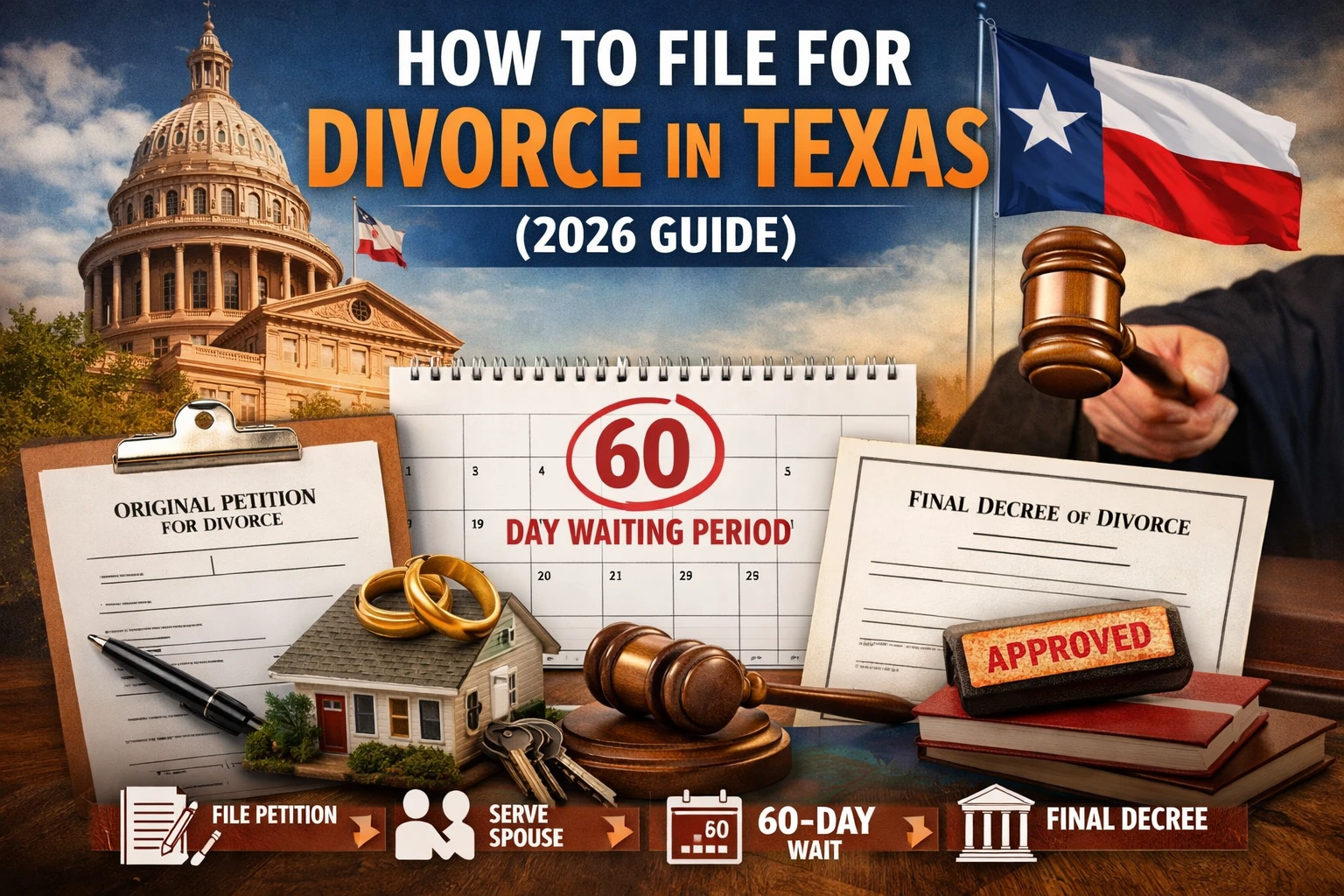
Filing your divorce in Texas involves several sequential steps.

Step 1: Complete Your Legal Packet
Your legal packet includes the original petition, any waivers of service, your parenting plan, child support calculations, and the final decree. Every form must be properly formatted, signed, and notarized where required.
Step 2: File with the District Clerk
File with the district clerk in your county in person, by mail, or through e-filing if your county offers it. E-filing is faster and eliminates the risk of documents being lost. When you file, you pay the filing fee. If you cannot afford the fee, you can request a fee waiver by submitting an indigency affidavit. selling your house.
Step 3: Serve Your Spouse (or Obtain Waiver)
Your spouse must receive formal notice of the divorce filing through a signed waiver of service or formal service by a constable or process server. If your spouse signs a waiver, include it with your filing.
Step 4: Wait Out the 60-Day Period
From the filing date, you must wait 60 days before the judge can sign your final decree. Use this time to confirm your settlement is final and all documents are accurate.
Step 5: Submit for Final Approval
After 60 days, submit your final decree and any other required documents to the judge for signature. In an uncontested case, the judge typically reviews the paperwork and signs it without a hearing.
Completing Your Legal Packet
Your legal packet must include specific forms in a specific order: the original petition, the waiver of service (if applicable), your parenting plan, your child support calculation, and the final decree. Each form has required fields and formatting rules. Mistakes like missing signatures, incorrect notarization, or incomplete sections can cause the court to reject your entire packet.
Service of Process and Notarization
Service of process is the legal method of delivering your divorce petition to your spouse. Texas law allows personal service by a constable or process server, service by certified mail, or a signed waiver of service.
A waiver of service is a notarized document your spouse signs, acknowledging receipt of the petition and agreeing not to contest the service method. If your spouse signs a waiver, you avoid the cost of a process server and the delay of arranging service.
Notarization is required for waivers, affidavits, and certain other documents. A notary public verifies your identity and witnesses your signature. Many banks, law libraries, and title companies offer notary services for a small fee.
Court Costs, Filing Fees, and Fee Waivers
Filing for divorce in Texas involves court costs that vary by county. The filing fee typically ranges based on your county’s fee schedule. If you use a process server for service, you’ll incur that separate cost.
If you cannot afford the filing fee, you can request a fee waiver by submitting an indigency affidavit. This document discloses your income and expenses and asks the court to waive or reduce your filing costs. To qualify, you typically must show that your income is at or below a certain threshold relative to the federal poverty line.
Couples with limited financial resources who want to avoid high attorney fees but need expert guidance to ensure their documents are correct and filed properly.
Organizing Your Documents and Creating a Filing Checklist
Before you file, organize all your documents in a clear, logical order. Create a checklist that includes every document you need to file:
| Document | Status | Notes |
|---|---|---|
| Original Petition | [ ] | Signed and notarized |
| Waiver of Service | [ ] | Spouse signed and notarized |
| Parenting Plan | [ ] | Both parents agree |
| Child Support Calculation | [ ] | Based on guideline formula |
| Final Decree | [ ] | Includes all settlement terms |
| Proof of Service | [ ] | If waiver not used |
| Filing Fee Receipt | [ ] | Keep for your records |

Print this checklist and check off each item as you complete it. Keep copies of every document you file. Store your original documents in a safe place for future reference.
What to Expect After Filing: Timeline and Next Steps
Once you file your divorce petition, the clock starts on the mandatory 60-day waiting period.
Days 1-10: Your spouse receives notice of the filing. If your spouse is signing a waiver, ensure it’s notarized and filed with the court promptly.
Days 10-50: Finalize any remaining details of your settlement. This is the ideal window to address outstanding questions and ensure all documents are accurate.
Days 50-60: Prepare your final decree for submission. The final decree is the judge’s order that officially ends your marriage and incorporates all settlement terms.
Day 60+: Submit your final decree to the judge for signature. In an uncontested case, the judge typically signs it within a few days to a few weeks.
After Signature: Once the judge signs your final decree, your divorce is final. The district clerk will provide you with certified copies for updating your name, beneficiaries, and relevant agencies.
The entire timeline, from filing to final decree, typically takes 60-90 days in an uncontested case.
Plan for 60-90 days from filing to final divorce decree. Use the first 50 days to [finalize your agreement](/how-to-finalize-agreed-divorce-texas/), and days 50-60 to prepare for final submission.
Mediation vs. Litigation: Choosing the Right Path for Your Family
Not every divorce starts as uncontested. Many couples begin with disagreement but later reach consensus through mediation. Understanding the difference between mediation and litigation helps you choose the right path.
Mediation is a process where a neutral third party helps you and your spouse communicate and negotiate a settlement. The mediator does not make decisions for you; they facilitate conversation and help you find common ground. Mediation is typically faster, less expensive, and less adversarial than litigation.
Mediation works best when both spouses are willing to compromise and communicate respectfully. Many couples who initially planned to litigate end up in mediation and reach an agreement, which then becomes an uncontested divorce. Understanding Starting the Divorce Process and your available options can help you determine whether mediation or an uncontested path is right for your situation.
Litigation is the traditional court process where each spouse has an attorney, and the judge makes final decisions on contested issues. Litigation is significantly more expensive, time-consuming, and emotionally draining than mediation or uncontested divorce.
If you and your spouse are considering divorce but haven’t yet agreed on terms, mediation is often a smart first step. For parents specifically, mediation models constructive communication for your children and sets a collaborative tone for future co-parenting.
Navigating texas divorce forms for parents requires attention to detail, understanding of Texas family law, and careful organization. The uncontested path is faster and more affordable than litigation, but it still demands accuracy and compliance with every legal requirement. If you’re ready to move forward, Which Plan is Right for You? can help you identify the support and document package that best fits your family’s needs. Ready Divorce Service specializes in guiding Texas parents through this process with expert document preparation and step-by-step support. Our goal is to make your transition simple, affordable, and stress-free by handling the complex paperwork so you can focus on your family’s future.
Frequently Asked Questions
What specific forms are required when children are involved in a Texas divorce?
When minor children are involved, you need the Original Petition for Divorce, a Parenting Plan, a Child Support Order, and a Waiver of Service (if both parties agree). These documents establish custody arrangements, visitation schedules, and child support obligations. The Suit Affecting the Parent-Child Relationship forms ensure the court has all necessary information to protect your children's interests. Your district clerk can provide the official forms, or you can access them through the court's website.
How is child support calculated in an uncontested Texas divorce?
Child support guidelines in Texas are based on the paying parent's net monthly income. The guidelines typically set support at 20% of income for one child, 25% for two children, and up to 30% for three or more children. However, the court can adjust these amounts based on factors like custody arrangements, medical expenses, and each parent's financial situation. Your parenting plan should include the calculated child support amount and payment schedule agreed upon by both parties.
What happens if I make mistakes on my Texas divorce forms?
Court errors can delay your case or result in rejection of your filing. If documents are incomplete or incorrectly completed, the district clerk may request corrections before accepting them. Working with a service that specializes in accurate document preparation helps ensure compliance with Texas law and reduces the risk of costly mistakes. If you've already started forms on your own, having them reviewed before filing can catch errors early.
Can I get a divorce in Texas without going to court?
Yes, if you have an uncontested divorce where both parties agree on all terms, you can typically avoid a court appearance. Once you file the required forms and complete the mandatory waiting period, the judge may grant your divorce without requiring you to appear in person. However, the court retains the right to require a hearing if needed. An uncontested divorce with a complete parenting plan and child support agreement significantly reduces the likelihood of court involvement.
This article was written using GrandRanker