Table of Contents
- What It Means to File for Divorce Without a Lawyer (Pro Se Divorce)
- Eligibility and Requirements for Pro Se Filing
- Understanding Uncontested vs. Contested Divorce
- Texas Divorce Forms for Uncontested Divorce
- The 60-Day Waiting Period and Timeline Expectations
- Texas Divorce Filing Fees and Court Costs
- Step-by-Step Filing Process
- Handling Minor Children and Support in Pro Se Divorce
Last Updated: August 27, 2026
What It Means to File for Divorce Without a Lawyer (Pro Se Divorce)
Filing for divorce without a lawyer means representing yourself in court as a "pro se" litigant. You handle legal responsibilities an attorney would normally manage: preparing documents, understanding procedural rules, meeting deadlines, and presenting your case. This approach works best when both spouses agree on major issues, property division, custody, and support, with no complex assets or disputes.
The term "pro se" comes from Latin and means "on one’s behalf." In Texas, thousands of individuals file for divorce this way each year, particularly in uncontested cases. Ready Divorce Service helps people navigate this path by providing guidance on document preparation and ensuring filings comply with Texas state law. This path requires attention to detail, understanding of Texas Family Code requirements, and commitment to meeting procedural deadlines while maintaining control over your timeline.
Pro se divorce works best when both spouses are communicating and have already reached agreement on major issues. If conflict exists or one spouse refuses to cooperate, you may need legal representation.
Eligibility and Requirements for Pro Se Filing
Your case must be uncontested, meaning you and your spouse agree on all major terms or your spouse doesn’t contest the divorce. Disputed property, custody, or support makes the case contested and significantly more complex.
Residency is critical. Either you or your spouse must have been a Texas resident for at least six months immediately before filing, and you must have lived in the county where you’re filing for at least 90 days. Texas imposes a mandatory 60-day waiting period from filing until finalization, which cannot be waived (statutes.capitol.texas.gov).
If minor children are involved, you must complete a parenting class before the divorce is finalized. The class covers how to support children through divorce and is required by Texas law for any parent filing for custody or visitation modification. Online options typically take 4-6 hours to complete.
You can file pro se if your case is uncontested, you meet residency requirements, and you’re willing to follow Texas procedural rules carefully. If your spouse contests the divorce or disputes exist, pro se filing becomes much more difficult.
Understanding Uncontested vs. Contested Divorce
An uncontested divorce means you and your spouse have reached agreement on all material issues: property and debt division, spousal support, and (if applicable) custody and child support. Both spouses sign the divorce decree, and the court approves it without a trial.
A contested divorce involves disputes on one or more major issues. The court holds hearings or a trial, and the judge makes decisions on disputed matters. Contested divorces almost always require legal representation because procedural rules and courtroom presentation become critical to protecting your interests.
The key question is whether your spouse will cooperate and sign an agreed divorce decree promptly. If there’s any doubt about their willingness or any disagreement on major issues, treat it as potentially contested and seek legal advice before proceeding pro se. Which Plan is Right for You? can help you determine whether your specific situation qualifies as uncontested by walking through your circumstances and identifying any areas where disputes might arise.
Texas Divorce Forms for Uncontested Divorce
Texas requires specific forms for pro se divorce filing. Courts will reject filings that don’t use approved documents or contain procedural errors. The primary form is the Petition for Divorce, which initiates the case and states the grounds for divorce, residency information, and details about any children or property involved.
For uncontested divorces, you’ll also need a Decree of Divorce (or Final Decree of Divorce), which the judge signs at the end of the case. This decree contains all agreed-upon terms: property division, custody arrangements, support obligations, and other relevant agreements. Both spouses must sign this document.
Additional forms depend on your situation. If minor children are involved, you’ll need a Suit Affecting the Parent-Child Relationship (SAPCR) form, which addresses custody, visitation, and child support. If spousal maintenance is part of your agreement, include that in the decree. If you have significant property or debts, you may need a Property Division Worksheet to clearly document what each spouse receives.
The State Bar of Texas provides free forms for pro se litigants on its website, and many county courts have local forms as well. Checking with your specific county court clerk before filing ensures you’re using the right version of each form.
Using outdated or incorrect forms is a leading reason pro se divorce filings are rejected. Always verify you’re using the current official forms from either the State Bar of Texas or your county court clerk’s office.
The 60-Day Waiting Period and Timeline Expectations
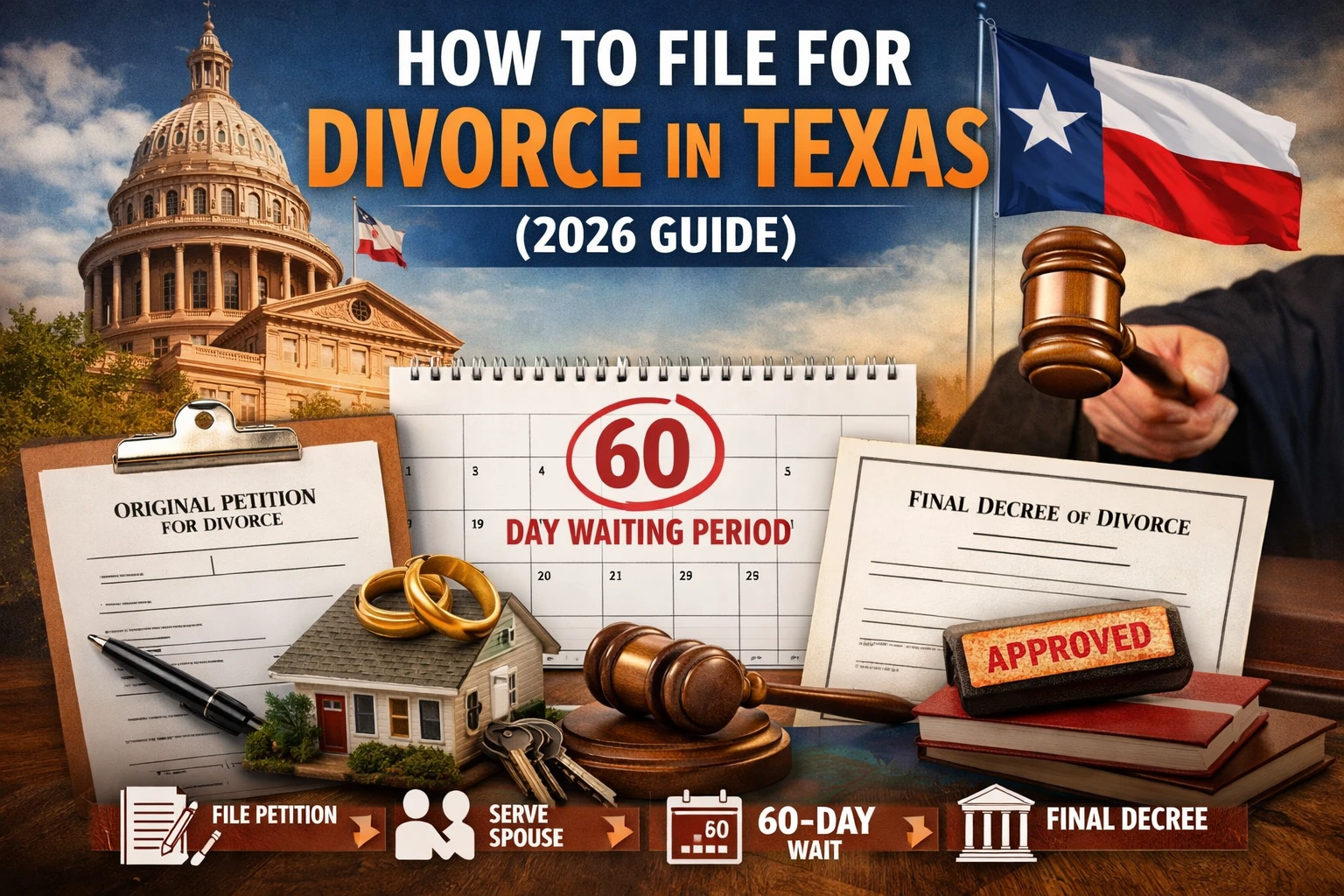
Texas law requires a mandatory 60-day waiting period between the date your petition for divorce is filed and the date your divorce can be finalized. This waiting period cannot be shortened, waived, or expedited under any circumstances.
The 60-day clock starts the day your petition is officially filed with the court. During this period, finalize your agreement on all terms, complete any required parenting classes, and prepare the final decree for the judge’s signature. After the 60-day waiting period expires, you can request that the judge sign your final decree. If everything is in order and both spouses have signed the agreed decree, this typically happens within a few days to a couple of weeks.
The total timeline for an uncontested pro se divorce typically ranges from 75 to 90 days from filing to finalization, assuming no delays or complications. The 60-day waiting period gives both spouses time to reconsider their decision and ensures neither party is rushed into an agreement they later regret.
Texas Divorce Filing Fees and Court Costs
Filing for divorce in Texas involves court costs that vary by county. The filing fee covers the cost of processing your petition and maintaining court records. Additional costs depend on your specific circumstances.
The filing fee varies by county but typically ranges based on the county’s size and local fee schedules. You’ll pay this fee when you submit your petition to the court clerk. Some counties also charge additional fees for services like certified copies of the final decree.
If you need to serve your spouse with divorce papers, you may incur service fees. If your spouse cooperates and signs a waiver of service, you avoid these costs. If your spouse won’t cooperate, you’ll need to hire a process server or use the sheriff’s department.
Other potential expenses include parenting class fees (typically $20-$50), certified copies of the final decree ($5-$15 per copy), and recording fees if you need to record the decree regarding property transfers.
For an uncontested divorce with a cooperative spouse, total costs are typically much lower than contested cases. The primary expense is the filing fee, plus modest costs for required classes and certified copies. This is substantially less than hiring an attorney, which typically costs thousands of dollars.
Pro se filing is most cost-effective for couples with modest assets, no significant disputes, and mutual agreement on terms. The savings are substantial compared to traditional legal representation.
Step-by-Step Filing Process
Step 1: Determine Jurisdiction and Venue
Before filing anything, establish that Texas courts have jurisdiction over your case and that you’re filing in the correct county. Jurisdiction requires that either you or your spouse has been a Texas resident for at least six months immediately before filing. Venue requires that you or your spouse has lived in the specific county for at least 90 days. Understanding these rules prevents your case from being dismissed on jurisdictional grounds.

Step 2: Prepare and File Your Petition
Your petition for divorce officially starts your case. It must include your name and your spouse’s name, the date and place of your marriage, whether you have minor children, a description of property you own together, and your grounds for divorce (in Texas, you can file on "no-fault" grounds, meaning irreconcilable differences, or "fault" grounds if applicable).
Complete the petition using the official Texas form. Be thorough and accurate; errors can delay your case or result in rejection. Make two copies: one for the court, one for your spouse, and one for your records. Take the original and copies to your county court clerk’s office and file them. Pay the filing fee at this time. The court clerk will stamp your documents, assign a case number, and your divorce case officially begins. Starting the Divorce Process provides detailed guidance on what to expect at each stage of filing.
Step 3: Serve the Respondent
Your spouse (called the "respondent") must be formally notified of the divorce petition through a legal process called "service of process." If your spouse cooperates, they can sign a "waiver of service," which acknowledges they received the petition and waives the formal service requirement. This is the simplest approach for uncontested divorces.
If your spouse won’t sign a waiver, you must have them served by a process server or the sheriff’s department. Your spouse then has at least 20 days to respond to the petition.
Step 4: File Required Documentation
After service, file additional documents depending on your situation. If you have minor children, file the SAPCR form addressing custody, visitation, and child support. File any property division agreements or financial affidavits if required by your county. Complete and file any required parenting class certificates if children are involved. Ensure all documents are properly formatted, include your case number, and are filed before any court-imposed deadlines.
Step 5: Wait for the Final Decree
After the 60-day waiting period expires and all required documents are filed, you’re ready for the judge to sign your final decree. If both spouses have signed the agreed decree and everything is in order, submit the decree to the judge for signature. The judge reviews it to ensure it complies with Texas law. If it does, the judge signs it, and your divorce becomes final.
Handling Minor Children and Support in Pro Se Divorce
When minor children are involved, your divorce becomes more complex because Texas law requires you to address custody, visitation, and child support in your divorce decree.

Custody in Texas is called "conservatorship," and you must designate who has the right to make decisions about the child’s upbringing, education, medical care, and other major life decisions. Visitation (called "possession and access") specifies when each parent spends time with the child. Child support is calculated based on the paying parent’s income and the number of children.
If you and your spouse agree on custody and visitation arrangements, include these in your agreed decree. The court will approve your agreement as long as it’s in the child’s best interest. If you disagree, the court will make these decisions for you, which typically requires a contested hearing or trial.
Child support in Texas is calculated using guidelines based on the paying parent’s net monthly income and the number of children. The guideline amount is a percentage of income: 20% for one child, 25% for two children, and so on, up to a maximum of 50% for five or more children. If both parents’ combined income exceeds a certain threshold, you can agree on a different amount, but it must be documented in your decree.
Before your divorce can be finalized, you must complete a parenting class approved by the Texas Attorney General. This class covers how to support children through divorce, managing conflict, and maintaining the parent-child relationship. Classes are typically available online and take 4-6 hours to complete. You’ll receive a certificate upon completion, which you file with the court.
If your spouse is uncooperative about custody or support arrangements, or if significant disagreements exist about what’s in the child’s best interest, you should seek legal counsel.
Filing for divorce in Texas without a lawyer is achievable when your case is uncontested and both spouses cooperate. The key is understanding Texas Family Code requirements, using correct forms, and meeting all procedural deadlines. Ready Divorce Service provides step-by-step guidance on document preparation and ensures your filing complies with state law, making the process straightforward and affordable. The Texas Attorney General’s Family Law Self-Help Resources offers free information on pro se divorce procedures, and the State Bar of Texas provides official forms and additional guidance. If complications arise or your spouse contests the divorce, consulting with a family law attorney protects your interests and ensures your rights are properly represented.
Frequently Asked Questions
What does 'pro se' mean when filing for divorce?
Pro se means representing yourself in court without hiring a lawyer. When you file for divorce without a lawyer, you are the petitioner acting pro se. This is a legal right in Texas, and many uncontested divorces are handled this way. Pro se filers must still follow all procedural requirements and file the correct legal documents with the court.
What is the mandatory waiting period for divorce in Texas?
Texas has a mandatory 60-day waiting period from the date you file your petition for divorce. This waiting period cannot be waived, even in uncontested cases. The final decree of divorce cannot be signed before this period expires. During this time, you must serve the respondent, gather financial documents, and ensure all required paperwork is filed with the court clerk.
Can I file for divorce if we have minor children without a lawyer?
Yes, you can file for divorce without a lawyer even if you have minor children, provided the divorce is uncontested and you and your spouse agree on custody, visitation, and child support. You must include a custody order and child support agreement in your filing. Many pro se divorces involve minor children when both parents cooperate and reach agreement on all terms affecting the children.
What happens if I make a mistake on my divorce forms?
If the court identifies errors in your divorce forms, the court clerk may reject them or request corrections before acceptance. Common mistakes include missing signatures, incomplete financial disclosures, or procedural errors in service of process. Working with a document preparation service can help ensure accuracy and reduce the risk of rejection, though some corrections can be made by filing amended documents with the court.
This article was written using GrandRanker