Table of Contents
- What Makes a Divorce Uncontested in Texas
- Texas Divorce Filing Requirements You Must Meet
- The Uncontested Divorce Waiting Period in Texas Explained
- The Real Cost of Uncontested Divorce vs. Litigation
- Core Benefits of Uncontested Divorce in Texas
- Agreement Readiness Checklist: Is an Uncontested Filing Right for You?
- Hidden Complexities: Taxes, Digital Assets, and Post-Divorce Modifications
- Frequently Asked Questions
Last Updated: September 16, 2026
What Makes a Divorce Uncontested in Texas
An uncontested divorce is a dissolution of marriage in which both spouses agree on every major term, including property division, debt allocation, and, if children are involved, conservatorship and possession and access. When both parties sign off, the case moves through the family law court as a simplified process rather than a fight.
- Uncontested: both spouses sign a settlement agreement covering all terms
- Contested: a judge resolves disputed issues after hearings
- Default: one spouse files, the other never responds
Texas Divorce Filing Requirements You Must Meet
Texas divorce filing requirements are set by state law and enforced by the court clerk. Miss one and the clerk rejects the filing, resetting your timeline.
Residency, Grounds, and the 60-Day Waiting Period
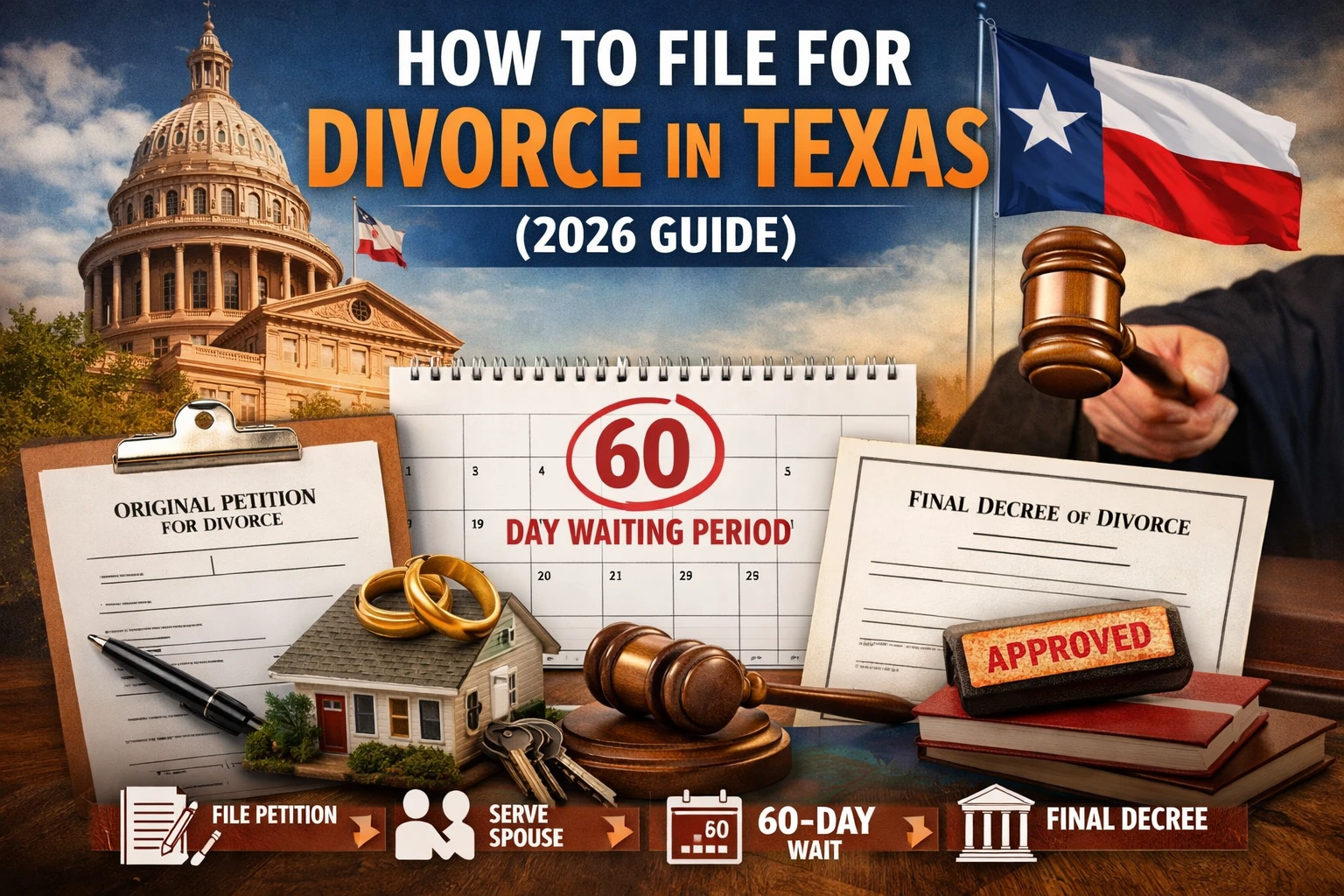
At least one spouse must meet Texas’s residency period before filing, and the case must be filed in the correct county. Texas allows no-fault dissolution of marriage, so you can cite insupportability without proving wrongdoing. The statutory waiting period is 60 days from the filing date before a judge can sign the final decree, mandatory, not optional.
Required Forms and the Final Decree of Divorce
Every uncontested case needs a petition for divorce, a waiver of service or proof of service of process, a settlement agreement, and an agreed final judgment for the judge’s signature. If you have children, the decree must address conservatorship, possession and access, and child support. The Texas Supreme Court publishes official divorce forms, and Texas Supreme Court official divorce forms lists the current versions.
The Uncontested Divorce Waiting Period in Texas Explained
The uncontested divorce waiting period is a 60-day countdown. Day one is the filing date; the judge cannot sign the final decree before day 61.
Filing an incomplete petition to “start the clock” backfires. Courts reject deficient filings, and the 60-day countdown restarts from the corrected filing date.
The Real Cost of Uncontested Divorce vs. Litigation
The cost of uncontested divorce in Texas is a fraction of a litigated case because you pay for document preparation and filing fees, not courtroom hours. Court costs and filing fees are set by the county, so check your county clerk’s published fee schedule rather than a general estimate.

Filing Fees, Court Costs, and What Drives the Total
A litigated divorce bills by the hour, and every hearing adds to the meter. An uncontested case replaces those hours with a one-time document preparation cost. Variables that move your total: whether you hire legal counsel, whether service is by waiver or formal service, and whether you need help correcting a rejected filing.
What Actually Drives the Total: A Mechanism-by-Mechanism Breakdown
| Cost driver | Uncontested path | Litigated path |
|---|---|---|
| Attorney billing | Optional, limited scope or flat fee | Hourly, ongoing, billed against a retainer |
| Filing fee | Paid once at filing | Paid once, then again for counter-petitions and motions |
| Service of process | Often waived | Process server, sheriff, or private service |
| Discovery | Rare | Interrogatories, depositions, subpoenas for records |
| Court-ordered hearings | Rare | Temporary orders, status hearings, final trial |
| Court reporter | Usually not needed | Per-hearing transcript cost |
| Timeline driver | 60-day waiting period | Court calendar and continuances |
| Emotional strain | Lower, cooperative | Higher, adversarial |
Two mechanisms deserve emphasis. First, discovery: in a contested case, each side can compel the other to produce financial records, answer written questions under oath, and sit for a deposition, each billed by the hour, and a single deposition can consume more attorney time than an entire uncontested filing. Second, temporary orders: when spouses cannot agree on who pays the mortgage or where the children sleep, the court holds a hearing to set interim rules, a separate billed event that often repeats if circumstances change.
Ask your county clerk for the current fee schedule in writing before you budget. Filing fees change, and a quote from an old forum post can be off by a meaningful margin.
Uncontested saves money because it removes discovery, hearings, and hourly billing, not because the paperwork is free. The savings hold only while the agreement holds.
Core Benefits of Uncontested Divorce in Texas
The core benefits of uncontested divorce in Texas are lower cost, faster completion, less emotional strain, and a final decree you both shaped. You avoid the adversarial posture that makes co-parenting harder after the case closes.
The benefits of an uncontested divorce depend on one condition: a genuine, complete agreement. Without it, you get the paperwork of an uncontested case with the friction of a contested one.
Agreement Readiness Checklist: Is an Uncontested Filing Right for You?
An uncontested filing is right for you when every material term is settled before you file. Run this checklist honestly before you start.
- You and your spouse agree on division of community property
- You agree on allocation of shared debts
- If you have children, you agree on conservatorship and possession and access
- You agree on child support and any spousal maintenance
- You know which county has jurisdiction and can confirm residency
- You have the current official forms for your county
- You can identify all accounts, including digital assets
- Neither spouse is hiding assets or stalling
Hidden Complexities: Taxes, Digital Assets, and Post-Divorce Modifications
Three issues quietly decide whether an uncontested case stays simple: taxes, digital assets, and future modifications. They are where agreements break down months later, the difference between a decree that holds and one that sends you back to court.
Tax Implications of Asset Division
How you divide an asset can change what it costs you at tax time. The IRS publishes rules on transfers between spouses, and IRS guidance on property transfers between spouses explains how those transfers are generally treated. The general rule is that a transfer of property between spouses, or former spouses if it is “incident to divorce”, does not trigger immediate gain or loss recognition.
A few practical rules follow from all this:
- Divide the asset, not just its dollar value. Two accounts worth the same amount can have very different tax consequences.
- Ask for the basis before you sign. If you cannot get it, assume the worst case and negotiate accordingly.
- Treat retirement accounts as a category of their own. They need a QDRO, not just a paragraph in the decree.
- Remember that the house is not just an asset. It carries property taxes, insurance, maintenance, and a mortgage, costs that continue after the divorce is final.
Digital Asset Division
Modern marital estates include assets that did not exist when most divorce forms were written. Cryptocurrency, peer-to-peer payment balances, brokerage apps, business interests held through an LLC, domain names, and shared subscription accounts all need to be named in the settlement agreement. An asset you forget to list is one you may have to litigate later, courts generally cannot divide what was never presented to them.
Post-Divorce Modification Risks
- State the method for calculating child support, not just the current figure, so the parties know how a future adjustment will be handled.
- Define possession and access with specific times, locations, and exchange procedures rather than general language like “reasonable visitation.”
- Address how the parties will handle a future relocation, including notice requirements.
- Include a dispute-resolution step, such as mediation before filing a modification, so minor disagreements do not become court cases.
- Name the assets and accounts specifically, including digital assets, so there is nothing left to argue about.
A vague decree is not a neutral decree. It shifts the ambiguity to the future, where it becomes a modification case with new filing fees, new attorney hours, and new conflict. Specificity at signing is the cheapest form of insurance.
Before signing, list every account by name and last four digits, including crypto wallets and retirement plans. Vague language like “the retirement account” invites disputes that a specific list prevents.
Ready Divorce Service helps Texas residents prepare accurate, compliant documents for exactly this kind of case, including matters with children and shared debt. If you want to confirm which filing path fits your situation, Starting the Divorce Process walks through the steps in plain language.
Frequently Asked Questions
What are the primary benefits of an uncontested divorce in Texas?
The main benefits include lower total costs, a faster timeline than contested litigation, less emotional strain, and more control over the outcome. Because both spouses agree on the terms, you avoid court-ordered hearings and lengthy discovery. You also reduce attorney fees and court costs, and you can often complete the process with document preparation support rather than full legal representation. The streamlined process lets you move forward without prolonged conflict.
How long does the uncontested divorce waiting period last in Texas?
Texas law requires a 60-day waiting period from the date the petition for divorce is filed before a judge can sign the final decree. This is a statutory waiting period, not a processing delay. During those 60 days, you can finalize your settlement agreement, gather any needed documents, and prepare the agreed final judgment. After the 60 days pass, the judge can sign the decree, and the dissolution of marriage becomes final.
Do I need a lawyer for an uncontested divorce in Texas?
You are not legally required to hire a lawyer for an uncontested divorce in Texas. Many people file pro se, meaning they represent themselves. However, you must ensure your documents meet all Texas divorce filing requirements, including the petition for divorce, waiver of service, and final decree. Document preparation services can help you complete the paperwork accurately, but they do not provide legal advice. For complex situations, consult a licensed Texas family law attorney.
What are the disadvantages of an uncontested divorce?
An uncontested divorce may not suit every situation. If there is a history of domestic violence, hidden assets, or significant disagreement over conservatorship, possession and access, or debt allocation, a contested process may be necessary to protect your interests. Also, once the judge signs the agreed final judgment, modifying terms later can be difficult. Tax implications of asset division and post-divorce modification risks are often overlooked, so review your settlement carefully before filing.
An uncontested divorce only delivers its advantages when the paperwork is right the first time. A rejected filing or a missed asset can turn a streamlined process back into a dispute. Ready Divorce Service specializes in Texas uncontested divorce document preparation, with step-by-step guidance, accurate forms, and support for cases involving children and shared debt. Get started with Ready Divorce Service and move through your filing with confidence.