Last Updated: November 21, 2026
Quick Summary
Divorce in Texas is a no-fault legal process that ends a marriage and divides property, debts, and, where children are involved, custody and support. Texas requires residency before filing and a waiting period before the divorce can be finalized, and the speed depends on whether the spouses agree.
- Insupportability is the no-fault ground most couples use in Texas.
- At least one spouse must be a Texas domiciliary for six months and in the filing county for 90 days.
- The waiting period is measured from the date the Original Petition is filed.
- An agreed divorce is generally faster and less costly than a contested one.
- Signing a decree does not update mortgages, retirement accounts, or beneficiary designations.
Table of Contents
- How Divorce in Texas Works: An Overview
- Texas Divorce Residency Requirements
- Grounds for Divorce in Texas: No-Fault and Fault-Based Options
- Texas Divorce Forms and Paperwork You Will Need
- How to File for Divorce in Texas, Step by Step
- Texas Divorce Waiting Period and Timeline
- Uncontested, Agreed, and Contested Divorces Compared
- Property, Children, and Costs: What to Plan For
- Getting Started With Your Texas Divorce Paperwork
- Frequently Asked Questions
How Divorce in Texas Works: An Overview
Divorce in Texas is the legal process that ends a marriage and divides the couple’s property, debts, and, where children are involved, custody and support. At Ready Divorce Service, we help Texas residents understand each stage of that process so they can make informed decisions. Texas is a no-fault state, which means a spouse does not have to prove the other person did something wrong to obtain a divorce. The most common ground, which the Texas Family Code calls “insupportability,” simply means the marriage has become insupportable because of discord or conflict that destroys the possibility of living together.
The path a divorce takes depends largely on whether the spouses agree. An agreed divorce, sometimes called an uncontested divorce, is one where both spouses agree on property, children, and support. A contested divorce is one where they cannot reach agreement on one or more issues, and a judge must decide them. Most people sit somewhere in between, agreeing on some issues and needing help resolving others. If you are unsure which category fits your situation, a guide like Which Plan is Right for You? can help you think through your options.
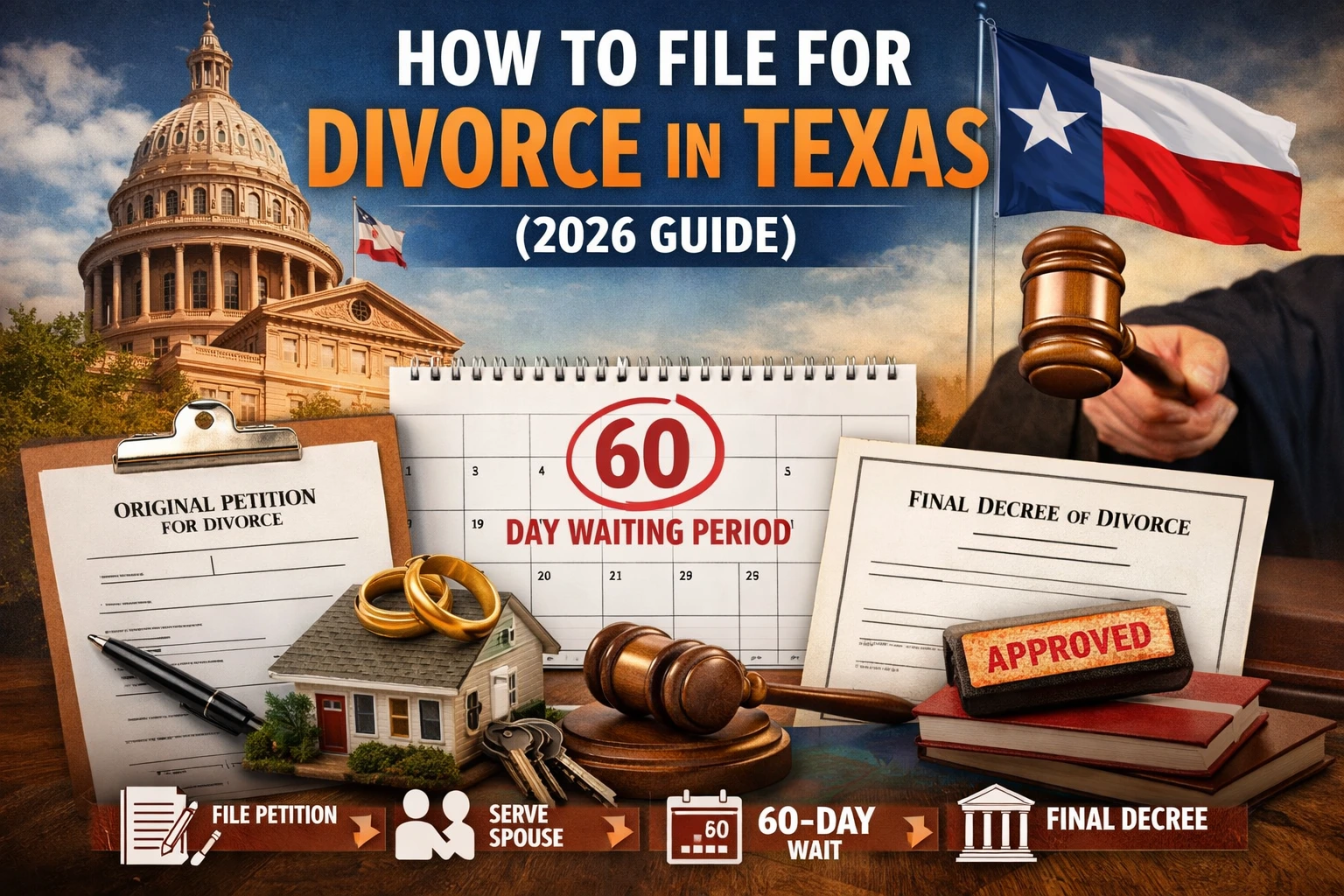
Every Texas divorce follows a general sequence: one spouse files an Original Petition, the other spouse is formally notified, a mandatory waiting period runs, and the court signs a final decree. Local courts may handle paperwork and scheduling differently, so it is worth confirming county-specific procedures with the clerk where you file.
Texas Divorce Residency Requirements
Before a Texas court can grant a divorce, at least one spouse must meet the state’s residency rules. Texas law sets residency requirements for filing, which generally require that one spouse has been a Texas domiciliary for a set period and has lived in the filing county for a set period before filing. Confirm the current requirements with the district clerk in your county. Our guide to Texas residency requirements for divorce covers county filing rules, exceptions, and what to do if you or your spouse recently moved.
These requirements matter most for people who recently moved. If you relocated within Texas or came from another state, confirm your dates carefully. A case filed before the residency period is met can be dismissed, which means lost time and filing costs. If your spouse lives in another state but you meet the requirements, the case can still proceed in Texas.
County choice is also a practical decision. Dallas, Tarrant, Denton, Collin, and Ellis counties each maintain their own district clerk and court procedures, so a filing location that satisfies the residency rule may still involve local forms or scheduling practices that differ from neighboring counties. You can check how the waiting period applies in your county by reading What Is the Waiting Period for Divorce in Texas?.
Grounds for Divorce in Texas: No-Fault and Fault-Based Options
Texas allows divorce on no-fault grounds, which is what most couples use. Insupportability is the no-fault ground, and it requires no proof of wrongdoing. Because it is the simplest path, most uncontested divorces are filed on this basis.
Texas also recognizes fault-based grounds, including adultery, cruelty, abandonment, and felony conviction with imprisonment. A spouse may raise these grounds when the facts support them, but they generally require more evidence and can lengthen the case. Fault can also be relevant to how a court divides property, which is why some spouses choose to plead it while others do not.
Choosing a ground is a legal decision with consequences. Anyone uncertain whether a fault-based claim fits their situation should consult a licensed Texas attorney before filing.
Texas Divorce Forms and Paperwork You Will Need
Most Texas divorces involve a set of core documents. The Original Petition for Divorce starts the case and states the grounds, the residency facts, and what each spouse is asking the court to order. If the spouses agree, they may also sign a Waiver of Service and a Final Decree of Divorce, along with a property settlement agreement and, where children are involved, a parenting plan.

Many filings also require a sworn inventory and appraisement, financial disclosures, and proposed orders for temporary support or custody if needed. The exact forms depend on the county, the issues in dispute, and whether the case is agreed or contested. Using outdated or incorrect forms is a common reason filings are returned, so always confirm you have the current version from the court or from a reliable source.
A neatly organized paperwork binder keeps everything in one place and makes it easier to respond quickly when the clerk or the other spouse requests something.
How to File for Divorce in Texas, Step by Step
Step 1: Confirm residency. Verify that you and your spouse meet the six-month state and 90-day county requirements before anything else.
Step 2: Choose your ground. For most uncontested cases, insupportability is the appropriate ground.
Step 3: Prepare the Original Petition. Include accurate names, dates of marriage and separation, children information, and the relief you are requesting.
Step 4: File with the district clerk. Pay the filing fee or submit a request to waive it, depending on your circumstances.
Step 5: Serve the other spouse. Service can be completed by a process server, by certified mail in some situations, or by a signed Waiver of Service if the spouse cooperates.
Step 6: Wait for the response period and the mandatory waiting period. Your spouse has time to respond, and the court cannot finalize the divorce until the waiting period has passed.
Step 7: Finalize the decree. For agreed cases, submit the final decree and supporting agreements for the judge’s signature.
Texas Divorce Waiting Period and Timeline
Texas requires a waiting period measured from the date the Original Petition is filed. Texas generally requires a waiting period after the petition is filed before a divorce can be finalized, and limited exceptions exist. Those are fact-specific and should be discussed with a licensed Texas attorney.
The waiting period is a floor, not a finish line. A common mistake is treating day 61 as the date the divorce is done. In practice, the decree still has to be drafted, signed by both spouses if agreed, and submitted to the judge for signature. A more realistic picture of an agreed case looks like this:
Preparation. Confirm residency, gather marriage and separation dates, inventory property and debts, and collect children’s information. Documents are drafted and reviewed. Errors caught here are cheap; errors caught after filing cost time.
Filing. The petition is filed with the district clerk and the case is assigned. The filing date starts the waiting-period clock, so this is the single most important date on the calendar.
Notice to the spouse. If the spouse signs a Waiver of Service, this step can compress to a few days. If service is required, a process server or certified mail adds time, and a spouse who avoids service can stretch this stage considerably.
Negotiation and drafting. For agreed cases, this is when the final decree, property settlement, and any parenting plan are finalized. For contested cases, this is when temporary orders, discovery, and mediation typically begin.
Finalization. The decree is submitted for the judge’s signature. Some courts require a brief prove-up hearing; others accept an agreed decree on the papers. County practice varies, and Dallas, Tarrant, Denton, Collin, and Ellis counties each handle scheduling differently.
What actually causes delays is predictable. Service problems are the most common. Missing or inconsistent information on the petition, a misspelled name, a wrong marriage date, an omitted child, is second. Unresolved property or parenting terms are third, because a judge cannot sign a decree the spouses have not agreed to. A contested case with custody or significant property disputes often runs many months, and no honest timeline can promise otherwise.
Watch out: Building a move, a refinance, or a new lease around the earliest possible finalization date assumes the court signs on schedule. Treat the waiting period as the earliest possible date, not a planned completion date.
The waiting period sets the earliest possible finish date, and several stages between filing and the signed decree can add time.
| Stage | What happens | Timing note |
|---|---|---|
| Preparation | Confirm residency, gather dates, inventory property and debts | Errors caught here are cheap |
| Filing | Petition filed with district clerk | Filing date starts the waiting-period clock |
| Notice to spouse | Waiver of Service or formal service | Waiver can compress this to a few days |
| Negotiation and drafting | Final decree and agreements finalized | Contested cases typically take longer |
| Finalization | Decree submitted for judge’s signature | County practice varies |
Uncontested, Agreed, and Contested Divorces Compared
An uncontested divorce is generally the least expensive and fastest route because the spouses resolve their issues before filing or early in the case. Documents can usually be prepared in advance, and the court typically needs only to review and sign the final decree.
An agreed divorce is closely related: the spouses agree on all terms, but the agreement is formalized in writing and submitted to the court. Court involvement still exists, including the final hearing or signing, so an agreed divorce is not a paperwork-free process.
A contested divorce means the spouses disagree on one or more issues, such as the division of a home or the terms of parenting time. Contested cases involve temporary orders, discovery, mediation, and often one or more hearings. They cost more and take longer, and they often benefit from representation by a licensed Texas attorney.
Many clients begin as contested and settle along the way. To compare cost, timeline, and court process side by side, see Agreed Divorce vs Contested Divorce in Texas. Knowing which category your case falls into helps you choose the right level of support.
Property, Children, and Costs: What to Plan For
Texas is a community property state. Property acquired during the marriage is presumed community property, and the court divides it in a manner it deems just and right, which is not automatically a 50/50 split. Separate property, meaning property owned before marriage or received by gift or inheritance, is generally confirmed to the spouse who owns it, but the burden of tracing and proving separate property falls on the spouse claiming it.
If you have children, the court addresses conservatorship (the Texas term for custody), possession and access (visitation), and child support. Texas courts apply a best-interest standard, and child support generally follows the statutory guidelines based on the paying parent’s net resources and the number of children, though the court can deviate with findings.
Costs fall into a few predictable categories. The district clerk’s filing fee is set by each county and changes periodically, so confirm the current amount with the clerk. Service of process adds a cost if a waiver is not signed. Mediation, if needed, is typically paid by the hour. Attorney fees, where an attorney is involved, are the largest variable and depend heavily on whether the case is agreed or contested.
One angle most guides skip is what happens after the decree. A signed decree does not update the mortgage company, the retirement plan administrator, or the beneficiary designations on life insurance. Common post-decree steps include transferring vehicle titles, refinancing or assuming a mortgage, dividing retirement accounts through a qualified domestic relations order where required, updating beneficiaries and wills, and closing joint accounts.
Watch out: Leaving a property division or parenting plan vague in an agreed divorce can create disputes that are expensive to fix after the decree is signed, and some errors, like an unaddressed retirement account, cannot be corrected by the court years later.
Getting Started With Your Texas Divorce Paperwork
If your divorce is uncontested or you are preparing an agreed case, the most useful first step is to organize your information: dates of marriage and separation, a list of property and debts, children’s details, and your residency history. From there, you can choose the level of support that fits your situation. Our team can walk you through the options and help you decide which package is the right fit, and you can start the process with Starting the Divorce Process to see what to expect. Start the process at our questionnaire and let Ready Divorce Service help you move forward with a clear, organized plan for your Texas divorce.
Frequently Asked Questions
How long does a divorce take in Texas?
A Texas divorce cannot be finalized until a statutory waiting period after the petition is filed has passed. Many uncontested divorces take a few months beyond that, depending on how quickly the paperwork is signed, how fast the other spouse responds, and how busy the court’s docket is. Contested cases with disputes over property or children often take considerably longer. County procedures and court schedules vary, so check with your local district clerk for current timing in your county.
What is the first step to divorce in Texas?
The first step is confirming that you meet the residency requirements for state and county, which you can verify with the district clerk. After that, the filing spouse prepares and files an Original Petition for Divorce with the district clerk in the proper county. Gathering basic information about marital property, debts, and any children beforehand makes the petition easier to complete accurately.
Can I get a divorce without a lawyer in Texas?
Yes. Texas law allows people to represent themselves in a divorce, and many couples handle uncontested cases on their own or with document preparation and procedural assistance. Ready Divorce Service is not a law firm and its non-attorney staff cannot give individualized legal advice or represent you in court. If your case involves disputes over property, children, or complex finances, consulting a licensed Texas attorney is a good idea.
What forms do I need to file for divorce in Texas?
A typical filing includes an Original Petition for Divorce, a civil case information sheet, and a citation or service paperwork so the other spouse receives notice. Depending on your situation, you may also need forms addressing children, property, temporary orders, a waiver of service, or a final decree. Requirements can differ by county, so confirm the current forms with the district clerk where you file.
Can an uncontested divorce in Texas be finalized without a court hearing?
In some uncontested cases, the court may grant the divorce on the signed paperwork without a live hearing, but this depends on the county, the judge, and whether the documents are complete. Even agreed divorces typically require the court to approve a final decree, so court involvement is still part of the process. Ask your local court how it handles uncontested divorces before assuming a hearing will be unnecessary.
What is the wife entitled to in a divorce in Texas?
Texas is a community property state, and the court divides community property in a manner it deems just and right, which is not necessarily an equal 50-50 split. Spouses keep their separate property, such as assets owned before marriage or received as a gift or inheritance. Spousal maintenance and child-related issues are governed by separate rules, and outcomes depend on the facts of each case, so individual legal advice is important for these questions.
What should I avoid doing during a divorce in Texas?
Avoid hiding or moving marital assets, making large purchases or transfers without discussing them, and withdrawing funds from joint accounts without agreement or court authority. Do not ignore court deadlines or paperwork, since missed deadlines can lead to a default judgment. Avoid discussing the case with children or making unilateral changes to custody arrangements. Keeping clear records and following court orders protects your position throughout the process.
Do I need to be a Texas resident to file for divorce?
At least one spouse must meet Texas residency requirements before filing, including a county residency requirement. Confirm the current requirements with the district clerk in your county. If you recently moved, you may need to wait until you meet these requirements. Because residency rules are strictly applied, confirming your eligibility before you file helps avoid a dismissed or delayed case.