Table of Contents
- What Is Document Review in a Texas Divorce?
- When You Need a Document Review Service
- How to Prepare Uncontested Divorce Forms
- Divorce Decree Review Cost: What to Expect
- DIY Divorce Legal Checklist for Accuracy
- Common Pitfalls in Self-Prepared Divorce Documents
- Why Attorney-Led Document Review Matters
- Conclusion
Last Updated: August 15, 2026
What Is Document Review in a Texas Divorce?
Document review in a Texas divorce is the process of examining and verifying all paperwork required for filing to ensure accuracy, legal compliance, and proper completion. When you’re going through an uncontested divorce, where both spouses agree on the major terms, every form, petition, and decree must meet specific state requirements or the court will reject it.
This matters because a single error can delay your divorce by weeks or months. Missing signatures, incorrect case numbers, improper notarization, or forms that don’t comply with the Texas Family Code can send your entire filing back to you for corrections. That’s where a divorce document review service steps in.
Ready Divorce Service specializes in this exact process: reviewing your uncontested divorce forms to catch mistakes before they reach the court. The service examines each document against current Texas law, checks for formatting compliance, verifies that all required information is present, and ensures your paperwork is ready for filing.
The difference between a document that sails through court processing and one that gets rejected often comes down to whether someone with legal knowledge reviewed it first. Even small details, the way you list community property, how you structure custody language, or whether your signature appears in the right location, can trigger a court clerk’s red flag.
Most people don’t realize that Texas courts have specific formatting requirements for divorce documents. Margins must be exactly 1 inch, fonts must be readable, and page numbers must be placed in specific locations. A professional review catches these details automatically.
When You Need a Document Review Service
You need a document review service when you’ve prepared your own divorce documents but want expert verification before filing. This applies to several situations.
First, if you and your spouse have already agreed on all divorce terms, property division, custody arrangements, child support, spousal support, and you’ve drafted the forms yourself, a document review ensures everything is legally sound. You’re not paying for someone else to negotiate or make decisions; you’re paying for accuracy and compliance.
Second, if you’re a pro se litigant (self-represented person) in Texas, you must follow the same rules as attorneys. The court won’t give you a pass on formatting, legal language, or procedural requirements just because you don’t have a law degree. A review service levels that playing field.
Third, if you’ve used an online form service or template but aren’t confident about the results, a professional review catches what automated systems miss. Templates are generic; a human reviewer understands your specific situation and verifies that your completed forms actually reflect your agreement with your spouse.
Fourth, if you’re concerned about compliance with the Texas Family Code, particularly around community property division, child support guidelines, or custody language, a document review service provides peace of mind. They verify that your paperwork aligns with current state law.
You don’t need a full attorney if you’ve already reached agreement with your spouse. What you need is someone who knows Texas divorce law to verify that your documents are correct before you file them with the court.

How to Prepare Uncontested Divorce Forms
Preparing uncontested divorce forms starts with gathering the right documents and information. You’ll need identification for both spouses, information about all assets and debts, details about any minor children, and documentation of your current income.
Begin by collecting these items: marriage certificate, birth certificates for any children, recent tax returns, bank statements, property deeds, mortgage documents, vehicle titles, and any existing agreements about property or custody. Organize this information before you start filling out forms, it makes the process faster and reduces errors.
Next, obtain the correct Texas court forms. The state provides required documents through the district court clerk’s office. These typically include the Petition for Divorce, Waiver of Service, Final Decree of Divorce, and any necessary addendums for child support, custody, or property division. Don’t use federal forms or forms from other states; Texas has specific requirements.
As you complete each form, read the instructions carefully. Many forms include guidance on how to fill specific sections. Pay attention to whether information should be typed or handwritten, whether signatures need to be notarized, and which documents require the court clerk’s file stamp.
One critical step: verify that both spouses understand and agree with everything in the documents before filing. In an uncontested divorce, both parties typically sign a Waiver of Service, confirming they’ve received notice and agree to the terms. If either spouse contests anything later, the entire process stalls.
After completing the forms, review them against a checklist of common requirements. Check that names are spelled consistently across all documents, dates are accurate, case numbers match, and all required signatures are present. Missing any of these details triggers a court rejection.
A common mistake is assuming that filing online or electronically means less accuracy is needed. Electronic filing still requires perfect compliance with formatting and content rules. The court’s automated system will reject improperly formatted documents just as quickly as a clerk would.
Divorce Decree Review Cost: What to Expect
The cost of document review services varies depending on the complexity of your divorce and the scope of review you need.
For a straightforward uncontested divorce with no children and minimal assets, a document review is typically less expensive than for cases involving child custody, child support calculations, or significant property division. The more complex your situation, the more time a reviewer needs to spend examining your documents.
Ready Divorce Service provides document review as part of its broader uncontested divorce support, offering guidance and accuracy verification. Rather than paying hourly rates that can exceed several hundred dollars per hour, a document review service charges a flat fee for reviewing your completed forms.
When evaluating cost, consider what’s included. Some services review only the final decree; others examine your entire file, including the petition, waiver of service, and any supporting documents. Some services offer unlimited revisions; others charge per revision round. Ask specifically what’s covered before committing.
The real cost of skipping a document review is higher. If your forms are rejected by the court due to errors, you’ll need to correct them and refile, which means additional court filing fees, delays in your divorce becoming final, and potential emotional stress from the extended process. A document review upfront prevents these costs.
Think of it this way: you’re paying a small amount now to avoid much larger costs and delays later. The investment in accuracy typically pays for itself by preventing court rejections and the fees associated with refiling.
DIY Divorce Legal Checklist for Accuracy
Before you file your uncontested divorce documents, use this checklist to verify accuracy and compliance.
| Item | Check | Status |
|---|---|---|
| All names spelled consistently | Match across all documents | ☐ |
| Case number (if assigned) | Matches on all pages | ☐ |
| Dates of marriage and separation | Accurate and consistent | ☐ |
| Both spouses’ signatures | Present on required pages | ☐ |
| Notarization | Completed where required | ☐ |
| Court filing fee paid | Receipt or confirmation received | ☐ |
| Margins and formatting | 1-inch margins, readable font | ☐ |
| Page numbers | Present and sequential | ☐ |
| All required sections completed | No blank required fields | ☐ |
| Property division listed | All assets and debts accounted for | ☐ |
| Child custody language | Clear and specific if applicable | ☐ |
| Child support amount | Calculated per Texas guidelines if applicable | ☐ |
| Waiver of Service signed | Both spouses have signed | ☐ |
| Copies made | Retain copies for your records | ☐ |

This checklist covers the fundamentals. However, a professional document review goes deeper, examining whether your language complies with Texas Family Code requirements, whether your property division is legally sound, and whether your custody provisions meet state standards.
Common Pitfalls in Self-Prepared Divorce Documents
Self-prepared divorce documents often contain errors that courts catch immediately. Understanding these pitfalls helps you avoid them.
The first pitfall is incomplete property division. Many people list major assets but forget about smaller items, retirement accounts, or debts. Texas requires a complete accounting of community property, everything acquired during the marriage. If you omit something, it may not be legally divided, creating complications later.
The second pitfall is vague custody language. Saying "joint custody" isn’t enough. Texas courts require specific details about where children live, who makes educational decisions, how holidays are divided, and how disputes are resolved. Vague language leads to court rejection or future disputes between parents.
The third pitfall is incorrect child support calculations. Texas has specific guidelines for child support based on income and the number of children. Many self-preparers either miscalculate or fail to account for adjustments that apply to their situation. A miscalculation can delay your divorce or result in a court order different from what you agreed.
The fourth pitfall is signature and notarization errors. Some documents require notarization; others require both spouses’ signatures. Missing signatures or improperly notarized documents get rejected. Many people don’t realize that a notary’s job is to verify identity and witness the signing, not to verify the document’s legal correctness.
The fifth pitfall is using outdated forms. Texas updates its divorce forms periodically. Using an old version can trigger rejection. Always verify that you’re using the current form version from the district court clerk’s website.
The sixth pitfall is inconsistent information. If your name appears as "John Michael Smith" on one document and "J. Michael Smith" on another, the court flags it as a potential error. Consistency matters.
Many DIY filers assume that if they file electronically, the system will catch errors automatically. Electronic filing systems validate formatting but not legal content. A document can be properly formatted and still violate Texas Family Code requirements. A human reviewer catches content errors that automated systems miss.
Why Document Review Matters
Document review differs from automated form services in one critical way: it involves actual legal judgment, not just template completion.
A legal professional reviewing your documents doesn’t just check whether you’ve filled in blanks correctly. They examine whether your agreement actually complies with Texas law, whether your property division is legally sound, whether your custody language protects your interests, and whether your documents are positioned to be accepted by the court without question.
This matters because Texas family law has nuances. For example, community property division isn’t always 50-50; it’s "just and right" division, which can vary based on circumstances. A professional review ensures your property division language reflects this legal standard correctly.
Another example: child support guidelines have adjustments for high-income situations, multiple children, and other factors. An automated template might not apply these adjustments correctly. A professional review catches these details.
Ready Divorce Service provides this level of review by having legal professionals examine your completed forms, not just running them through a template checker. This means your documents get reviewed for legal compliance, not just formatting.
Additionally, professional review provides a layer of accountability. If something goes wrong with your documents, you have recourse. A service that simply filled in your blanks offers no protection. A service that actually reviewed your documents for legal compliance provides assurance.
The cost difference between a document review and hiring a full attorney is substantial. You’re not paying for negotiation, representation, or legal advice. You’re paying for accuracy verification, a much smaller scope of work at a much lower price.
Navigating an uncontested divorce in Texas is manageable when your documents are accurate and compliant with state law. A document review service bridges the gap between DIY filing and full attorney representation, ensuring your paperwork is correct before it reaches the court.
Ready Divorce Service specializes in exactly this: reviewing your uncontested divorce forms to catch errors, verify compliance with Texas Family Code, and ensure your filing is accepted the first time. With step-by-step guidance and professional accuracy verification, you can move through your divorce efficiently and affordably. Start with Ready Divorce Service’s questionnaire to discuss your specific situation and get clarity on what your divorce requires.
Frequently Asked Questions
Can I file for divorce without a lawyer if we agree on everything?
Yes, if your divorce is uncontested and you meet Texas requirements, you can file without a lawyer. However, document review services help ensure your forms comply with Texas Family Code and prevent costly filing errors. Many people use document review to verify accuracy before submission, even when they handle the filing themselves. This protects you from court rejection or delays.
What is the 60-day waiting period for divorce in Texas?
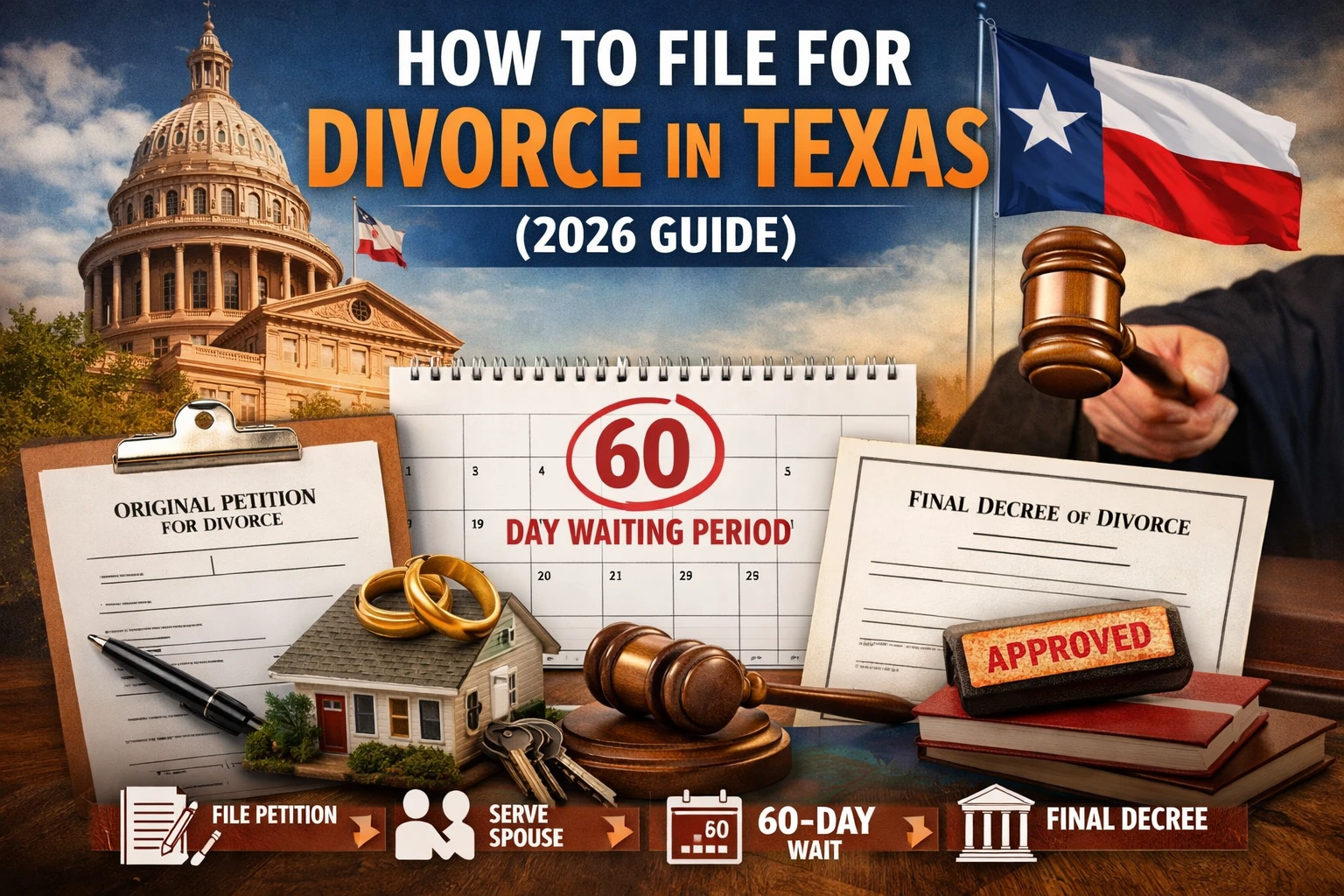
Texas law requires a 60-day waiting period between filing your petition for divorce and when the final decree can be granted. This period begins when the respondent receives service of process or signs a waiver of service. During this time, you and your spouse can finalize settlement agreements and prepare all required documents. Document review services help ensure everything is ready for submission after the waiting period ends.
Do I need a lawyer to review my divorce decree?
A lawyer is not required, but professional document review is recommended. Document review services examine your final decree of divorce for legal compliance, accuracy in asset division, child support guidelines compliance, and procedural correctness. This verification catches errors before court filing, saving time and money. Many people choose document review as a cost-effective alternative to full legal representation.
What are the risks of using online divorce document preparation services?
Common risks include incomplete forms, missing required signatures or notarization, incorrect jurisdiction information, and failure to comply with Texas statutory requirements. Documents prepared without professional review may be rejected by the court, requiring resubmission and extending your divorce timeline. Using a document review service reduces these risks by having experienced professionals verify all forms before filing.
This article was written using GrandRanker