Table of Contents
- Can Online Divorce Services Actually Handle Cases With Children?
- Understanding Uncontested Divorce With Children
- Child Custody Agreement Templates and Online Tools
- Online Divorce Child Support Calculator: How It Works
- How to File for Divorce With Minor Children
- When Online Services Fall Short: Situations Requiring an Attorney
- Post-Divorce Modification: What Happens After the Decree
- Conclusion
Last Updated: August 11, 2026
Can Online Divorce Services Actually Handle Cases With Children?
The short answer: some can, but most fall short in critical ways. Many online divorce services provide templates and calculators for child custody and support, but they excel only at document preparation for straightforward, uncontested cases. They struggle when real family dynamics, state-specific custody laws, or competing parental interests enter the picture.
At Ready Divorce Service, we work with Texas families navigating uncontested divorce with children every day. The distinction between "can handle" and "should handle" matters enormously when your kids are at stake. This guide walks you through exactly what online services can and cannot do, which situations require attorney involvement, and how to protect your family’s interests whether you choose to go digital or seek professional counsel.

Online divorce services can prepare documents for uncontested divorces with children, but they cannot provide legal advice, negotiate custody disputes, or ensure your agreement serves your child’s best interests. Success depends entirely on whether you and your co-parent already agree on all major issues.
Understanding Uncontested Divorce With Children
An uncontested divorce with children means you and your spouse have already reached agreement on custody, visitation, child support, and all other parental matters. The court doesn’t decide anything, you do.
What Makes a Divorce Uncontested When Kids Are Involved
An uncontested divorce with minor children requires agreement on five core elements: who has primary custody, the visitation or parenting time schedule, child support obligations, health insurance responsibility, and decision-making authority for major issues like education and medical care. Texas courts require a detailed parenting plan addressing these elements and the best interests of the child. Online services generate templates based on your state’s requirements, but they cannot adapt those templates to unique family circumstances or advise whether your custody arrangement protects your child’s interests.
Many couples believe they’re uncontested when they’re actually partially contested. One parent agrees to the other’s proposed custody schedule but hasn’t thought through how it affects their work schedule or the child’s school routine. Another settles on child support based on rough calculation, not the actual formula. These gaps create problems later when modification becomes necessary.
Legal Requirements for Minor Children in Divorce
Texas law requires specific documentation for any divorce involving minor children. A parenting plan must specify the child’s primary residence, the schedule for possession and access, decision-making rights, and how major expenses are handled. Child support calculations follow state guidelines based on the paying parent’s income and the number of children, roughly 20% for one child, 25% for two, and so on. The court also requires disclosure of both parents’ financial information. Online services provide forms for this disclosure, but they don’t verify accuracy or completeness. If one parent underreports income or omits assets, the child support calculation becomes invalid, but the service won’t catch it.

Child Custody Agreement Templates and Online Tools
Online services offer custody templates and calculators designed to simplify the process. Understanding what these tools actually do is essential before relying on them.
What Online Services Provide for Custody Documentation
Most online divorce services generate a parenting plan template based on your state and your answers to a questionnaire. You specify the child’s primary residence, the other parent’s visitation schedule, and who makes decisions about education, healthcare, and religion. The service plugs your answers into a state-approved form and produces a document ready to file. The limitation is consistency with your actual life. A template might specify every other weekend visitation and two weeks in summer. For families where one parent travels for work, the child has special needs, or the parents live far apart, the standard schedule creates conflict immediately. Online services also cannot negotiate. If you and your co-parent disagree on custody, the service cannot mediate.
Red Flags in DIY Custody Agreements
Several warning signs suggest a DIY custody agreement needs attorney review before filing:
- Vague language on decision-making. A template might say both parents share "major decisions" but not define what qualifies as major. Ambiguity leads to conflict.
- Unequal financial responsibility. Child support covers routine expenses, but who pays for sports, tutoring, or orthodontics? If your agreement doesn’t specify, disputes are inevitable.
- No modification process. Life changes. A custody schedule that works when your child is six may be impossible when they’re sixteen.
- Ignoring the child’s needs. A schedule that looks fair on paper might not account for your child’s school hours, extracurricular activities, or emotional needs.
- Missing health and education details. Which parent enrolls the child in school? Who handles medical appointments? These details prevent constant negotiation.
A custody agreement that looks complete may still omit critical protections for your child. Only an attorney familiar with your family’s situation can assess whether an agreement truly serves your child’s best interests.
Online Divorce Child Support Calculator: How It Works
Child support calculators are among the most useful tools online divorce services offer. Most use your state’s child support guidelines to compute a baseline obligation. In Texas, this typically means multiplying the paying parent’s net monthly income by a percentage (20% for one child, 25% for two, and so on). The strength of this approach is consistency. The weakness is that guidelines assume standard situations. They don’t account well for split custody, extended visitation by the non-custodial parent, or income above the statutory cap. A calculator might show that you owe $1,200 per month based on your income and one child, but if you have the child 40% of the time instead of the standard 20%, your obligation should be lower. The calculator won’t automatically adjust for this.
Online services also cannot advise whether the calculated amount is actually sufficient for your child’s needs. A guideline calculation might produce $800 per month, but your child’s actual expenses might be $1,200. The calculator is legally compliant but practically inadequate. Many couples use an online calculator as a starting point, then negotiate from there.
How to File for Divorce With Minor Children
Filing for divorce with minor children follows a specific process, though the steps vary by state.
Step-by-Step Filing Process With Children
Step 1: Prepare your documents. Gather your parenting plan, child support calculation, and financial disclosures. If you’re using an online service, answer the questionnaire and generate your forms. Review them carefully before filing.
Step 2: File with the court. Submit your divorce petition, parenting plan, child support worksheet, and financial disclosures to the family court in your county. Include the filing fee (typically between $200 and $400, depending on your county).
Step 3: Serve your spouse. Your spouse must receive official notice of the divorce filing. This can be done by certified mail, personal service by a sheriff, or agreed-upon service if your spouse consents.
Step 4: Wait for response. Your spouse has a set time (usually 20 days in Texas) to respond. If they agree with everything, they sign the agreement. If they contest anything, the case becomes contested, and you’ll need attorney representation.
Step 5: Finalize the decree. Once both parties agree, the judge reviews the parenting plan and child support calculation to ensure they comply with state law and serve the child’s best interests. If everything is in order, the judge signs the decree, and the divorce is final.
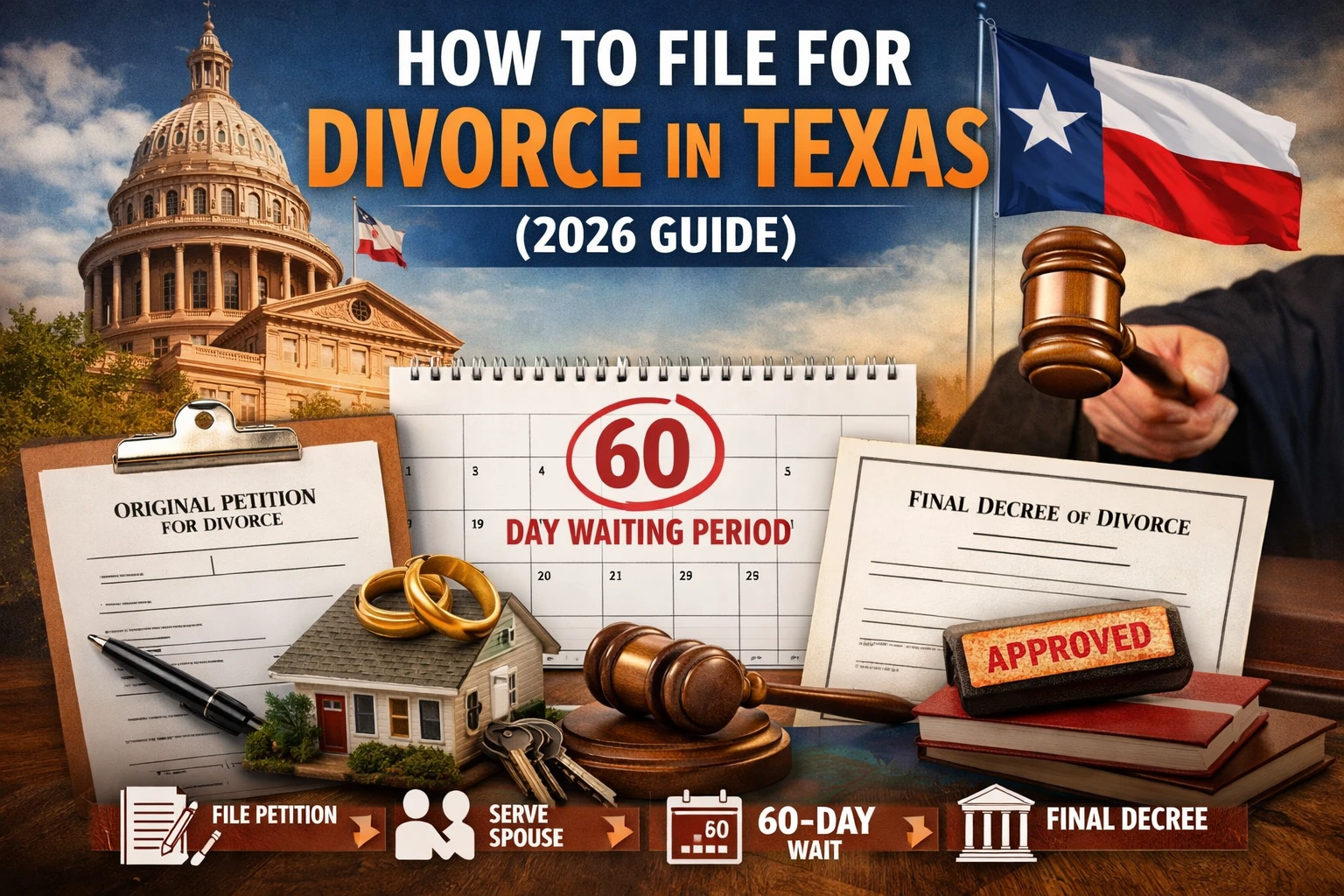
The 60-Day Waiting Period and What Happens During It
Texas law imposes a 60-day waiting period between filing and finalization. This period exists to ensure couples have time to reconsider and to allow for proper notice and response. During the waiting period, your spouse responds to the filing (or fails to respond, which defaults in your favor). If there are disagreements, you negotiate or mediate. Many parents use this time to test their custody schedule in practice and reconsider whether it will work.
After the waiting period ends, you file a final decree for the judge to sign. If everything is uncontested and complies with state law, this is typically a formality.
Use the 60-day waiting period to test your custody schedule in practice. If it doesn’t work, modify it now, before the decree is final. Changes after finalization require court approval and are much more complicated.
When Online Services Fall Short: Situations Requiring an Attorney
Online divorce services handle straightforward uncontested cases well. They struggle in situations where complexity, conflict, or high stakes are present.
Complex Family Situations Beyond Online Scope
Certain circumstances demand attorney involvement, regardless of how amicable you and your co-parent appear:
- One parent wants to relocate. If the custodial parent plans to move out of state or more than 100 miles away, Texas law requires the non-custodial parent’s consent or a court modification.
- One parent has a history of substance abuse or domestic violence. Child safety requires careful documentation and protective provisions.
- The child has special needs. A child with autism, severe allergies, or chronic illness requires a detailed parenting plan addressing medical decision-making and expense responsibility.
- One parent earns significantly more than the other. Guidelines work for moderate-income parents. When one parent earns $50,000 and the other earns $500,000, the calculation becomes complex.
- One parent is self-employed or has irregular income. Calculating child support for a business owner or freelancer requires analysis of tax returns and business finances.
- Either parent has children from other relationships. Child support guidelines adjust for other children you’re obligated to support.
- You own significant assets or debt. Property division becomes complicated with a house, investments, retirement accounts, or substantial debt.
Psychological Impact Considerations for Children
Online divorce services operate under the assumption that a legal agreement is the end goal. But the real goal is minimizing harm to your child. An attorney or family therapist can help you design a parenting plan that accounts for your child’s age, temperament, and needs. A five-year-old needs more frequent contact with both parents and shorter stretches away from either one. A teenager might prefer more flexibility and input into the schedule. Online services cannot provide this psychological insight. They generate legal documents; they don’t consider how those documents affect your child’s wellbeing.
Post-Divorce Modification: What Happens After the Decree
The divorce decree is not the end of the story. Life changes, and custody and support arrangements often need adjustment. Modification of custody or child support requires showing a "material and substantial change in circumstances" since the last decree or agreement. Examples include a significant change in either parent’s income, a change in the child’s needs or health status, or a change in the custody arrangement’s feasibility.
Either parent can request modification by filing a motion with the family court. If the other parent agrees, the process is straightforward. If they disagree, the case becomes contested, and you’ll likely need attorney representation. Online services generally do not handle modifications. They’re designed for initial divorces, not post-divorce adjustments. Build flexibility into your original agreement where possible and include a process for requesting modification if circumstances change.
A divorce decree is not permanent. Either parent can request modification if circumstances change significantly. Plan for this possibility when designing your original custody and support arrangement.
Conclusion
Online divorce services can handle uncontested divorces with children when you and your co-parent have already reached agreement on custody, visitation, and child support. They excel at document preparation and ensure your paperwork complies with state requirements. But they cannot provide legal advice, mediate disagreements, or assess whether your arrangement truly serves your child’s best interests.
Ready Divorce Service specializes in guiding Texas families through this process with accuracy and care. We prepare court-approved documents, ensure full compliance with Texas family law, and provide step-by-step guidance from filing through finalization. If your situation is straightforward and uncontested, we can help you complete your divorce affordably and efficiently. If complexity arises, disagreements over custody, special circumstances, or concerns about your child’s wellbeing, we’ll be honest about when attorney involvement is necessary. Your family’s stability matters more than saving money on the filing process.
Frequently Asked Questions
Can you get a divorce online if you have kids?
Yes, you can use online divorce services for an uncontested divorce with children, but only if you and your spouse agree on custody, visitation, and child support. Online services provide templates for parenting plans and child support calculations. However, the court still requires specific documentation about how custody and support will be handled. If you disagree on any aspect of your children's care or financial support, you'll need mediation or an attorney.
What documents are required for an uncontested divorce with children?
For an uncontested divorce with minor children, you'll need a divorce petition, a marital settlement agreement, a parenting plan specifying custody and visitation schedules, a child support calculation worksheet, and a decree. Many online divorce services provide these court-approved forms tailored to your state. Some services also include name change documents and property division agreements if applicable. Your state's family court clerk can confirm the exact requirements for your jurisdiction.
How do online divorce services handle child support calculations?
Online divorce services typically include child support calculators that apply your state's guidelines. These tools ask for income information, custody arrangement, and the number of children, then calculate the obligation based on statutory formulas. However, these calculators provide estimates only. The court uses the same guidelines but may adjust amounts based on special circumstances like healthcare costs or unusual custody splits. Always verify the result with your state's child support guidelines or consult an attorney if your situation is complex.
When is it necessary to hire an attorney instead of using an online service?
You should hire an attorney if you and your spouse disagree on custody, visitation, or support; if significant assets or debt are involved; if either parent has a history of abuse or substance issues; or if one spouse refuses to cooperate. Online services work only for truly uncontested divorces where both parties agree on all terms. An attorney can also review agreements you've drafted to catch issues that online templates might miss, protecting your rights and your children's interests long-term.
This article was written using GrandRanker