Table of Contents
- Who Qualifies for an Uncontested Divorce in Texas
- Step-by-Step: Filing Your Texas Uncontested Divorce Online
- Uncontested Divorce Forms Texas Courts Require
- Texas Divorce Filing Fees and What Affects Total Cost
- eFileTexas Requirements for Self-Represented Litigants
- How the Texas Divorce Waiting Period Works After Filing
- Document Preparation vs. Legal Advice: What an Online Service Can and Cannot Do
- Frequently Asked Questions
Last Updated: September 14, 2026
Who Qualifies for an Uncontested Divorce in Texas
An uncontested divorce in Texas is one where both spouses agree on every major issue: property division, debt allocation, and, if minor children are involved, custody, visitation, and child support. When both parties sign off, no one has to prove fault, and the case can move through the courts without a trial.
The eligibility rules are stricter than most people expect. To file as an uncontested case, you generally need:
- You or your spouse has lived in Texas for at least six months and in the county where you file for at least 90 days
- Both spouses agree the marriage is over and cite insupportability, the state’s no-fault ground
- You have a signed settlement agreement covering all marital property and debts
- If you have minor children, you have a written agreement on conservatorship, visitation, and child support
Insupportability is defined under the Texas Family Code, Title 1, Chapter 6 as a conflict of personalities that destroys the legitimate ends of the marriage and prevents any reasonable expectation of reconciliation. It is the ground most self-represented filers use because it requires no proof of wrongdoing.
Here is the part most guides skip: an “agreement” is not a conversation where you both said you want it over. Texas courts want a written, signed document. If your spouse will not sign, your case is contested, and the online no-lawyer path is not the right fit.
If your spouse is missing, incarcerated, or refuses to sign anything, do not file as uncontested. The court will reject or delay the case, and you may lose your filing fee. Ask the court clerk about service by publication or a contested filing instead.
Step-by-Step: Filing Your Texas Uncontested Divorce Online
Filing an uncontested divorce online in Texas means preparing court-approved forms, submitting them through the state’s electronic filing system, and following the case to a final decree. These are the steps most counties expect.
Total time: several weeks of preparation, then a waiting period set by statute before a judge can sign the decree.
- Confirm jurisdiction and venue. Verify the six-month state residency and 90-day county requirement before drafting anything.
- Draft the divorce petition. This starts the case and states the grounds, the relief you want, and whether children are involved.
- Prepare supporting documents. A settlement agreement, a waiver of service if your spouse signs voluntarily, and any required affidavits.
- File the petition. Submit through eFileTexas or, in counties that allow it, in person with the district clerk. You receive a case number and it appears on the docket.
- Serve your spouse or obtain a waiver. A signed waiver of service is faster and cheaper than formal service.
- Wait out the statutory period. Texas law sets a minimum waiting period after filing before a court can grant the divorce.
- Submit the final decree. Once the waiting period passes and required documents are in, the judge reviews and signs the decree.

A common mistake is filing the petition before the settlement agreement is finalized. The petition locks in your case number and starts the clock, but if the agreement changes afterward, you may need to amend your pleadings, which adds time and another filing.
Uncontested Divorce Forms Texas Courts Require
The core forms in an uncontested case are the original petition, the waiver of service, the final decree of divorce, and, when children are involved, the documents covering conservatorship and support. Texas does not use one statewide packet for every county, the form that works in one county can be rejected in the next, which derails most self-represented filers.
Statewide promulgated forms vs. county local forms
The Texas Supreme Court promulgates certain family law forms that are accepted statewide. These cover the most common filings, including the petition for divorce, the waiver of service, and the final decree in basic cases. The Texas Office of Court Administration maintains the current list of promulgated forms.
But many counties require additional local forms on top of the promulgated set. Common examples include:
- A docket control or scheduling order form
- A local information sheet with case-specific data
- A standing order acknowledgment
- A prove-up affidavit for submission without a hearing
Some counties accept the promulgated forms as-is; others publish their own versions and reject the state form if a local one exists. The only reliable way to know is to check your district clerk’s website or call the clerk’s office and ask which forms they currently accept for an agreed divorce.
The standing order problem
Many Texas counties issue a standing order automatically when a divorce petition is filed. It imposes temporary restrictions on both parties, typically covering property transfers, insurance changes, and conduct around the children, and applies whether or not you read it. If your county has one, it is part of your required documents even though you did not draft it. Ask the clerk whether one applies and get a copy.
The documents you will typically assemble:
- Original petition for divorce
- Waiver of service or a return of service
- Final decree of divorce
- Settlement agreement dividing property and allocating debt
- If minor children are involved: an agreed parenting plan, child support order, and the required affidavit on children
- Any county-specific local forms, such as a docket control or information sheet
- Standing order acknowledgment, if your county issues one
Two details that cause rejections:
First, notarization: some documents must be signed in front of a notary, and a missing stamp is a common reason clerks reject filings. Second, the decree must match the petition, if the petition asks for one thing and the decree grants another, the judge can send it back.
TexasLawHelp’s self-help divorce resources publishes plain-language form guides organized by county, and the Texas Office of Court Administration maintains the state’s promulgated forms. Use the version your county currently accepts, and when in doubt, confirm with the clerk before you file.
Do not download a form from a random website and assume it is current. Form versions change, and a stale form is a rejected filing. Pull forms from the county clerk’s site or the state’s promulgated list, and check the revision date.
Texas Divorce Filing Fees and What Affects Total Cost
Filing fees in Texas are set at the county level, so there is no single statewide number; your district clerk’s fee schedule is the authoritative source. Beyond the filing fee, expect these possible costs:
- Service of process, if your spouse will not sign a waiver
- Notary fees for affidavits and signed documents
- Copies and certified-copy fees for the final decree
- Postage or e-filing convenience charges
Here is the honest part about “affordable.” A no-lawyer online route avoids attorney hourly rates, but it does not make court fees disappear. Pricing for document preparation services depends on your situation, whether you have children, and how much review you need. Pricing for document preparation services depends on your situation, whether you have children, and how much review you need. You can see how plans differ on the Which Plan is Right for You? page or request a quote directly.
| Cost Item | Who Sets It | What Changes It |
|---|---|---|
| Filing fee | County district clerk | County fee schedule |
| Service of process | Process server or sheriff | Whether spouse signs a waiver |
| Notarization | Notary | Number of documents requiring it |
| Document preparation | The service you choose | Children, property, complexity |
The cheapest filing is the one that is accepted the first time. A rejected petition costs you the fee again and resets your timeline, which is why accuracy matters more than speed.
eFileTexas Requirements for Self-Represented Litigants
eFileTexas is the state’s electronic filing system, and most Texas courts require documents to be submitted through it. As a self-represented litigant, you can register and file without an attorney.
What you need to file electronically:
- A registered eFileTexas account with your contact information
- Your documents saved as a PDF
- The correct case category and filing code for a divorce
- Payment method for the filing fee, or an affidavit of indigency if you qualify to have fees waived
A frequent snag is choosing the wrong filing code. The system routes documents by code, and a mislabeled petition can land in the wrong queue and sit there. Confirm with the clerk which code your county uses for an original petition for divorce.
Do not email sensitive documents to yourself or store them in an unsecured cloud folder. A divorce petition contains your address, financial details, and often your children’s information. Use the court’s own filing portal and keep personal copies on a password-protected device.
How the Texas Divorce Waiting Period Works After Filing
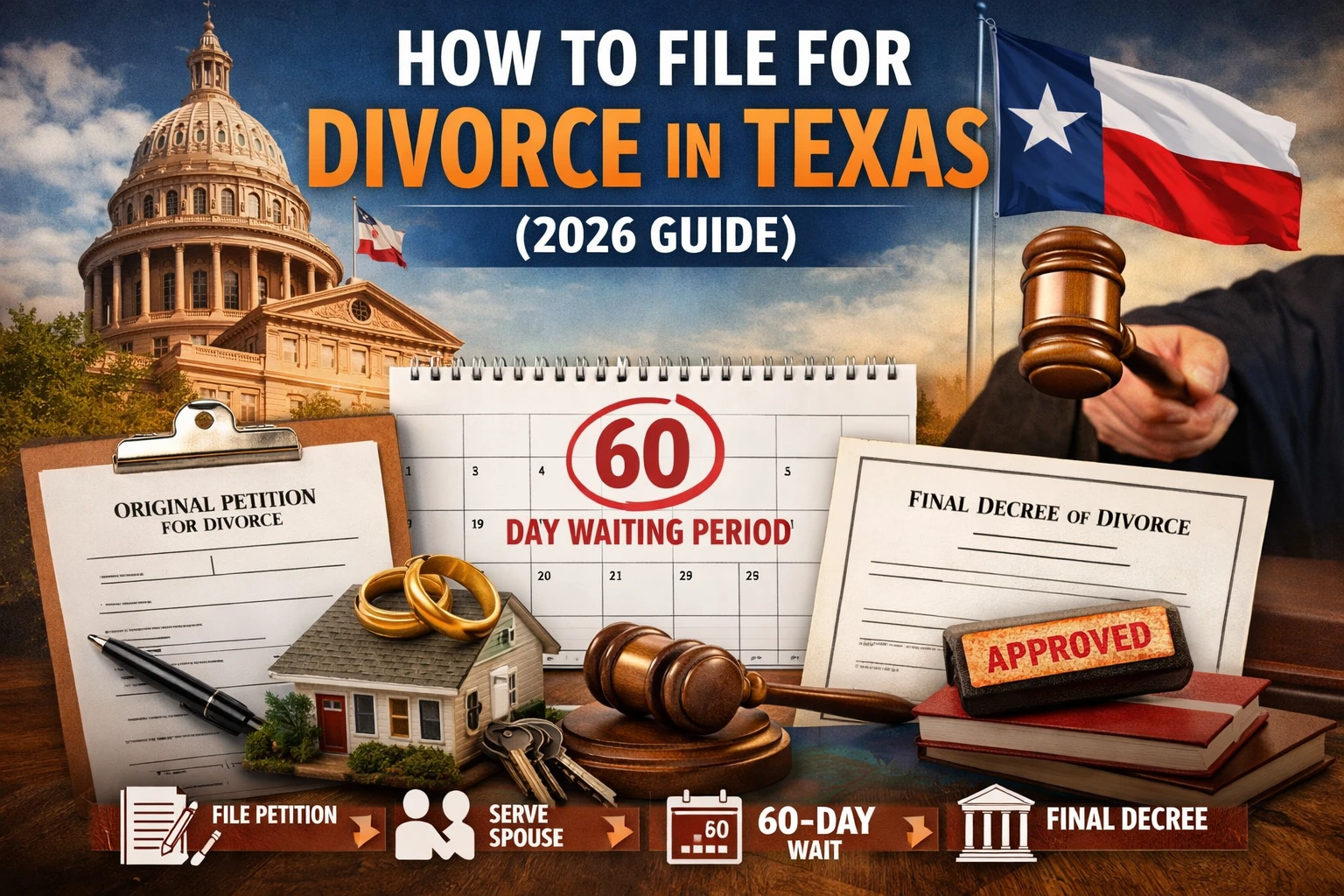
Texas law imposes a mandatory waiting period before a court can grant a divorce. Under the Texas Family Code, the petition must be on file with the clerk for at least 60 days before the judge signs the final decree. The clock starts the day the petition is filed and stamped by the district clerk, not the day you agree on terms or finish drafting the decree.
This is the most misunderstood mechanic in the no-lawyer process. The 60-day period is a floor, not a deadline, the earliest date the court may act, not a promise your case finalizes on day 61.
What actually happens during and after the 60 days:
- Days 1-60: The court is barred from granting the divorce. You can still file amendments, correct documents, and prepare the final decree.
- Day 61 onward: The case becomes eligible for a final hearing or, in counties that allow it, submission on the paperwork without an appearance.
- Docket scheduling: Even after day 61, your case needs a slot. Some counties finalize agreed divorces on the papers within days; others schedule prove-up hearings weeks or months out. The variance is county-level, not statutory.
- Children’s cases: If minor children are involved, the court may require additional review of the parenting plan and child support order, extending the timeline beyond the statutory minimum.
How to track your case status:
Most Texas district clerks publish an online case search portal where you can look up your case by cause number or party name. It typically shows filed documents, scheduled hearings, and the assigned court. Check weekly rather than daily, docket updates are not always real-time. If your county lacks online tracking, the clerk’s office can confirm status by phone or in person.
What to do while you wait:
- Confirm the settlement agreement matches the petition exactly. A mismatch is the most common reason a decree gets bounced back.
- Get every document requiring notarization signed and stamped.
- Have the final decree drafted and ready so you can submit the moment the case is eligible.
- Watch for standing orders. Many counties issue one at filing that imposes temporary restrictions, for example, on transferring property or changing insurance, and those apply automatically even without a hearing notice.
Do not assume the 60-day mark means you are done. Build in a buffer for docket scheduling, especially in larger counties where agreed divorces still compete for hearing slots. Filing the decree the day the case becomes eligible is the fastest path, but the court controls the calendar after that.
Document Preparation vs. Legal Advice: What an Online Service Can and Cannot Do
A legal document preparation service helps you complete and organize court forms correctly. It does not represent you and cannot give legal advice, the most important distinction to understand before hiring anyone online.
What a preparation service can do:
- Provide and populate court-approved forms based on your answers
- Check that documents are complete and internally consistent
- Guide you through the filing sequence and deadlines
- Assist with Spanish-language support for filers who need it
What it cannot do:
- Tell you what outcome you should seek or which terms are best for you
- Represent you in court or negotiate with your spouse
- Predict how a judge will rule on your specific case
If your situation involves hidden assets, a dispute over the children, or an abusive spouse, you need an attorney, not a form service. For a straightforward, fully agreed case, document preparation is the faster and more affordable path. Ready Divorce Service specializes in that middle ground, and its Starting the Divorce Process FAQ explains what a self-represented litigant needs to bring.
If you have already started filling out forms on your own, you do not have to start over. A preparation service can review what you have, flag errors, and correct them.
Frequently Asked Questions
Can I get a divorce in Texas without a lawyer?
Yes. Texas allows self-represented litigants to file for an uncontested divorce without an attorney. You must meet residency and jurisdictional requirements, have a settlement agreement on property, debt, and any minor children, and file the correct court-approved forms. An online document preparation service can help you complete the paperwork accurately, but it cannot give legal advice or represent you in court.
How long does an uncontested divorce take in Texas?
Texas has a statutory waiting period that begins once the respondent is served or files a waiver of service. The court cannot grant a final decree before that period ends. After the waiting period, finalization depends on your county’s docket and whether the judge requires a court appearance. Some counties process agreed divorces by affidavit without a hearing, while others schedule a brief prove-up.
What is the process for an uncontested divorce using online document preparation in Texas?
You complete a questionnaire about your marriage, property, debts, and children. The service generates your divorce petition and related forms. You file the petition with the district clerk in the county where you or your spouse has lived, arrange service or a waiver, and submit the final decree once the waiting period passes. The court reviews the paperwork and issues the final decree.
Do I have to go to court for an uncontested divorce in Texas?
Not always. Some Texas counties allow a final decree by affidavit when both spouses agree and no minor children are involved. Other counties require a short prove-up hearing, which can sometimes be handled by phone or video. Your county’s local rules determine whether a court appearance is needed, so check with the district clerk before filing.
Filing an uncontested divorce on your own is manageable when the paperwork is right and the timeline is clear, but a single rejected form can cost you weeks. Ready Divorce Service specializes in Texas uncontested divorce document preparation, with step-by-step guidance, accurate court-ready forms, and a clear path from petition to final decree. Get started with Ready Divorce Service by completing the questionnaire, and move through your divorce with confidence instead of guesswork.