Table of Contents
- What Qualifies as an Uncontested Divorce in Texas
- Residency Requirements for Divorce in Texas
- How to File for Uncontested Divorce in Texas: Step-by-Step
- Divorce Forms for Uncontested Divorce: What You Need
- Texas Divorce Waiting Period: What Happens During the 60 Days
- Dividing Property, Debt, and Digital Assets
- Child Custody, Support, and Mediation as a Bridge
- Conclusion
- Frequently Asked Questions
Last Updated: September 15, 2026
What Qualifies as an Uncontested Divorce in Texas
An uncontested divorce in Texas is a dissolution of marriage where both spouses agree on all terms, property division, debt allocation, and child-related matters, before filing. Once both parties sign the settlement agreement, the case moves through the court system without a trial.
This guide covers the full process for understanding Texas uncontested divorce laws, from residency rules to the final decree. The core principle: no disagreements means no courtroom battle.
Most couples confuse “uncontested” with “simple.” A case with children, real property, and shared debt can still be uncontested, provided both spouses agree on how to handle each item.
An uncontested case requires agreement on every issue before filing. One disputed item, even a small one, can push your case into contested territory and add months to the timeline.
Residency Requirements for Divorce in Texas
Texas requires at least one spouse to have lived in the state for 90 days before filing and in the county of filing for 90 days as well. These are statutory requirements, and the clerk will check them before accepting your original petition for divorce.
If you recently moved, wait until you meet the 90-day threshold. Filing early leads to rejection and a lost filing fee.
The residency rule applies to the petitioner, not the respondent. A spouse who moved out of state can still be named as the respondent in a case filed by the Texas resident.
How to File for Uncontested Divorce in Texas: Step-by-Step
Filing an uncontested case follows a defined sequence; skipping a step or filing forms out of order is the most common reason courts reject a case. The Texas Supreme Court has approved standardized forms for uncontested divorces without children, which most counties accept, though some require additional local forms.

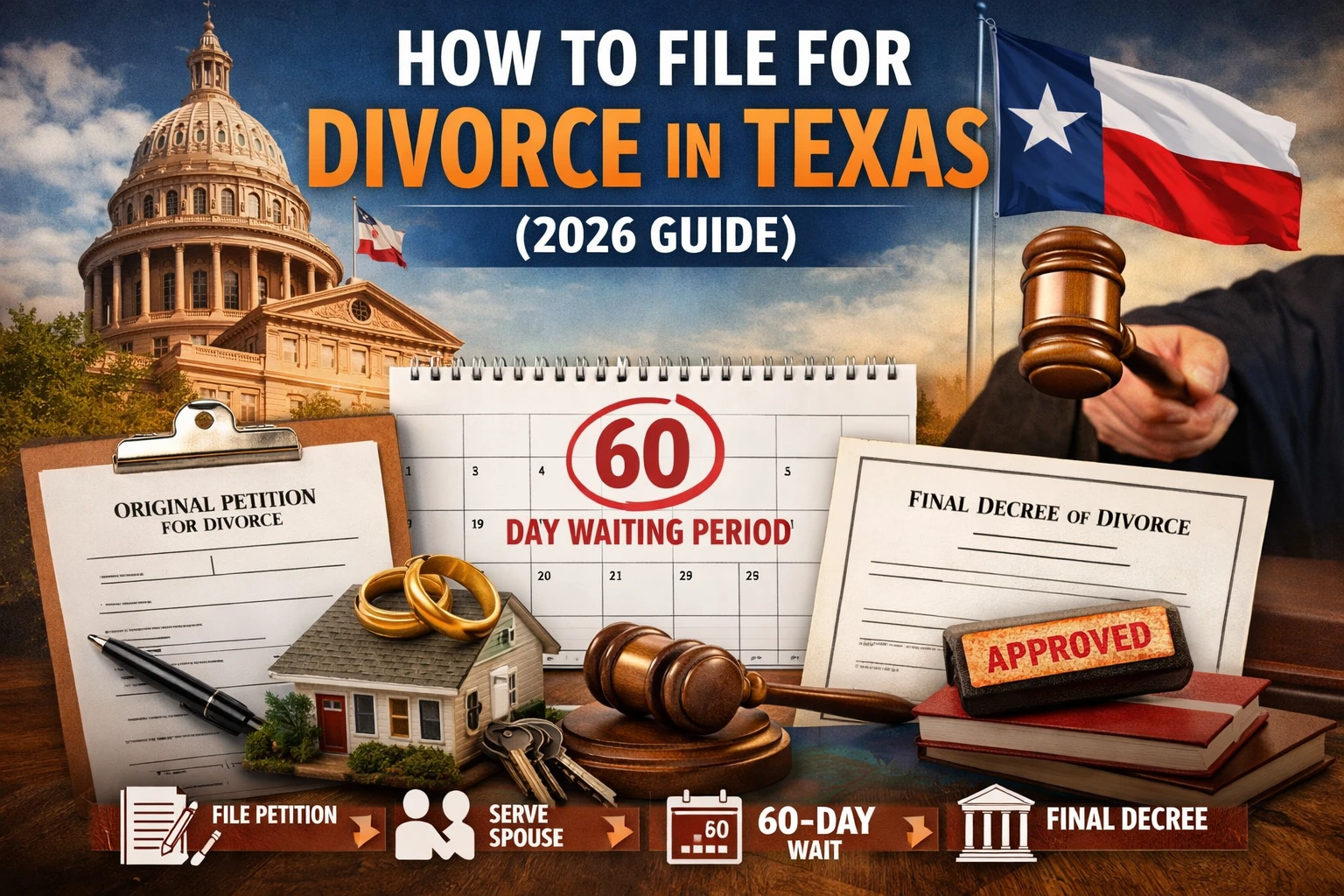
Here is the sequence:
- Confirm residency and eligibility
- Complete the original petition for divorce
- File the petition with the district clerk
- Serve your spouse or obtain a waiver of service
- Wait out the 60-day waiting period
- Submit the final decree and supporting documents
- Attend the prove-up hearing if the court requires one
Preparing Your Original Petition for Divorce
The original petition starts your case. It identifies the petitioner and respondent, states the grounds, and outlines what you are asking the court to approve. Texas is a no-fault state, so most couples file on the ground of insupportability, discord or conflict of personalities.
Use court-approved forms for your county. The Texas Supreme Court’s standardized Original Petition for Divorce (Form 1) works in most counties, but Harris, Dallas, and others require local forms or cover sheets. Check your district clerk’s website before filing, a form that works in one county may be rejected in another.
Serving Your Spouse and Waiver of Service
Service of process is the formal delivery of the petition to your spouse. In an uncontested case, most couples avoid it by having the respondent sign a waiver of service, confirming receipt without a constable or process server.
If your spouse will not sign the waiver, you must arrange formal service, by personal delivery, certified mail with return receipt requested, or alternative service approved by the court. A constable or process server typically charges $50 to $100, and service can add two to four weeks to your timeline.
Submit the waiver of service with your petition rather than waiting for the clerk to request it. Courts process agreed cases faster when the waiver is already on file.
The Prove-Up Hearing
Even in an uncontested case, many Texas courts require a brief prove-up hearing before a judge. This is not a trial. The petitioner appears (often by Zoom or telephone) and answers a few basic questions: that the marriage is insupportable, residency is met, and the settlement agreement is voluntary and fair. It usually takes five to ten minutes.
Some counties allow an affidavit prove-up, where you submit a sworn statement instead of appearing; ask your district clerk. If you have children, some judges require both spouses to appear. Failing to show up can delay your divorce by weeks.
After the Decree Is Signed
Once the judge signs the final decree, your marriage is legally over. But the paperwork does not end there. You will need to:
- File the decree with the county clerk to make it part of the public record
- Send a certified copy to the Social Security Administration if you are changing your name
- Update your name and marital status with the Texas Department of Public Safety, your bank, employer, and insurance providers
- Transfer titles for vehicles and real property using the decree as proof of ownership
- Update beneficiary designations on retirement accounts and life insurance policies
Couples often finalize the divorce and discover months later that a retirement account or vehicle title was never updated. Build a post-decree checklist before the judge signs so you can execute it immediately.
Divorce Forms for Uncontested Divorce: What You Need
Texas uncontested divorce forms fall into three groups: the petition, the agreed orders, and the final decree. Missing any required form delays your case.
| Form Type | Purpose | When Filed |
|---|---|---|
| Original petition | Starts the case | At filing |
| Waiver of service | Confirms spouse received notice | With petition |
| Divorce settlement agreement | Records agreed terms | Before final decree |
| Final decree of divorce | Officially ends the marriage | End of waiting period |
| Child support worksheet | Sets support amount | If minor children |
Ready Divorce Service prepares these documents to match county requirements, reducing the chance of rejection. If you have already started your forms, we can review and correct errors rather than starting over.
Texas Divorce Waiting Period: What Happens During the 60 Days
The 60-day waiting period is a mandatory pause between filing and the final decree.
Dividing Property, Debt, and Digital Assets
Community Property vs. Separate Property
Retirement Accounts and QDROs
Tax Implications of Property Division
Digital Assets and Cryptocurrency
Do not assume a signed agreement is final. If the terms in the decree do not match the settlement agreement word for word, the judge can reject the decree and send you back to correct it.
Debt Division and Indemnification
Child Custody, Support, and Mediation as a Bridge
Do not assume a signed agreement is final. If the terms in the decree do not match the settlement agreement word for word, the judge can reject the decree and send you back to correct it.
Conclusion
Frequently Asked Questions
What qualifies as an uncontested divorce in Texas?
An uncontested divorce in Texas means you and your spouse agree on all terms: property division, debt, child custody, and support. Neither party disputes the divorce itself. You must have a no-fault ground, typically insupportability, meaning the marriage cannot continue. If you agree on everything, you can file an agreed divorce without going to trial. If any issue is disputed, the case becomes contested and may require a judge to decide.
How long does an uncontested divorce take to finalize in Texas?
Texas law requires a 60-day waiting period after filing the original petition for divorce before a judge can sign the final decree. The total time depends on court processing and whether you file all documents correctly. Many uncontested cases finish in 60 to 90 days. If you need help preparing forms and staying compliant, Ready Divorce Service guides you through each step to avoid delays.
Do I need a lawyer for an uncontested divorce?
You are not required to hire a lawyer for an uncontested divorce in Texas. Many people file pro se, meaning they represent themselves. However, you must use court-approved forms and follow statutory requirements. A document preparation service like Ready Divorce Service can help you complete paperwork accurately without the cost of traditional legal representation. For complex issues like retirement accounts or real property, consulting an attorney is wise.
What are the residency requirements for filing for divorce in Texas?
To file for divorce in Texas, at least one spouse must have lived in the state for the 6 months immediately before filing. You must also file in the county where either you or your spouse has lived for the 90 days immediately before filing. If you moved recently, you may need to wait until you meet these timelines. Ready Divorce Service can help you confirm your eligibility before you start.
How much does it cost to file for an uncontested divorce in Texas?
Court filing fees vary by county, and you may also pay for service of process or a waiver. Ready Divorce Service does not publish fixed prices because costs depend on your specific needs. We offer affordable document preparation as an alternative to traditional attorney fees, which often run several thousand dollars. Contact us for a quote tailored to your situation and county requirements.
What is the mandatory waiting period after filing in Texas?
Texas has a 60-day waiting period from the date you file the original petition for divorce. The court cannot grant a final decree until that period ends. This gives both parties time to review the divorce settlement agreement and ensure all issues are resolved. Use this time to gather financial documents, finalize property division, and prepare for the final hearing if your county requires one.
Can we divide digital assets and retirement accounts in an uncontested divorce?
Yes. Digital assets like cryptocurrency, online business accounts, and digital royalties are part of the marital estate and must be divided. Retirement accounts and investment portfolios also require specific language in the divorce decree. Some transfers may trigger tax consequences, so consult a tax professional. Ready Divorce Service can help you document these assets clearly in your settlement agreement.