A divorce can be agreed on in the kitchen and still get delayed at the courthouse because one form is incomplete, one signature is missing, or the decree does not match the petition. This Collin County divorce form guide is for Texans who want a clear path through an agreed divorce without turning a straightforward case into a costly procedural problem.
An uncontested divorce generally means both spouses agree on the major terms: ending the marriage, dividing property and debts, and, when children are involved, conservatorship, possession, and support. Agreement makes the process simpler, but the court still requires accurate paperwork and compliance with Texas law.
Start by confirming that Collin County is the right place to file
Before choosing forms, make sure you meet Texas residency rules. At least one spouse must have lived in Texas for the previous six months and in Collin County for at least 90 days before filing. If you do not meet both requirements yet, filing too soon can create an avoidable setback.
You should also be realistic about whether your case is truly agreed. A case may not be a good fit for self-directed agreed-divorce paperwork if a spouse will not sign, you cannot locate them, there are serious disputes about assets or parenting, or there are concerns involving family violence, hidden property, bankruptcy, immigration consequences, or a business with uncertain value. Those circumstances may require legal advice beyond document preparation.
Collin County divorce form guide: the core documents
The exact packet depends on your family and finances. A divorce without minor children uses a different set of documents than a divorce involving children. The court may also have current local requirements, so forms and filing procedures should be checked before submission.
Original Petition for Divorce
The Original Petition for Divorce opens the case. It identifies the spouses, states the legal grounds for divorce, confirms residency, and tells the court what orders you are requesting. In many agreed cases, the petition uses Texas’s no-fault ground of insupportability.
The petition must also match the relief you eventually request in the Final Decree of Divorce. For example, if one spouse wants a name change, the petition should request it. If the case involves children, the petition needs to address the requested conservatorship, possession schedule, child support, medical support, and other child-related orders.
Civil filing forms and local requirements
Electronic filing is commonly used in Texas courts, and the filing system or Collin County clerk may require case-specific information at the time of filing. Requirements can change, so do not rely on an old packet saved from a prior case or shared by a friend.
The filing fee is usually paid when the petition is filed. If paying the fee would create a genuine hardship, a party may be able to request that court costs be waived by filing the appropriate statement of inability to afford payment. Approval is not automatic.
Waiver of Service or Respondent’s Answer
Filing the petition is only one part of starting a divorce. The other spouse must be properly brought into the case. In an agreed divorce, the respondent may sign a Waiver of Service or file an Answer instead of being formally served by a constable, sheriff, or private process server.
A waiver is not just a courtesy signature. It has legal significance, and it generally must be completed correctly after the case has been filed. The respondent should receive a copy of the filed petition before signing. If either spouse is unsure about the effect of waiving service, getting legal advice before signing is the prudent choice.
Final Decree of Divorce
The Final Decree of Divorce is the document that matters most after the case is over. It becomes the court’s order and sets out who receives property, who is responsible for debts, whether either party changes a name, and the terms that will govern future responsibilities.
A vague decree can cause trouble months later. “We will split the savings” is not as useful as language that identifies the account, the institution, the amount or percentage, and the deadline for completing the transfer. The same principle applies to vehicles, retirement accounts, credit cards, the family home, and personal property.
For retirement benefits, a decree alone may not be enough to transfer a portion of an account. A separate qualified domestic relations order, often called a QDRO, may be needed for certain employer-sponsored retirement plans. This is one area where spouses should not make assumptions based on a generic form.
Additional forms when children are involved
When spouses have minor children together, the paperwork must do more than divide a bank account or assign a car loan. Texas courts focus on the children’s best interests, and the decree needs enforceable terms for parenting and support.
A typical agreed divorce with children may require orders addressing conservatorship, possession and access, child support, medical support, dental support, and who may claim a child for tax purposes if the parents agree on that issue. The court may also require child-support calculations and other supporting information.
Do not treat the standard possession schedule as a formality. Parents can agree to a different schedule, but the arrangement should be specific enough to work during school weeks, holidays, exchanges, vacations, and unexpected changes. A parenting agreement that sounds cooperative but leaves every detail open can become difficult when communication breaks down later.
Prepare the financial details before completing the decree
The fastest way to make divorce forms harder is to start filling them out before gathering the facts. Take time to list all property and debts, including items held jointly and items in only one spouse’s name. Agreement should be informed agreement.
Review recent account balances, vehicle information, mortgage statements, loan balances, retirement accounts, credit cards, tax returns, and insurance policies. Consider whether either spouse has separate property claims, such as property owned before marriage, inheritances, or gifts. Texas community-property rules can be complex, and a disputed separate-property claim may not be appropriate for a basic agreed-divorce approach.
If the marital home is awarded to one spouse, address more than ownership. The decree should state who will pay the mortgage and other costs, when the other spouse will sign transfer documents, and whether refinancing is expected. A divorce decree does not automatically remove a person’s name from a mortgage loan. That is a lender issue, not simply a courthouse issue.
File, wait, and complete the case
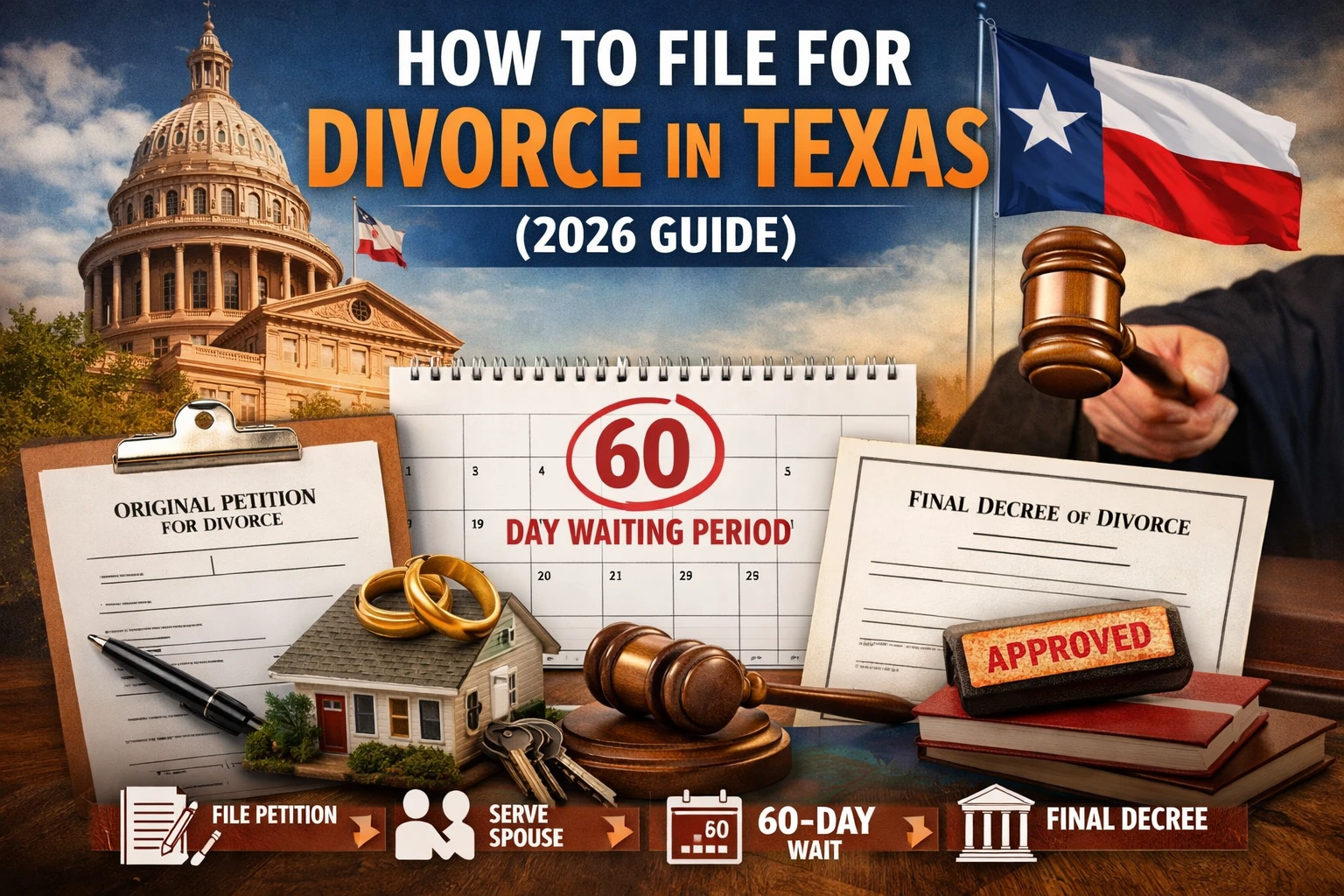
After the petition is filed and the respondent has been properly notified or has responded, the case enters the waiting period. Texas generally requires at least 60 days between filing the petition and finalizing the divorce. Limited exceptions may apply, including certain situations involving family violence, but most agreed cases should plan around the full waiting period.
During that time, finish the decree, confirm signatures, and make sure the documents are internally consistent. Names, dates, account details, and child-support figures should not conflict from one form to another. Courts may reject or require corrections to proposed orders that are incomplete, unclear, or inconsistent.
When the waiting period has passed, the final step is often called a prove-up. Depending on the court’s procedures, one spouse may need to appear before the judge, either in person or through an approved remote process, and briefly confirm the required facts. Court procedures can vary, so review the assigned court’s current instructions before setting a final hearing or submitting final paperwork.
Common form mistakes that slow down agreed divorces
Most delays are preventable. The recurring problem is not that spouses disagree. It is that their paperwork does not say clearly what they already agreed to do.
Watch for these frequent issues:
- Using a petition or decree designed for a case without children when minor children are involved.
- Leaving property or debt language vague, especially for homes, vehicles, retirement accounts, and credit cards.
- Signing service or final documents at the wrong time or without required formalities.
- Forgetting to include a requested name change in the petition and decree.
- Assuming the divorce decree changes a mortgage, vehicle loan, or retirement account without additional steps.
Get practical support before filing
An agreed divorce does not need unnecessary conflict or attorney-level litigation costs. It does need organized documents, accurate Texas-specific forms, and a process that respects court requirements. Ready Divorce Service helps eligible Texans prepare for an uncontested divorce with practical document support and step-by-step procedural guidance.
Before you file, take one calm hour to gather your financial information, confirm your agreements, and compare every requested term against the forms. That preparation can make the path to closure feel far more manageable.
Get Started Today – Your Divorce Is Just a Click Away
If you’re in Texas and want your divorce handled quickly, correctly, and without unnecessary stress, we can help you from start to finish.
👉 Start here: Complete the Divorce Questionnaire
📞 Call now: (469) 913-4000