When people search for Texas divorce filing requirements, they are usually not looking for legal theory. They want to know one thing: can I file, and what do I need to do next? That is especially true if the divorce is uncontested and both spouses want a practical, lower-stress path forward.
The good news is that Texas has a fairly clear process. The hard part is making sure each requirement is met in the right order. A missed form, filing in the wrong county, or misunderstanding the waiting period can slow everything down. If you are trying to keep your divorce affordable and efficient, getting the basics right matters.
Texas divorce filing requirements at a glance
In most cases, the core Texas divorce filing requirements include residency, filing the correct petition in the proper county, paying the filing fee or requesting a waiver, completing service or waiver paperwork, observing the mandatory waiting period, and submitting final divorce documents for court approval.
That sounds straightforward, but every one of those steps has details that can affect your timeline. The process is usually much smoother when the case is uncontested, meaning both spouses agree on the major terms such as property division, debts, and if applicable, child-related issues.
Residency rules come first
Before you file, Texas requires that at least one spouse has lived in Texas for at least six months. In addition, one spouse must have lived in the county where the divorce will be filed for at least 90 days.
If you do not meet both parts of that rule, the court may not have authority to move forward with the case yet. This is one of the most common early problems for people who recently moved. The answer is not always no, but it may mean waiting until the timing works.
There are a few situations that can get more complicated, especially if one spouse lives out of state or if military service is involved. In those cases, the residency analysis may still allow filing in Texas, but it needs to be reviewed carefully.
Filing in the right county matters
Texas divorces are generally filed in the district clerk’s office in the county that meets the residency requirement. That county choice is not just a technical detail. Filing in the wrong county can create delays or force you to refile.
For many couples, the right county is obvious because they both live in the same place. But if spouses are separated and living in different counties, the decision depends on which county satisfies the 90-day rule for at least one spouse.
County procedures can also vary. The statewide legal requirements are the same, but local courts may have their own preferences for scheduling, document formatting, prove-up settings, or filing logistics.
The petition starts the case
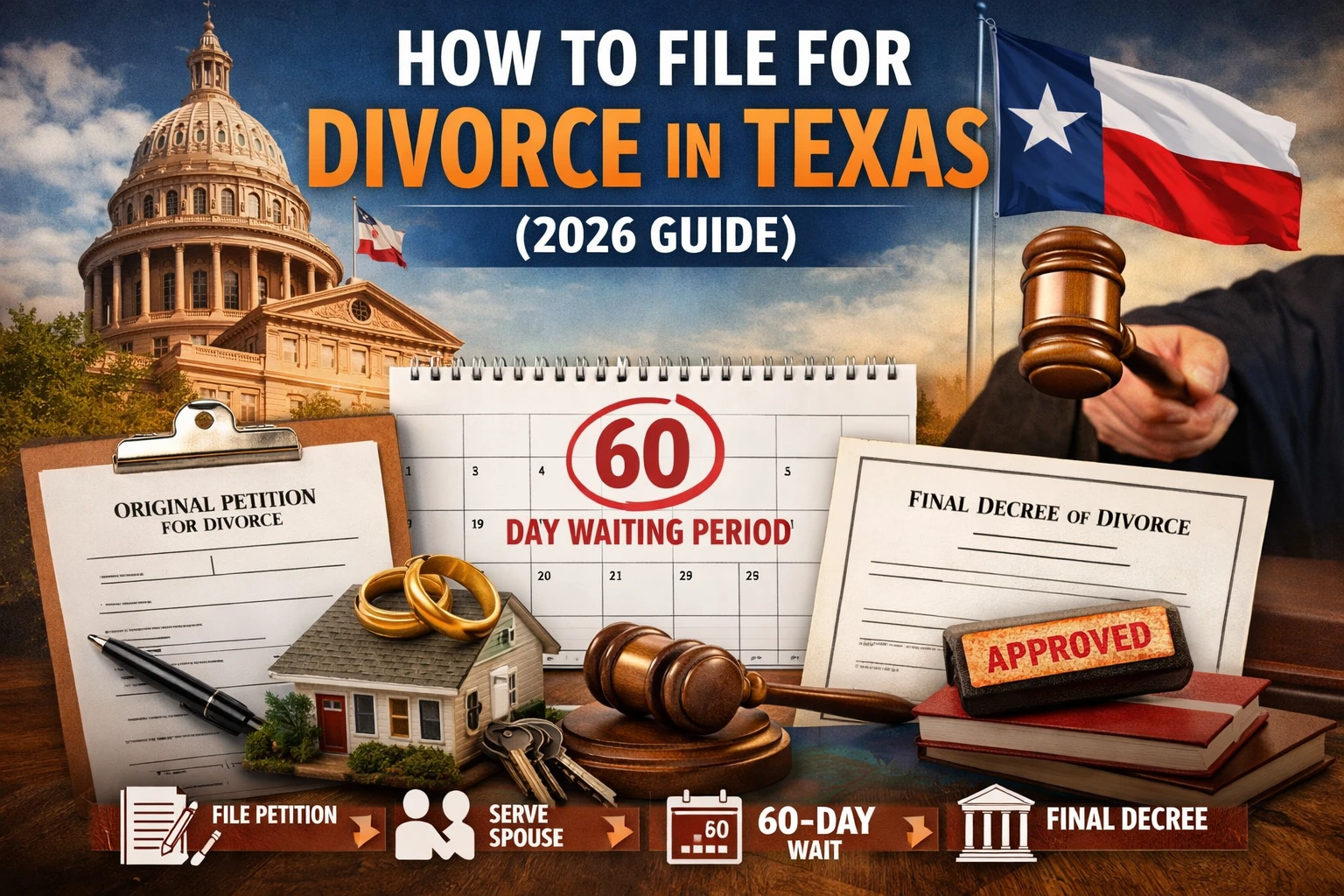
The divorce officially begins when the Original Petition for Divorce is filed. This document identifies the parties, states that the marriage has become insupportable, and tells the court whether children, property, or other issues are involved.
For an uncontested divorce, the petition is still important because it sets the framework for the case. If children are involved, or if there is a house, retirement account, or significant debt, the paperwork has to reflect those facts accurately. A simple filing can become less simple if the initial documents leave out key details.
Texas also requires a civil case information sheet or similar county-specific intake documentation in many courts, along with any additional forms required by the local clerk. If there are children under 18, other forms may be required during the case as well.
Filing fees and fee waivers
Most Texas counties charge a filing fee to open a divorce case. The amount varies by county, and additional fees may apply depending on whether children are involved or whether citation needs to be issued.
If paying the fee would create a financial hardship, you may be able to file a Statement of Inability to Afford Payment of Court Costs. If the court approves it, filing fees and certain other court costs may be waived.
This is one area where people sometimes make assumptions. A fee waiver is not automatic just because divorce is expensive. The form must be completed correctly, and the court has to accept it.
Service, waiver, or answer
After the petition is filed, the other spouse must be formally notified unless there is a proper waiver. In an uncontested divorce, many couples choose to use a Waiver of Service. This lets the responding spouse acknowledge the case without formal service by a constable, sheriff, or private process server.
The waiver has to be done correctly. It generally cannot be signed before the petition is filed, and courts expect specific language. If it is incomplete or signed too early, the court may reject it.
If the spouse will not sign a waiver, formal service is usually required. Once served, the respondent can file an answer. Even in agreed cases, these procedural steps still matter because the court needs proof that the other party was legally brought into the case.
The 60-day waiting period
One of the best-known texas divorce filing requirements is the waiting period. In most cases, Texas requires at least 60 days to pass between the date the petition is filed and the date the divorce can be finalized.
This is a minimum, not a guarantee that the case will be done on day 61. Delays can happen if documents are incomplete, if the court calendar is crowded, or if child-related terms need revision. If the divorce is fully agreed and the paperwork is prepared correctly, the process is usually faster than a contested case, but it still has to move through the court’s timeline.
There are limited exceptions to the 60-day rule, such as certain cases involving family violence. Those exceptions are case-specific and should not be assumed.
What if children are involved?
A divorce with children can still be uncontested, but the filing requirements are more detailed. The court will expect paperwork that addresses conservatorship, possession and access, child support, medical support, and other child-related issues.
Texas courts focus heavily on whether the final orders are in the child’s best interest. That means even if both parents agree, the judge may look closely at the terms. If something appears incomplete or inconsistent, the court may require changes before signing the divorce decree.
Parents may also need to complete a parenting class in some counties. This is not universal across every Texas court, which is why county-specific guidance matters.
The final decree is where details matter most
The Final Decree of Divorce is the document that ends the marriage, but it does much more than that. It sets out the legal terms for property division, debt allocation, name changes if requested, and all child-related orders if children are involved.
This is where small errors can create big problems later. If retirement accounts are not described properly, if vehicle information is vague, or if debt responsibility is unclear, the decree may not do what you think it does. In uncontested cases, the goal is not just to finish the divorce. It is to finish it with paperwork that is complete, accurate, and enforceable.
Many courts also require additional finalization documents, such as a prove-up affidavit, final hearing testimony, or a court information sheet. Some counties allow remote or affidavit-based finalization in certain cases, while others require an in-person hearing.
Common issues that slow down filing
Most delays happen for practical reasons, not dramatic ones. People file before meeting residency rules, use outdated forms, leave blanks in the decree, or assume that agreement between spouses replaces court procedure. It does not.
Another common issue is mixing up an agreed divorce with a truly uncontested divorce. If spouses still disagree about property, support, or parenting terms, the case may not be ready for streamlined filing. The paperwork should reflect a real, complete agreement.
That is why process support can make such a difference. If your goal is a low-conflict divorce, having a clear roadmap helps you avoid expensive detours. Ready Divorce Service helps Texans handle uncontested divorce paperwork and filing steps with a focus on accuracy, affordability, and moving the case forward efficiently.
When an uncontested divorce is the best fit
If both spouses are prepared to cooperate, an uncontested divorce is often the simplest path. It usually costs less, takes less time, and creates less stress than litigation. But simple does not mean careless. The court still expects the legal requirements to be satisfied.
If there is a history of hiding assets, domestic violence, extreme conflict, or complete disagreement on core terms, a more involved legal strategy may be necessary. For many couples, though, the case is not complicated in substance. It just feels complicated because the court process is unfamiliar.
That is the real value of understanding the filing requirements early. Once you know the rules on residency, county filing, service, waiting periods, and final documents, the process becomes more manageable. And when the paperwork matches the agreement, moving forward starts to feel possible again.
A divorce can be emotionally heavy even when it is agreed. Clear steps make a difference. When you handle the filing requirements carefully from the start, you give yourself the best chance at a smoother finish and a more stable next chapter.
Get Started Today – Your Divorce Is Just a Click Away
If you’re in Texas and want your divorce handled quickly, correctly, and without unnecessary stress, we can help you from start to finish.
👉 Start here: Complete the Divorce Questionnaire
📞 Call now: (469) 913-4000