Table of Contents
- Is an Uncontested Divorce Right for You?
- Filing for Divorce Without a Lawyer: What You Need to Know
- Understanding the Texas Divorce Waiting Period
- Divorce Forms for No Minor Children: Simplified Filing
- Step-by-Step Filing Process for an Uncontested Divorce
- Managing Costs: Filing Fees, Court Costs, and Financial Assistance
- Marital Property Division and Debt Allocation in Uncontested Divorce
- Post-Divorce Financial Checklist: What to Do After Your Decree
Last Updated: August 21, 2026
Is an Uncontested Divorce Right for You?
An uncontested divorce in Texas is a legal dissolution of marriage where both spouses agree on all major terms, including property division, debt allocation, and custody arrangements if applicable. This approach eliminates court battles and significantly reduces time and expense compared to contested divorces.
You and your spouse must genuinely agree on dividing your marital estate, handling debts, and resolving custody or support issues if children are involved. Both parties must be willing to cooperate without extensive legal representation, and neither spouse can be hiding assets or income.
Eligibility requirements are straightforward: at least one spouse must have lived in Texas for the preceding six months and in the filing county for at least 90 days (statutes.capitol.texas.gov). Texas recognizes no-fault divorce based on insupportability, requiring no proof of wrongdoing. If minor children are involved, you must have a parenting plan in place.
An uncontested divorce is only viable if both parties genuinely want the same outcome. Any significant disagreement about property, debt, or custody shifts the process into contested territory, which demands litigation and legal representation. Ready Divorce Service helps individuals assess whether their situation qualifies for an uncontested approach and guides them through the entire filing process with accuracy and compliance.
Before proceeding, confirm that both you and your spouse can discuss key issues without escalating into conflict. If communication has broken down entirely, mediation may be necessary before filing.
Filing for Divorce Without a Lawyer: What You Need to Know
Self-representation, known as pro se representation, is a legal option in Texas divorce cases. Many individuals choose this path to reduce costs and maintain control over the process.
Self-representation makes sense if your marriage is short, you have no minor children, minimal shared assets, and both spouses fully agree on all terms. However, even in straightforward cases, a single procedural error, missed deadline, incorrect formatting, or incomplete filing can delay your divorce by months or require you to refile and repay court fees.
The risks increase substantially when children, significant assets, or debt are involved. Family law in Texas contains nuances that experienced practitioners navigate automatically but that self-represented individuals often overlook. Community property rules require precise accounting of marital versus separate property. Custody arrangements must comply with specific statutory language about the "best interest of the child." Debt allocation must be structured so creditors and the court understand who bears responsibility for each obligation.
Many individuals discover midway through the process that they need help. At that point, hiring an attorney becomes more expensive because the lawyer must review and correct what’s already been filed. Ready Divorce Service provides document preparation and guidance specifically designed to prevent these costly mistakes, ensuring your filings are compliant with Texas law from the start.
Filing incorrect documents or missing court deadlines can result in dismissal of your case, requiring you to refile and pay court fees again. This is a common and expensive consequence of self-representation without proper guidance.
Understanding the Texas Divorce Waiting Period
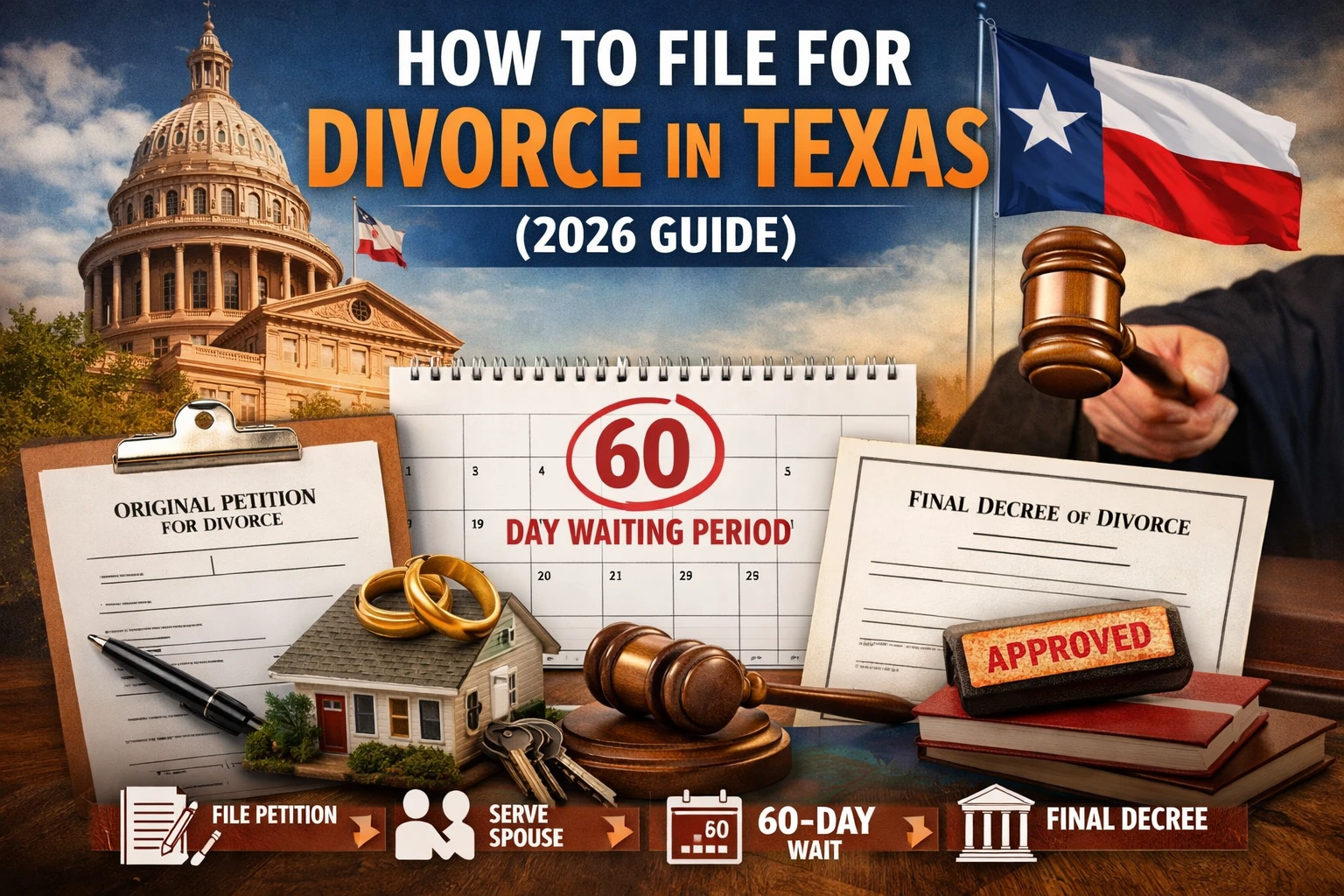
Texas imposes a mandatory statutory waiting period of 60 days from the date you file your original petition for divorce until the final decree can be entered (statutes.capitol.texas.gov). This waiting period applies to all divorces, contested and uncontested alike, providing time for reflection and ensuring both parties have adequate opportunity to consider the implications of divorce.
The 60-day clock starts the moment your petition is filed with the court clerk and served on your spouse (or when your spouse waives service). You cannot obtain a final divorce decree before those 60 days have elapsed, even if both parties agree on everything and all paperwork is complete. The absolute minimum timeline for an uncontested divorce is roughly 60 days, assuming no delays in filing, service, or document processing.
The waiting period does not prevent you from taking action during those 60 days. You can file your agreed decree and all supporting documents well before the waiting period ends. However, the court will not sign the final decree until at least 60 days have passed since the original petition was filed.
One important exception exists: if documented family violence is present or if the respondent waives the waiting period in writing, the court may grant a waiver. However, waivers are not automatic and require specific circumstances. For most uncontested divorces, plan for the full 60-day timeline.
Divorce Forms for No Minor Children: Simplified Filing
When your divorce involves no minor children, the required paperwork is significantly simpler. The core documents you need are the Original Petition for Divorce, the Agreed Decree of Divorce, and proof of service or waiver of service.
The Original Petition for Divorce is your formal request to the court to dissolve the marriage. It must include basic information: the petitioner’s and respondent’s names and addresses, the date and location of marriage, grounds for divorce (insupportability is most common in uncontested cases), and a statement that at least one spouse meets the residency requirement.
The Agreed Decree of Divorce outlines exactly how you and your spouse have agreed to divide your marital estate and handle any debts. This is the heart of your uncontested divorce. The decree must specify which assets go to which spouse, how debts are allocated, and any spousal support arrangements if applicable. Texas uses community property law, meaning most property acquired during the marriage is presumed to be community property (jointly owned) unless proven otherwise (statutes.capitol.texas.gov).
The Waiver of Service of Process is critical if your spouse agrees not to require formal service. Instead of having a process server deliver the petition, your spouse can sign a waiver acknowledging receipt and agreeing to the filing. This saves time and money. If your spouse will not sign a waiver, you must proceed with formal service through a process server or sheriff, which adds cost and extends the timeline.
Texas courts provide free templates through the state bar association and court websites. Ready Divorce Service ensures your forms are completed accurately and comply with Texas law, reducing the risk of rejection or delays.
For divorces without minor children, the filing process is simplified to three core documents: petition, agreed decree, and proof of service or waiver. Accuracy in these documents is critical to avoiding costly rejections or delays.
Step-by-Step Filing Process for an Uncontested Divorce
The process for filing an uncontested divorce in Texas follows a predictable sequence. Understanding each step helps you stay organized and meet all deadlines.
Step 1: Prepare Your Petition and Agreed Decree
Before you file anything, you and your spouse must reach complete agreement on all terms. Decide how to divide your property, handle your debts, and address any support obligations. Draft your Original Petition for Divorce and your Agreed Decree of Divorce using legally accurate language and correct statutory terminology for Texas courts. Any ambiguity or missing detail can trigger a court rejection, requiring you to refile and pay fees again.

Step 2: File with the Court Clerk and Pay Filing Fees
Take your documents to the district court clerk’s office in the county where you meet the residency requirement. You’ll file the Original Petition for Divorce and pay the filing fee. The clerk will assign a case number and docket your petition. Keep a copy of the filed petition and the receipt showing the filing fee payment.
Step 3: Serve or Obtain Waiver of Service
Your spouse must be formally notified of the divorce filing. If your spouse cooperates, have them sign a Waiver of Service of Process, acknowledging receipt of the petition and agreeing not to require formal service. If your spouse will not sign a waiver, you must hire a process server or the sheriff’s office to serve the petition formally.
Step 4: Wait the Statutory Period and File Final Documents
After service or waiver, the 60-day waiting period begins. Ensure that both you and your spouse sign the Agreed Decree of Divorce. Once the 60 days have passed, file the signed Agreed Decree with the court clerk along with any additional required documents. The judge will review the documents and, if everything is in order, will sign the final decree.
Managing Costs: Filing Fees, Court Costs, and Financial Assistance
The cost of an uncontested divorce in Texas depends on filing fees and whether you use document preparation services or hire an attorney.
Court filing fees vary by county but typically range from several hundred dollars to over a thousand dollars. You may also incur costs for service of process if your spouse does not waive service, typically ranging from a few hundred dollars depending on the process server or sheriff’s office fees.
If you use a document preparation service like Ready Divorce Service, you’ll pay substantially less than hiring an attorney. Ready Divorce Service provides expert document preparation and step-by-step guidance to ensure compliance with Texas law, helping you avoid costly mistakes and rejections.
For individuals with limited income, Texas offers indigency waivers that may reduce or eliminate court filing fees. To qualify, you must demonstrate that you cannot afford the fees without undue hardship. You’ll complete an affidavit of indigency and submit it to the court. Legal aid organizations in Texas also provide assistance to low-income individuals, offering free or reduced-cost legal guidance and document preparation.
Individuals with minimal assets, no minor children, and full spousal agreement who want to reduce costs while ensuring their documents are accurate and compliant with Texas law.
Marital Property Division and Debt Allocation in Uncontested Divorce
Texas is a community property state, which fundamentally shapes how property and debt are divided in divorce. Understanding these rules is essential to ensuring a fair and legally sound agreement.
Community property basics in Texas means that property acquired during the marriage by either spouse is presumed to be community property (jointly owned) unless proven otherwise. This includes income earned during the marriage, retirement accounts funded during the marriage, and real estate purchased during the marriage. Separate property, owned before the marriage or inherited, remains the separate property of the spouse who owns it and is not divided in divorce.
The critical distinction is timing. A house purchased before marriage remains separate property even if the mortgage is paid down during the marriage. When dividing your marital estate in an uncontested divorce, you and your spouse must account for all community property and decide how to allocate it. This doesn’t mean 50-50; the law requires a "just and right" division, which can be unequal if both parties agree.
Debt allocation follows the same community property rules. Debts incurred during the marriage are generally community debt, meaning both spouses are liable to creditors regardless of how you allocate the debt in your divorce decree. However, your decree can specify that one spouse is responsible for paying a particular debt. Clear, detailed debt allocation in your agreed decree is critical to protecting both parties and reducing the risk of future disputes.
Post-Divorce Financial Checklist: What to Do After Your Decree
Your divorce decree is signed, and you’re legally divorced. But the legal end of marriage is just the beginning of financial reorganization. Many individuals overlook critical steps immediately after divorce, leading to complications months or years later.

Update your financial accounts and beneficiaries. Review all bank accounts, investment accounts, retirement accounts, and insurance policies. Change ownership or beneficiary designations as specified in your decree. If your ex-spouse was listed as a beneficiary on your life insurance or retirement account, update that immediately.
Refinance or remove your ex-spouse from joint accounts. If you have joint credit cards, loans, or mortgages, work to remove your ex-spouse’s name or refinance the debt in your own name. Joint accounts create ongoing financial entanglement and can damage your credit if the other party fails to pay.
Update your tax filing status and withholding. Notify your employer of your change in marital status so your W-4 withholding is adjusted correctly. If you were filing jointly, you’ll now file as single or head of household, which affects your tax liability and refunds.
Obtain copies of your final decree and keep them accessible. You’ll need certified copies of your divorce decree for updating your name with the Social Security Administration, updating driver’s license and passport information, and proving your marital status for future financial or legal transactions.
Review and update your estate plan. If you have a will, power of attorney, or healthcare directive, review it now. Your ex-spouse may still be listed as executor or agent. Update these documents to reflect your current wishes and remove your ex-spouse from any roles.
Monitor your credit report. Pull your credit report from all three bureaus (Equifax, Experian, TransUnion) and check for accounts you don’t recognize or that your ex-spouse was supposed to pay. Dispute any errors and monitor your credit regularly for fraud.
Filing an uncontested divorce in Texas is achievable without expensive litigation, but accuracy in documentation and compliance with state law are non-negotiable. Ready Divorce Service specializes in guiding individuals through this process with expert document preparation and step-by-step support, ensuring your filing meets all requirements and your transition is as smooth and affordable as possible. Get started with Ready Divorce Service and move forward with confidence that your divorce is handled correctly.
Frequently Asked Questions
Can I file for an uncontested divorce in Texas without a lawyer?
Yes. Texas allows self-represented litigants, known as pro se filers, to file for uncontested divorce without attorney representation. You must complete the required legal forms accurately, file them with the court clerk, pay filing fees, ensure proper service of process or obtain a waiver of service from your spouse, and follow all statutory requirements. Many people handle uncontested divorces independently when both spouses agree on all terms.
How long does the Texas divorce waiting period last?
Texas law imposes a mandatory 60-day waiting period from the date you file your original petition for divorce. This statutory waiting period cannot be waived, even in uncontested cases. After 60 days have passed and all other requirements are met, you can file your final decree of divorce with the court. This waiting period applies to all divorces in Texas.
What divorce forms do I need if my spouse and I have no minor children?
For an uncontested divorce with no minor children, you typically need the original petition for divorce, an agreed decree of divorce, and a waiver of service or proof of service. Specific forms vary by county, so contact your local court clerk for the exact divorce forms required in your jurisdiction. Some courts provide fillable templates online. Ensure all documents comply with Texas Family Code requirements for proper filing.
What are the typical filing fees and court costs for an uncontested divorce in Texas?
Filing fees vary by county but typically range from $250 to $400 for the initial petition. Additional court costs may apply depending on your county's requirements. If you cannot afford filing fees, you may request an indigency waiver from the court. Contact your county court clerk for exact fee amounts and to inquire about financial assistance programs or legal aid if you qualify for reduced-cost or free legal services.
How do I divide marital property and debt in an uncontested divorce?
In Texas, community property acquired during marriage is divided fairly but not necessarily equally. You and your spouse should reach an agreement on how to divide all assets and debts, then document this in your agreed decree of divorce. The decree specifies who receives what property and who is responsible for each debt. Both spouses must sign the agreed decree. If you cannot agree, the case becomes contested and requires court intervention.
What should I do after my divorce decree is final?
After receiving your final decree of divorce, update your legal documents, including your will, beneficiary designations on insurance and retirement accounts, and property titles. Change your name if applicable through your county clerk. Notify banks, creditors, employers, and government agencies of your new status. Review your tax filing status, health insurance, and financial accounts. Consider meeting with a financial advisor to adjust your post-divorce financial plan and budget.
This article was written using GrandRanker