Table of Contents
- 1. File an Uncontested Divorce to Save Thousands
- 2. Understand Uncontested Divorce Texas Cost and Court Fees
- 3. Use DIY Divorce Texas Forms and Official Court Documents
- 4. Explore Texas Divorce Legal Aid and Pro Bono Services
- 5. Use Mediation Divorce Texas to Avoid Court Costs
- 6. Digital and E-File Texas Divorce Documents Efficiently
- 7. Choose an Affordable Divorce Service or Self-Help Option
- Getting Started with Your Affordable Divorce in Texas
Last Updated: July 29, 2026
Finding an affordable divorce for Texas residents doesn’t require hiring a high-priced attorney or navigating the court system alone. According to the Texas State Law Library, uncontested divorces, where both spouses agree on all terms, cost significantly less than contested cases. At Ready Divorce Service, we specialize in helping Texas residents complete their uncontested divorces efficiently and affordably by providing expert guidance on document preparation and filing procedures that keep costs low while ensuring full compliance with Texas law. This guide covers seven proven strategies to reduce your divorce expenses, from filing uncontested petitions to exploring legal aid resources and digital filing options.
1. File an Uncontested Divorce to Save Thousands
The most direct path to an affordable divorce is filing uncontested, where you and your spouse agree on property division, custody, support, and all other terms. When both parties cooperate, you eliminate court battles, depositions, discovery processes, and lengthy litigation that drive costs upward.
An uncontested divorce requires only basic court filings, minimal attorney involvement, and typically fewer court appearances. This simplified process reduces total time and expense compared to contested divorces that can stretch over months or years.
What Makes an Uncontested Divorce Affordable
Cost savings come from reduced attorney hours, fewer court filings, and no need for expert witnesses or extended litigation. You’re paying for document preparation and filing guidance rather than months of legal representation. Ready Divorce Service helps you prepare all required forms accurately the first time, avoiding costly rejections or amendments.
Texas Residency Requirements You Need to Know
To file for divorce in Texas, at least one spouse must have been a resident for at least six months before filing, and the filing must occur in the county where you or your spouse has lived for at least 90 days. Filing in the wrong county can result in dismissal and wasted fees.

Verify your residency status before filing. The Texas Family Code Section 6.301 sets these requirements for all divorces.
2. Understand Uncontested Divorce Texas Cost and Court Fees
Court filing fees for an uncontested divorce in Texas typically range from $200 to $400 for the initial petition. Service of process may cost an additional $50 to $150, and certified copies cost $5 to $10 each. The real savings come from avoiding attorney fees and litigation expenses.
Breaking Down Filing Fees and Hidden Costs
The filing fee covers court administrative costs. Service of process, delivering divorce papers to your spouse, may cost extra if your spouse doesn’t waive service. Many people underestimate hidden costs: court filing errors requiring amendments ($50-$100), missed deadlines extending timelines indefinitely, and document rejections. A professional document preparation service catches errors before filing, saving money on corrections and delays.
The biggest hidden cost of DIY divorce is getting it wrong. A rejected filing means starting over, paying additional court fees, and extending [your divorce](/best-ways-to-simplify-divorce-texas/) timeline by weeks or months. One mistake can cost more than using a professional service from the start.
How to Avoid Expensive Mistakes with DIY Divorce
Use official Texas court forms from the Texas State Law Library or your county clerk’s office, not generic templates from other states. Texas has specific requirements for language, formatting, and disclosures that courts enforce strictly.
Common DIY mistakes include incomplete property descriptions, incorrect child support calculations, missing signatures or notarizations, and failure to include mandatory family law disclosures. Each error requires amendment and re-filing. Working with Ready Divorce Service ensures compliance with all Texas requirements on the first filing.
3. Use DIY Divorce Texas Forms and Official Court Documents
Texas provides free, official divorce forms through the Texas State Law Library and your county clerk’s office. Using these forms ensures you’re complying with current Texas Family Code requirements and local court rules.
Where to Find Texas-Compliant Court Forms
The Texas State Law Library self-help resources offers comprehensive, free divorce forms and step-by-step instructions for uncontested divorces. These forms are updated regularly and accepted by all Texas district courts. Your county clerk’s office also maintains local forms and can answer county-specific questions.
When downloading forms, verify the date to ensure you’re using the current version. Courts reject outdated forms, requiring resubmission and additional fees.
Pro Se Divorce: Representing Yourself in Texas Court
Pro se representation means representing yourself without an attorney. Texas law allows this for uncontested divorces, and many people successfully complete their own by carefully following court procedures and using official forms. However, pro se filers must understand Texas Family Code requirements for property division, spousal support, child custody, and child support calculations.
If you proceed pro se, attend a court self-help clinic if your county offers one. Many Texas courts sponsor free clinics where staff answer procedural questions and review your forms for completeness before filing. This catches errors before they cost you time and money.
The advantage is maximum cost savings, you pay only court fees. The disadvantage is you bear full responsibility for accuracy and compliance.
4. Explore Texas Divorce Legal Aid and Pro Bono Services
If you cannot afford court fees or attorney representation, Texas offers free or low-cost legal assistance programs for income-eligible individuals. These programs provide legal advice, document preparation help, and sometimes court representation.
Qualifying for Free Legal Assistance
Legal Aid of NorthWest Texas and Lone Star Legal Aid serve low-income Texans with free civil legal services, including family law matters. Eligibility is based on household income and typically covers individuals at or below 125% of the federal poverty line.
Contact your local legal aid office by phone with your household income, family size, and case information ready. Legal aid attorneys can review your divorce agreement, help complete court forms, and represent you in court at no cost. However, wait times may be several weeks due to high caseloads.
Filing Fee Waivers: Statement of Inability to Afford Payment
If you cannot afford court filing fees, request a fee waiver by filing a Statement of Inability to Afford Payment. This form requires you to disclose income, expenses, and assets. If approved, you can file your divorce without paying court fees. The court may require repayment if your financial situation improves, but fees may be permanently waived if income remains below the threshold.
5. Use Mediation Divorce Texas to Avoid Court Costs
Mediation is a structured negotiation process where a neutral third party helps you and your spouse reach agreement on divorce terms. Mediation typically costs $500 to $2,000 total, far less than litigation.
How Mediation Reduces Legal Fees and Dispute Time
In mediation, you meet with a mediator to discuss property division, custody, support, and other issues. The mediator facilitates conversation but doesn’t make decisions. Once you reach agreement, the mediator may draft a settlement agreement for your uncontested divorce filing.
Mediation works best when both spouses negotiate in good faith. It eliminates depositions, court hearings, and prolonged attorney representation. Most mediated divorces complete within 2-4 months, compared to 1-2 years for contested cases.
Many Texas counties offer court-ordered mediation for contested cases. Using mediation voluntarily before filing lets you control the process and often reduces total cost.
6. Digital and E-File Texas Divorce Documents Efficiently
Filing divorce documents electronically through E-File Texas eliminates printing, mailing, and hand-delivery costs while speeding up processing. Many Texas courts now require or encourage electronic filing for civil cases.
E-File Texas: Filing Documents Online to Save Time
E-File Texas is the state’s official electronic filing system. You can create an account, upload divorce documents, and submit them to your county district court electronically. E-filing reduces processing time and provides immediate receipt confirmation.
E-filing typically requires a small transaction fee ($5-$15 per filing), offset by eliminating printing and mailing expenses. Electronic filing accelerates your divorce timeline by days or weeks. Check your county court’s e-filing requirements before attempting to file electronically.
The 60-Day Waiting Period and What to Expect
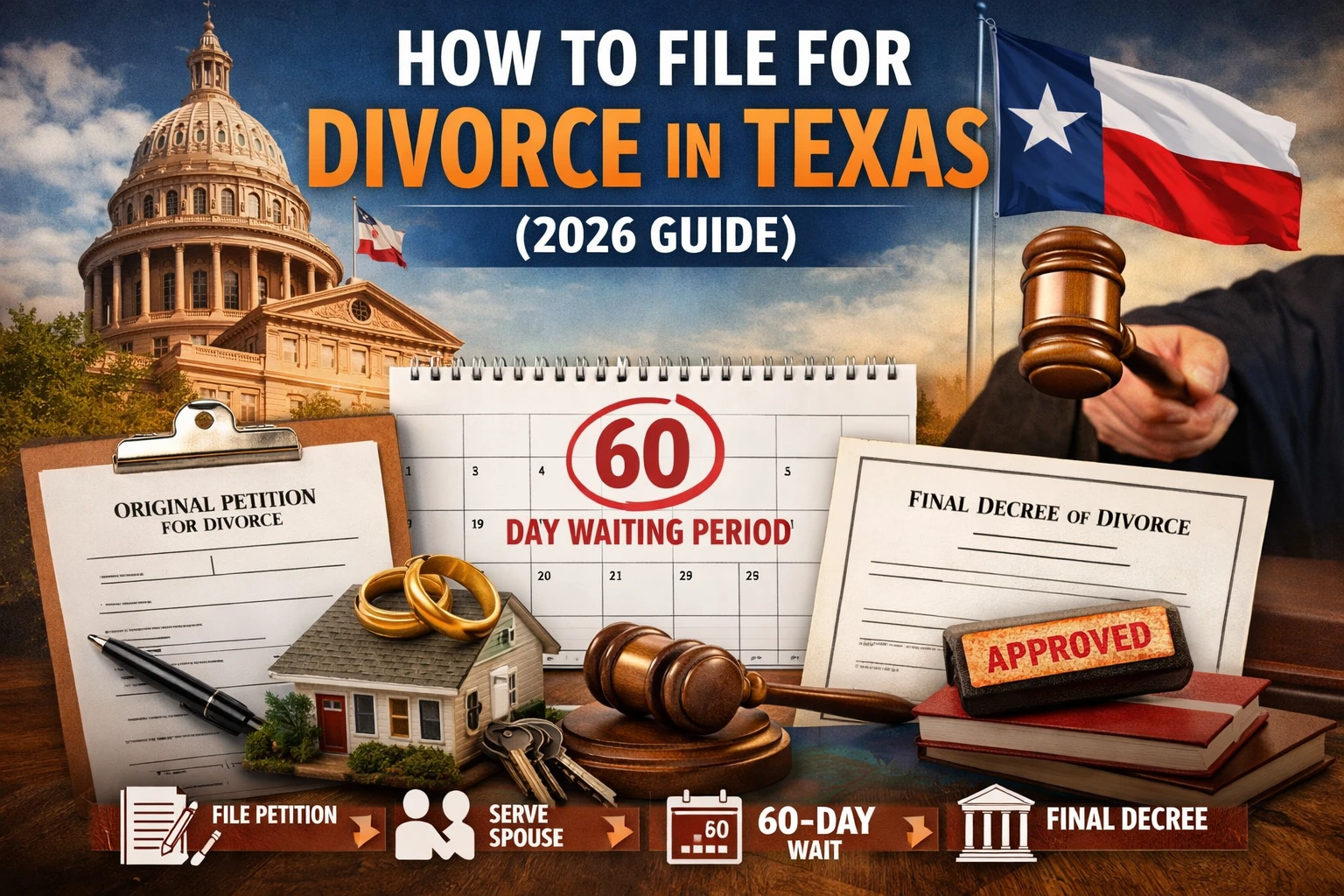
Texas law requires a mandatory 60-day waiting period between filing your divorce petition and finalizing your divorce. This waiting period cannot be waived except in cases of family violence. During this time, you can negotiate terms, finalize your settlement agreement, and prepare for the final hearing.
The 60-day waiting period gives you time to negotiate without pressure and ensures both parties understand the agreement before signing. Many divorces finalize shortly after the waiting period ends if both parties cooperated.
7. Choose an Affordable Divorce Service or Self-Help Option
Several service options exist between full DIY divorce and hiring a traditional attorney. Document preparation services, online divorce platforms, and fixed-rate legal services offer affordable alternatives.
Document Preparation Services vs. Traditional Attorneys
Document preparation services complete your divorce forms based on information you provide. They don’t provide legal advice but ensure documents are accurate and compliant with Texas law. Costs typically range from $150 to $500 for uncontested divorce preparation.
Traditional attorneys charge hourly rates ($150-$400+ per hour) or flat fees. The hourly model can become expensive with extensive negotiation or court time. Flat-fee services provide cost certainty but may limit representation scope.
Ready Divorce Service offers document preparation for Texas uncontested divorces, combining accuracy with affordability. We guide you through each step, answer questions about Texas requirements, and ensure your filing is complete and correct the first time.
Fixed-Rate Services: What You Actually Pay
Fixed-rate divorce services charge one flat fee for uncontested divorce preparation and filing assistance. This model provides budget certainty: you know your total cost upfront.
When comparing fixed-rate services, confirm what’s included: Do they prepare all required forms? Do they handle e-filing? Do they provide ongoing support during the 60-day waiting period? Do they offer revisions if the court requests changes?
| Service Type | Typical Cost | What’s Included | Best For |
|---|---|---|---|
| DIY (forms only) | $0-$50 | Court forms only | Highly organized individuals with no complications |
| Document preparation service | $150-$500 | Form completion, accuracy review, filing guidance | Uncontested divorces with straightforward terms |
| Fixed-rate legal service | $300-$800 | Document prep, e-filing, limited legal advice | Uncontested divorces needing professional guidance |
| Hourly attorney | $150-$400/hour | Full legal representation, negotiation, court appearance | Contested divorces or complex family situations |
| Legal aid (income-eligible) | Free | Legal advice, document prep, court representation | Low-income individuals qualifying for assistance |
Getting Started with Your Affordable Divorce in Texas
Choosing an affordable divorce begins with honestly assessing your situation. If you and your spouse agree on all terms, an uncontested divorce is your most cost-effective path. If you have disagreements but are willing to negotiate, mediation offers a middle ground.
Start by gathering financial documents, property descriptions, and custody preferences. Understand Texas community property law, which presumes all property acquired during marriage is community property (owned equally by both spouses). Know your county’s specific filing procedures by contacting your county clerk.
If you’re uncertain about any aspect of Texas divorce law, Ready Divorce Service provides expert guidance tailored to uncontested divorces. We ensure your documents are complete, accurate, and filed correctly, giving you confidence your divorce will proceed smoothly without costly mistakes.
The key to an affordable divorce is preparation, accuracy, and choosing the right service level for your needs. Whether you proceed entirely on your own, use a document preparation service, or work with an attorney, filing uncontested, using official forms, exploring legal aid, and considering mediation will help you minimize costs and complete your divorce efficiently.
Frequently Asked Questions
What is the cheapest way to get an affordable divorce in Texas?
An uncontested divorce with pro se filing (representing yourself) is typically the most affordable option. You file the petition for divorce yourself using official Texas court forms, pay only the county filing fee, and avoid attorney fees. If you qualify based on income, you may request a filing fee waiver using a Statement of Inability to Afford Payment. Document preparation services offer a middle ground, they help you complete forms accurately for a flat fee, reducing the risk of costly court rejections while staying far below traditional attorney rates.
How much does an uncontested divorce cost in Texas?
Uncontested divorce costs in Texas vary by county but typically include a filing fee (generally $250-$400) plus any optional service fees if you use document preparation help. Court costs are separate from attorney fees. If you qualify for a fee waiver, you may pay nothing to file. Using a document preparation service adds a fixed fee but eliminates the risk of expensive mistakes. Traditional attorney representation costs significantly more. The total depends on your county, whether you use professional help, and if you need a fee waiver.
Can I get a divorce in Texas without a lawyer, and what are the risks?
Yes, you can file for divorce pro se (without a lawyer) in Texas if your divorce is uncontested and you understand the process. You’ll complete official court forms, file them with the county clerk, and follow the 60-day waiting period. Risks include filing errors that cause court rejection, missing deadlines, or incomplete property division agreements. Using free resources like TexasLawHelp.org or a low-cost document preparation service reduces these risks significantly. Complex situations involving children, debt, or military service require careful attention to avoid costly mistakes.
What free legal aid and pro bono resources are available for divorce in Texas?
Texas offers several free resources for low-income residents. TexasLawHelp.org provides free legal forms and guides for uncontested divorce. Organizations like Legal Aid of NorthWest Texas and Lone Star Legal Aid offer free legal advice and representation to income-eligible individuals in their service areas. You can also request a filing fee waiver from the court using a Statement of Inability to Afford Payment. Many county bar associations operate pro bono clinics offering brief legal consultations. Contact your local legal aid office to determine eligibility based on income.
How can mediation help reduce the cost of my divorce in Texas?
Mediation is significantly cheaper than contested litigation because both parties work with a neutral mediator to reach agreement rather than going to trial. You avoid extended court battles, discovery costs, and attorney fees for multiple hearings. In Texas, even uncontested divorces can benefit from mediation to clarify property division and custody arrangements, creating a solid divorce decree. Mediation typically costs a fraction of what contested litigation requires. Once you reach agreement through mediation, filing an uncontested divorce with court forms becomes straightforward and affordable.
An affordable divorce for Texas residents is within reach when you understand your options and take a strategic approach. Ready Divorce Service specializes in uncontested divorce document preparation with full Texas law compliance, expert guidance through each step, and affordable fixed-rate pricing that eliminates surprises. Start your path to a simpler, more affordable divorce today.
📞 Get Started Today – Your Peaceful Divorce Is Just a Click Away
When you’re ready to move on, we’re ready to help.
📲 Call us now at (800) 432-0018
🖥️ Start your divorce online today