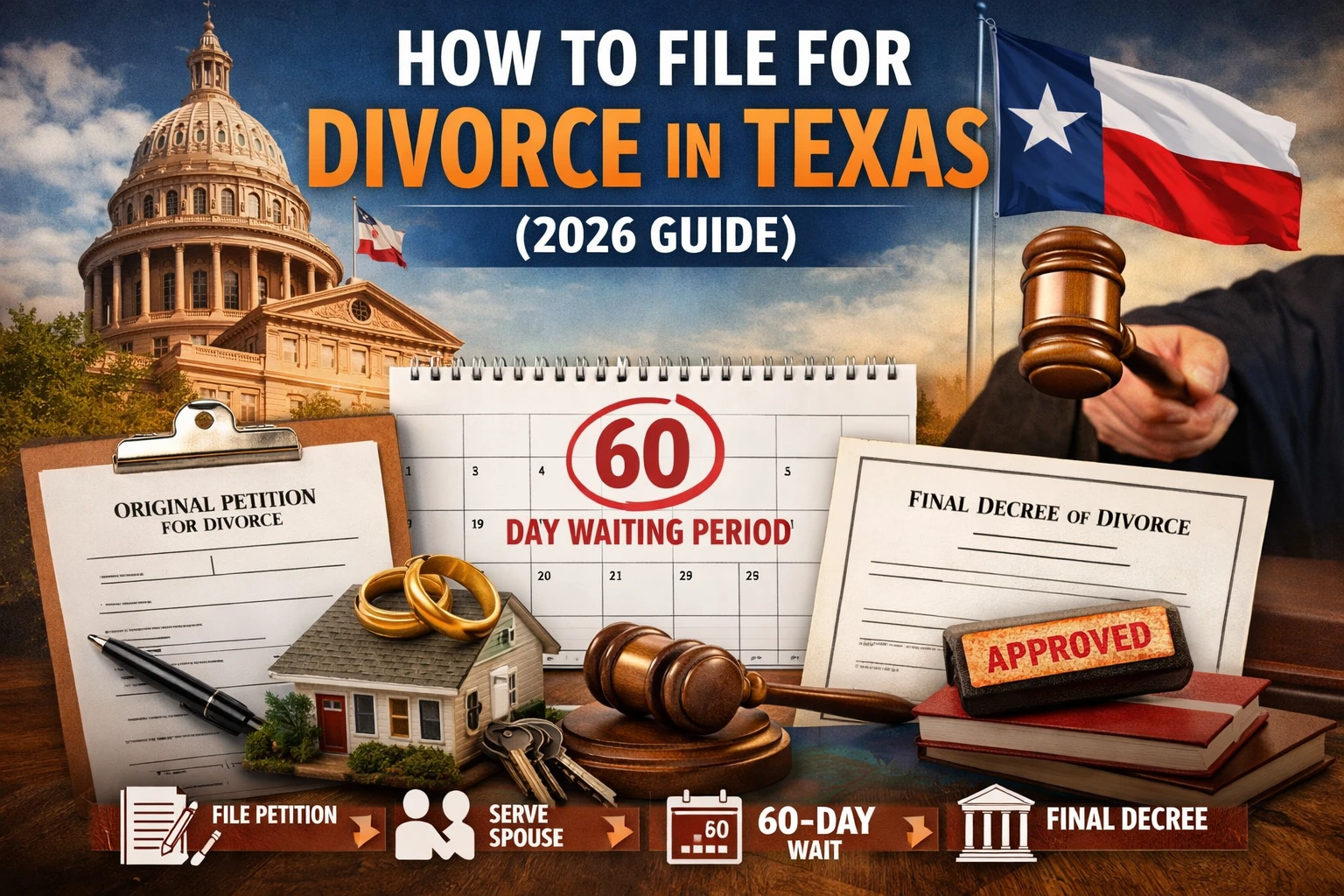
When both spouses are ready to separate and agree on the major decisions, the divorce process can be more straightforward than it first appears. Still, Bexar County divorce requirements involve more than signing an agreement. You must meet Texas residency rules, use the right court documents, follow filing and notice procedures, and wait the required amount of time before a judge can finalize the case.
For many San Antonio-area couples, an uncontested divorce is the most practical route. It can reduce legal expense and avoid unnecessary conflict, but only when the paperwork accurately reflects the agreement and the court’s procedural requirements are met.
Bexar County divorce requirements begin with residency
Texas law requires at least one spouse to have lived in Texas for the previous six months and in Bexar County for at least 90 days before the divorce petition is filed. The spouse who files does not necessarily have to be the one who meets both requirements. If either spouse meets them, filing in Bexar County may be appropriate.
Residency is not just a mailing address. It generally means the person has genuinely been living in Texas and Bexar County. If neither spouse meets the county requirement yet, filing too early can create delays or require the case to be filed in a different county.
A divorce may be available even when one spouse has moved away, as long as the Texas residency and venue rules are satisfied. Cases involving a spouse who lives outside Texas can require extra attention, particularly if property, children, or service of process is involved.
Start with the right divorce petition
A Texas divorce begins when one spouse, called the petitioner, files an Original Petition for Divorce with the appropriate Bexar County district clerk. The petition tells the court that the marriage has broken down because of insupportability, which is Texas’s common no-fault ground for divorce.
The petition also identifies the basic issues the final decree must resolve. Those may include the division of community property and debts, a request to restore a former name, and any child-related orders. A vague or incomplete petition can cause problems later when it does not support the terms requested in the final decree.
Bexar County has several district courts that handle family cases. The clerk’s office processes filings, while the assigned court and judge ultimately review and sign the final paperwork. Filing procedures, accepted payment methods, and local forms can change, so it is wise to confirm the current clerk requirements before submitting documents.
The other spouse must receive legal notice
Filing the petition does not finish the process. The other spouse must be legally notified of the case unless they choose to waive formal service.
In an agreed divorce, the non-filing spouse can often sign a Waiver of Service. This document acknowledges that a divorce has been filed and allows the case to move forward without hiring a process server. A waiver must be completed carefully. It does not mean the spouse gives up the right to review the final decree or participate in the case.
Another common option is for the non-filing spouse to file an Answer. An answer lets that spouse participate without being formally served, as long as it is filed after the petition. If a spouse will not sign a waiver or answer, formal service may be necessary. That changes the timeline and may make the matter less suitable for a simple uncontested process.
Texas requires a waiting period
In most cases, a Texas court cannot grant a divorce until at least 60 days have passed from the date the petition was filed. This is commonly called the cooling-off period. Even if both spouses have signed every document and agree on every term, the judge generally cannot finalize the divorce before the 60th day.
There are limited exceptions involving certain family violence circumstances. Outside of those situations, plan on at least 60 days. The actual finish date may be later depending on whether the documents are complete, whether the court requires a prove-up hearing, and the court’s current docket.
The waiting period is a good time to make sure financial terms are clear. Rushing an agreement can create expensive problems after the divorce is final, especially when retirement accounts, real estate, tax obligations, or credit card debt are involved.
Property and debt must be addressed
A final divorce decree needs to clearly state who receives property and who is responsible for debts. Texas is a community-property state, which generally means property and debt acquired during the marriage may belong to both spouses regardless of whose name appears on an account or title.
That does not mean every item must be divided exactly in half. Texas courts divide the marital estate in a manner that is just and right. In an agreed divorce, spouses have flexibility to decide what that looks like, provided the agreement is workable and the decree states it clearly.
Before finalizing an agreement, identify major assets and liabilities. This often includes the home or lease, vehicles, bank accounts, retirement accounts, credit cards, personal loans, business interests, and tax debts. Separate property may also need to be identified, such as assets owned before marriage or certain gifts and inheritances.
A divorce decree can assign responsibility for a debt between spouses, but it does not automatically remove a name from a lender’s account. For example, if both spouses signed a car loan, the lender may still pursue either borrower until the loan is refinanced, paid, or otherwise resolved. This is one of the practical details couples should settle before signing.
Extra Bexar County divorce requirements apply when children are involved
If the spouses have children under 18, or adult children who require continuing support because of a disability, the divorce must include orders about conservatorship, possession and access, child support, and medical support. Texas courts focus on the child’s best interest, not simply on what is easiest for either parent.
Parents may agree on a parenting schedule, but the order must be specific enough to be enforced. It should state where the child will live, how parenting time works, how holidays are handled, who makes major decisions, and how support will be paid. A standard possession schedule is common, but it is not the only option when another arrangement better fits the family’s work schedules, school needs, and distance between homes.
Child support is generally based on Texas guidelines, though circumstances can affect the calculation. Accurate income information matters. So do health insurance costs, daycare expenses, and support obligations for other children. Parents should avoid informal promises that are not included in the final order, because the written decree controls.
Prepare a final decree that matches the agreement
The Final Decree of Divorce is the document that ends the marriage and sets out the enforceable terms. Both spouses typically sign an agreed decree before it is presented to the court. The decree should match the petition, address every relevant issue, and use language that is clear enough for banks, title companies, retirement plan administrators, and future courts to follow.
If real estate is part of the divorce, additional documents may be needed to transfer ownership or protect each spouse’s interest. If retirement funds are being divided, a separate qualified domestic relations order may be required for certain plans. These are situations where generic paperwork can be risky.
Depending on the court’s procedures, the petitioner may need to attend a brief prove-up hearing or submit final documents in the manner the court directs. The judge reviews the documents and, if everything is in order, signs the decree. The divorce is not final until the judge signs it.
When an uncontested divorce is a good fit
An uncontested divorce works best when both spouses can communicate respectfully and agree on the essential terms. That includes property, debts, children, support, and the timing of the divorce. Agreement does not mean the situation is easy. It means both people are willing to resolve it without asking a judge to decide disputed issues.
It may not be the right fit when there is ongoing intimidation, hidden assets, major disagreement over parenting, uncertainty about finances, or an inability to locate the other spouse. Those situations may require legal advice or a more formal court process.
For couples who do agree, organized document preparation and procedural guidance can make a meaningful difference. Ready Divorce Service helps Texans pursuing agreed divorces understand the paperwork, filing sequence, and practical steps needed to move forward with greater confidence.
Before filing, take time to confirm residency, gather financial information, and put every agreement in writing. A careful start gives your Bexar County case the best chance of reaching the finish line without avoidable delays – and helps both spouses begin the next chapter with clear expectations.
📞 Get Started Today – Your Peaceful Divorce Is Just a Click Away
When you’re ready to move on, we’re ready to help.
📲 Call us now at (800) 432-0018
🖥️ Start your divorce online today