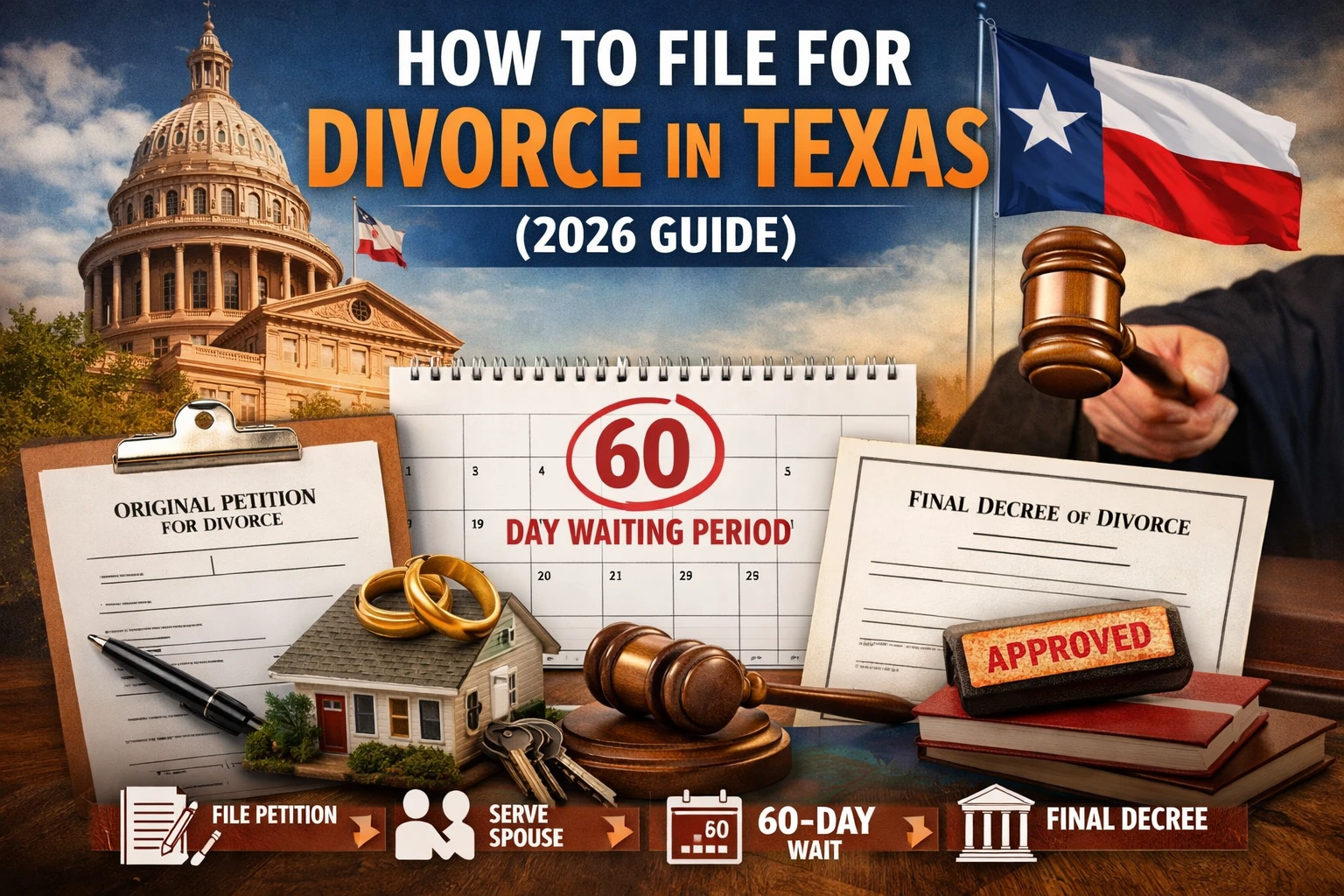
A divorce does not become official because spouses agree it is over. The court must receive the correct documents, the other spouse must be properly notified or waive service, and a judge must sign the Final Decree of Divorce. This guide to filing in Collin County explains the practical steps for Texans pursuing an agreed, uncontested divorce without adding unnecessary conflict or expense.
An uncontested divorce can be a much simpler path when both spouses agree on the major terms. That includes how property and debts will be divided, whether either spouse will use a former name again, and, when children are involved, conservatorship, possession schedules, child support, and medical support. Agreement matters, but accurate paperwork and court procedure still matter just as much.
Start With Texas and Collin County Residency Rules
Before preparing a Petition for Divorce, make sure Collin County is the proper place to file. Under Texas law, at least one spouse generally must have lived in Texas for the previous six months and in Collin County for at least 90 days before filing.
There can be details that change the analysis. For example, a spouse may have recently moved, may live in a different Texas county, or may be stationed elsewhere for military service. If residency is not clear, it is better to address that question before filing than to spend time and filing fees on a case that belongs in another court.
You do not need to file jointly simply because the divorce is agreed. One spouse is the Petitioner, meaning the person who starts the case. The other spouse is the Respondent. Those labels are procedural only. They do not decide who is at fault or who has more rights in the divorce.
A Guide to Filing in Collin County Step by Step
Prepare the petition and required divorce forms
The divorce begins with an Original Petition for Divorce. This document identifies the spouses, asks the court to grant the divorce, and states the general relief being requested. In an agreed case, it is still the opening document, not the final agreement.
The paperwork needed depends heavily on your family situation. A divorce without children under 18 usually requires fewer documents than one involving minor children. If children are involved, the documents must address issues such as legal decision-making, parenting time, child support, medical support, and geographic restrictions. The court will focus on whether the orders protect the children’s best interests, even if both parents agree.
Property can also make a case more complicated. Texas is a community-property state, which means assets and debts acquired during the marriage may need to be divided. A clear agreement should account for homes, vehicles, bank accounts, retirement plans, credit cards, tax obligations, and personal property. Leaving an asset or debt vague may create problems after the divorce is finalized.
File the case with the district clerk
Divorce cases in Collin County are filed with the district clerk and assigned to a district court. The filing process may be completed through the approved electronic filing system, and self-represented filers may also have options to file directly with the clerk. Procedures, accepted payment methods, document formatting requirements, and local court practices can change, so confirm the current process before submitting your paperwork.
Expect a filing fee unless you qualify to ask the court to waive costs. If paying court costs would create a genuine hardship, you may be able to file a Statement of Inability to Afford Payment of Court Costs. A fee waiver is not automatic. The court reviews the request and may require additional information.
Once the petition is accepted, keep the cause number. Put that number on every later filing. Save file-stamped copies of your petition and any notices from the clerk or court. These records help you track the case and avoid submitting documents under the wrong case number.
Give the Respondent legal notice
Filing the petition starts the case, but the Respondent must still be legally brought into it. In a cooperative divorce, the Respondent may sign a Waiver of Service. A valid waiver can avoid the cost and stress of having a constable, sheriff, or private process server formally deliver divorce papers.
The waiver should be handled carefully. It must meet Texas requirements, and timing matters. A Respondent who signs a waiver is not necessarily giving up the right to review the final decree or participate in the case. The purpose is to acknowledge the lawsuit and allow the case to move forward without formal service.
If the Respondent will not sign a waiver, does not respond, or cannot be located, the matter may no longer be a straightforward uncontested divorce. Formal service, deadlines, and additional court steps may be needed. That is a point where getting individual legal advice can be wise.
Complete the agreed final documents
The Final Decree of Divorce is the document that will govern after the case is over. It needs to be specific enough to be enforceable. A phrase such as “we will divide things later” is not a reliable plan for a court order.
For a no-children case, the decree should clearly state who receives each significant asset and who is responsible for each significant debt. If real estate is involved, additional documents may be needed to transfer title or clarify responsibility for a mortgage. A divorce decree does not automatically remove someone’s name from a loan, so spouses should understand the difference between court responsibility and a lender’s rights.
For cases with children, use the court-required language for support and possession provisions whenever applicable. Child support is not simply a private preference. Texas guidelines, income information, health insurance, and the children’s needs all affect the final orders. A judge can ask questions or require corrections before approving an agreement.
Plan for the Waiting Period and Final Hearing
Texas generally requires a 60-day waiting period from the date the petition is filed before a divorce can be finalized. The waiting period applies even when both spouses are fully cooperative and have signed all documents. Limited exceptions may apply in certain family-violence situations, but most agreed divorces should be planned around the full 60 days.
Use that time productively. Confirm that every document is signed where required, review the decree against your actual agreement, gather any court-required information, and check whether the assigned court has specific procedures for requesting a final hearing. Some courts may allow an agreed prove-up by hearing, affidavit, or another procedure permitted by that court. Do not assume one court’s process applies to every Collin County courtroom.
At the final prove-up, the Petitioner is often asked brief questions to confirm residency, the date of marriage and separation, the lack of a reasonable expectation of reconciliation, and the terms of the decree. When children are involved, the court may ask whether the proposed orders are in their best interests. Answer honestly and bring any required originals or copies.
The divorce is final only after the judge signs the decree. Afterward, obtain certified copies if you will need them for a name change, property transfer, retirement order, or other post-divorce task. Update beneficiaries, insurance records, financial accounts, and emergency contacts as appropriate.
When an Agreed Filing May Need More Help
An agreed divorce is not always a simple divorce. It may be better to slow down and seek legal advice if there is family violence, pressure or fear affecting the agreement, a missing spouse, disputed property, a business, significant retirement assets, bankruptcy concerns, immigration questions, or uncertainty about children’s needs.
Document preparation support can be especially helpful when spouses agree but need a clear, Texas-specific process for completing and filing the paperwork. Ready Divorce Service helps eligible Texans move through uncontested divorce steps with practical guidance designed to reduce preventable mistakes. That support does not replace advice from an attorney when a dispute or legal complication requires it.
A calm, organized filing process cannot remove every emotional difficulty, but it can remove much of the uncertainty. Take the time to make the agreement complete, file carefully, and treat the final decree as the long-term legal document it is.
📞 Get Started Today – Your Peaceful Divorce Is Just a Click Away
When you’re ready to move on, we’re ready to help.
📲 Call us now at (800) 432-0018
🖥️ Start your divorce online today