Table of Contents
- Online Divorce vs. Traditional Attorney: Key Differences
- Texas Uncontested Divorce Requirements
- How Long Does an Uncontested Divorce Take in Texas
- Average Cost of Divorce in Texas: Online vs. Traditional
- The E-Filing Process in Texas and Document Preparation
- When You Absolutely Need a Traditional Divorce Attorney
- Making Your Decision: Online Divorce Service or Traditional Representation
Last Updated: August 5, 2026
Online Divorce vs. Traditional Attorney: Key Differences
An online divorce vs traditional attorney decision fundamentally comes down to complexity, cost, and whether your case requires courtroom advocacy. Online divorce services handle straightforward, uncontested cases where both spouses agree on all major terms. You complete questionnaires, receive court-approved documents, and file them yourself or with the service’s assistance. A traditional divorce attorney provides full legal representation, negotiates contested issues, and appears in court if necessary.
The key distinction: online services assume you and your spouse have already settled everything. Traditional attorneys assume you haven’t and exist to protect your interests if negotiations break down. Neither approach is universally “better”, the right choice depends entirely on whether your divorce is truly uncontested.

| Aspect | Online Divorce Service | Traditional Divorce Attorney |
|---|---|---|
| Best For | Uncontested divorces with mutual agreement | Contested cases or complex assets |
| Cost | Significantly lower | Substantially higher |
| Timeline | Faster (if no court delays) | Longer (negotiation + court scheduling) |
| Legal Advice | Limited to document preparation | Full representation and strategy |
| Court Appearance | Usually not required | Attorney appears on your behalf |
| Complexity Handling | Basic cases only | All scenarios, including high-conflict |
Texas Uncontested Divorce Requirements
To qualify for an uncontested divorce in Texas, both spouses must agree to the divorce, meet residency requirements (at least one spouse must have lived in Texas for six months and in the county for 90 days), have grounds for divorce (Texas allows “no-fault” divorce based on insupportable differences), and resolve all property division, spousal support if applicable, and child custody arrangements in writing. Texas is a community property state, meaning most assets and debts acquired during marriage are divided equally unless you have a written agreement stating otherwise.
Asset Division Complexity: Where Online Services Often Fail
Texas community property law appears straightforward, divide everything 50/50, but execution is where most DIY divorces encounter problems. Online services provide templates for asset schedules but rarely guide you through legal nuances that determine enforceability.
Separate Property vs. Community Property: Assets owned before marriage, inherited property, or gifts to one spouse are separate property and should not be divided. However, if separate property was commingled with community funds (e.g., an inheritance deposited into a joint account and used for home improvements), determining what portion remains separate requires detailed tracing. Online questionnaires typically ask “Do you have separate property?” but do not guide you through documentation needed to prove it in court.
Retirement Accounts and Qualified Domestic Relations Orders (QDROs): Texas courts require specific language when dividing retirement accounts (401(k)s, IRAs, pensions). A simple statement like “Wife receives 50% of Husband’s 401(k)” is legally insufficient. The account administrator will not process the division without a Qualified Domestic Relations Order (QDRO), a separate court order with precise language dictating how the plan should split the account. Many online services do not include QDRO language, leaving you with a divorce decree that cannot be executed. You then face months of additional legal work to obtain the QDRO after divorce is final.
Business Interests and Professional Licenses: If either spouse owns a business or holds a professional license, valuation and division become exponentially more complex. Texas courts require detailed business valuations, often necessitating expert appraisals. An online service cannot evaluate whether your agreed-upon business division is fair or legally sufficient.
Debt Allocation and Liability: Community property law means both spouses are liable for debts incurred during marriage, even if only one spouse’s name is on the debt. Your agreement must explicitly allocate each debt and include language holding that spouse harmless from the other’s liability. Without this language, creditors can pursue either spouse for the full debt amount after divorce.
Red-Flag Checklist: When Asset Division Requires an Attorney
Before filing with an online service, ask yourself:
- Do you own a home with significant equity?
- Do you have retirement accounts?
- Does either spouse own a business or professional practice?
- Are there significant debts (mortgages, business loans, credit cards)?
- Do you have separate property you want to protect?
- Has either spouse received a bonus, inheritance, or significant gift during the marriage?
- Are there tax implications you haven’t considered?
If you answered “yes” to more than one of these questions, an online service is likely insufficient. The cost of an attorney to review and refine your agreement is far less than correcting an unenforceable division after divorce.
Child Custody and Support Specificity
If you have minor children, you must file a detailed custody and child support agreement. Texas courts require these arrangements to serve the child’s best interests. A vague agreement about “splitting time” will not satisfy the court. You need specific visitation schedules, decision-making authority, and child support calculations based on Texas guidelines.
Texas child support is calculated using the obligor’s net monthly income up to a statutory cap (currently $9,200 per month as of 2024). The standard rate is 20% of net income for one child, 25% for two children, 30% for three children, and up to 40% for five or more children. Your agreement must show this calculation explicitly. If you deviate from the guideline amount, you must document the reason or the court may reject it.
Custody arrangements must specify: which parent has primary custody; the exact visitation schedule (days, times, and pickup/dropoff locations); decision-making authority for medical, educational, and religious matters; how holidays and summer breaks are divided; and provisions for communication with the non-custodial parent.
How Long Does an Uncontested Divorce Take in Texas
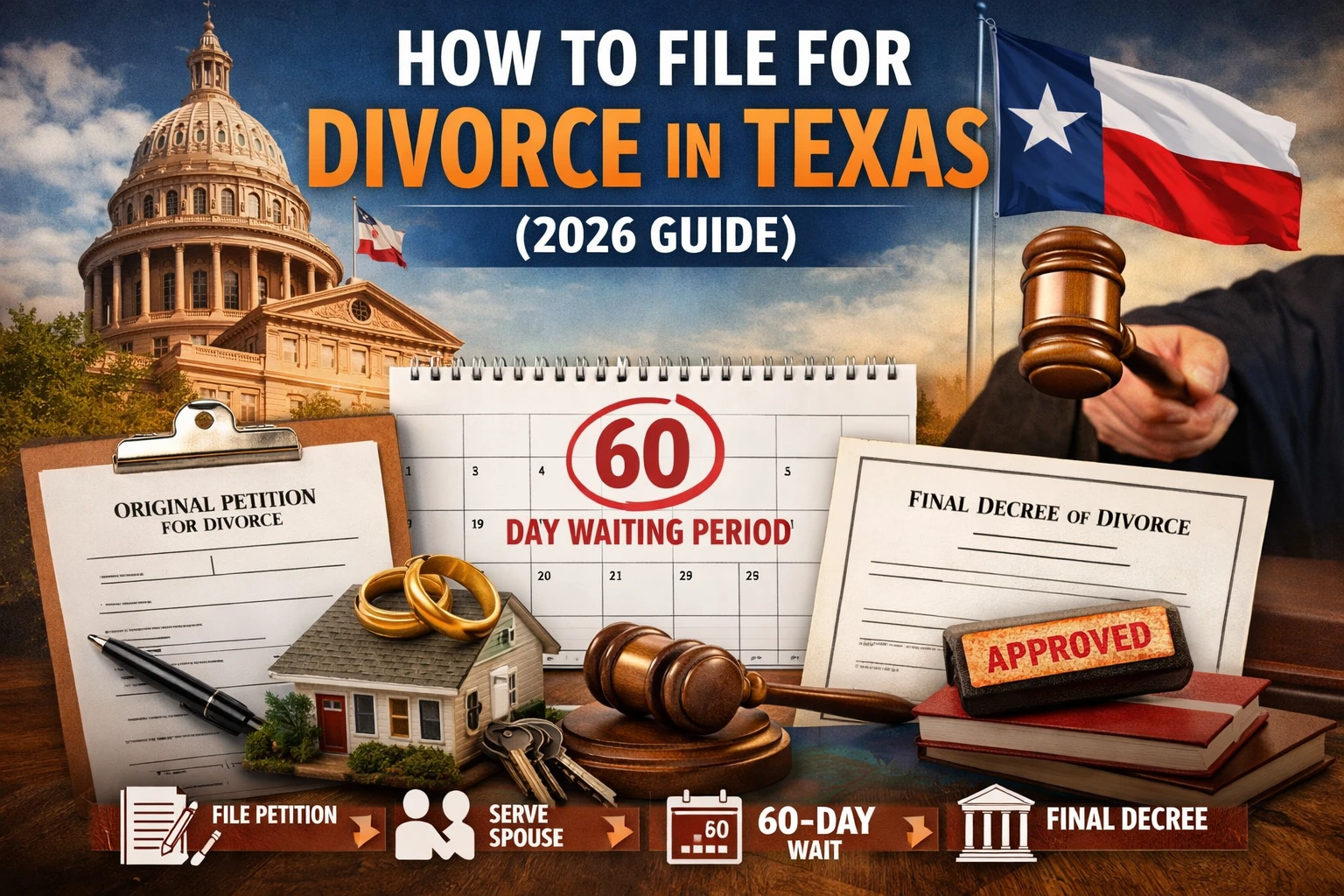
The timeline for how long does an uncontested divorce take in Texas has a built-in floor: Texas mandates a 60-day waiting period from the date you file the divorce petition until the final decree can be issued. In practice, total time typically ranges from 2 to 4 months for straightforward cases, assuming no complications arise after filing.
The 60-Day Waiting Period: When It Actually Starts
The 60-day clock begins on the date the court officially accepts your filing, not the date you submit documents. If your documents are rejected for formatting errors, missing signatures, or incomplete schedules, you must resubmit. The waiting period does not start until the court accepts the corrected filing. A single rejection can delay your timeline by 1-2 weeks.
DIY filers who submit documents themselves face higher rejection rates, particularly if unfamiliar with Texas e-filing requirements. The court clerk’s office reviews each submission for compliance with local rules, which vary by county.
Service of Process: A Hidden Procedural Requirement
After you file your petition, your spouse must be formally notified of the divorce filing. In Texas, service of process can be accomplished through personal service (a process server or constable physically delivers documents), certified mail (if your spouse agrees), or waiver of service (if your spouse signs an acknowledgment).
If your spouse is uncooperative or cannot be located, service becomes complicated. You may need to file a motion for alternative service, which adds weeks to your timeline. The court will not issue a final decree until it has proof that your spouse was properly served.
Online divorce services typically do not handle service of process. If service fails or is delayed, your entire timeline extends.
Court Review and the “Prove-Up” Hearing
After the 60-day waiting period expires, the court must review your divorce decree to ensure it complies with Texas law and serves the best interests of any children involved. In uncontested cases, this review typically happens without a hearing. However, if the court identifies issues, vague language, missing schedules, inadequate child support calculations, the judge may request corrections before signing. This correction cycle can add 2-4 weeks to your timeline.
In some cases, the court schedules a “prove-up” hearing, where you appear before the judge to testify that the agreement is fair. This hearing is typically brief (10-15 minutes) but requires you to take time off work. If you cannot attend or if the judge has questions, the hearing may be continued, delaying your final decree.
Online divorce services do not represent you at prove-up hearings. If the court schedules one, you must appear alone or hire an attorney.
What Happens After the Final Decree Is Issued
Once the judge signs your final decree, your divorce is legally final. However, several post-decree steps may be necessary: property transfers (filing a new deed), retirement account divisions (obtaining a QDRO from the court), mortgage refinancing (if one spouse keeps the home), name changes, and custody and support enforcement if your spouse fails to comply.
Online divorce services typically do not assist with these post-decree steps. You are responsible for ensuring that property transfers, QDROs, and other administrative tasks are completed.
Average Cost of Divorce in Texas: Online vs. Traditional
The average cost of divorce in Texas varies dramatically based on your approach. Online divorce services typically charge a flat fee for document preparation and filing assistance. Traditional attorneys charge hourly rates or flat fees that can be 5 to 10 times higher.
Court filing fees themselves are modest, typically a few hundred dollars. The real cost difference lies in legal work. An uncontested divorce through an online service might cost several hundred dollars total. A traditional attorney handling the same uncontested case typically charges substantially more.
The cost calculation shifts dramatically if your case becomes contested. If disagreements emerge over assets, custody, or support, an online service cannot help you, you’ll need an attorney anyway, and you’ve already spent money on documents you can’t use. Traditional attorneys factor this risk into their pricing.
Hidden costs exist in both approaches. Online services sometimes charge extra for document review, amendments, or filing assistance. Traditional attorneys bill for every phone call, email, and document revision.
The E-Filing Process in Texas and Document Preparation
Texas courts accept electronically filed divorce documents through the state’s e-filing system. Documents must be submitted in PDF format with proper headers, signatures, and case number references. If formatting is incorrect, the clerk rejects the filing and you must resubmit. This rejection delays your 60-day waiting period.
Document preparation requires understanding Texas family law. Your divorce decree must address every asset and debt acquired during marriage. If you own a home, the deed must be addressed in writing. If you have retirement accounts, those require specific language. Child support calculations must follow Texas guidelines precisely. One missing element can cause the court to reject your entire filing.
When You Absolutely Need a Traditional Divorce Attorney
Certain situations make online divorce services unsuitable. If your divorce involves contested issues, disagreement over custody, asset division, spousal support, or any major term, you need an attorney. Online services cannot negotiate or advocate for you.
High-net-worth cases require attorney representation. If you own a business, substantial retirement accounts, real estate beyond your primary residence, or significant investments, the stakes are too high for template documents.
Cases involving child abuse allegations, substance abuse, or domestic violence require an attorney. Texas courts scrutinize custody arrangements closely when safety is a concern.
Situations where one spouse is uncooperative demand attorney involvement. If your spouse won’t sign documents, hides assets, or refuses to engage in the process, you cannot use an online service.
Cases with significant debt, particularly business debt or jointly-guaranteed loans, require legal expertise. Community property rules mean you may be liable for debts you didn’t incur.

Making Your Decision: Online Divorce Service or Traditional Representation
The decision between an online divorce service and traditional attorney hinges on one question: is your divorce truly uncontested? Not “do you want it to be uncontested,” but have you actually reached agreement on every material issue?
If yes, you’ve agreed on asset division, custody arrangements (if applicable), child support, and spousal support, an online service can handle the filing efficiently and affordably.
If uncertainty exists about any major issue, or if your spouse has shown reluctance to cooperate, hire an attorney immediately. The cost difference between an online service and an attorney is negligible compared to the cost of a contested divorce or an unenforceable agreement.
Consider this practical framework: an online service costs several hundred dollars. An attorney for a simple uncontested case costs substantially more. But an attorney for a contested case costs exponentially more. If there’s any chance your case becomes contested, the attorney’s hourly rate for handling complications will dwarf the upfront savings of an online service.
The timeline matters too. If you need a divorce completed quickly, an online service accelerates the pre-filing phase. You’ll still wait the mandatory 60 days, but you won’t wait weeks for attorney availability or document drafting. This speed is valuable when circumstances demand quick resolution.
Frequently Asked Questions
Is online divorce in Texas legally recognized?
Yes. Online divorce services in Texas are legally valid when they prepare documents that comply with Texas Family Code requirements. The court recognizes divorce filings regardless of how documents were prepared, provided they meet statutory requirements, include proper service of process, and contain all required information. However, the quality of document preparation matters, errors can lead to court rejection or delays. This is why accurate preparation and compliance with Texas law are essential.
How much does an uncontested divorce cost in Texas?
Costs vary significantly based on your chosen method. Online divorce services typically cost substantially less than hiring a traditional attorney, though exact pricing depends on the complexity of your situation and what services you need. Traditional attorney representation involves higher costs due to hourly rates or flat fees. Court filing fees apply regardless of method. For accurate pricing tailored to your situation, contact Ready Divorce Service or consult with a local attorney to understand your specific costs.
What happens if my online divorce documents are rejected by the court?
Court rejection typically occurs due to incomplete forms, missing signatures, or non-compliance with Texas Family Code requirements. If documents are rejected, you’ll need to correct errors and refile, which costs additional filing fees and extends your timeline. This is why working with a service that understands Texas procedural compliance is important. Ready Divorce Service guides you through accurate document preparation to minimize rejection risk, but consulting the court clerk about specific requirements can also prevent errors.
Does Texas require a lawyer for an uncontested divorce?
No. Texas does not require legal representation for an uncontested divorce. You can file pro se (representing yourself) using court-approved forms and guidance. However, many people choose professional assistance to ensure documents are accurate and compliant with Texas law. Whether you use an online service, a traditional attorney, or handle it yourself depends on your comfort level with legal procedures and the complexity of your situation, such as child custody or asset division.
If you’ve reached agreement with your spouse on all divorce terms, Ready Divorce Service can guide you through the filing process with accuracy and efficiency. The service specializes in Texas uncontested divorces and provides step-by-step assistance to ensure your documents comply fully with state law. Get started with a questionnaire to assess your situation and receive a clear path forward.
📞 Get Started Today – Your Peaceful Divorce Is Just a Click Away
When you’re ready to move on, we’re ready to help.
📲 Call us now at (800) 432-0018
🖥️ Start your divorce online today