Table of Contents
- When Online Divorce Services Fall Short
- How to File for Divorce in Texas Without a Lawyer
- Texas Uncontested Divorce Forms: Where to Get Them
- Texas Divorce Filing Fees and Court Costs Explained
- Mediation as a Structured Alternative
- Limited-Scope Legal Representation and Paralegal Services
- Comparison of Your Options
- Risks of DIY Divorce and When to Seek Expert Help
Last Updated: August 6, 2026
When Online Divorce Services Fall Short
Online divorce platforms promise simplicity: fill out a questionnaire, pay a flat fee, and receive court-ready documents. But simplicity doesn’t guarantee suitability. For many Texas couples, the one-size-fits-all template approach creates more problems than it solves.
Online services excel at straightforward cases: couples with no children, minimal assets, and complete agreement on every term. The moment your situation involves a child, shared debt, or property division questions, generic forms show their limits. The questionnaire can’t capture nuance, templates don’t account for your county’s local rules, and there’s no one to call who understands Texas family law.
This is where alternatives to Texas divorce online become essential. Not because online services are fraudulent, but because they’re designed for a narrow slice of divorces. At Ready Divorce Service, we’ve worked with couples whose generic online platforms resulted in court rejection. The issue wasn’t dishonesty, it was that forms didn’t account for their specific situation or county filing requirements.
Rejected court filings cost time and money. If your divorce involves children, significant assets, or any disagreement between spouses, a generic online service may not be sufficient. The cost of fixing a rejected filing often exceeds the price difference between a cheap online service and a better alternative.
How to File for Divorce in Texas Without a Lawyer
Filing for divorce without a lawyer is legally possible in Texas through pro se representation, meaning you represent yourself in court. However, pro se doesn’t mean you’re entirely on your own. Court-approved forms, legal information resources, and document preparation services exist specifically to guide you through the process.

The DIY Path: Court-Approved Forms and Self-Filing
Court-approved forms are the foundation of any DIY divorce in Texas. These forms are designed to meet state and local court requirements, using official documents matters far more than using templates from general legal websites.
Texas provides free access to court-approved divorce forms through the Texas Court System website, though these forms are bare-bones and provide minimal guidance on completion. This is where many DIY attempts falter.
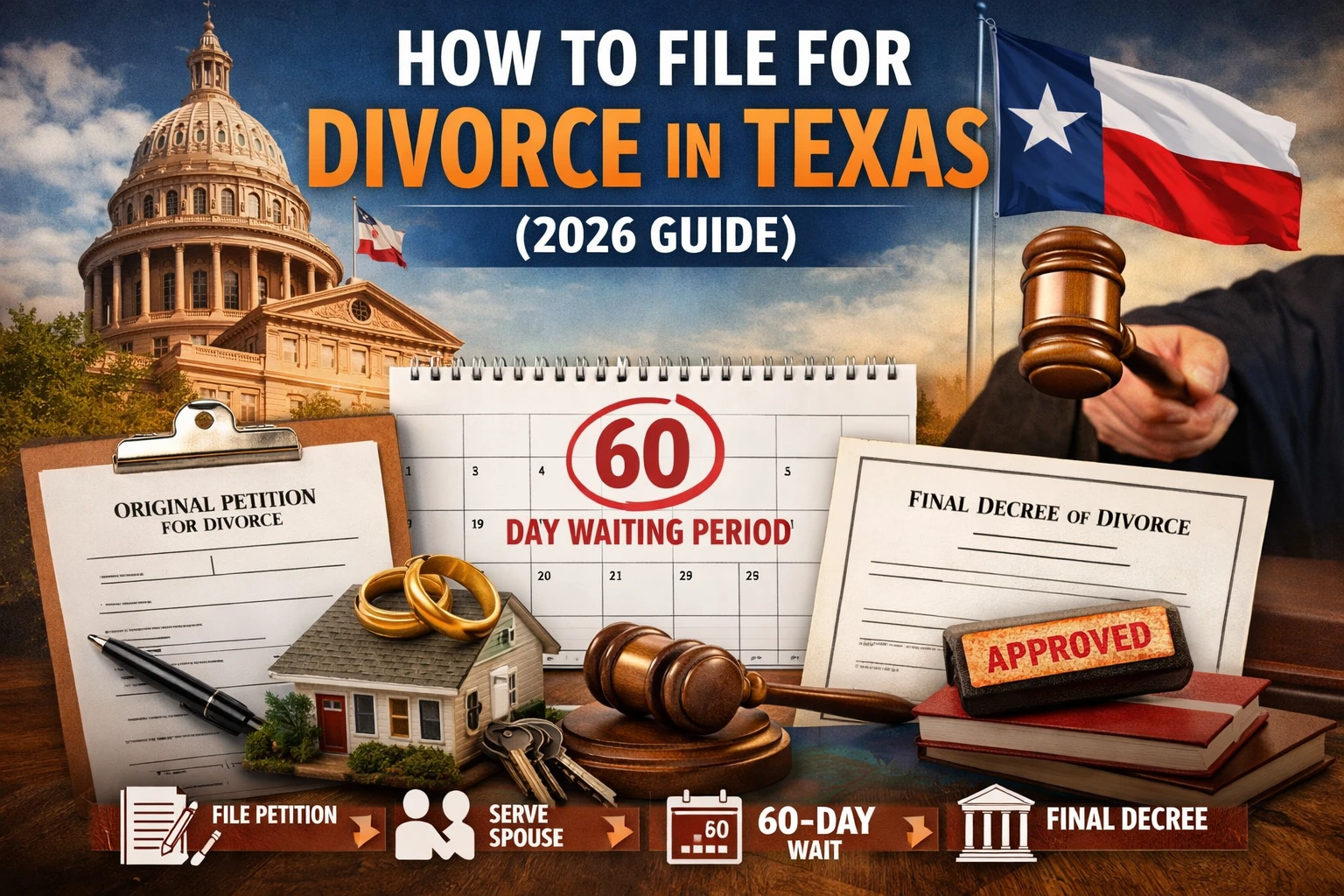
The filing process involves several steps: prepare your documents (petition, marital settlement agreement if applicable, and any orders regarding children or support); file with the district court clerk in your county; serve your spouse with copies or obtain a waiver of citation; and wait the mandatory 60-day waiting period before finalization.
Each step has specific requirements. Service of process must follow Texas Rules of Civil Procedure. A waiver of citation, an agreement by your spouse that they received documents, can simplify this but requires proper execution.
The 60-day waiting period in Texas is mandatory and cannot be waived, even if both spouses agree. Use this time to ensure all documents are correct and address every required element.
What You’ll Need Before You Start
Before opening the first form, gather:
- Full legal names and current addresses for both spouses
- Marriage date and location
- Grounds for divorce (Texas allows no-fault divorce)
- Complete list of community property (vehicles, real estate, retirement accounts, bank accounts)
- Details on any children, including names, ages, and birthdates
- Information on spousal support or child support arrangements
- Any existing court orders affecting either spouse
- Social Security numbers for both spouses
Having this information organized prevents delays and reduces the chance of filing incomplete documents, which courts reject.
Texas Uncontested Divorce Forms: Where to Get Them
Finding the right forms is crucial. Not all divorce forms are created equal, and using outdated or incorrect forms results in court rejection.
Free Resources: Texas Law Help and Government Sources
Texas Law Help provides free, downloadable divorce forms and comprehensive guides in English and Spanish. All forms are updated to reflect current Texas law. The Texas Court System website also offers official forms, though with minimal completion guidance.
The advantage of free resources is cost; the disadvantage is lack of personalized guidance. You’re working alone, which works if your situation is straightforward but creates risk with complications.
Paid Document Preparation Services vs. Templates
Document preparation services occupy the middle ground between free forms and hiring an attorney. Services like Ready Divorce Service provide court-approved forms plus guidance on completion, ensuring documents are accurate and compliant with Texas law.
A template service gives you a form and expects you to fill it correctly. A document preparation service guides you through completion, asking clarifying questions to ensure forms capture your specific situation accurately. This distinction becomes critical when your divorce involves children, as templates won’t guide you through legal implications or ensure compliance with Texas Family Code requirements.
Document preparation services cost more than free forms but less than attorney representation. For uncontested divorces with minor children or shared assets, this middle option often prevents costly filing errors.
Texas Divorce Filing Fees and Court Costs Explained
Filing fees typically range from $250 to $350 for the initial filing. Additional costs may apply depending on your county’s fee structure.
Beyond the filing fee, you may incur costs for service of process if your spouse doesn’t cooperate with a waiver of citation. Formal service through a process server typically costs $75 to $150. If mediation becomes necessary, services range widely depending on the mediator’s experience.
A complete DIY divorce might involve filing fees, service costs, document preparation assistance, and potentially mediation, totaling $500 to $1,500 depending on complexity. This is why comparing alternatives requires looking at total cost, not just advertised price. A $300 online service resulting in rejected forms costs more than a $500 document preparation service that gets it right the first time.
Mediation as a Structured Alternative
Mediation isn’t a replacement for divorce filing, but it’s a critical tool when spouses don’t fully agree on terms. Unlike litigation, which puts decisions in a judge’s hands, mediation keeps control with you and your spouse.

Agreed Divorce vs Mediation in Texas
A mediator is a neutral third party trained to help couples communicate and reach agreements on disputed issues. Mediators don’t make decisions; they facilitate the process of you and your spouse reaching decisions together. This is fundamentally different from court proceedings, where a judge decides custody, property division, and support.
Mediation works best when both spouses are willing to negotiate and neither party has a significant power imbalance. It’s particularly valuable for couples with children, as it allows parents to design custody and support arrangements that work for their family.
Mediation typically costs $300 to $1,800 depending on hourly rates ($150 to $300 per hour) or flat fees. A typical process takes 2 to 6 sessions. Mediation also typically takes less time than litigation, often 4 to 8 weeks, though the mandatory 60-day waiting period still applies.
Limited-Scope Legal Representation and Paralegal Services
Limited-scope representation allows you to hire an attorney for specific tasks rather than full representation. This might mean hiring an attorney to review documents before filing, handle service of process, or represent you at the final hearing while you handle document preparation yourself.
Paralegal services offer another middle-ground option. Paralegals cannot provide legal advice or represent you in court, but they can assist with document preparation, filing, and procedural tasks. Working with a paralegal costs less than hiring an attorney but provides more guidance than using templates alone.
The advantage of limited-scope representation is flexibility. You pay for help where you need it most. The limitation is that paralegals cannot provide legal advice on whether your custody arrangement complies with Texas law or how to structure property division.
Comparison of Your Options
The landscape of alternatives to Texas divorce online includes free resources, paid document preparation, mediation, limited-scope legal services, and full attorney representation. Each serves different situations and budgets.
Cost, Timeline, and Suitability Matrix
| Option | Typical Cost | Timeline | Best For | Key Limitation |
|---|---|---|---|---|
| Free government forms | $250-$350 filing fee | 60+ days | Completely uncontested, no children, minimal assets | No guidance; high error risk |
| Document preparation service | Pricing depends on the specific services required. | 60+ days | Uncontested with children or modest assets | No legal advice; forms-based only |
| Mediation (hourly) | $300-$1,800 | 4-8 weeks plus 60-day wait | Couples with disagreements who want control | Requires both spouses’ participation |
| Limited-scope attorney | $500-$2,000 | 60+ days | DIY approach with attorney review on specific tasks | Limited to specific services; no full representation |
| Full attorney representation | $1,500-$5,000+ | 60+ days to 12+ months | Any divorce, especially contested or complex | Highest cost; less control over process |
Ready Divorce Service fits the document preparation category: we provide guidance and accurate document preparation for uncontested divorces in Texas, ensuring your forms meet state requirements and local court standards.
Risks of DIY Divorce and When to Seek Expert Help
The primary risk of DIY divorce is filing errors resulting in rejection. Texas courts are strict about form compliance. Missing information, incorrect legal language, or failure to follow local rules forces you to refile and restart the 60-day waiting period.
A second risk is incomplete agreements. If you and your spouse haven’t fully addressed every element, custody schedules, child support, property division, spousal maintenance, gaps can create post-divorce disputes. Modifying a divorce decree after it’s final is expensive and time-consuming.
A third risk is missing deadlines or procedural requirements. Service of process must follow specific rules, and certain documents must be filed in specific order.
Seek expert help if your divorce involves minor children, significant assets, disagreement on any terms, previous court orders affecting either spouse, or either spouse’s unwillingness to cooperate. You should also seek help if English is not your first language, as navigating legal documents in a non-native language increases error risk.
Post-divorce modification disputes are expensive and time-consuming. Getting the agreement right initially, even if it costs more upfront, prevents far greater costs later.
Filing for divorce in Texas without a lawyer is possible, but it requires choosing the right approach for your specific situation. Alternatives to Texas divorce online range from free government resources to mediation to limited-scope legal help, each serving different needs. Ready Divorce Service provides document preparation guidance specifically designed for Texas uncontested divorces, ensuring your forms are accurate and compliant with state law. If your situation involves children, shared assets, or any complexity beyond the simplest uncontested case, professional guidance prevents costly filing errors and post-divorce disputes. Start by assessing your divorce’s complexity, then choose the alternative that matches your needs and budget.
Frequently Asked Questions
What is the least expensive way to get a divorce in Texas?
The least expensive option is filing for an uncontested divorce yourself using free court-approved forms from Texas Law Help or your county clerk, paying only filing fees (typically $250-$350). If you need help preparing documents, services like DivorceMe ($129) or 3StepDivorce ($299) are more affordable than attorneys. Ready Divorce Service offers expert guidance on document preparation at a price point between DIY and full legal representation, ensuring compliance with Texas law without the cost of traditional litigation.
Can you file for divorce online in Texas without a lawyer?
Yes. Texas allows pro se representation, meaning you can file for an uncontested divorce without hiring an attorney. You’ll need to complete court-approved forms, file them with your county clerk, pay filing fees, and serve your spouse (or obtain a waiver of citation). Online services and free resources provide the forms and instructions, but you remain responsible for accuracy and timely filing. Many people use document preparation services or expert guidance to reduce errors.
What are the risks of using online divorce document preparation services?
Common risks include court rejection of forms due to incomplete or incorrect information, which delays your divorce and wastes money. Some services have limited customer support or refund policies. If your situation involves minor children, significant assets, or disagreements, generic templates may miss critical details required by Texas family law. Post-divorce modification issues can arise if settlement agreements lack clarity. This is why many people pair online services with expert review or limited-scope legal help.
How do Texas divorce filing fees work, and what should I budget?
Texas divorce filing fees vary by county but typically range from $250 to $350 for an uncontested divorce. These fees cover the court clerk’s processing and filing your petition. Additional costs may include service of process (if your spouse doesn’t waive citation), certified copies of your final decree, and any document preparation service fees. Ready Divorce Service can clarify your county’s specific costs and help you understand the full financial picture upfront.
📞 Get Started Today – Your Peaceful Divorce Is Just a Click Away
When you’re ready to move on, we’re ready to help.
📲 Call us now at (800) 432-0018
🖥️ Start your divorce online today