Table of Contents
- Texas Divorce 60-Day Waiting Period: The Clock Starts Here
- Step 1: Meet Texas Residency Requirements Before You File
- Texas Divorce Forms for Parents: Your Complete Filing Checklist
- Parenting Plan Requirements Texas: What the Court Expects
- How Children Affect the Uncontested Divorce Texas Timeline
- From Petition to Final Decree: The Complete Uncontested Divorce Texas Timeline
- Common Mistakes That Delay Your Timeline
- Conclusion: Start Your Uncontested Divorce With Confidence
- Frequently Asked Questions
Last Updated: September 7, 2026
The mandatory 60-day waiting period in Texas often surprises couples, but it is only one piece of the puzzle when children are involved. An uncontested divorce Texas timeline with children typically spans 90 to 120 days from filing to final decree, assuming both parents agree on custody and support terms from the start. The most common source of delay is not the court, but incomplete paperwork and unclear parenting agreements.
Below, we break down each phase of the timeline, what the court expects from parents, and the specific mistakes that can turn a 90-day process into a six-month ordeal. A divorce Texas timeline is largely within your control when you know the rules ahead of time.
Texas Divorce 60-Day Waiting Period: The Clock Starts Here
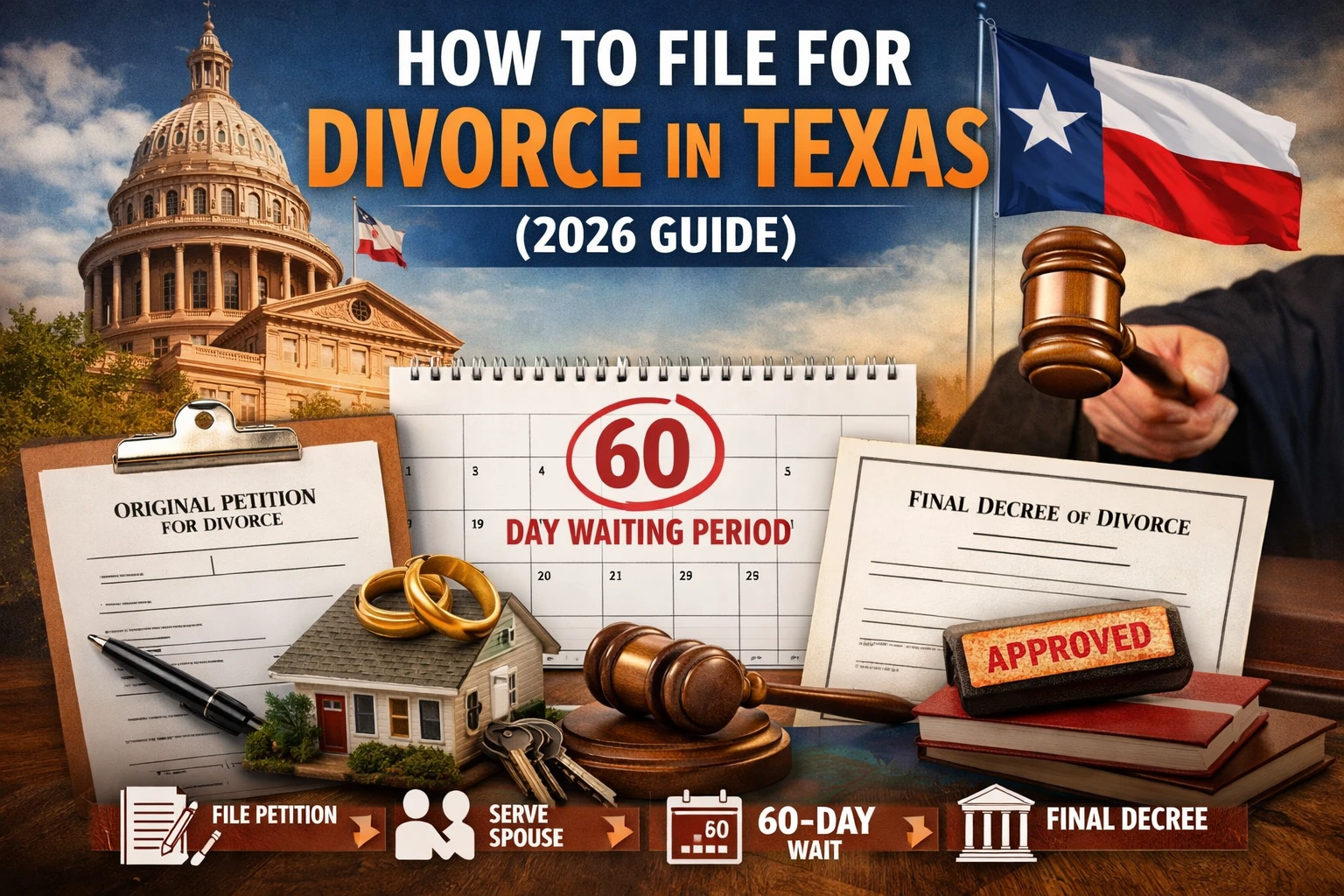
Texas law imposes a mandatory waiting period of 60 days from the date the petition is filed, not from the date you decide to divorce. This statutory waiting period is designed to give couples time to reconcile, and the court cannot sign your final decree before day 61, even if both parties are in complete agreement.
The clock only starts once the petition for divorce is officially filed with the district court clerk. Days spent preparing forms, gathering documents, or negotiating terms do not count toward this period. For parents, this waiting period runs concurrently with the time needed to finalize a parenting plan, so a common approach is to use these 60 days productively rather than waiting to begin custody discussions.
Step 1: Meet Texas Residency Requirements Before You File
Before the 60-day clock can even start, you must satisfy Texas residency requirements. At least one spouse must have lived in Texas for the six months preceding the filing, and the petitioner must have resided in the county where they plan to file for at least 90 days.
The court clerk will verify your residency when you submit your petition, and filing in the wrong county or before meeting these thresholds results in immediate rejection. If you recently moved to Texas, confirm you meet both the state and county requirements before paying the filing fee, as the court will not refund it for a rejected petition.
Texas Divorce Forms for Parents: Your Complete Filing Checklist
For an uncontested divorce with children, the court requires more than a basic petition. You will need the original petition for divorce, a waiver of service if your spouse agrees to the terms, and critically, a parenting plan that addresses conservatorship, possession and access, and child support.
The complete filing checklist for parents typically includes:
- Original Petition for Divorce
- Waiver of Service (signed and notarized by your spouse)
- Parenting Plan (agreed upon by both parents)
- Child Support worksheets
- Proposed Final Decree of Divorce
- Civil Case Information Sheet
Each form must be completed accurately and filed with the court clerk. Missing a signature or filing an outdated version of a form forces the clerk to return your packet, which resets part of your timeline.
Service of Process and the Waiver of Service Option
After filing, your spouse must be formally notified, which is called service of process. The fastest route in an uncontested case is the waiver of service, where your spouse voluntarily signs a document acknowledging they received the petition and agree not to be formally served by a constable or process server.
A signed waiver of service eliminates the need to locate your spouse, pay for a process server, or wait for a return of service. This single document often saves one to two weeks on the overall timeline. The waiver must be signed in front of a notary, and it cannot be used if your spouse is unwilling to cooperate.
Parenting Plan Requirements Texas: What the Court Expects
A parenting plan in Texas must address three core areas: conservatorship, possession and access, and child support. Conservatorship determines who makes major decisions about the child’s education, healthcare, and welfare. Possession and access establishes the living schedule, and child support follows the state’s guideline percentages.
The court expects the parenting plan to be specific and workable, not vague. A plan that says “reasonable visitation” will be rejected. Instead, detail the exact schedule, including holidays, school breaks, and how exchanges will happen. The Texas Attorney General’s child support guidelines provide the standard formula, and while parents can agree to different amounts, the court must approve any deviation.
A vague parenting plan is the single fastest way to delay your final decree. The judge will not sign a divorce with children without a clear, enforceable custody schedule. Courts see hundreds of cases, and they will send yours back for revisions if the plan lacks specifics.
How Children Affect the Uncontested Divorce Texas Timeline
Children introduce mandatory steps that a childless divorce does not require. Both parents in Texas must complete a court-approved parenting class, called a Parent Education and Family Stabilization Course, before the court will grant the divorce. This course typically takes 2 to 4 hours online, and the certificates of completion must be filed with the court before your final decree is signed. Failing to complete this step is one of the most common reasons a final decree gets delayed.
The deeper impact of children on your timeline comes from how the court reviews your agreement. In an uncontested case with children, the judge does not simply rubber-stamp your parenting plan. The court has a statutory duty to determine if the plan is in the child’s best interest, and the judge will scrutinize:
- Conservatorship designations: Who is the Joint Managing Conservator (JMC) and who is the Sole Managing Conservator (SMC)? If both parents are JMCs, the court expects the plan to specify which parent has the right to make decisions on education, healthcare, and religious upbringing. If one parent is the SMC, the court will want to see a clear justification and a specific possession schedule for the other parent.
- Possession and access schedule: The court will check that your schedule meets the minimum standards of the Texas Standard Possession Order (SPO). If you deviate from the SPO, the judge will want to know why. A schedule that gives one parent only every other weekend and no midweek visitation may be flagged as not in the child’s best interest, even if both parents agreed to it.
- Child support amount: The court will verify that the child support amount matches the Texas guidelines. If you agree on a different amount, the judge must approve the deviation, and you will need to provide a written explanation and a Child Support Review Order or similar document. This review is not instant; it adds a layer of administrative processing.
A parenting plan that merely says “joint custody” or “reasonable visitation” will be rejected. The court requires a specific, enforceable schedule that names the conservators, defines the possession schedule down to the day and time, and states the child support amount. Vague language is the #1 reason a final decree is sent back for revision.
Temporary Orders: The Hidden Timeline Multiplier
One angle most guides miss is how temporary orders interact with the 60-day waiting period. If you and your spouse cannot agree on immediate custody or support arrangements while the divorce is pending, one of you may file a motion for temporary orders. This triggers a hearing, usually scheduled 2 to 4 weeks out, depending on the county’s docket.
A temporary orders hearing does not pause the 60-day clock, but it does consume your time and attention. If the judge issues temporary orders that differ from your final parenting plan, you will need to reconcile the two, which can add 1 to 2 weeks of document redrafting and re-filing. Couples who avoid temporary orders by agreeing on a temporary schedule themselves save a significant chunk of time.
The Child Support Review Process
If either parent receives state assistance (like Medicaid or SNAP), or if the court refers the case to the Texas Attorney General’s Child Support Division, a child support review may be triggered. This process can add 30 to 60 days to your timeline because the AG’s office operates on its own schedule, independent of the district court. To avoid this, agree on child support that matches the guidelines and file a written agreement that the court can approve without referral.
The 60-Day Clock and Children: What Actually Runs Concurrently
The 60-day waiting period runs from the date of filing and does not wait for your parenting plan to be finalized. While the 60-day clock ticks, you should be:
- Completing the parenting class (both parents)
- Drafting and negotiating the parenting plan
- Finalizing the child support worksheet
- Preparing the financial disclosures
If you complete all of these tasks before day 60, you can submit your final decree on day 61. If you wait until after day 60 to start these tasks, you add 2 to 4 weeks to the backend.
Children add time to an uncontested divorce timeline on average, not because of the legal requirements themselves, but because the court’s review of your parenting plan is substantive. The more specific and guideline-compliant your plan is, the faster the judge can sign off.
From Petition to Final Decree: The Complete Uncontested Divorce Texas Timeline
The full timeline from petition to final decree follows a predictable sequence. After filing and the 60-day waiting period, the court reviews your paperwork, and if everything is in order, a judge signs the final decree without requiring an in-person hearing.
Here is the typical sequence:
- File petition and pay filing fee (Day 1)
- Serve spouse or obtain waiver of service (Days 1-14)
- Complete parenting classes (both parents, before Day 60)
- Wait out the 60-day statutory period
- Submit final decree and supporting documents for judge’s signature (after Day 60)
- Receive signed final decree (typically 2-4 weeks after submission)

The judge’s signature is the final step, and courts process these requests in batches. The actual waiting time after submission depends on the county’s caseload, which is why the total timeline varies even in smooth cases.
Digital Filing vs. Paper Filing: Which Is Faster?
Most Texas counties now offer e-filing, which can be faster than submitting paper documents in person. E-filing provides immediate confirmation of receipt, can reduce formatting errors, and may put your documents in the queue sooner.
Paper filing requires a trip to the courthouse, waiting in line at the clerk’s office, and manual data entry by court staff. In counties with high volume, this can add days or even weeks to the processing time. The Texas Office of Court Administration’s e-filing resources confirm that e-filing is the standard for most civil cases, and it is the option we recommend to every client.
Check your specific county’s rules before filing. Some counties have local standing orders that require additional forms for cases involving children, and a few still require an in-person hearing even for uncontested divorces. Knowing your county’s quirks in advance prevents surprise delays.
Common Mistakes That Delay Your Timeline
Most timeline overruns trace back to preventable errors. The most frequent mistake is filing before both spouses have fully agreed on the parenting plan, which forces amendments and restarts portions of the review process. Another common error is missing the deadline to file parenting class certificates.
Financial disclosures are another hidden trap. Texas courts require both spouses to file an Inventory and Appraisement or a similar financial statement, and incomplete asset lists trigger requests for additional documentation. The Texas Judicial Branch’s family law resources outline the required financial disclosures, and failing to include all accounts, properties, and debts is a leading cause of rejection.
A final mistake is handling the paperwork alone without understanding the court’s formatting rules. Margins, font sizes, and specific phrasing requirements vary by county, and a document that looks fine to you may be rejected by the clerk. Professional document preparation can help ensure compliance.
Conclusion: Start Your Uncontested Divorce With Confidence
The uncontested divorce Texas timeline with children is predictable, but only when every form is accurate and every requirement is met on schedule. Missing a parenting class certificate or filing an incomplete financial disclosure can add weeks to your process.
Our team helps you complete accurate paperwork the first time, so you can move through the 60-day waiting period without the stress of rejected filings or court delays.
Begin with our Which Plan is Right for You? assessment to see which package fits your situation, or review our Starting the Divorce Process guide to answer your initial questions. Get started with Ready Divorce Service and move through your divorce with confidence, knowing your documents are prepared correctly the first time.
Frequently Asked Questions
How long does an uncontested divorce take in Texas when children are involved?
Texas law imposes a mandatory 60-day waiting period from the date the petition is filed. If you have children, the court will not sign the final decree before that period ends. In practice, uncontested divorces with children can be finalized after the 60-day waiting period, depending on how quickly your spouse is served and how fast you complete the required parenting plan and other forms.
Does having children change the divorce timeline in Texas?
Having children adds requirements, but it does not extend the mandatory 60-day waiting period. The court requires a parenting plan and will review child support and conservatorship terms before signing the decree. These additional documents can add preparation time, but because you are filing uncontested, you control the pace. The court will not finalize the divorce until the parenting plan is approved.
What documents are required for an uncontested divorce with children in Texas?
You need the original petition for divorce, a waiver of service or citation, a final decree of divorce, and a child support order. Texas also requires a parenting plan that covers conservatorship, possession and access, and medical support. Many counties have local rules about additional forms, so check with the district clerk or use a document preparation service that knows county-specific filing procedures.
Can I file for divorce in Texas if I just moved here?
Texas requires that you or your spouse have lived in the state for the six months before filing. You must also have lived in the county where you plan to file for at least 90 days. If you have not met these residency requirements, the court lacks jurisdiction and will reject your petition. Planning around this waiting period is essential to an accurate timeline.