Table of Contents
- Is Online Divorce Legal in Texas?
- Texas Divorce Residency Requirements
- Understanding the eFileTexas Divorce Process
- How to File for Divorce in Texas Without a Lawyer
- Texas Divorce Waiting Period and Timeline
- Eligibility for Online Divorce and When You Need an Attorney
- Cost, Court Fees, and Fee Waivers
- Conclusion
Last Updated: August 9, 2026
Is Online Divorce Legal in Texas?
Yes, is online divorce legal in Texas, and it’s become one of the most practical options for couples seeking an uncontested divorce. Texas allows online filing through eFileTexas, the state’s official electronic filing system, which means you can submit your divorce petition and supporting documents without stepping foot in a courthouse. This applies to uncontested divorces where both spouses agree on the terms of separation, division of assets, custody arrangements, and other key issues.
Online filing is legal and official in Texas, but it’s only available for uncontested cases. If you and your spouse disagree on major issues, you’ll need to resolve those disputes first through mediation or litigation before you can file online. Ready Divorce Service specializes in guiding Texas residents through this exact process, ensuring your documents meet state requirements and your filing stays on track.
The real advantage of online divorce in Texas is cost and speed. Traditional litigation can stretch on for months or years and cost thousands in attorney fees. An uncontested online divorce follows a clear timeline and predictable process.
Texas Divorce Residency Requirements
Before you can file for divorce in Texas, you must meet the state’s residency requirements. At least one spouse must have been a resident of Texas for the six months immediately preceding the filing, and that same spouse must have been a resident of the county where you’re filing for at least 90 days before the petition is submitted.
These requirements establish jurisdiction, the court’s legal authority to handle your case. If neither spouse meets these thresholds, Texas courts cannot grant your divorce. The 90-day county requirement determines which courthouse will handle your case and where you’ll file through eFileTexas.
If you’ve recently moved to Texas, timing matters. The six-month state residency clock starts when you establish Texas residency, typically with a Texas address on your driver’s license. Once you’ve met both requirements, you’re eligible to file online.
Understanding the eFileTexas Divorce Process
eFileTexas is the official electronic filing system for Texas courts. For uncontested divorces, it’s the primary way most people submit their petitions and supporting documents. The system is designed to simplify the filing process and reduce paperwork, though it requires careful attention to formatting, document specifications, and procedural rules.
When you file through eFileTexas, you’re submitting documents directly to the court that will oversee your case. The system automatically routes your petition to the correct county clerk’s office based on where you file. Once submitted, your documents are date-stamped and entered into the court’s docket, the official record of your case.
The eFileTexas system requires specific formatting: documents must be in PDF format, follow particular page margins, include proper headers with case numbers (once assigned), and meet file size requirements. A single mistake in formatting can result in rejection, which delays your case and requires resubmission. Ready Divorce Service ensures your documents are formatted correctly the first time, eliminating the frustration of rejected filings.
How to File for Divorce in Texas Without a Lawyer
Filing for divorce without an attorney is possible in Texas for uncontested cases, but it requires careful preparation and strict adherence to state law.

Step 1: Prepare Your Court-Approved Forms
Texas requires specific, court-approved forms for divorce filings. You cannot use generic templates; courts will reject anything that doesn’t match the official format. Required forms include the Petition for Divorce, Waiver of Service (if your spouse agrees not to be formally served), and a Final Decree of Divorce. If you have minor children, you’ll also need a Suit Affecting the Parent-Child Relationship (SAPCR) form, along with a parenting plan and child support worksheet.
Each form must include specific language, proper formatting, and accurate information. Missing fields, incorrect case numbers, or improper formatting will trigger rejection.
Step 2: Complete the Mandatory Disclosures
Texas law requires both spouses to exchange financial information through mandatory disclosures. This includes bank statements, tax returns, property valuations, and debt documentation. These disclosures must be provided at least 21 days before trial or final hearing, even in uncontested cases.
Step 3: File Your Petition Through eFileTexas
Once your forms are complete and properly formatted, you’ll create an account on eFileTexas and upload your documents. The system will validate the file format and size. After submission, you’ll receive a confirmation number and filing fee receipt. Court costs vary by county but typically range from filing fees to service of process fees.
Step 4: Serve Your Spouse (or Obtain Waiver of Service)
Your spouse must be formally notified of the divorce petition through service of process. In an uncontested divorce, your spouse can sign a Waiver of Service agreement, which eliminates the need for formal service and speeds up the process significantly. If your spouse refuses to waive service, you’ll need to have them served by a process server or constable, which adds time and cost.
Step 5: Wait Out the Statutory Waiting Period
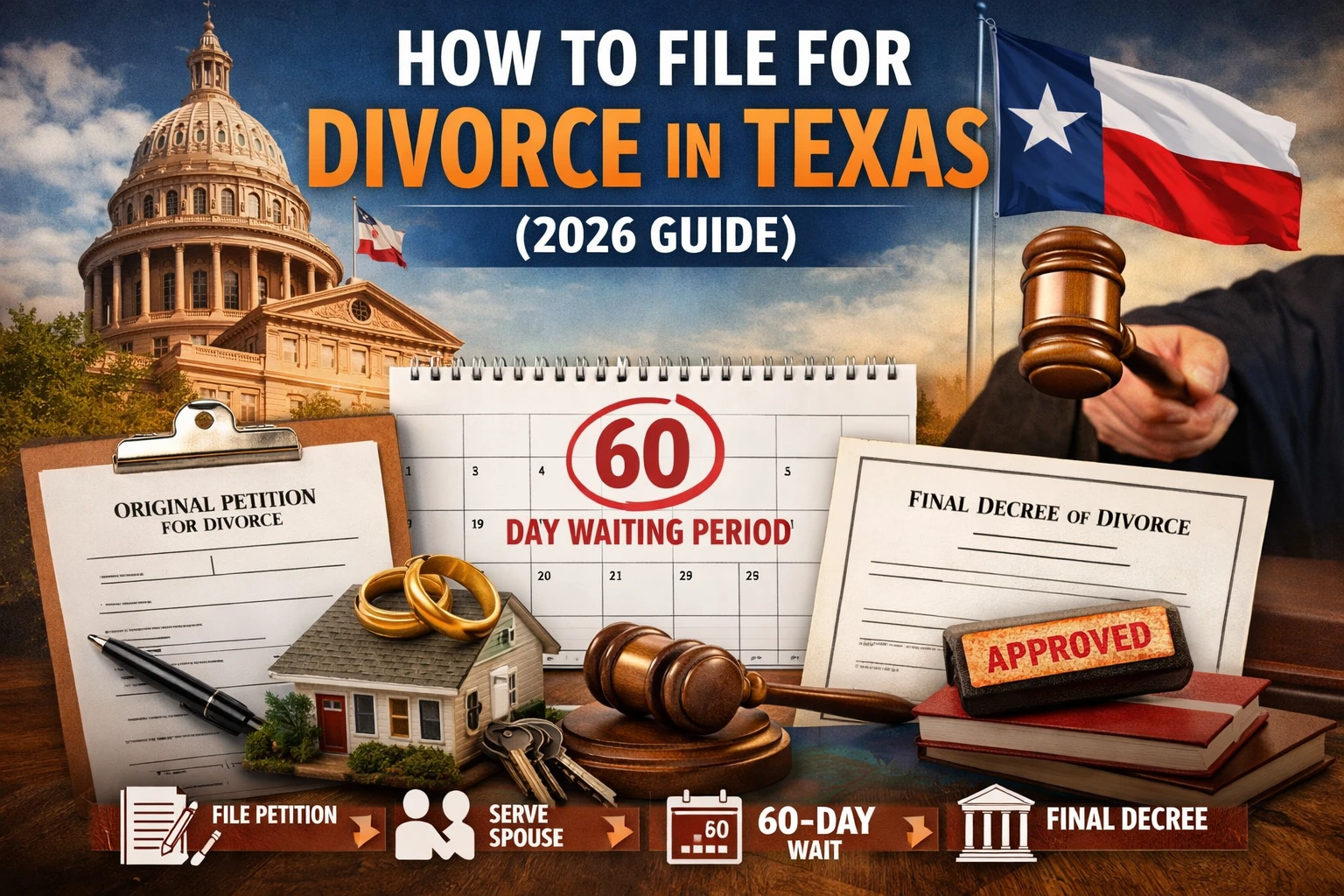
Texas law mandates a 60-day waiting period from the date your petition is filed until a final decree can be granted. This period cannot be waived, even in uncontested cases where both parties agree.
Step 6: Obtain the Final Decree
After the 60-day waiting period has passed and all documents are in order, you can request a final hearing. For uncontested cases, this hearing is often brief or conducted without both parties present. The judge reviews the documents, confirms that Texas law requirements have been met, and signs the Final Decree of Divorce.
Uncontested vs. Contested Divorce
An uncontested divorce means both spouses agree on all major issues: property division, debt responsibility, child custody, child support, and spousal support (if applicable). Both parties sign off on the final settlement, and the process moves through the court system with minimal judicial involvement.
A contested divorce occurs when spouses disagree on one or more significant issues. Property division disputes, custody disagreements, or disagreements over support amounts all trigger contested status. In contested cases, the court must hold hearings, possibly order mediation, and ultimately make decisions on disputed issues. This process takes considerably longer and costs significantly more.
Most people filing for divorce in Texas do so without major disputes. If you and your spouse have genuinely reached agreement, an uncontested online divorce is viable. If disagreements remain unresolved, attempting to file pro se becomes risky because you may inadvertently waive rights or accept unfavorable terms.
Court-Approved Forms and Document Preparation
Texas courts provide official forms designed specifically for divorce filings. These forms are available through the Texas Court System website and through eFileTexas itself. Using court-approved forms is not optional; judges will not accept custom documents or templates from non-official sources.
Required forms vary depending on your circumstances. A basic uncontested divorce with no children requires fewer forms than a case involving minor children and complex asset division. Common forms include the Petition for Divorce, Waiver of Service by Respondent, Final Decree of Divorce, Parenting Plan (if children are involved), Child Support Worksheet, and Property Division Agreement.
Each form must be completed with accurate information. Property descriptions must be specific enough for the court to understand what assets are being divided. Child custody arrangements must clearly state custody type, conservatorship rights, and visitation schedules. Document preparation is where many pro se filers encounter problems. Ready Divorce Service handles this critical step by ensuring every form is completed accurately and formatting meets eFileTexas specifications.
Texas Divorce Waiting Period and Timeline

(/texas-divorce-petition-form-help/) Waiting Period and Timeline]
The statutory waiting period in Texas is 60 days from the date your divorce petition is filed. This mandatory period cannot be shortened or waived, even if both spouses fully agree. The waiting period exists to give both parties time to reconsider and ensure they’re making an informed decision.
During this 60-day window, either spouse can still modify the proposed settlement, request changes to custody arrangements, or contest the divorce entirely. Once the period ends, you can request a final hearing and obtain your Final Decree of Divorce.
A realistic timeline for an uncontested online divorce in Texas looks like this:
- Days 1-7: Document preparation and eFileTexas submission
- Days 8-14: Court processing and case assignment
- Days 15-60: Statutory waiting period
- Days 61-75: Final hearing scheduling and judge review
- Day 75+: Final Decree signed and divorce becomes official
If there are any issues with your initial filing, formatting errors, or missing documents, the timeline extends. The court will issue a notice of deficiency, and you’ll have time to correct and resubmit.
Eligibility for Online Divorce and When You Need an Attorney
You’re a candidate for online divorce if both spouses agree on all major issues (property division, custody, support), you meet Texas residency requirements, you have no minor children or have a fully agreed parenting plan, neither spouse disputes the grounds for divorce, and you can complete and accurately file all required court-approved forms.
You should consult with an attorney if your spouse refuses to cooperate, you have significant assets or business interests, custody of minor children is disputed, one spouse has significantly higher income, you suspect hidden assets or undisclosed debts, or you’re uncertain about property division laws or your rights.
The key question is whether you and your spouse genuinely agree on the terms. If you do, online filing is viable. If disagreement exists on any major issue, attempting pro se filing becomes risky.
Cost, Court Fees, and Fee Waivers
Court costs for filing for divorce in Texas vary by county but typically include filing fees, service of process fees, and clerk fees. If you cannot afford the filing fees, Texas offers fee waivers for individuals who qualify based on income. To request a fee waiver, you’ll file an Application for Waiver of Court Costs.
An uncontested online divorce costs significantly less than hiring an attorney for full representation. Ready Divorce Service offers document preparation and guidance at a cost that is an affordable alternative to traditional legal representation.
Conclusion
Is online divorce legal in Texas? Yes, and for couples with agreed terms, it’s the most practical path forward. Texas allows electronic filing through eFileTexas, which simplifies the process and reduces costs compared to traditional litigation.
The process requires meeting residency requirements, preparing court-approved forms accurately, filing through eFileTexas, serving your spouse (or obtaining a waiver), waiting 60 days, and obtaining your final decree. What sounds straightforward in outline becomes complex in execution; formatting errors, missing documents, or procedural mistakes delay your case and require expensive resubmission.
Ready Divorce Service specializes in guiding Texas residents through uncontested divorce with expert document preparation, step-by-step guidance, and full compliance with state law. Our goal is to make your transition simple, affordable, and stress-free. For current information on Texas divorce procedures and forms, visit the Texas Court System website. Get started with Ready Divorce Service and move forward with confidence.
Frequently Asked Questions
Is online divorce in Texas legit and recognized by courts?
Yes. Online divorce is legal in Texas when filed through eFileTexas, the state’s official e-filing system. Texas courts recognize electronically filed divorce documents as valid. However, your divorce must still meet all state requirements: residency, proper service of process, court-approved forms, and the statutory waiting period. Using an online platform to prepare and file your documents does not bypass these legal requirements, it simply makes the filing process more accessible and affordable.
Do I need a lawyer for an uncontested divorce in Texas?
No. You can file an uncontested divorce in Texas without an attorney if you and your spouse agree on all terms, including property division, debt allocation, and custody arrangements (if applicable). You must still complete court-approved forms accurately, follow eFileTexas procedures, and meet all residency and waiting period requirements. Many Texas residents successfully file pro se (on their own) or with document preparation assistance. An attorney is required only if your divorce is contested or involves complex issues.
What is the Texas divorce waiting period, and how does it affect my timeline?
Texas has a mandatory 60-day waiting period from the date you file your petition for divorce until the final decree can be issued. This waiting period cannot be waived except in cases of family violence. After filing, you must serve your spouse, allow time for response, and complete any required disclosures. The total process typically takes 2-3 months for uncontested divorces, though it can extend longer if complications arise or if the court docket is busy.
What are the residency requirements for filing for divorce in Texas?
To file for divorce in Texas, you or your spouse must have been a resident of Texas for at least six months immediately before filing. Additionally, you must file in the county where you or your spouse has been a resident for at least 90 days. If both spouses are out of state, you cannot file in Texas. These residency requirements establish jurisdiction and ensure the Texas court has the legal authority to handle your case.
📞 Get Started Today – Your Peaceful Divorce Is Just a Click Away
When you’re ready to move on, we’re ready to help.
📲 Call us now at (800) 432-0018
🖥️ Start your divorce online today