Table of Contents
- Is Uncontested Divorce Right for You: A Self-Assessment Framework
- Contested vs. Uncontested Divorce: Key Differences Explained
- Uncontested Divorce Requirements: What You Must Agree On
- Marital Settlement Agreement: Building Your Binding Agreement
- Uncontested Divorce Cost and Timeline: What to Expect
- Pros and Cons of Uncontested Divorce for Your Situation
- Post-Divorce Modification Risks: Planning Beyond the Decree
- Next Steps: Is Uncontested Divorce Right for You?
Last Updated: July 28, 2026
Wondering whether is uncontested divorce right for me is a question many people ask when facing the end of a marriage. At Ready Divorce Service, we understand that divorce decisions require honest self-assessment about your relationship dynamics, financial situation, and emotional readiness. According to the American Academy of Matrimonial Lawyers, uncontested divorces represent a growing share of dissolutions, particularly among couples who prioritize speed and cost-effectiveness. Below, we’ll walk you through a practical framework to determine whether an uncontested divorce aligns with your circumstances.
Is Uncontested Divorce Right for You: A Self-Assessment Framework
An uncontested divorce is right for you if both spouses agree on major issues, property division, custody arrangements, and support obligations, without court intervention. This path works best when you and your spouse can communicate civilly, even if your marriage has broken down. The key distinction is not whether you like each other, but whether you can negotiate fairly and reach binding agreements.
Not every situation suits this approach. If significant conflict exists around custody, hidden assets, or spousal support, litigation may be necessary.
The most common reason uncontested divorces fail is when one spouse discovers hidden assets or income during the process. Before committing to this path, conduct a thorough financial audit together and disclose all material facts upfront.
Emotional Readiness: The Often-Overlooked First Step
Emotional readiness is the foundation of any successful uncontested divorce. Assess your emotional state honestly. Can you discuss finances without escalating into conflict? Are you able to separate anger about the relationship from practical decisions about property and custody?
Consider whether you’re pursuing an uncontested divorce because it’s genuinely the right choice, or because you’re exhausted and want the process to end quickly. Quick resolution under emotional duress often leads to unfavorable settlement terms that you regret later.
Financial and Custody Alignment Checklist
Before proceeding, both spouses must align on three core areas. Use this checklist to assess whether you’re ready:
- Marital assets and debts identified. You’ve listed all property, retirement accounts, vehicles, and liabilities. Neither spouse suspects hidden accounts.
- Property division method agreed. You’ve chosen equitable distribution or community property rules, and both parties accept the framework.
- Spousal support resolved. You’ve discussed alimony needs, duration, and amount, or agreed that neither party requires support.
- Child custody and visitation clear. If children are involved, you’ve outlined physical custody, legal decision-making authority, and a realistic parenting schedule.
- Child support calculated. You understand your state’s child support guidelines and have agreed on the monthly obligation.
- Communication remains civil. You can discuss these topics without yelling, threats, or stonewalling.
If you’ve checked all boxes, an uncontested divorce is likely viable. If more than one remains unchecked, contested litigation or mediation may be necessary.
The presence of minor children doesn’t automatically disqualify you from an uncontested divorce, but it does raise the stakes. Courts scrutinize custody and support agreements more carefully when children are involved. Both parents must demonstrate that the arrangement serves the child’s best interests.
Contested vs. Uncontested Divorce: Key Differences Explained
An uncontested divorce occurs when both spouses agree on all material issues and file a joint petition with a settlement agreement. The court reviews the documents for legal compliance and issues a final divorce decree without a trial. This process typically takes weeks to months, depending on your state’s mandatory waiting periods.
A contested divorce involves disagreement on one or more issues, custody, property division, or support. When spouses cannot reach consensus, the case proceeds to litigation with motions, discovery requests, and depositions. Eventually, if settlement doesn’t occur, a judge holds a trial and makes binding decisions. Contested divorces frequently take 12-24 months or longer.

| Aspect | Uncontested Divorce | Contested Divorce |
|---|---|---|
| Agreement Required | Both spouses agree on all issues | Disagreement on one or more issues |
| Timeline | 2-6 months (including waiting period) | 12-24+ months |
| Court Involvement | Minimal; document review only | Extensive; motions, discovery, trial |
| Cost | $500-$2,500 total | $5,000-$25,000+ per spouse |
| Emotional Impact | Lower; collaborative process | Higher; adversarial litigation |
| Settlement Agreement | Required; binding document | Judge-imposed order if no settlement |
| Outcome Certainty | High; you control the terms | Lower; judge decides disputed issues |
| Post-Divorce Modification | Possible but requires mutual consent | Easier to modify if circumstances change |
Uncontested Divorce Requirements: What You Must Agree On
To file an uncontested divorce in most U.S. states, you and your spouse must reach binding agreements on specific legal and financial matters.
Marital settlement agreement. This legal document binds both parties to the agreed-upon terms and must address every material issue. The settlement agreement becomes part of the final divorce decree and is legally enforceable.
Property and debt division. You must identify all marital assets and debts acquired during the marriage and agree on how to split them. Both spouses must disclose their financial situation completely; hidden assets discovered later can invalidate the agreement.
Spousal support (alimony). If one spouse earned significantly more or sacrificed career advancement for the marriage, the lower-earning spouse may be entitled to temporary or permanent support. You must agree on the amount, duration, and payment method.
Child custody, visitation, and support. If you have minor children, you must agree on legal custody (decision-making authority) and physical custody (where the child lives), along with a specific parenting schedule and child support amount calculated using your state’s guidelines.
State-Specific Procedural Nuances in Texas
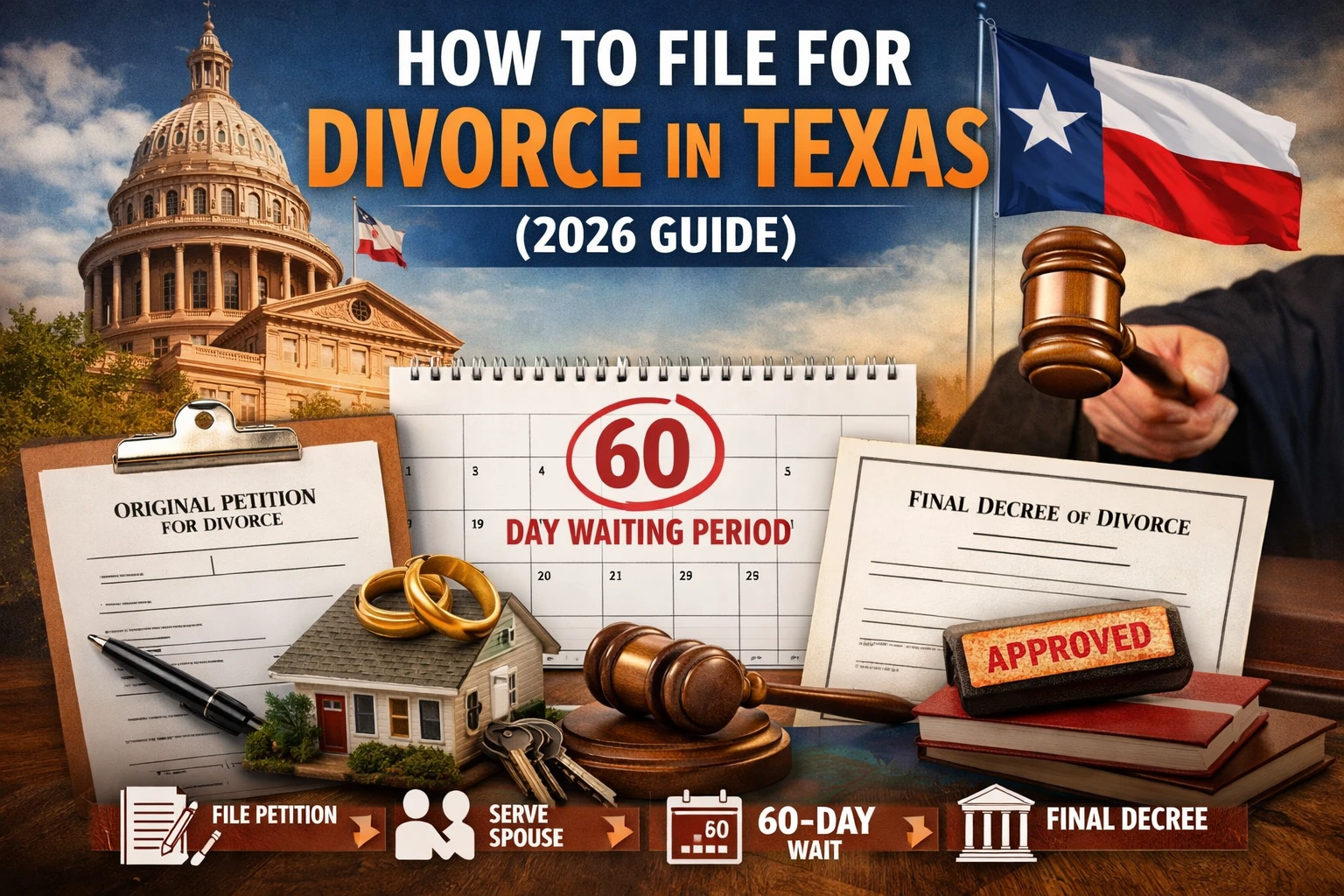
Texas offers a simplified uncontested divorce process, but specific procedural requirements must be followed. In Texas, you must meet a 60-day waiting period from the date of filing before the divorce can be finalized. This waiting period cannot be waived except in rare circumstances involving family violence.
Texas requires both spouses to file an Affidavit Disclosing Material Facts, which certifies that you’ve fully disclosed all assets, debts, income, and liabilities. The state also mandates that any settlement agreement be in writing and signed by both parties. If minor children are involved, the agreement must include a child support order that complies with Texas child support guidelines.
Ready Divorce Service specializes in ensuring your Texas uncontested divorce paperwork meets all state-specific requirements. Our team reviews documents for compliance with Texas Family Code provisions and helps you avoid common filing errors that delay cases.
Marital Settlement Agreement: Building Your Binding Agreement
The marital settlement agreement is the centerpiece of an uncontested divorce. This legal document outlines how you and your spouse will divide property, address support obligations, and arrange custody and visitation. Once signed by both parties and approved by the court, it becomes enforceable.
Drafting a settlement agreement requires precision. Vague language, missing details, or internal contradictions can create disputes that force you back to court. Key sections include identification of marital property and division method, debt assignment, spousal support terms, child custody and visitation schedules, child support calculation, and tax and insurance provisions.
DIY vs. Attorney-Assisted Document Preparation
Many couples face a decision: prepare settlement agreement documents themselves or hire an attorney. DIY preparation using online templates is the most affordable option but carries significant risk. Templates are generic and may not address Texas-specific requirements or your unique circumstances.
Attorney-assisted preparation ensures your agreement complies with all legal requirements and protects your interests. The cost is higher, typically $1,000-$3,000 for an uncontested divorce, but the protection is substantial.
Ready Divorce Service offers a middle path: document preparation with expert guidance. We provide templates tailored to Texas law, review your financial disclosures for completeness, and ensure your settlement agreement meets all statutory requirements.
A common mistake is assuming that because your divorce is “uncontested,” the paperwork doesn’t matter. Courts still scrutinize settlement agreements for legal sufficiency. An agreement that omits required provisions, fails to comply with state law, or contains ambiguous language can be rejected, forcing you to refile and restart the waiting period.
Uncontested Divorce Cost and Timeline: What to Expect
Cost and timeline are often the primary drivers of the uncontested divorce decision.
Cost factors. Uncontested divorce costs vary based on whether you use DIY forms, a document preparation service, or an attorney. Court filing fees in Texas typically range from $300-$500. If you use a document preparation service like Ready Divorce Service, expect to pay a service fee in addition to court costs. If you hire an attorney for full representation, costs escalate significantly.
Timeline factors. The 60-day waiting period in Texas is mandatory and non-waivable except in cases of family violence. Most uncontested divorces in Texas are finalized within 90-120 days from start to finish, assuming both spouses cooperate and complete financial disclosures promptly.
The 60-Day Waiting Period and What Happens During It
Texas’s mandatory 60-day waiting period begins on the date you file the divorce petition. During this time, you cannot finalize the divorce, but you can complete all preparatory work. Use the waiting period to finalize your settlement agreement, gather financial documents, and ensure both spouses understand and sign all required paperwork. On day 60 or later, you can submit your final documents to the court for approval. The judge reviews the settlement agreement and divorce decree for legal compliance. If everything is in order, the judge signs the decree, and your divorce is final.
Pros and Cons of Uncontested Divorce for Your Situation
Uncontested divorce offers significant advantages but isn’t right for every situation.
Pros of uncontested divorce:
- Lower cost. Uncontested divorce costs a fraction of contested litigation, freeing resources for rebuilding your life.
- Faster resolution. You avoid prolonged litigation and move forward within months rather than years.
- Privacy. Settlement agreements remain confidential. Contested divorces involve public court records and testimony.
- Control over outcomes. You and your spouse decide the terms, rather than leaving decisions to a judge.
- Reduced conflict. Collaborative negotiation minimizes ongoing hostility, especially important if you share children.
Cons of uncontested divorce:
- Requires cooperation. If your spouse is uncooperative, hostile, or unwilling to negotiate, this path fails.
- Pressure to compromise. You may accept unfavorable terms to avoid litigation, resulting in long-term regret.
- Limited discovery. You won’t have formal legal tools to uncover hidden assets or income if you suspect dishonesty.
- No legal advocacy. Without an attorney, you may overlook important protections or fail to assert your rights.
- Difficult with high-conflict dynamics. If abuse, substance issues, or severe mental health challenges exist, negotiation may be unsafe or ineffective.
When Uncontested Divorce Isn’t the Right Choice
Certain situations make uncontested divorce inappropriate or dangerous:
Domestic violence or abuse. If you’ve experienced physical, emotional, or financial abuse, negotiating directly with your spouse is unsafe. Litigation with attorney representation and court protection orders is necessary.
Substance abuse or mental health crisis. If your spouse is actively struggling with addiction or untreated mental illness, they may be unable to negotiate fairly or honor agreements.
Hidden assets or income. If you suspect your spouse is concealing money, business interests, or property, you need formal discovery tools available only in contested litigation.
Severe custody disagreement. If you and your spouse fundamentally disagree about custody, visitation, or parenting approaches, courts need to evaluate the situation and determine what serves the child’s best interests.
Power imbalance. If one spouse significantly outearns the other, has superior financial knowledge, or has controlled finances during the marriage, the lower-earning spouse may lack the information needed to negotiate fairly.
The question “is uncontested divorce right for me” ultimately hinges on whether you can negotiate in good faith with your spouse. If trust, safety, or fairness is compromised, litigation provides legal protections that uncontested divorce cannot.
Post-Divorce Modification Risks: Planning Beyond the Decree
Many people focus exclusively on finalizing the divorce, overlooking the reality that life circumstances change. Your settlement agreement may require modification years later, and the ease of modification depends on how your original agreement was structured.
Spousal support modifications. If your agreement specifies that alimony is modifiable based on changed circumstances, either spouse can petition the court for an increase or decrease if income, employment, or health status changes significantly. If the agreement states alimony is non-modifiable, it cannot be changed even if circumstances shift dramatically.
Child support and custody modifications. Texas law allows child support modification if circumstances have changed materially, typically a 10% or greater change in either parent’s income. Custody arrangements can be modified if the modification serves the child’s best interests and there’s been a material and substantial change in circumstances.
Plan for post-divorce modifications by ensuring your original settlement agreement clearly addresses modification triggers, procedures, and any non-modifiable terms.
Next Steps: Is Uncontested Divorce Right for You?
Determining whether is uncontested divorce right for me requires honest self-assessment across emotional, financial, and practical dimensions. Use the framework above to evaluate your situation:
- Can you and your spouse communicate civilly about finances and custody?
- Have you both disclosed all material assets and debts?
- Do you agree on property division, support, and custody arrangements?
- Are you emotionally ready to move forward, or are you rushing to escape conflict?
- Are there safety, substance abuse, or hidden asset concerns that require litigation?
If you’ve answered yes to the first three questions and no to the last two, an uncontested divorce is likely appropriate. If uncertainty remains, consult with an attorney or mediator who can assess your specific circumstances.
The uncontested divorce process doesn’t have to be complicated or expensive. Ready Divorce Service specializes in guiding Texas residents through accurate, compliant document preparation that ensures your divorce is finalized efficiently. With comprehensive support including settlement agreement drafting, financial disclosure review, and filing assistance, we help you avoid costly mistakes while maintaining full control over your divorce terms. Start your journey toward closure, contact Ready Divorce Service for a personalized questionnaire and discover how we can simplify your uncontested divorce process.
Additional Resources
According to the Texas Family Code guidelines on uncontested divorce procedures, compliance with specific filing requirements is essential for court approval. Understanding these requirements prevents delays and rejection of your documents.
Research from the American Bar Association’s family law resources confirms that couples who reach settlement agreements without litigation report significantly lower stress levels and better post-divorce relationships, particularly when children are involved.
The National Institute for Trial Advocacy guidance on settlement agreements emphasizes that clear, comprehensive settlement language prevents future disputes and modification litigation, reinforcing the importance of thorough document preparation at the outset.
Frequently Asked Questions
What are the key requirements for an uncontested divorce in Texas?
For an uncontested divorce to proceed in Texas, both spouses must agree on all major issues: division of marital assets, child custody and support, spousal support (if applicable), and debts. You must file a divorce petition, reach a marital settlement agreement, and meet the 60-day waiting period after filing. Both parties must sign the settlement agreement, and the court must approve the final divorce decree. If you have minor children or significant shared property, accuracy in your settlement agreement is critical to avoid future disputes.
How much does an uncontested divorce cost compared to contested litigation?
Uncontested divorce costs vary significantly based on complexity and service type. Factors include whether you use online document services, hire an attorney for limited assistance, or pursue full legal representation. Filing fees, document preparation, and any mediation services affect total cost. For current pricing and transparent cost breakdowns tailored to your situation, Ready Divorce Service provides personalized quotes through a questionnaire. Compared to contested divorce, which involves court appearances, extended litigation, and attorney hourly fees, uncontested divorce is substantially more affordable.
Can I handle an uncontested divorce myself, or do I need an attorney?
You can pursue a DIY uncontested divorce if your situation is straightforward (no children, minimal assets, mutual agreement). However, mistakes in forms or settlement agreements can lead to court rejection, costly corrections, or post-divorce modification disputes. Many people benefit from attorney-assisted document preparation, a middle ground between full representation and going solo. An experienced service reviews your agreement for compliance with Texas law, protecting you from errors. If your situation involves child custody, significant debt, or property division, professional guidance significantly reduces risk.
What happens if I agree now but circumstances change after the divorce is final?
Post-divorce modifications are possible but complex and costly. Child support and custody can be modified if circumstances change significantly (job loss, relocation, child’s needs). However, property division and alimony are typically final and difficult to change. This is why a carefully drafted marital settlement agreement, reviewed for enforceability and completeness, is essential. Getting your settlement agreement right the first time prevents future legal battles. Ready Divorce Service ensures your agreement addresses foreseeable changes and complies with Texas law to minimize modification risks.
📞 Get Started Today – Your Peaceful Divorce Is Just a Click Away
When you’re ready to move on, we’re ready to help.
📲 Call us now at (800) 432-0018
🖥️ Start your divorce online today