Table of Contents
- What Is an Uncontested Divorce in Texas?
- Simple Texas Divorce Alternatives: Understanding Your Options
- Texas Divorce Mediation: A Neutral Path Forward
- Collaborative Divorce Texas: Working Together With Attorneys
- DIY Divorce Texas: Self-Help Resources and Forms
- Document Preparation Services vs. Traditional Attorneys
- Cost Comparison: What Each Simple Divorce Alternative Costs
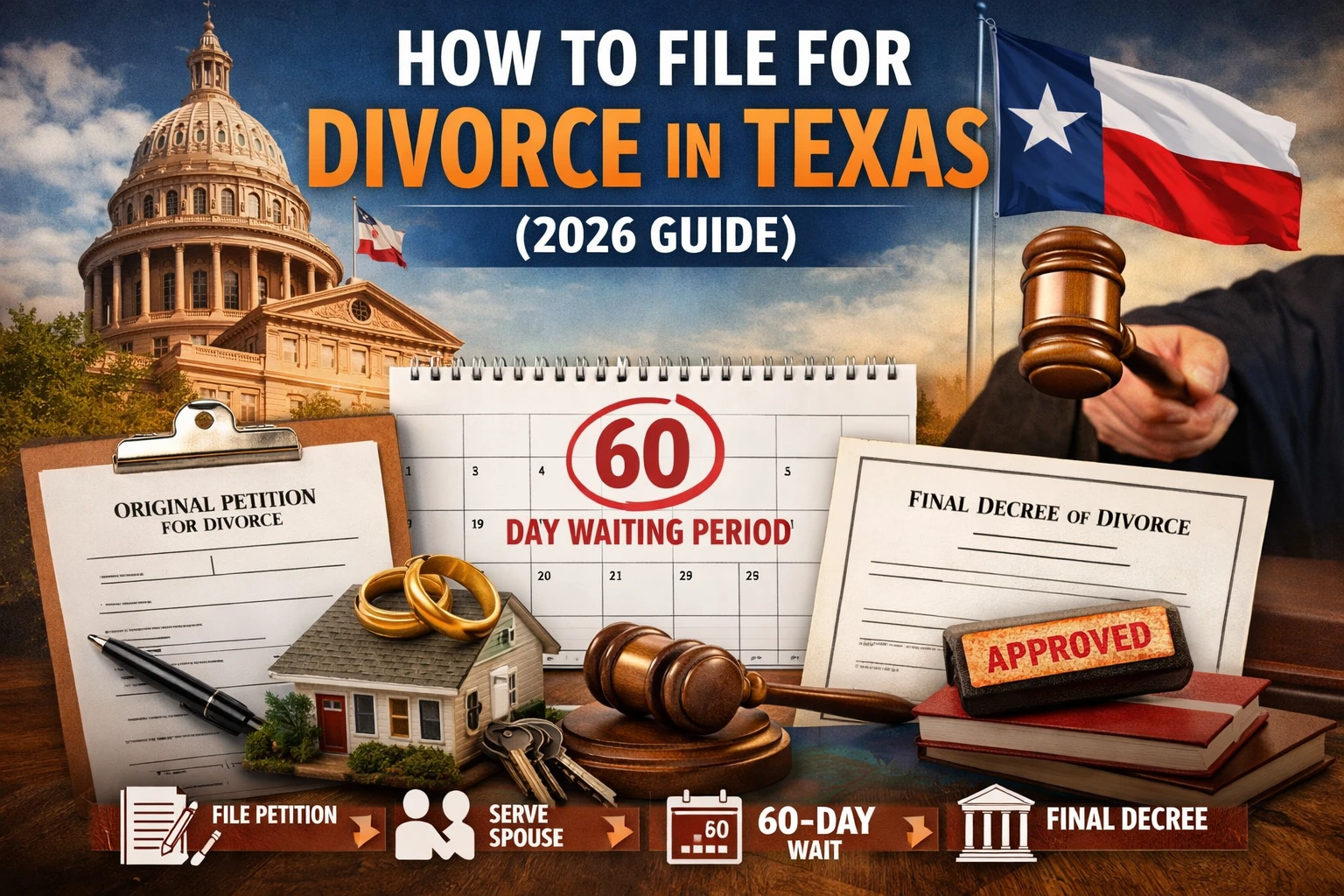
- Texas Divorce Timeline: The 60-Day Waiting Period and Beyond
Last Updated: July 30, 2026
What Is an Uncontested Divorce in Texas?
An uncontested divorce in Texas is a legal process where both spouses agree on all major issues, property division, child custody, child support, and spousal maintenance, before filing with the court. Texas courts recognize that couples who cooperate save time, money, and emotional energy. The state requires a mandatory 60-day waiting period from filing before a divorce decree can be finalized.

The key distinction lies in preparation. An uncontested divorce requires careful documentation of your agreement, accurate completion of required forms, and proper filing procedures. A single error in property descriptions or custody language can delay finalization by months.
The 60-day waiting period in Texas gives you time to reconsider and ensure all paperwork is correct before the final hearing. Use this time to verify that every detail in your divorce decree reflects your actual agreement.
Simple Texas Divorce Alternatives: Understanding Your Options
When facing divorce in Texas, you have more choices than hiring a traditional attorney or attempting the process alone. Understanding each alternative helps you select the approach that matches your situation, budget, and comfort level.
| Alternative | Best For | Complexity Level | Typical Outcome |
|---|---|---|---|
| Uncontested DIY with free forms | Couples with no children or assets, strong agreement | Low | Court-approved divorce decree |
| Mediation | Couples who communicate well, need neutral guidance | Low-Medium | Binding settlement agreement |
| Document preparation services | Couples with agreement, want accuracy assurance | Low-Medium | Filed documents, court-ready forms |
| Collaborative divorce | Couples wanting professional support, complex assets | Medium-High | Negotiated settlement agreement |
| Legal aid organizations | Low-income individuals, complex family issues | Medium-High | Full legal representation |
| Arbitration | Couples needing binding decision, privacy priority | High | Arbitrator’s enforceable decision |
| Fixed-fee attorney services | Couples wanting professional guidance, budget clarity | Low-Medium | Complete legal representation |
The choice depends on three factors: whether you and your spouse agree on terms, your financial resources, and the complexity of your situation. Couples with minor children or significant assets typically benefit from professional guidance, while those with straightforward agreements may succeed with document preparation services or DIY approaches.
How to Choose the Right Alternative for Your Situation
Start with honest assessment of your agreement level. If you and your spouse have reached consensus on all issues, you’re positioned to use lower-cost alternatives. If disagreement remains on even one major issue, you’ll need mediation, collaborative law, or traditional litigation.
Consider your asset complexity next. Couples with only personal property can often succeed with simpler approaches. Those with business interests, investment accounts, or significant real property benefit from professional review to ensure equitable division under Texas community property law.
Financial capacity matters considerably. Traditional litigation costs thousands of dollars and takes months or years. Mediation typically costs less but requires both parties’ willingness to cooperate. Document preparation services and free resources cost minimal amounts but offer no legal advice if problems arise.
Your comfort with legal processes influences the right choice. Ready Divorce Service helps individuals who want professional document preparation without the full cost of attorney representation, ensuring compliance with Texas Family Code requirements while keeping costs manageable.
The “right” alternative isn’t necessarily the cheapest, it’s the one that matches your agreement level, asset complexity, and risk tolerance. A slightly higher investment in mediation often prevents costly mistakes that DIY approaches create.
Texas Divorce Mediation: A Neutral Path Forward
Mediation brings a neutral third party into your divorce discussions to help you and your spouse reach agreement on disputed issues. The mediator doesn’t make decisions for you; instead, they facilitate communication and guide you toward mutually acceptable solutions.
Texas courts increasingly encourage mediation before litigation. Many district courts require parties to attempt mediation for custody disputes, and judges often order mediation when couples cannot agree on property division or support issues.
The process typically unfolds over several sessions. Each spouse may have separate meetings with the mediator to discuss concerns confidentially, then joint sessions where both parties work toward agreement. Mediators trained in family law understand Texas property division principles, child support guidelines, and custody factors.
Mediation costs vary based on mediator experience and session duration, but generally remain lower than litigation. Sessions are confidential, meaning statements made during mediation cannot be used against you in court if mediation fails. This confidentiality encourages honesty and creative problem-solving. Successful mediation results in a settlement agreement that both parties sign, which becomes the basis for your divorce decree.
Mediation vs. Litigation: Key Differences
In mediation, you and your spouse control the outcome. You decide what feels fair for property division, custody arrangements, and support amounts. Litigation places decision-making power in a judge’s hands, who applies Texas law and orders a settlement.
Timeline differs significantly. Mediation can resolve issues in weeks or months. Litigation typically takes 6-18 months, depending on court schedules and case complexity.
Cost structures diverge. Mediation charges hourly fees for the mediator’s time, typically $150-$300 per hour. Litigation involves attorney hourly fees, court filing fees, discovery costs, and expert witness fees. Couples spending $10,000-$50,000 on litigation often could have resolved the same issues through mediation for a fraction of that cost.
Confidentiality is stronger in mediation. Mediation statements are privileged and cannot be disclosed in court. Litigation is a public process where court filings and trial testimony become public record.
Collaborative Divorce Texas: Working Together With Attorneys
Collaborative divorce brings both spouses’ attorneys together with the shared commitment to resolve issues outside of court. Both attorneys sign an agreement stating that if collaborative efforts fail, they will withdraw from the case and new attorneys must be hired for litigation. This structure creates powerful incentive for all parties to cooperate.
The collaborative process typically involves multiple four-way meetings where both spouses and both attorneys sit together. Additional professionals, financial specialists, child development experts, or appraisers, may participate when their expertise helps resolve specific issues.
This approach works best for couples who can communicate respectfully and want professional guidance without court involvement. It’s particularly valuable when minor children are involved, since the focus remains on finding solutions that serve the family’s interests. Collaborative divorce costs more than mediation due to multiple professionals’ involvement, but typically costs less than litigation.
DIY Divorce Texas: Self-Help Resources and Forms
Texas provides extensive free resources for individuals handling their own divorce. The Texas State Law Library, TexasLawHelp.org, and eFileTexas.gov offer court-approved forms, detailed instructions, and step-by-step guidance for uncontested divorces.
These resources work well for straightforward situations: couples without children, minimal property, and genuine agreement on all terms. TexasLawHelp.org provides forms for both divorces with and without children, along with checklists and instructions written in plain language.
TexasLawHelp.org self-help resources for Texas divorce
eFileTexas.gov Self-Help allows you to complete an online questionnaire, then generates court-approved forms you can file electronically. This tool works specifically for uncontested divorces without minor children or real property.
The primary advantage of DIY divorce is cost, you pay only court filing fees, typically $300-$500. However, you must understand Texas Family Code requirements, accurately complete all forms, meet all filing deadlines, and ensure proper service of documents. A single error can result in rejection by the court, requiring you to refile and restart the waiting period.
Risk Assessment for DIY Divorce: What Can Go Wrong
The most common mistake is incomplete or inaccurate property division. Texas follows community property law, meaning property acquired during marriage is presumed community property subject to “just and right” division. If your divorce decree fails to address specific assets, those assets may remain legally married property, creating complications for years.
Custody and support errors carry serious consequences. Texas child support guidelines specify exact calculations based on income. If your agreement deviates from guidelines without proper legal justification in the decree, courts may later challenge the agreement. Custody language must be specific about possession schedules, decision-making authority, and dispute resolution methods.
Document service requirements create another common problem. Texas requires that your spouse receive proper notice of the divorce filing. Improper service means the court lacks jurisdiction, and your divorce decree is invalid.
If you file DIY divorce and make significant errors, you cannot simply amend the decree after it’s finalized. You would need to file for modification or annulment, costing more than getting it right initially. A professional review of your completed forms costs far less than fixing mistakes later.
Document Preparation Services vs. Traditional Attorneys
Document preparation services occupy a middle ground between DIY divorce and full attorney representation. These services help you complete forms accurately, ensure compliance with Texas requirements, and prepare documents for filing. They do not provide legal advice or represent you in court.
Ready Divorce Service specializes in this model, offering expert guidance and document preparation to ensure your filing is completed in full compliance with state law. Our step-by-step approach helps you understand each requirement while ensuring accuracy that DIY approaches often miss. We focus specifically on uncontested divorces where both parties have reached agreement.
Document preparation services cost significantly less than attorney representation, typically a few hundred dollars rather than thousands. You maintain more control than hiring an attorney, since you understand every decision being made. Yet you gain professional assurance that your documents meet Texas requirements and will not be rejected by the court.
Cost Comparison: What Each Simple Divorce Alternative Costs
DIY divorce with free forms costs only court filing fees, typically $300-$500. Mediation typically costs $150-$300 per hour, with straightforward cases requiring 4-6 hours across multiple sessions, totaling roughly $900-$2,300 including court filing fees.
Document preparation services typically range from a few hundred dollars for simple cases to $1,000-$1,500 for cases involving minor children or modest property division. Ready Divorce Service provides transparent pricing for document preparation, ensuring you know costs upfront without hidden fees.
Collaborative divorce costs $3,000-$8,000 or more, depending on how many sessions are needed and whether additional specialists participate. Traditional attorney representation for uncontested divorce ranges from $1,500-$3,000 for straightforward cases. Contested divorces requiring litigation can cost $10,000-$50,000 or more.
Legal aid organizations provide free services to low-income individuals. Eligibility depends on income and case type. Legal Aid of NorthWest Texas serves multiple counties and provides full legal representation at no cost to qualifying clients.
Texas Divorce Timeline: The 60-Day Waiting Period and Beyond
Texas law mandates a 60-day waiting period from the date you file your divorce petition until the final divorce decree can be signed. This waiting period applies to all divorces and cannot be circumvented.
The 60-day clock starts when your petition is filed with the district court. Your spouse must be served with notice of the filing, then has time to respond. If your divorce is uncontested and both parties have agreed to all terms, your final hearing can occur immediately after the 60-day period expires, typically requiring just a brief court appearance or submission of agreed documents.
During the waiting period, finalize all agreements, complete all required forms, and prepare for the final hearing. After the judge signs the final decree, your divorce is legally finalized. The decree addresses property division, custody, support, and all other divorce issues.
If your situation is complex or contested, the timeline extends significantly. Discovery, depositions, and court scheduling can stretch the process 6-18 months beyond the initial 60-day waiting period.
Use the 60-day waiting period strategically. If you’re completing documents yourself or using a document preparation service, finish everything before this period ends. If mediation is ongoing, prioritize reaching agreement so your final hearing can occur immediately after the 60 days expire.
Eligibility Requirements for Texas Divorce
You must meet specific requirements to file for divorce in Texas.
Residency is the primary requirement. Either you or your spouse must be a resident of Texas for at least six months immediately preceding the filing, and the spouse filing must be a resident of the county where the petition is filed for at least 90 days before filing.
You must be legally married. Grounds for divorce in Texas include both fault-based and no-fault options. No-fault divorce, filed on grounds of “insupportability,” meaning the marriage has become insupportable due to conflict, requires no proof of wrongdoing and is available to anyone. This is the most common ground for uncontested divorce.
You must meet the waiting period requirement. Texas imposes a mandatory 60-day waiting period that cannot be waived.
If minor children are involved, additional requirements apply. Texas courts must ensure custody and support arrangements serve the children’s best interests. You cannot simply agree to custody terms without court approval; the court reviews the agreement to ensure it’s appropriate.
Texas Family Code requirements for divorce
Choosing the right simple Texas divorce alternative depends on your specific circumstances, agreement level with your spouse, and financial resources. If you and your spouse have reached genuine agreement on all issues, document preparation services like Ready Divorce Service provide professional accuracy and compliance assurance without the full cost of attorney representation. Our step-by-step guidance ensures your documents meet Texas requirements, your filing is completed correctly, and your transition to post-divorce life proceeds smoothly. Get started with Ready Divorce Service to ensure your uncontested divorce is handled with accuracy, affordability, and the professional support that gives you confidence in the process.
Frequently Asked Questions
What is the difference between a simple Texas divorce alternative and traditional litigation?
A simple Texas divorce alternative like mediation, collaborative law, or DIY filing avoids court battles by keeping the process amicable and focused on mutual agreement. Traditional litigation involves adversarial court proceedings where a judge decides contested issues. Alternatives typically cost less, take less time, and allow you to maintain control over the outcome. They work best when both spouses can communicate respectfully and have reached general agreement on key issues like property division and custody.
Can I handle an uncontested divorce in Texas without hiring a lawyer?
Yes, you can file an uncontested divorce without a lawyer using DIY divorce resources like TexasLawHelp.org, eFileTexas.gov Self-Help, or document preparation services. These options work best if you have no minor children, minimal shared assets, and both spouses agree on all terms. However, you remain responsible for ensuring all documents comply with Texas Family Code requirements. Many people use document preparation services to reduce error risk while staying cost-effective. If your situation involves children, significant property, or debt, consider mediation or a consultation with an attorney.
How long does a simple uncontested divorce take in Texas?
Texas law requires a minimum 60-day waiting period from when the petition is filed until the divorce can be finalized. In practice, simple uncontested divorces typically take 2-4 months total, depending on how quickly you prepare documents, file them, and obtain the final decree. The 60-day period exists whether you choose mediation, DIY filing, or collaborative divorce. If court delays occur or documents need correction, the timeline extends. Document preparation services and mediation can help you stay on track during this waiting period.
What happens if I make a mistake on my DIY divorce forms?
If the court finds errors in your DIY divorce documents, it may reject them, requiring you to correct and refile, which delays your divorce and costs additional filing fees. Common mistakes include incorrect legal descriptions of property, missing signatures, or failure to comply with Texas Family Code formatting. Some errors can be caught and fixed before filing; others only surface during court review. This is where document preparation services add value: they review your forms for compliance before submission, reducing rejection risk. If an error is discovered after filing, you’ll need to amend and resubmit.
Is Texas divorce mediation required, or is it optional?
Mediation is not automatically required for uncontested divorces in Texas, but many courts encourage or order it for contested cases, especially those involving children. For a simple, amicable divorce where both spouses already agree, mediation is optional, you can skip it and proceed directly to filing. However, many couples choose mediation voluntarily because it provides a structured, neutral environment to finalize agreements on custody, property division, and support. Court-ordered mediation is part of the Alternative Dispute Resolution (ADR) process and helps reduce litigation costs and court backlogs.
📞 Get Started Today – Your Peaceful Divorce Is Just a Click Away
When you’re ready to move on, we’re ready to help.
📲 Call us now at (800) 432-0018
🖥️ Start your divorce online today