When spouses agree on who will keep the house, the vehicles, the credit cards, and the savings, they are often closer to an uncontested divorce than they realize. But an example property division agreement Texas couples review should be treated as a planning tool, not something to copy and sign without making sure it matches their actual assets, debts, and proposed Final Decree of Divorce.
In Texas, property division needs to be clear enough for a court to approve and specific enough for both spouses to carry out after the divorce is final. A vague promise to “split everything fairly” can create new problems months later, especially when a mortgage, retirement account, or joint debt remains.
What a Texas property division agreement does
A property division agreement lays out the terms both spouses have reached about marital property and debt. In an agreed divorce, those terms are generally incorporated into the Final Decree of Divorce, which is the court order that makes the division enforceable.
Texas follows community property principles. In general, property and debt acquired during the marriage are presumed to be community property, though there are exceptions. Property owned before marriage, inherited property, and gifts made to one spouse may be separate property. Texas courts divide the community estate in a manner that is “just and right,” which does not always mean an exact 50/50 split.
That distinction matters. A couple may agree that one spouse keeps more of the community property because that spouse also takes more debt, gives up a claim to another asset, or needs the family home for the children. If the agreement is truly voluntary and the terms are clear, an unequal division can still be workable.
Example property division agreement Texas couples can adapt
The following is a simplified illustration of the level of detail an agreed divorce typically needs. It is not a complete court form or a substitute for documents prepared for your situation.
Example scenario
Assume Jordan and Casey have been married for eight years. They own a home in Tarrant County, two vehicles, a joint checking account, credit card balances, and retirement accounts. They agree that Casey will remain in the home with their children and Jordan will keep the larger retirement account.
Their agreement may address the following points in plain, direct terms:
Marital residence. Casey is awarded the house located at the identified street address, subject to the existing mortgage. Casey must refinance the mortgage into Casey’s sole name by a stated deadline, such as 12 months after the divorce. If refinancing does not happen by that date, the agreement should say whether the home must be sold, whether the deadline may be extended by written agreement, and how sale proceeds will be divided.
Vehicles. Jordan is awarded the 2021 pickup truck and is responsible for its loan, insurance, registration, taxes, maintenance, and any other expenses. Casey is awarded the 2020 sedan and assumes its related loan and expenses. Each spouse should sign any title documents needed to complete the transfer.
Bank accounts. Casey receives the joint checking account ending in 1234, with a balance of approximately $3,200 as of an agreed date. Jordan receives the joint savings account ending in 6789, with a balance of approximately $2,900. The spouses agree to close or remove the other spouse from any joint accounts by a stated date.
Credit card debt. Jordan is responsible for the Visa account ending in 4550, with an approximate balance of $4,800. Casey is responsible for the store card ending in 1122, with an approximate balance of $1,600. The agreement should identify the account, not just say “Jordan’s cards” or “Casey’s debts.”
Retirement accounts. Jordan keeps the 401(k) held through an employer, and Casey keeps the individual retirement account in Casey’s name. If one spouse will receive a portion of the other’s plan, the decree must state the division precisely. Many employer retirement plans require a separate Qualified Domestic Relations Order, often called a QDRO, before the plan administrator can transfer funds.
Personal property. Casey receives the living room furniture, dining table, washer, dryer, and children’s bedroom furniture. Jordan receives the garage tools, camping equipment, television, and personal electronics. For higher-value property, include enough description to avoid an argument later.
This type of agreement is not about using complicated legal language. It is about eliminating uncertainty. A good provision answers three questions: What is the asset or debt? Who receives or pays it? What must happen next, and by when?
The issues that deserve extra attention
The family home is often the most difficult item to divide. Awarding the house to one spouse does not automatically remove the other spouse from the mortgage. Until a refinance, assumption approved by the lender, or sale occurs, the lender may still hold both borrowers responsible. A divorce decree can assign responsibility between spouses, but it does not rewrite the loan contract with the mortgage company.
Joint debt creates a similar risk. If the decree says your former spouse must pay a credit card but they miss payments, the creditor may still pursue you if your name remains on the account. Whenever possible, consider whether accounts can be paid off, refinanced, closed, or transferred before the case is completed.
Retirement accounts require careful handling because a poorly worded division can delay the transfer or lead to an unexpected tax issue. The account type, plan name, division percentage or dollar amount, valuation date, gains and losses, and required order all may matter. It depends on the plan’s rules, so broad language such as “split retirement equally” is usually not enough.
Separate property claims also require caution. Texas law generally protects a spouse’s separate property from division, but the spouse claiming it may need evidence to establish that it is separate. A bank account that existed before marriage may have become mixed with marital funds. That does not automatically settle the question either way, but it can make the paperwork and proof more complicated.
How to turn an agreement into divorce paperwork
For an uncontested Texas divorce, both spouses need to agree on all material issues before signing final documents. Property division is only one part of the case. If children are involved, the paperwork must also address conservatorship, possession and access, child support, medical support, and related responsibilities.
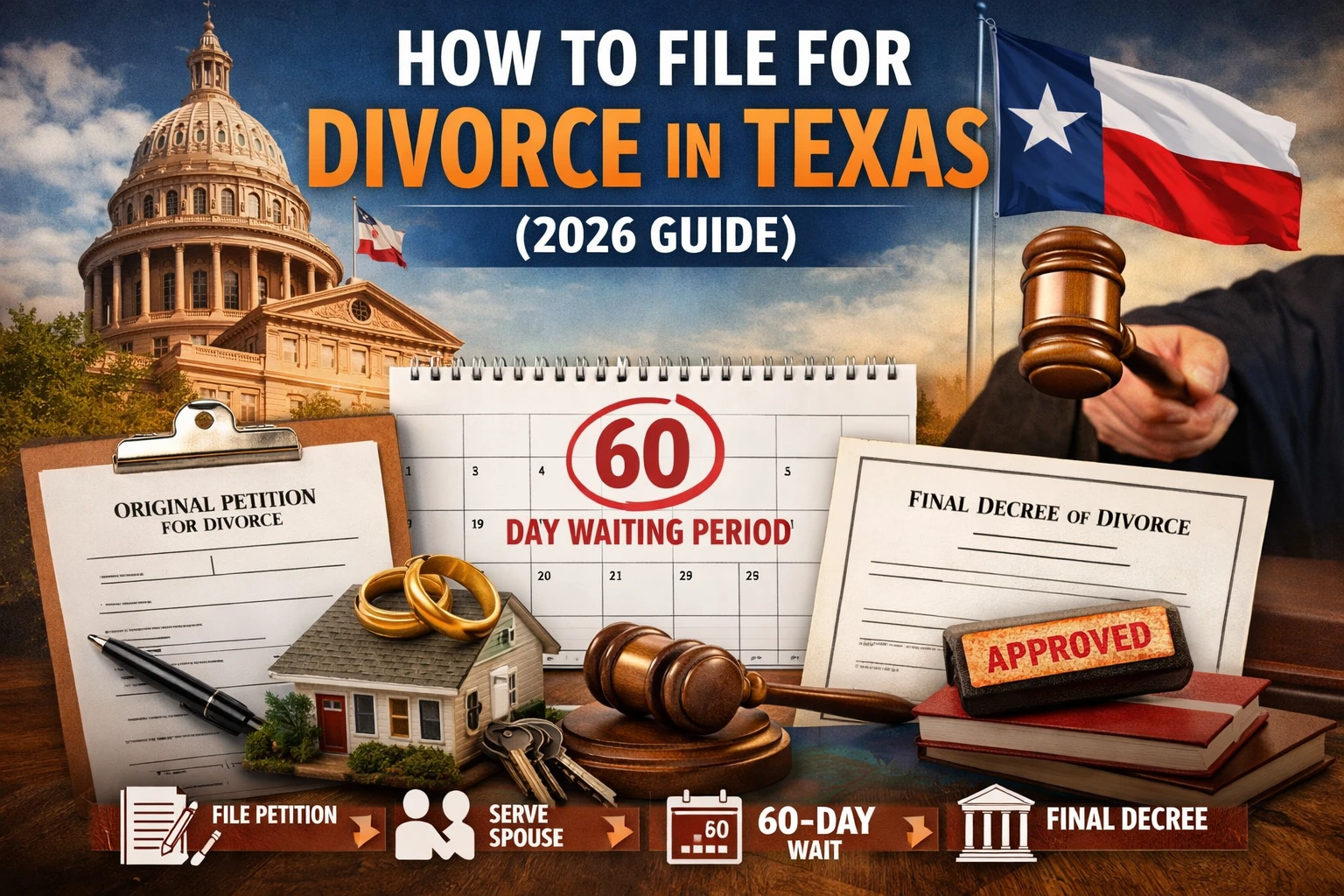
A typical agreed case begins with filing the Original Petition for Divorce in the appropriate county. Texas generally requires a 60-day waiting period from the date of filing before the divorce can be finalized, unless a limited exception applies. During that time, spouses can confirm property values, collect account statements, decide how to handle debts, and prepare the final documents.
The Final Decree of Divorce should reflect the agreement accurately. Before signing, each spouse should read every property and debt provision, including account numbers, deadlines, legal descriptions of real estate when needed, and any language requiring deeds, vehicle title transfers, or retirement orders.
If you and your spouse agree but feel overwhelmed by the forms and filing process, document preparation support can help keep an uncomplicated case organized. Ready Divorce Service assists Texans with the procedural steps and paperwork for agreed divorces, helping clients move forward with greater clarity and fewer costly mistakes.
When an example is not enough
An example agreement is useful for spotting the decisions you still need to make. It is not enough when spouses disagree about whether an asset is separate property, cannot agree on the value of a business, have significant investments, face bankruptcy concerns, or suspect hidden assets or debt. Those situations may call for individualized legal advice before anyone signs a final decree.
Even in a straightforward case, do not rush past the details because the divorce feels emotionally settled. Take the time to list every account, loan, vehicle, piece of real estate, and retirement benefit. A clear agreement gives both spouses something valuable after divorce: a practical path to separate their finances and begin the next chapter with fewer loose ends.
📞 Get Started Today – Your Peaceful Divorce Is Just a Click Away
When you’re ready to move on, we’re ready to help.
📲 Call us now at (800) 432-0018
🖥️ Start your divorce online today