Table of Contents
- Simple Texas Divorce vs Affordable Divorce: What’s the Real Difference?
- Uncontested Divorce Texas Cost: Breaking Down Your Expenses
- DIY Divorce Texas: Self-Representation and Risk Assessment
- Texas Divorce Laws: Requirements for an Uncontested Divorce
- Texas Divorce Waiting Period: Timeline and Process
- Mediation and Settlement: The Affordable Path Forward
- Choosing Your Path: DIY Kits, Document Services, or Attorney Help
- Low-Income Assistance and Affordable Divorce Options
Last Updated: August 1, 2026
When facing a divorce in Texas, couples often encounter two distinct paths: the simple texas divorce vs affordable divorce distinction that can significantly impact both their timeline and financial burden. At Ready Divorce Service, we help Texas residents navigate this critical choice by breaking down exactly what separates these two approaches and which option makes sense for your specific situation.
Simple Texas Divorce vs Affordable Divorce: What’s the Real Difference?
A simple Texas divorce typically refers to an uncontested divorce where both spouses agree on all major issues: property division, debt allocation, spousal support, and child custody arrangements. An affordable divorce emphasizes cost-effectiveness through DIY document preparation, mediation, or online document services rather than hiring a full-service attorney.
The critical distinction: simple addresses the nature of the divorce (uncontested), while affordable addresses the method of handling it (cost-conscious). You can have a simple divorce that’s expensive if you hire a traditional attorney, or an affordable divorce that’s complex if you use a document service for a contested case, though the latter is generally not recommended. The best outcome combines both: an uncontested (simple) divorce handled through an affordable method like mediation or document preparation services.
Simple = uncontested agreement on all issues. Affordable = cost-effective method of handling the divorce. The best outcome combines both elements.
Comparison Table: At a Glance
| Aspect | Simple Texas Divorce | Affordable Divorce Path |
|---|---|---|
| Definition | Both spouses agree on all major issues | Cost-focused approach to divorce filing |
| Contested vs. Uncontested | Always uncontested | Can be either (though affordable works best for uncontested) |
| Typical Cost Range | Varies by method used | Generally lower than traditional litigation |
| Timeline | 60+ days (waiting period) | 60+ days (waiting period) |
| Best For | Couples with full agreement | Budget-conscious individuals and couples |
| Risk Level | Low (if properly documented) | Medium to high (depends on method and complexity) |
| Professional Help | Optional (mediation or attorney) | Often DIY or document service-based |
| Court Involvement | Minimal (final hearing required) | Minimal if uncontested |
Uncontested Divorce Texas Cost: Breaking Down Your Expenses
The total cost of an uncontested divorce in Texas breaks down into several distinct categories. Understanding these components helps you anticipate your true out-of-pocket expense.
Court Filing Fees and Government Costs
Texas courts charge filing fees that vary slightly by county but fall within a predictable range. According to Texas Judicial Branch court fee schedules, county courts assess fees for divorce petitions. These government costs are non-negotiable and the same whether you hire an attorney, use a document service, or file pro se (representing yourself). If you qualify for fee waivers due to low income, you can request one from the court clerk.
Document Preparation and Service Fees
This is where the simple texas divorce vs affordable divorce distinction becomes financially meaningful. If you prepare documents yourself using free Texas court forms, your cost is zero beyond the filing fee. If you use an online document service, you’ll pay a flat fee for professionally prepared, court-compliant documents.
3StepDivorce charges a flat fee of $299 for Texas divorce documents, with flexible payment plans available ($84/month for 4 months, $109/month for 3 months, or $157/month for 2 months). LegalZoom charges $499 for state-specific divorce documents plus legal guidance. Rocket Lawyer offers subscription access starting at $39.99/month with access to document templates and attorney consultations.
If you use a document service, verify it includes a court-acceptance guarantee. Many services will revise documents for free if the court initially rejects them, which provides valuable protection for your investment.
Attorney vs. Self-Help Resource Costs
Hiring a full-service divorce attorney for an uncontested case typically costs significantly more than document services or DIY approaches. Traditional attorneys often charge either hourly rates or flat fees for uncontested divorces. Ready Divorce Service specializes in document preparation and guidance for uncontested Texas divorces, focusing on accuracy and compliance without the overhead costs of traditional legal representation.
DIY Divorce Texas: Self-Representation and Risk Assessment
Filing for divorce pro se (without an attorney) is legal in Texas and technically free beyond court fees. However, the apparent cost savings mask real risks that can become expensive if mistakes occur.
When DIY Works: Eligibility and Ideal Scenarios
DIY divorce works best when all of these conditions are true: both spouses have reached complete agreement on all issues; there are no minor children, or custody/support is fully agreed; community property division is straightforward with no disputed assets; neither spouse is seeking spousal maintenance, or this is agreed; both spouses understand Texas divorce law requirements; and both spouses are willing to cooperate throughout the process.
You’ll need access to current Texas court forms, available free from the Texas Judicial Branch website. However, one common mistake derails many DIY divorces: using outdated forms or forms designed for a different county. Texas courts are particular about form compliance.
Common Mistakes and Risk Factors in Self-Representation
The most frequent DIY errors include incomplete property division disclosures, improper service of process, missing required signatures or notarizations, and incorrect calculation of the 60-day waiting period. Many people underestimate the complexity of property division. Texas is a community property state, meaning property acquired during the marriage belongs equally to both spouses regardless of who earned it or whose name is on it. Failing to properly account for all community property can result in an incomplete divorce decree that requires modification later.
If [your divorce](/after-your-divorce-is-final/) documents are rejected by the court, you’ll need to refile, pay additional filing fees, and restart the 60-day waiting period. This can add months and hundreds of dollars to your process. Document services often include free revisions if rejection occurs, making them worth the upfront cost for error prevention.
Post-Filing Expectations: What Happens After You Submit
After you file your divorce petition, your spouse must be served with the documents. If they agree and sign the necessary paperwork, your case remains uncontested. Texas law requires a 60-day waiting period from the date of filing before a divorce can be finalized. After this period expires, you typically attend a final hearing before a judge. In an uncontested case, this hearing is often brief. The judge reviews your documents to ensure compliance with Texas law, then signs the divorce decree. The total timeline from filing to final decree is typically 60-90 days for uncontested divorces.
Texas Divorce Laws: Requirements for an Uncontested Divorce
Texas divorce law establishes specific eligibility requirements that must be met before you can file, regardless of whether you’re pursuing a simple texas divorce vs affordable divorce approach.
Residency Requirements and Eligibility
To file for divorce in Texas, at least one spouse must have been a resident of Texas for at least six months immediately before filing, and you must file in the county where you’ve been a resident for at least 90 days. You must be legally married. If your marriage is void (never legally valid), you cannot file for divorce; you’d need to file for annulment instead.
Agreement on All Major Issues
For an uncontested divorce to proceed smoothly, you and your spouse must have reached written agreement on all material issues: division of all community property and debt, custody and support arrangements for any minor children, and whether either spouse will receive spousal maintenance. This agreement must be documented in a marital settlement agreement, which becomes part of your divorce decree and is legally binding. If you and your spouse cannot reach agreement on any major issue, your divorce becomes contested and typically costs significantly more.
Texas Divorce Waiting Period: Timeline and Process
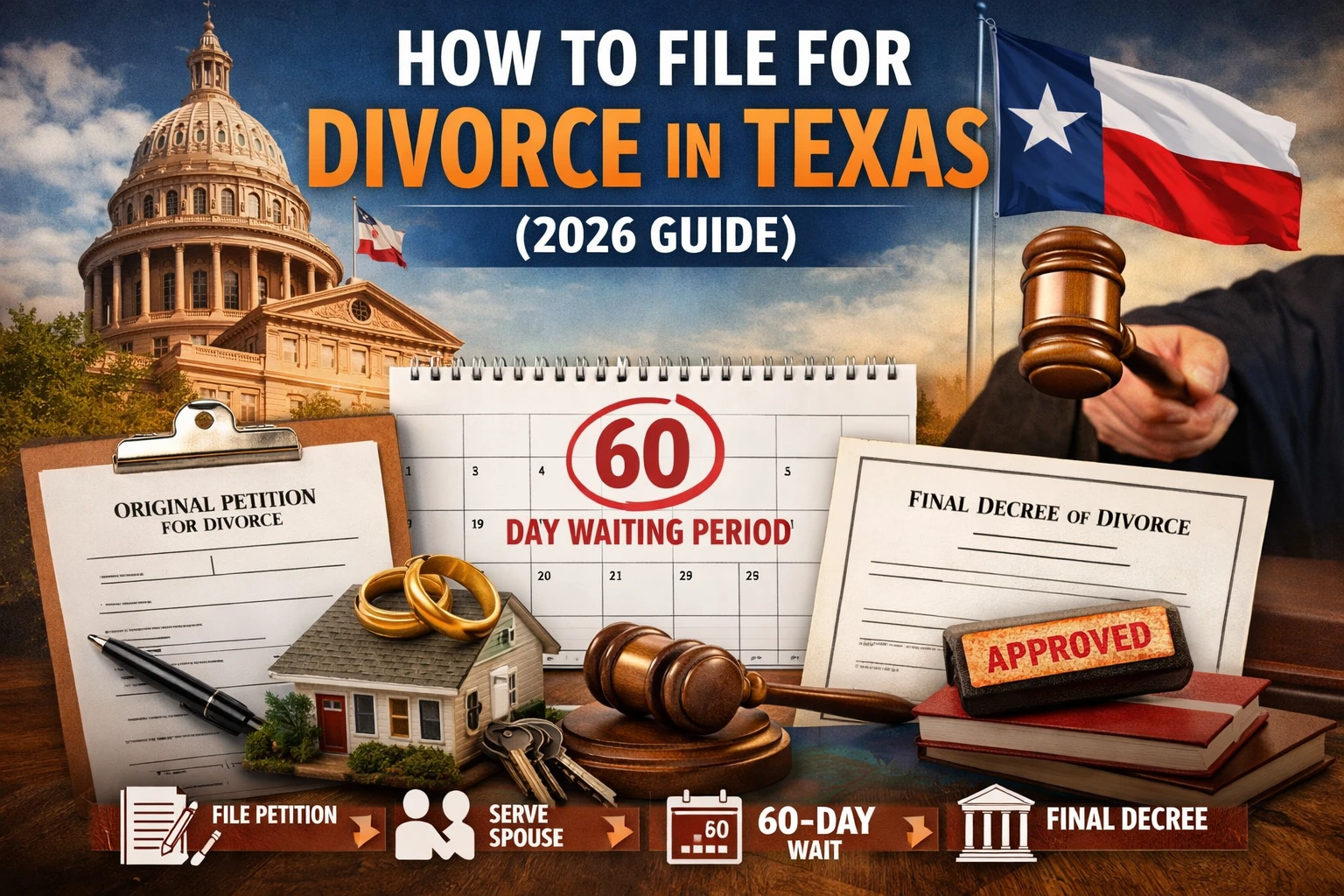
The 60-day waiting period is a mandatory component of Texas divorce law that applies to all divorces.
The 60-Day Waiting Period Explained
Texas Family Code Section 6.702 requires a mandatory 60-day waiting period from the date the divorce petition is filed until the divorce can be finalized. This waiting period cannot be waived except in cases of family violence. The waiting period begins on the date you file your petition, not the date your spouse is served. During this 60-day period, you and your spouse should finalize all settlement agreements.
Final Hearing and Decree Timeline
After the 60-day waiting period expires, you can request a final hearing. In an uncontested divorce, you typically schedule this hearing with the court clerk. Some courts allow you to submit documents for the judge’s signature without appearing in person; others require at least one spouse to appear. The judge reviews your divorce decree to confirm it complies with Texas law, then signs the decree. The total timeline from filing to finalization is typically 60-90 days for straightforward uncontested divorces.
Mediation and Settlement: The Affordable Path Forward
Mediation is one of the most effective ways to achieve an affordable divorce while ensuring both spouses’ interests are protected. A trained mediator facilitates discussions between you and your spouse about property division, custody, support, and other divorce terms. The mediator doesn’t make decisions for you; instead, they help you both communicate effectively and find mutually acceptable solutions.
This process costs significantly less than litigation because it avoids the expense of separate attorneys and court battles. Mediation also tends to produce better long-term outcomes. When both spouses participate in creating the settlement, they’re more likely to comply with it afterward.
A successful mediation results in a written settlement agreement that addresses all material issues in your divorce. This agreement becomes the basis for your divorce decree. The settlement agreement must be comprehensive, addressing property division, debt allocation, custody and visitation arrangements if minor children are involved, child support calculations, and spousal maintenance if applicable.

Choosing Your Path: DIY Kits, Document Services, or Attorney Help
Your choice among these three approaches depends on your comfort level with legal documents, your financial situation, the complexity of your case, and your risk tolerance.
Divorce Kit and Self-Help Resources in Texas
Texas offers free self-help resources through the Texas Judicial Branch and local legal aid organizations. These include court-approved divorce forms, instructional guides, and sometimes free or low-cost legal clinics. Using these resources, you can prepare your own divorce documents at minimal cost. The advantage is clear: you save money on professional services. The disadvantage is equally clear: you’re responsible for ensuring accuracy and compliance with all Texas legal requirements.
Professional Document Preparation Services
Document preparation services like 3StepDivorce and LegalZoom occupy a middle ground. They charge a flat fee to prepare your documents based on information you provide. These services ensure your documents are formatted correctly and comply with Texas court requirements. The advantage is that professional preparation significantly reduces the risk of court rejection. Many services include a court-acceptance guarantee. The limitation is that these services don’t provide legal advice. They’re best suited for straightforward cases where both spouses have already negotiated all terms.
Ready Divorce Service provides document preparation with step-by-step guidance through the Texas divorce process, ensuring your filing is completed in full compliance with state law.
When to Hire Legal Representation
You should consider hiring an attorney if your case involves complexity: significant assets, business ownership, substantial debt, disputed child custody, or concerns about hidden assets. You should also hire an attorney if your spouse is uncooperative, if you suspect your spouse won’t honor a settlement agreement, or if you feel pressured or unsafe.
Low-Income Assistance and Affordable Divorce Options
Texas recognizes that divorce costs can be prohibitive for low-income individuals. Legal aid organizations in Texas provide free or reduced-cost legal services to eligible low-income individuals. According to State Bar of Texas Lawyer Referral Service, you can find local legal aid providers through the State Bar website. Court fee waivers are available if you cannot afford filing fees. You can request a waiver by filing an affidavit of indigency with the court. Some document preparation services offer payment plans or reduced rates for low-income filers. Cost should not prevent you from obtaining a divorce. Resources exist to help low-income Texans navigate the process affordably.
Navigating a simple texas divorce vs affordable divorce choice doesn’t have to be overwhelming. The right path depends on your specific situation, your level of agreement with your spouse, your financial constraints, and your comfort with legal processes. Ready Divorce Service helps you move through this decision by providing expert guidance and document preparation that ensures your filing is accurate and compliant with Texas law. Whether you choose DIY, a document service, or legal representation, the goal is the same: a finalized divorce that protects your interests and allows you to move forward. Start by reviewing Texas Family Code requirements and honestly assessing your situation. Then reach out to Ready Divorce Service for a consultation to determine which approach makes sense for your circumstances.
Frequently Asked Questions
What is the difference between a simple divorce and an affordable divorce in Texas?
A ‘simple’ divorce typically refers to an uncontested divorce where both spouses agree on all terms, asset division, child custody, and support. An ‘affordable’ divorce emphasizes cost-effectiveness through DIY kits, document preparation services, or mediation rather than hiring a traditional attorney. A divorce can be both simple and affordable, or simple but expensive (if you hire an attorney), or complex but made more affordable through mediation. The key distinction is whether you’re describing the process complexity or the cost approach.
How much does an uncontested divorce in Texas cost compared to hiring an attorney?
Uncontested divorce Texas cost varies significantly by approach. Court filing fees alone are a fixed government expense. DIY divorce kits and online document preparation services (like 3StepDivorce) offer flat-fee options starting around $299, while services like LegalZoom charge around $499. Traditional attorney representation typically costs substantially more due to hourly rates or flat fees for contested cases. For current pricing on Ready Divorce Service’s document preparation and guidance, visit their website for a personalized quote based on your specific situation.
What are the main risks of DIY divorce in Texas, and when should I hire help?
Common mistakes in DIY divorce Texas include incomplete paperwork, incorrect legal language, missing required signatures, and improper service of documents, any of which can cause court rejection and delays. You should consider professional help if you have minor children, significant assets, real property, debt disputes, or spousal maintenance concerns. Even in uncontested situations, a document preparation service or brief attorney consultation can catch errors before filing. Post-filing expectations include the 60-day waiting period and a final hearing; mistakes discovered late are expensive to fix.
What is the Texas divorce waiting period, and how does it affect my timeline?
Texas requires a 60-day waiting period from the date the divorce petition is filed before a divorce decree can be finalized. This period cannot be waived, even in uncontested cases. During this time, both spouses must receive proper notice (waiver of service can speed this up), and you’ll prepare your final divorce decree and settlement agreement. A final hearing occurs after the waiting period ends. Total timeline from filing to final decree typically ranges from 2-4 months for uncontested divorces, depending on court scheduling and document accuracy.
Can I use an online divorce kit if my situation involves minor children or shared property?
Yes, but with caution. Online divorce kits and document services can handle cases with minor children and shared property, provided both spouses fully agree on custody, child support, asset division, and debt allocation. However, these situations require precise legal language regarding parenting plans, community property characterization, and child support calculations to comply with Texas divorce laws. If either spouse disputes any term, or if you’re uncertain about property division or child custody arrangements, professional guidance, whether through mediation or a document preparation service, is strongly recommended to avoid costly errors.
📞 Get Started Today – Your Peaceful Divorce Is Just a Click Away
When you’re ready to move on, we’re ready to help.
📲 Call us now at (800) 432-0018
🖥️ Start your divorce online today