Table of Contents
- Understanding Texas Divorce Eligibility and Residency Requirements
- Preparing Your Financial Documents and Property Division
- Filing the Original Petition for Divorce
- Understanding Divorce Filing Fees and Cost Breakdown
- Navigating the Pro Se Divorce Process Without an Attorney
- How Long Does a Divorce Take in Texas: Timeline and Waiting Periods
- Service of Process, Court Procedures, and Final Decree
- Common Mistakes to Avoid When Filing for Divorce
Last Updated: August 14, 2026
Understanding Texas Divorce Eligibility and Residency Requirements
Before filing for divorce in Texas, either you or your spouse must have lived in Texas for at least six months, and you must have lived in the county where you’re filing for at least 90 days. This ensures Texas courts have proper jurisdiction over your case.
Texas recognizes only no-fault divorce grounds. The standard ground is "insupportability," meaning the marriage has become insupportable because of discord or conflict that makes it impossible to continue the relationship. This is the most straightforward path for uncontested divorces, where both parties agree to end the marriage.
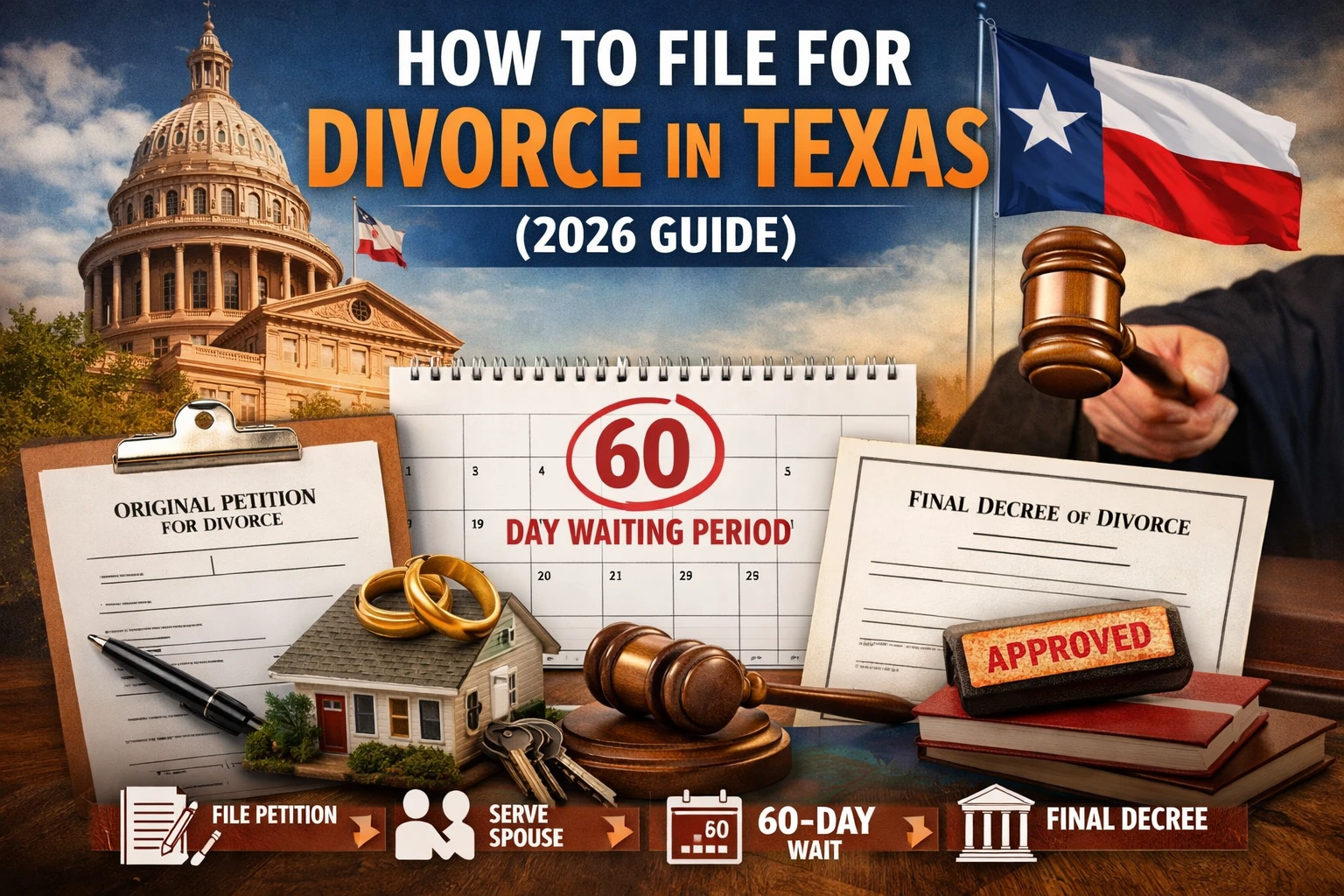
If you’ve been married for less than two years, Texas law requires a 60-day waiting period from the date you file the original petition until the court can grant your final decree. For longer marriages, the waiting period still applies unless both spouses waive it in writing.
Ready Divorce Service helps clients verify their eligibility before filing, ensuring you meet all residency requirements and understand the grounds for divorce.
Check your residency dates carefully. If you’re unsure whether you’ve lived in Texas or your county long enough, contact the county clerk’s office before filing. A residency mistake can result in your petition being rejected and having to refile.
Preparing Your Financial Documents and Property Division
Gathering your financial documents before filing is one of the most important steps in the divorce process. You’ll need bank statements, investment account records, retirement account statements, mortgage documents, property deeds, vehicle titles, credit card statements, and any documentation of debts. These documents form the foundation for property division under Texas community property law.

Texas is a community property state, meaning most property acquired during the marriage is divided equally between spouses. Separate property, assets owned before marriage or received as a gift or inheritance, remains with the spouse who owns it. Accurately identifying which assets are community property and which are separate property is essential for a fair division.
Create a comprehensive inventory of all marital assets and debts, including approximate values, acquisition dates, and how each is titled. For real estate, gather the property deed and recent appraisal if available. For vehicles, collect titles and current market values. For retirement accounts, obtain statements showing current balance and vesting information.
A common mistake is failing to account for all debts. Both spouses are typically responsible for debts incurred during the marriage. Request a free credit report from AnnualCreditReport.com, the official government resource to ensure nothing is missed.
Ready Divorce Service guides you through organizing these documents in a format that’s clear for both you and the court. Proper documentation prevents disputes during property division and speeds up the overall timeline.
The more complete your financial documentation is before filing, the faster your divorce will be processed and the fewer disputes will arise over property division.
Filing the Original Petition for Divorce
The original petition for divorce is the formal legal document that initiates your divorce case. This document states your grounds for divorce, identifies both spouses, describes any minor children, and outlines your requests regarding property division, custody, and support.

When filing with the county district court, you must include your name and address, your spouse’s name and address, the date and place of your marriage, the grounds for divorce (insupportability), and details about any children under 18. If you have minor children, you’ll also need to file a Suit Affecting the Parent-Child Relationship (SAPCR), which addresses custody, conservatorship, possession and access, and child support.
The petition must be filed in the correct county district court, generally where you or your spouse lives, or where the children primarily reside. After filing, you’ll receive a case number and court date. In an uncontested divorce, your spouse will need to acknowledge receipt of the petition through a waiver of service or formal service of citation.
Many people make mistakes when filing without professional guidance, including incomplete information, missing required forms, incorrect legal descriptions of property, or failure to include all required disclosures. Ready Divorce Service ensures your petition is accurate and complete before submission, reducing the risk of rejection or delays.
Understanding Divorce Filing Fees and Cost Breakdown
Court filing fees in Texas vary by county but typically range based on the county’s fee schedule. Beyond the court filing fee, you may encounter costs for service of process if your spouse doesn’t voluntarily accept service, document preparation costs if you use a service like Ready Divorce Service, and potential mediation costs if required by the court.
Court filing fees are non-refundable, even if your divorce is dismissed or contested later. Some counties offer an indigency affidavit for individuals who cannot afford the filing fee, allowing you to request a waiver or payment plan.
When comparing total divorce costs, consider what’s included in your approach. A do-it-yourself filing saves on professional fees but risks costly mistakes. An uncontested divorce with professional document preparation through Ready Divorce Service provides expert guidance and accuracy at a fraction of the cost of traditional litigation. Full litigation with attorneys can cost significantly more due to hourly legal fees, court appearances, and extended discovery.
Ready Divorce Service helps you understand your options and realistic costs associated with each path.
Never attempt to minimize costs by filing incomplete or inaccurate documents. A rejected petition means refiling fees, court delays, and potential complications that cost far more than getting it right the first time.
Navigating the Pro Se Divorce Process Without an Attorney
A pro se divorce means you represent yourself without an attorney. In Texas, this is legal for uncontested divorces where both spouses agree on all terms. However, navigating the legal process without professional guidance requires careful attention to detail and clear understanding of Texas family law requirements.
When filing pro se, you’re responsible for preparing all required documents, filing them correctly, meeting all deadlines, and ensuring compliance with court rules. The court will not provide legal advice or help you prepare documents, but court clerks can answer procedural questions about filing requirements and deadlines.
The pro se divorce process involves several key steps: preparing the original petition for divorce, filing it with the court, ensuring your spouse receives proper service of citation, completing discovery if required, potentially attending mediation, and appearing at the final hearing to present your agreed-upon divorce decree to the judge.
Many people choose pro se divorce to save money, but the process requires significant time investment and carries real risk of mistakes. Common errors include failing to properly serve the respondent, missing court deadlines, omitting required forms, or creating an agreement that doesn’t comply with Texas law. These mistakes often result in dismissal or the need to refile, ultimately costing more than professional assistance.
Ready Divorce Service bridges the gap between full pro se representation and hiring a traditional attorney. We provide expert guidance on the pro se divorce process, ensure your documents are accurate and complete, and help you understand each step.
If you choose pro se divorce, create a checklist of all required documents and deadlines. Missing even one form or deadline can delay your entire case by months.
How Long Does a Divorce Take in Texas: Timeline and Waiting Periods
Understanding the timeline for divorce in Texas helps you plan realistically. The minimum time from filing to final decree is 60 days if both spouses agree to waive the waiting period, but most uncontested divorces take 90 to 120 days from filing to completion.
The 60-day waiting period begins on the date you file the original petition. During this time, both spouses must be served with the petition, discovery must be completed if applicable, and any required mediation must occur. The court cannot grant your final decree until 60 days have passed, even if everything is agreed upon and ready earlier.
If you have minor children, the timeline may be longer because the court may require additional proceedings related to the SAPCR. Child custody determinations and child support calculations require careful consideration, and the court may order mediation to help parents reach agreement.
An uncontested divorce with professional document preparation typically follows this timeline: filing takes 1-2 weeks, service of process takes 2-3 weeks, the waiting period runs 60 days, and final hearing and decree issuance takes 1-2 weeks. This results in approximately 90 to 120 days from start to finish.
Service of Process, Court Procedures, and Final Decree
Service of process means officially notifying your spouse that a divorce petition has been filed. In an uncontested divorce, your spouse may sign a waiver of service, which acknowledges receipt and waives formal service requirements. This speeds up the process considerably.
If your spouse doesn’t sign a waiver, you must arrange for formal service of citation, typically by hiring a process server or sheriff’s deputy to deliver the citation and petition in person. The process server then files an affidavit with the court proving service was completed.
Once service is complete, both spouses have a period to respond. In an uncontested divorce, the respondent typically files a response agreeing to the terms outlined in the original petition.
Discovery is the process of exchanging financial information and other relevant documents between spouses. In an uncontested divorce, discovery is often simplified because both parties are cooperating. Many courts require mediation before proceeding to trial, even in uncontested cases.
The final decree of divorce is the court’s official order that ends your marriage. This document includes the division of property and debt, custody and support arrangements if applicable, and any other court orders. The judge must sign the final decree, which typically happens at a final hearing where you present your agreed-upon terms to the court.
Ready Divorce Service ensures all procedural requirements are met, from proper service of process to accurate preparation of the final decree.
Common Mistakes to Avoid When Filing for Divorce
Filing for divorce requires precision, and even small mistakes can cause significant delays. One of the most common errors is incomplete or inaccurate information on the original petition. Missing details about assets, debts, or children can result in rejection or require amendments that delay your case.
Another frequent mistake is failing to serve your spouse correctly. If service of citation isn’t completed properly or documented accurately, the court may dismiss your case because proper jurisdiction hasn’t been established.
Many people underestimate the importance of financial documentation. Failing to gather complete bank statements, property deeds, and debt records leads to incomplete property division agreements and potential disputes later.
A critical error is not understanding Texas community property law. Some people attempt to divide property in ways that don’t comply with state law, which can result in the court rejecting their agreement or ordering a different division.
Missing court deadlines is another costly mistake. If you fail to file required documents or appear at scheduled hearings, the court may dismiss your case or enter a default judgment against you. Create a calendar of all deadlines and set reminders well in advance.
Some individuals attempt to hide assets or income to avoid fair division. This is illegal and can result in severe penalties, including contempt of court charges. Full disclosure of all assets and debts is required by law.
Many pro se filers also make mistakes with the SAPCR if they have minor children. Failing to include proper child support calculations or custody arrangements that comply with the child support guidelines can result in rejection or modification by the court.
Ready Divorce Service helps you avoid these common pitfalls by reviewing your documents before filing, ensuring compliance with all legal requirements, and guiding you through each step of the texas divorce filing process.
Filing for divorce in Texas doesn’t have to be overwhelming. Whether you’re navigating an uncontested divorce on your own or seeking professional guidance, understanding the process, requirements, and timeline is essential. Ready Divorce Service specializes in helping Texas residents complete the texas divorce filing process accurately and affordably, with step-by-step guidance that ensures your documents comply with state law and your case moves forward without unnecessary delays. Get started with Ready Divorce Service today and take control of your divorce with confidence and clarity.
Frequently Asked Questions
What are the residency requirements to file for divorce in Texas?
To file for divorce in Texas, either you or your spouse must have been a resident of the state for at least six months, and you must have lived in the county where you're filing for at least 90 days. These residency requirements ensure the court has jurisdiction over your case. If you meet these requirements, you can proceed with filing the original petition for divorce in your county district court.
How much does it cost to file for divorce, and are there hidden fees?
Divorce filing fees vary by county but typically range from $200 to $500 for the initial filing. Additional costs may include service of process fees, certified copy fees, and mediation costs if required. An indigency affidavit can waive filing fees if you qualify based on income. For exact pricing and a complete cost breakdown tailored to your situation, contact Ready Divorce Service directly to discuss your specific needs and get a transparent quote.
What is the pro se divorce process, and can I handle it without an attorney?
Pro se means representing yourself without a lawyer. In Texas, you can file for an uncontested divorce pro se by completing the required forms accurately, filing them with the court clerk, serving your spouse with citation, and following all court procedures. Many individuals successfully navigate the pro se divorce process when both spouses agree on terms. However, accuracy is critical, errors can delay your case or result in rejection. Ready Divorce Service provides expert guidance and document preparation to ensure your pro se filing is compliant with Texas law.
How long does a divorce take in Texas from filing to final decree?
Texas law requires a 60-day waiting period from the date you file the original petition before the court can grant a final decree of divorce. For uncontested divorces where both parties agree on all terms, the process typically takes 60 to 90 days total. Contested divorces can take significantly longer, often six months to over a year, depending on discovery, mediation, and court scheduling. The timeline depends on how quickly you serve your spouse, whether issues are resolved, and court availability.
This article was written using GrandRanker