Texas Uncontested Divorce Process

0 Comments

An uncontested divorce in Texas is the fastest and simplest way to end a marriage—but it still must follow a specific legal process.

Even when both spouses agree, the case must be filed with the court, processed by the district clerk, and approved by a judge before it becomes final.

Many uncontested divorce cases are delayed or rejected due to small mistakes in paperwork, missing required language, or improper service. Understanding the process from start to finish helps avoid those issues and keeps your case moving forward.

What Is an Uncontested Divorce?

In relation to an uncontested divorce being understood as an agreed divorce, both parties agree on all of the terms of the divorce. In these cases, both spouses are willing to sign an agreement stating that they are willing to skip the trial process that typically occurs before a judge. If you are able to file for an agreed divorce in this manner, it can mean that your divorce can be more affordable and faster than going the traditional route.

Are you wondering how much it costs to get an uncontested divorce in Texas? Take a look at this article about the Cost of Uncontested Divorce in Texas.

In relation to the term meaning the divorce is granted by default, this means that the Respondent never filed an answer, and the divorce was, therefore, granted to the Petitioner without the involvement of the Respondent.

It may appear that using the same phrase to describe these various divorce outcomes would lead to confusion. In reality, though, both agreed and default divorces are technically uncontested. In the case of default divorces, the Respondent does not respond and so does not challenge the divorce.

The process for an uncontested divorce is the same regardless of where the person filing lives in Central Texas, Coastal Texas, North Texas, East Texas, South Texas, or West TexasThe procedure and process of divorce under Texas Family Code Section 6 is the same no matter what county the filer may reside.

Step-by-Step Texas Uncontested Divorce Process

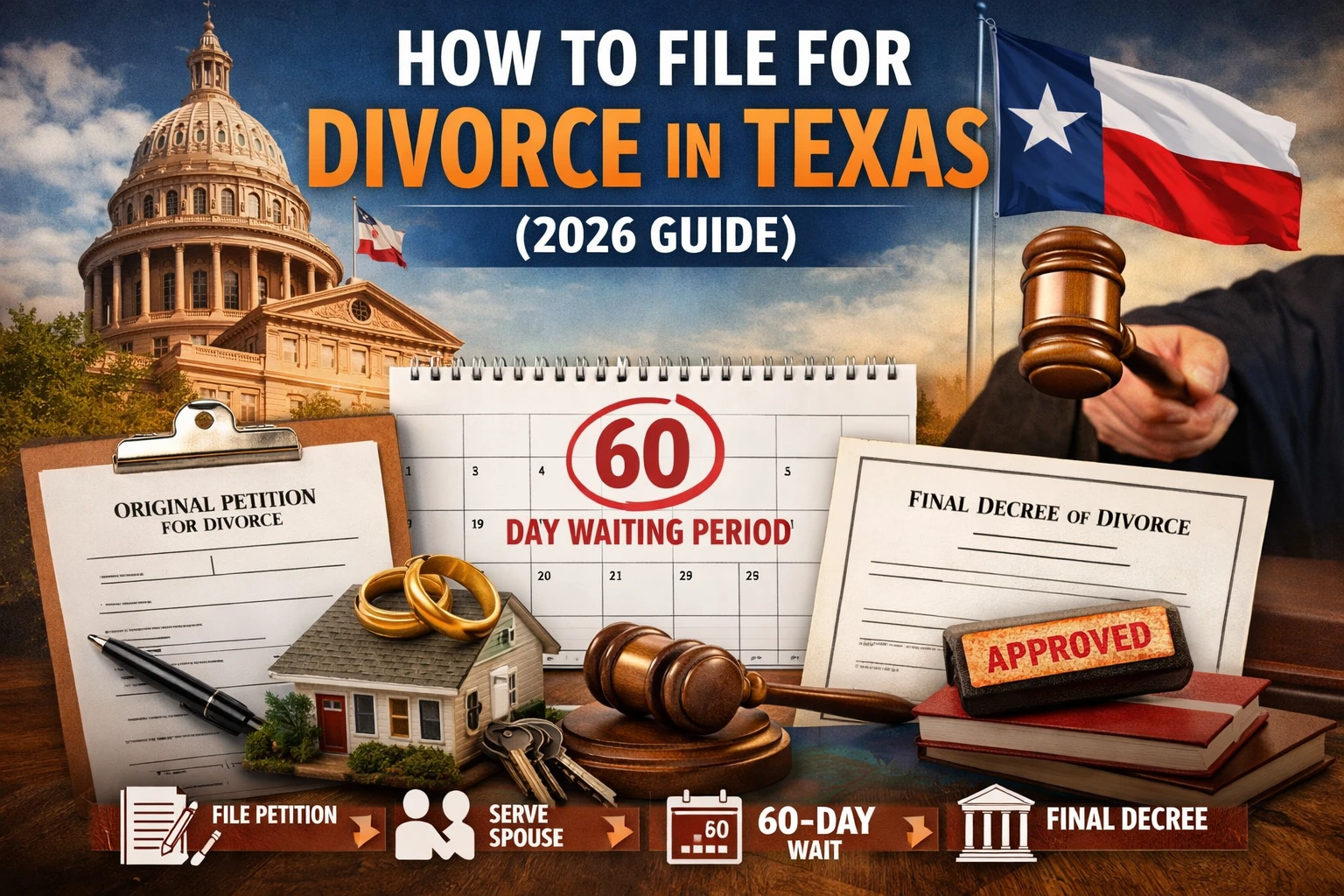
Step 1: File the Original Petition for Divorce

The process begins when one spouse files the Original Petition for Divorce with the district clerk in the appropriate Texas county.

Step 2: Notify Your Spouse

The other spouse must be formally notified. In uncontested cases, this is typically done through a Waiver of Service, avoiding the need for formal service.

Step 3: Agreement on All Terms

Both spouses must agree on:

Step 4: Complete the Final Decree of Divorce

The Final Decree outlines all terms of the agreement and must meet Texas legal requirements before a judge will sign it.

Step 5: Wait the 60-Day Waiting Period

Texas law requires a minimum 60-day waiting period before a divorce can be finalized.

Step 6: Finalize the Divorce

After the waiting period, the case is finalized through:

  • a short prove-up hearing, or
  • submission without a hearing (depending on the court)

Once signed by the judge, the divorce is official.

Divorce Process

What Happens After You File for Divorce in Texas

After filing, your case is assigned to a court and handled through the court system.

From that point forward:

  • documents are reviewed by the clerk
  • filings must meet court requirements
  • the judge reviews the Final Decree before signing

Even uncontested cases must meet all legal standards before they are approved.

What are Criteria to Getting an Uncontested Divorce?

If you want to get an uncontested divorce because you and your spouse agree on all of the terms, there are some criteria you will need to meet. These include:

  • Both of you agree to dissolve the marriage
  • Both of you agree on the reason (grounds) for the divorce
  • There aren’t any court orders for support or custody that are already in place
  • Both of you agree on all divorce-related issues, including child support and custody

If there has been a final order issued by the court in regard to child custody and support, you can request an agreed divorce if you meet the following criteria:

  • Neither spouse desires to change the order
  • The final court order is not a protective order or a temporary order
  • The final court order includes all of the children that you and your spouse have had together

You cannot get an uncontested divorce if you are filing for divorce on fault-based grounds. Instead, you will need to file using one of the two no-fault reasons for divorce under Texas law. These are insupportability or living apart.

You will need to file for a traditional divorce if you don’t meet the above criteria.

An agreed divorce is a type of uncontested divorce, where both parties agree to all of the terms of the divorce. The terms “uncontested divorce” and “agreed divorce” are often used synonymously in Texas. In many instances, you will find that these phrases are used completely interchangeably. When this occurs, both phrases refer to the fact that the divorce occurred with both spouses agreeing on all of the divorce-related issues and are willing to sign an agreement in order to skip the trial process that occurs before a judge. In the case of contested divorces, it's important to understand that people can be driven to extremes in stressful situations. If your spouse does not want to divorce, for example, you may witness a side of them that you have never seen before, such as their constant attempts to sabotage the process. It's a good idea to be familiar with some of the most typical sneaky divorce methods so you know what to look out for.
If your spouse never responds to being served with papers and cannot be located, you can still get a divorce in the form of a default divorce. This is also a type of uncontested divorce. You will sometimes find the term “uncontested divorce” used in relation to a default divorce. A default divorce is when the Respondent fails to respond to the divorce petition. In these cases, the divorce can move forward without the input of the spouse that failed to respond.
In an agreed or uncontested divorce, both parties are able to come to an agreement on all of the terms of the divorce and can therefore go through a much simpler divorce process. A contested divorce, on the other hand, is when the spouses aren’t able to agree on one or more of the significant issues involved in a divorce. For example, if spouses can't decide on how they are going to divide their property or whether one spouse should receive alimony from the other, they can’t proceed with the simpler uncontested divorce process. Instead, they will have to go through a traditional divorce where a judge will hold a trial and decide on the contested issues for the spouses. However, contested divorces don’t necessarily have to go to court, either. If spouses are able to come to an agreement through mediation or other methods before it’s time to go to trial, they can avoid the outcome where a judge is making decisions for them.

Fault Vs. No-Fault Divorce in Texas

In the state of Texas, you can either file for a no-fault divorce or a fault-based divorce. A no-fault divorce is when neither party is accusing the other of being responsible for the marriage falling apart. A fault-based divorce is when one or both parties accuse the other of being to blame for the divorce.

If your partner wronged you in some way that legitimately led to the dissolution of your marriage, it is totally understandable to want them to face the consequences of their actions. That being said, the cost of a fault divorce is going to be significantly higher than a no-fault divorce. This type of divorce also typically takes quite a bit longer than a no-fault divorce.

For this reason, you might find that it is more advantageous to you in the big picture to file for a no-fault divorce, even if you have compelling evidence to prove your spouse’s fault.

How Long Does an Uncontested Divorce Take in Texas?

The fastest an uncontested divorce can be completed in Texas is approximately 60–61 days, due to the mandatory waiting period.

However, most cases take longer depending on:

  • how quickly paperwork is completed
  • court scheduling
  • whether corrections are required

Texas Uncontested Divorce FAQ

FAQs Texas Divorce

Can a divorce be finalized in less than 60 days in Texas?

No. Texas law requires a minimum 60-day waiting period in most cases.

Do both spouses have to agree?

Yes. All terms must be agreed upon for the divorce to be uncontested.

Do I have to go to court?

Some cases require a short prove-up hearing, while others may be finalized without a hearing depending on the court.

What happens if paperwork is wrong?

The court may reject or delay the case until corrections are made.

✨ Conclusion: Avoid Mistakes, Protect Your Future

Uncontested divorce can save you time, money, and stress—but only if you approach it carefully. Avoid the common mistakes by preparing thoroughly, communicating clearly, and getting professional assistance when needed.

Ready to start your uncontested divorce the right way?
👉 Contact Ready Divorce Service for affordable, guided help with your Texas divorce paperwork.

📍 Serving Dallas, Tarrant, Harris, Denton, and Collin Counties.

📞 Call (800) 432-0018
🔗 Schedule Your Consultation


Posted on Google Google
Ryan N profile picture
Ryan N
5 September 2026
Google star 1Google star 2Google star 3Google star 4Google star 5
I am truly thankful to have RDS supporting me every step of the way over the past year. Despite hoping for a simple, uncontested process turned into the opposite. Chris helped me navigate my strategy and maintained the pace while everyone else was dragging their feet. RDS made it possible to reach finalization!
Posted on Google Google
J H profile picture
J H
28 July 2026
Google star 1Google star 2Google star 3Google star 4Google star 5
I highly recommend Ready Divorce Service. Chris was extremely helpful and easy to work with. He answered all of my questions and made me feel at ease throughout the entire process. Thank you so much Chris!
Posted on Yelp Yelp
Richard B. profile picture
Richard B.
24 July 2026
Yelp star 1Yelp star 2Yelp star 3Yelp star 4Yelp star 5
I was honestly considering not using an attorney for my divorce, however, at the last minute I found Chris Martin, and I could NOT have dreamed of a better attorney. Chris made my divorce go smoother than I could have imagined, he kept me updated on any changes in my case, and notified me when my ex pulled legal stunts that I would not have known without his expertise. He is easy ro work with, and even easier to talk to. Hell, he will even simplify legal jargon for my simple mind, if you ask him to. This is the best investment I have EVER paid for. Chris, I genuinely thank you for everything you and your team have done for me; you sir, are a godsend. Thank you.
Posted on Facebook Facebook
Monica Fam profile picture
Monica Fam
15 July 2026
positiverecommends
God bless you priest Iyayi for bringing back my ex lover after 2 years of separation, anyone who need help can also reach out to Priest Iyayi Spell
Posted on Google Google
mia madison profile picture
mia madison
10 July 2026
Google star 1Google star 2Google star 3Google star 4Google star 5
Amazing personal service! Fully updated information, reliable updates and communication was on point! Thank you for your service.
Posted on Google Google
Richard Buchanan profile picture
Richard Buchanan
1 July 2026
Google star 1Google star 2Google star 3Google star 4Google star 5
Absolutely Fantastic service. Extremely Professional, affordable, and Chris Martin went out of his way to make sure that the process was explained to me. I HIGHLY recommend his services,
Posted on Google Google
Mayeli Malave profile picture
Mayeli Malave
12 June 2026
Google star 1Google star 2Google star 3Google star 4Google star 5
Attorney Martin made my divorce process much easier and helped me through the hoops and loops that the judge kept giving me. It took longer than expected but it was something out of his control. I would definitely recommend his services to my friends and family!
Posted on Google Google
Luana Donato profile picture
Luana Donato
12 June 2026
Google star 1Google star 2Google star 3Google star 4Google star 5
Great. Just great. Mr. Martin was very knowledgeable and always available during this delicate process. Look no further!
Posted on Google Google
David Ransom profile picture
David Ransom
5 June 2026
Google star 1Google star 2Google star 3Google star 4Google star 5
Chris is very knowledgeable and professional. I'd highly recommend his services. He helped me get the results I was seeking in the courts.
Posted on Google Google
Kiana Smith profile picture
Kiana Smith
2 June 2026
Google star 1Google star 2Google star 3Google star 4Google star 5
The Worlds BEST family law attorney, Chris Martin. He’s gentle in spirit, soft spoken, highly communicative, and follows through on every ask. Chris made my uncontested divorce easy. He explained everything in a way that’s easy to comprehend. No complexities whatsoever! Fees are fair! Payment plans are available. Throughout my entire divorce if I ever had a question on anything Chris was always there. God bless him always. I highly recommend!!! Wish I could do 10/10 stars ⭐️
Verified by Trustindex
Trustindex verified badge is the Universal Symbol of Trust. Only the greatest companies can get the verified badge who has a review score above 4.5, based on customer reviews over the past 12 months. Read more
facebook.com linkedin.com twitter.com
Categories:

Related Posts

Filing Divorce in Texas in 2026 How To File for Divorce in Texas (Step-By-Step Guide 2026)
If you’re searching how to file for divorce in Texas, you’re likely ready to move
how to change your name after a texas divorce 2026 guide 1789091532 1 How to Change Your Name After a Texas Divorce (2026 Guide)
Name change after divorce: Learn how to change your name after a Texas divorce, from
texas uncontested divorce checklist for spouses 1789004825 1 Texas Uncontested Divorce Checklist for Spouses
Use this Texas uncontested divorce checklist for spouses to organize forms, residency, property, and waiting
understanding texas divorce filing fees in 2026 1788832951 1 Understanding Texas Divorce Filing Fees in 2026
Understand Texas divorce filing fees in 2026, including average costs, county variations, and how to