Table of Contents
- What You’ll Need Before Filing for Uncontested Divorce in Texas
- Understanding Texas Uncontested Divorce Forms You’ll Submit
- Step-by-Step: How to File for Uncontested Divorce in Texas
- Uncontested Divorce Texas Timeline: What to Expect
- Do I Need a Lawyer for Uncontested Divorce in Texas?
- Cost of Uncontested Divorce in Texas and Budget Planning
- Common Mistakes to Avoid When Filing Uncontested Divorce
- Post-Filing Logistics: What Happens After You File
How to File for Uncontested Divorce in Texas
Last Updated: July 22, 2026
When you’re ready to move forward with an uncontested divorce in Texas, understanding the filing process can save you months of frustration and thousands in legal fees. In an uncontested divorce, both spouses agree on all major issues before filing, no court battles, no drawn-out litigation. This guide covers everything you need to know about filing for uncontested divorce in Texas, from residency requirements through the final decree.
What You’ll Need Before Filing for Uncontested Divorce in Texas
Residency and Waiting Period Requirements
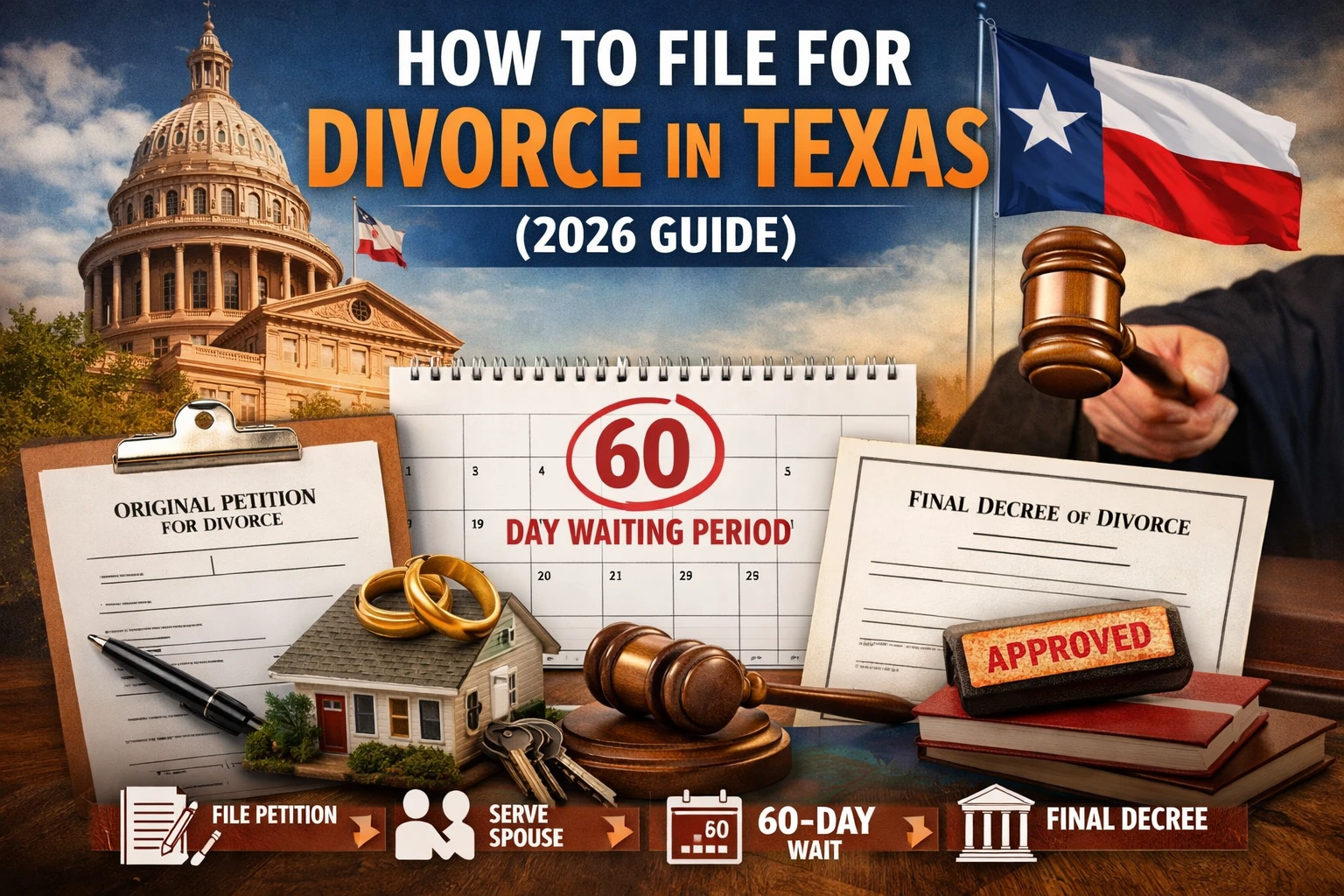
Texas requires that at least one spouse has been a resident of the state for at least six months immediately before filing, and the filing spouse must have lived in the county where you’re filing for at least 90 days. Once you file your Original Petition for Divorce, Texas law imposes a mandatory 60-day waiting period before your divorce can be finalized. This waiting period begins on the filing date and cannot be shortened except in rare circumstances requiring judicial approval.
File your petition early in the week if possible. This gives you a full business day to correct any filing errors before the court clerk’s office closes.
Required Documentation and Information
Before completing your divorce forms, gather:
- Full legal names and Social Security numbers for both spouses
- Driver’s license or identification numbers
- Current addresses for both spouses
- Date of marriage and date of separation
- Names and birthdates of any minor children
- Description of all community property (real estate, vehicles, retirement accounts, bank accounts)
- Details of any debt (mortgages, car loans, credit cards, student loans)
- Current income information for both spouses
- Existing child custody arrangements
- Any prenuptial or postnuptial agreements
If you have minor children, you’ll also need to complete a Suit Affecting the Parent-Child Relationship (SAPCR) as part of your divorce filing.
Understanding Texas Uncontested Divorce Forms You’ll Submit
Original Petition for Divorce and Core Documents
The Original Petition for Divorce initiates your divorce case and tells the court who you are, why it has jurisdiction, and what you’re requesting. For an uncontested divorce, your petition must clearly state that you and your spouse have agreed on all major issues and include a proposed Final Decree of Divorce outlining how community property is divided and addressing custody if applicable.
Core documents in an uncontested Texas divorce filing typically include:
- Original Petition for Divorce
- Final Decree of Divorce (proposed)
- Affidavit of Indigency (if applicable, to waive filing fees)
- Waiver of Service (signed by your spouse)
- Agreed Divorce Judgment or similar settlement document
Waiver of Service and Affidavit of Indigency
The Waiver of Service is a document your spouse signs to acknowledge they’ve been informed of the divorce filing and agree not to require formal service of process. When your spouse signs this waiver, you don’t need to hire a process server, saving significant costs.
The Affidavit of Indigency is optional but important if you cannot afford court filing fees. Texas allows individuals who cannot pay court costs to file this affidavit requesting that fees be waived.
If you file an Affidavit of Indigency falsely, you could face perjury charges. Only file this document if your household income genuinely falls below the threshold for your family size.
Step-by-Step: How to File for Uncontested Divorce in Texas
Step 1: Prepare and Complete Your Divorce Documents
Obtain the correct forms for your county’s District Court. Texas doesn’t have statewide mandatory forms, so requirements vary by county. Your county clerk’s office can provide forms, or download them from the court’s website. The State Bar of Texas provides a list of county court websites.

Complete your Original Petition for Divorce with accurate information. Double-check all names, dates, and property descriptions. If you have minor children, prepare your SAPCR form detailing custody and support arrangements. Prepare your proposed Final Decree of Divorce describing exactly how property will be divided and addressing custody and visitation if applicable.
Have your spouse sign the Waiver of Service in front of a notary public or court clerk. If you qualify, complete your Affidavit of Indigency listing your household income and family size.
For a clearer breakdown of the full process, review our Texas divorce filing timeline from start to finish.
Step 2: File With the District Court Clerk
Take all completed documents to the District Court clerk’s office in the county where you meet the 90-day residency requirement. The clerk will verify that your documents are complete and properly formatted. If everything is in order, they’ll accept your filing and assign your case a number.
You’ll pay the filing fee at this point, unless you’ve filed an approved Affidavit of Indigency. Filing fees in Texas typically range from $200 to $400. Many Texas counties now offer e-filing through their District Court websites, allowing you to submit documents online without visiting the courthouse.
Keep multiple copies of your file-stamped petition. You’ll need these for your prove-up hearing. Ask the clerk how many certified copies to request, typically 3-4 is sufficient.
Step 3: Serve Your Spouse or Use Waiver of Service
If your spouse has already signed a Waiver of Service, service of process is complete. Simply file the signed waiver with the court clerk.
If your spouse hasn’t signed a waiver, you must serve them formally by hiring a process server (typically $50-$150) or having the county sheriff deliver documents (usually $30-$75).
Step 4: Navigate the 60-Day Waiting Period
After your petition is filed, you must wait 60 days before the court can grant your divorce. During this time, organize your financial documents, ensure both spouses have signed all necessary agreements, and review your Final Decree one more time for accuracy.
Step 5: Attend Prove-Up Hearing and Receive Final Decree
After the 60-day waiting period expires, you’ll attend a prove-up hearing before a judge. In an uncontested divorce, this hearing is typically brief, often just 10-15 minutes. The judge will ask you standard questions to confirm the divorce is truly uncontested and you agree to the terms.
At the prove-up hearing, you’ll testify that:
- You and your spouse have agreed on all terms
- The property division is fair and equitable
- You understand the terms of the Final Decree
- You’re not under duress or coercion
If everything is in order, the judge will sign the decree, making it a binding judgment. You’ll receive certified copies to update your name with the Social Security Administration, update insurance beneficiaries, and close joint accounts.
Uncontested Divorce Texas Timeline: What to Expect
The total timeline for an uncontested divorce in Texas typically ranges from 75 to 120 days, depending on court scheduling and how quickly you gather documents and complete forms.
| Phase | Timeline | Key Actions |
|---|---|---|
| Document Preparation | 1-2 weeks | Gather information, complete forms, obtain spouse’s signatures |
| Filing | 1 day | Submit documents to District Court clerk, receive case number |
| Mandatory Waiting Period | 60 days | Court processing, address any filing issues, finalize agreements |
| Prove-Up Hearing | 1 day | Appear before judge, testify to uncontested status |
| Final Decree | 1-2 weeks | Receive certified copies, update records |
The 60-day waiting period is the longest phase and cannot be shortened except in rare circumstances.
Do I Need a Lawyer for Uncontested Divorce in Texas?
When Pro Se Filing Works Best
Pro se means representing yourself in court without an attorney. For uncontested divorces where both spouses genuinely agree on all terms, pro se filing is often viable.
Pro se filing works best when:
- You and your spouse have no minor children
- Your assets are minimal or easily valued
- You’ve already agreed on property division
- Neither spouse is claiming spousal support
- You’re comfortable with legal terminology and forms
When You Should Consult an Attorney
You should strongly consider consulting an attorney if:
- You have minor children and custody is disputed or complex
- One spouse has significantly more income or assets than the other
- You own a business or have complex financial arrangements
- Spousal support (alimony) is being negotiated
- One spouse is unwilling to fully cooperate
- You own real estate in multiple states or countries
- You have retirement accounts that need special handling (QDRO)
Cost of Uncontested Divorce in Texas and Budget Planning
Court Fees, Filing Costs, and Hidden Expenses
The District Court filing fee varies by county but typically ranges from $200 to $400. If you file an approved Affidavit of Indigency, this fee may be waived.
If your spouse doesn’t sign a Waiver of Service, you’ll need to pay for formal service of process. A process server typically charges $50 to $150, while the county sheriff’s office usually charges $30 to $75.
Other potential costs include:
- Notary fees for signing documents ($5-$15 per signature)
- Certified copies of your Final Decree ($5-$10 per copy)
- Name change filing fees ($50-$100)
- Updating vehicle titles and deeds ($25-$50 per document)
Legal Aid and Affidavit of Indigency Options
If you cannot afford filing fees, the Affidavit of Indigency allows you to request that fees be waived based on household income and family size.
Texas has legal aid organizations that provide free or low-cost legal assistance to low-income individuals. The State Bar of Texas Lawyer Referral Service can connect you with legal aid providers in your area.
Common Mistakes to Avoid When Filing Uncontested Divorce
One of the most frequent errors is incomplete or inaccurate information on the Original Petition. Missing a middle initial, misspelling a name, or providing incorrect Social Security numbers can cause court rejection. Always double-check every detail against your identification documents.
Another common mistake is failing to ensure both spouses have signed all required documents. The Waiver of Service must be notarized. Any agreement about property division or custody must be signed by both parties.
Many self-represented filers underestimate the importance of the Final Decree of Divorce. This document must be specific and detailed. Vague language is not acceptable. The decree must specify exactly which assets go to which spouse, how debts are allocated, and what custody and support arrangements apply.
Failing to meet the 90-day county residency requirement before filing is another critical error. Calculate your 90 days carefully and don’t file early.
Never file your petition without confirming your spouse is willing to sign the Waiver of Service. If your spouse refuses to cooperate after you’ve filed, your uncontested divorce becomes contested, and you’ll face litigation costs and delays.
Post-Filing Logistics: What Happens After You File
After you file your Original Petition for Divorce, the District Court clerk will assign your case a number and create a file. The court will schedule a prove-up hearing date, typically 60-75 days after filing. You’ll receive notice of this hearing by mail or email.
Before your prove-up hearing, review your Final Decree one final time. Ensure all property descriptions are accurate, all names are spelled correctly, and all terms match your agreement. Bring certified copies to the hearing.
After your divorce is final, update your name with various agencies and institutions. File a name change application with the District Court clerk if you’re changing your name. Update the Social Security Administration, your driver’s license, passport, employer, banks, insurance policies, and any other accounts.
Navigating an uncontested divorce in Texas doesn’t have to be overwhelming. When both spouses agree on the major issues, the process becomes straightforward with the right guidance and accurate documents.
Frequently Asked Questions
What are the residency requirements for an uncontested divorce in Texas?
Texas requires at least one spouse to be a resident of the state for six months before filing and a resident of the county for 90 days. These are the 6-month state rule and 90-day county rule that must be satisfied. If you meet these residency requirements and have an agreed divorce with no disputed issues, you can proceed with filing in the District Court of your county.
What forms do I need to file for an uncontested divorce in Texas?
The primary Texas uncontested divorce forms include the Original Petition for Divorce, the Final Decree of Divorce, Waiver of Service (if your spouse agrees), and potentially an Affidavit of Indigency if you qualify for fee waivers. Additional forms depend on whether you have minor children or community property to divide. The District Court clerk can provide a complete divorce kit or you can access forms through the Texas Courts Online portal.
How long does an uncontested divorce take in Texas?
The uncontested divorce Texas timeline typically takes 2-4 months minimum, primarily due to the mandatory 60-day waiting period that begins when you file your Original Petition for Divorce. After the 60 days pass, you’ll attend a brief prove-up hearing before the judge issues your Final Decree of Divorce. The exact timeline depends on court scheduling and how quickly you complete and submit all required documents.
Do I need a lawyer for an uncontested divorce in Texas?
No, you do not need a lawyer for an uncontested divorce in Texas if you are filing pro se (self-represented). Many people successfully file uncontested divorces without an attorney, especially when there are no minor children, minimal assets, or debt. However, consulting an attorney is wise if you have complex community property, custody concerns, or want to ensure documents comply with Texas Rules of Civil Procedure. Legal aid may be available if you cannot afford representation.
📞 Get Started Today – Your Peaceful Divorce Is Just a Click Away
When you’re ready to move on, we’re ready to help.
📲 Call us now at (800) 432-0018
🖥️ Start your divorce online today